“Yellow journalism” lives on in as ready shorthand for sensationalism, for reckless and lurid treatment of the news.
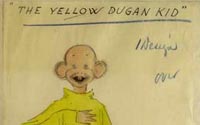
“Yellow journalism” is a delicious and versatile sneer, a term that first appeared in print in late January 1897 and routinely invoked in the decades since to describe egregious journalistic misconduct of almost any kind.
But such casual, shorthand characterizations are not very accurate.
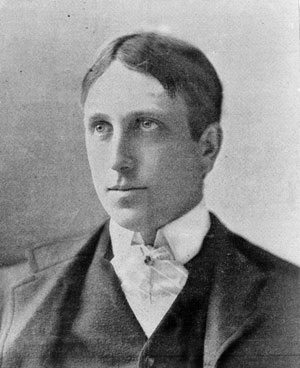
Young W.R. Hearst
They fail to capture or reflect the complexity and vigor of yellow journalism, the leading practitioners of which were the newspapers of William Randolph Hearst and, to a lesser extent, those of Joseph Pulitzer.
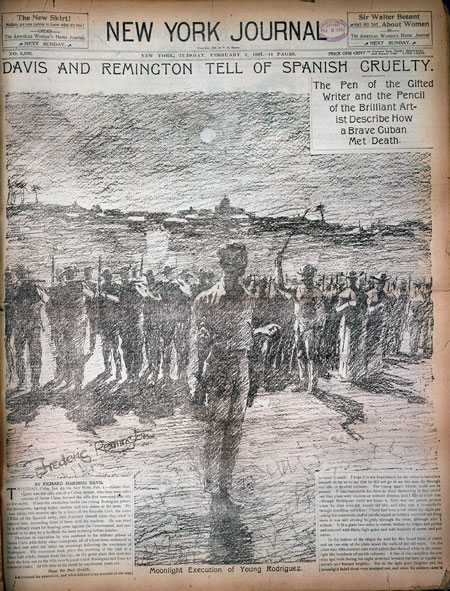
Yellow journalism was flamboyant and aggressive, to be sure. Especially so was Hearst’s New York Journal. But to equate “yellow journalism” simply to sensationalism is to misunderstand what a dynamic phenomenon it was.
As I wrote my 2001 book, Yellow Journalism: Puncturing the Myths, Defining the Legacies, “in its most developed and intense form, yellow journalism was characterized by” these features:
- the frequent use of multicolumn headlines that sometimes stretched across the front page.
- a variety of topics reported on the front page, including news of politics, war, international diplomacy, sports, and society.
- the generous and imaginative use of illustrations, including photographs and other graphic representations such as locator maps.
- bold and experimental layouts, including those in which one report and illustration would dominate the front page. Such layouts sometimes were enhanced by the use of color.
- a tendency to rely on anonymous sources, particularly in dispatches of leading reporters.
- a penchant for self-promotion, to call attention eagerly to the paper’s accomplishments. This tendency was notably evident in crusades against monopolies and municipal corruption.
As defined above and as practiced more than a century ago, yellow journalism, I wrote in the book, “certainly could not be called predictable, boring, or uninspired”—complaints of the sort often raised about contemporary American newspapers.
Moreover, yellow journalism “was a product of a lusty, fiercely competitive, and intolerant time, when newspapers routinely traded brickbats and insults,” I wrote.
“The latter practice was remarkably well-developed at the end of the nineteenth century. The Journal and [Pulitzer’s] World, for example, were ever eager to impugn, denounce, and sneer at each other; so, too, were conservative newspapers.”
More generally, “yellow journalism reflected the brashness and the hurried pace of urban America at the turn of the twentieth century,” I wrote.
“It was a lively, provocative, swaggering style of journalism well suited to an innovative and expansive time—a period when the United States first projected its military power beyond the Western Hemisphere in a sustained manner. The recognition was widespread at the end of the nineteenth century that the country was on the cusp of rapid, perhaps even disruptive transformation.”
Yellow journalism, moreover, “was a genre keen to adapt and eager to experiment.” It took risks; it shook up and even shocked the field.
Were that mainstream news media of the 21st century so inclined.




 Media Myth Alert