W. Joseph Campbell

Posts Tagged ‘Pulitzer’

About the innovative social media deck, and ‘yellow blogging’

In 1897, Newspapers, Yellow Journalism on April 20, 2010 at 10:22 am

Kudos to my nephew, Rob Campbell, and the innovative social media deck he’s helped launch at the Cleveland Indians’ ballpark, Progressive Field.

The Tribe Social Deck, believed to be the first of its kind in a major professional sports venue, is described as “a press box for bloggers/social media types.”

The Deck was launched last week at the team’s home opener.

As far as is known, Rob has been quoted as saying, “the Tribe Social Deck is a one-of-a-kind endeavor.  Other professional sports teams have offered individual bloggers press credentials on occasion but to our knowledge there has never been a section exclusively catering to the internet and social media community.”

Rob heads up social media efforts for the Indians and posts frequently to the team’s Twitter site, Tribetalk.

In other developments in social media, a writer for the BetaNews blog has proposed “yellow blogging” as a latter day “reincarnation” of yellow journalism, which flared in the U.S. press more than 100 years ago.

By “yellow blogging,” he means those “gossip and rumor blogsites [that] ruthlessly compete for pageviews.”

Cool term, “yellow blogging.”  I like it.

But as heir to yellow journalism, as it was practiced in urban America at the end of the 19th century and early 20th century–unh-uh.

As I wrote in my 2001 book, Yellow Journalism: Puncturing the Myths, Defining the Legacies, “yellow journalism” has become a shorthand term–a cliché, really–for exaggerated, sensationalized, rumor-driven treatment of the news.

But that’s far from what “yellow journalism” was.

Hearst caricature, 1896

Newspapers of a century or so ago that can be classified as “yellow journals” (such as those of William Randolph Hearst and Joseph Pulitzer)  “were, at a minimum, typographically bold in their use of headlines and illustrations,” I wrote in Yellow Journalism, adding:

“They certainly looked different from their gray, conservative counterparts, and their use of design elements was more conspicuous and imaginative. They were, moreover, inclined to campaign against powerful interests and municipal abuses, ostensibly on behalf of ‘the people.’ And they usually were not shy about doing so.”

More specifically, yellow journalism–a term that emerged in 1897–was defined by these features and characteristics:

  • the frequent use of multicolumn headlines that sometimes stretched across the front page.
  • a variety of topics reported on the front page, including news of politics, war, international diplomacy, sports, and society.
  • the generous and imaginative use of illustrations, including photographs and other graphic representations such as locator maps.
  • bold and experimental layouts, including those in which one report and illustration would dominate the front page. Such layouts sometimes were enhanced by the use of color.
  • a tendency to rely on anonymous sources, particularly in dispatches of leading reporters.
  • a penchant for self-promotion, to call attention frequently to the newspaper’s accomplishments.

So the yellow press back then was certainly anything but boring, predictable, or uninspired—complaints of the sort that frequently are raised about contemporary American newspapers.

The yellow journals were hardly wretched scandal sheets, indulging in gossip and rumor.

WJC

Remembering the Maine — and a myth of yellow journalism

In Anniversaries, Debunking, Media myths, New York Times, Spanish-American War on April 6, 2010 at 5:33 pm

American yellow journalism of the late 19th century, led by the newspapers of William Randolph Hearst, has been often blamed for bringing on the Spanish-American War, which began 112 years ago this month.

Wreckage of the Maine (Library of Congress)

Wreckage of the Maine

It is an enduring media-driven myth, a misleading, media-centric interpretation that refuses to die, despite considerable evidence to the contrary.

The media myth of the Spanish-American War was invoked in a commentary posted today at the conservative online news site, Human Events.

The commentary–which contemplated parallels in the recent sinking of a South Korean Navy vessel and the destruction in Havana harbor in 1898 of the USS Maine– declared:

“While the cause of the explosion [that destroyed the Maine] remained a mystery, newspapers fighting for readership jumped on the incident as a means to increase sales. Exploiting and distorting the news—an industry art form that came to be called ‘yellow journalism’—reporters slanted the news to sensationalize it. As the Navy continued its investigation [into the causes of the battleship’s loss], the newspapers worked the American public’s emotions into a frenzy.”

There is, quite simply,  little evidence to support such a claim. (And coining the term “yellow journalism” predated the Maine‘s destruction by more than a year.)

Rather than stirring emotions “into a frenzy” in late winter 1898,  the American press was “notably becalmed and restrained,” as I wrote in my 2001 book, Yellow Journalism: Puncturing the Myths, Defining the Legacies.

I cited the trade journal Fourth Estate, which observed that the “frightful news from Havana, telling of the destruction of the . . . Maine, was treated here as a terrible calamity. The natural suspicion that Spanish methods of warfare had destroyed the ship moved men to cry for war, but the press as a whole published and reiterated the message from the [Maine’s] Captain, to ‘suspend judgment.’”

The trade journal also noted:

“Some of our papers, overheated with natural anger, have clamored for war, but the great majority have shown to the world that the press of the United States is in accord with the Government and is anxious for war only when it must be.” (Emphasis added.)

The Fourth Estate‘s reference to “some” papers clamoring for war no doubt was a reference to Hearst’s New York Journal and its racy sister publication, the Evening Journal. Hearst’s papers, as well as those of Joseph Pulitzer, were often speculative and over-the-top in their reporting.

But these newspapers, the leading exemplars of yellow journalism, hardly set an agenda for the American press in the aftermath of the Maine‘s destruction.

As I wrote in Yellow Journalism, scholarly “studies of the heartland press in 1898 signal the limited influence of the Hearst and Pulitzer newspapers—and note that few local newspapers immediately and vigorously advocated war” because of the loss of the Maine in a harbor under Spanish control.

The staid New York Times, which in the late 19th century began emerging as the antithesis to yellow journalism, also noted the generally calm reaction in the United States after the Maine‘s destruction.

The Times stated in late February 1898:

“No Latin race, we imagine, would have kept its head as well as the American people have kept theirs during the disturbing events of the past two weeks. In Spain or France or Italy there would have been tumultuous assemblages, much outcry in the streets, and incitements to riots.

“Outside of the reckless newspapers there has been no raving here.”

So it scarcely can be said that newspapers “worked the American public’s emotions into a frenzy” that led to the Spanish-American War. There is  little to support the notion that a journalistic war cry arose in the wake of the Maine’s destruction.

WJC

Yellow journalism ‘juiced’ the appetite for war? Not likely

In Debunking, Media myths, Spanish-American War, Yellow Journalism on February 18, 2010 at 5:39 am

An undying myth of American journalism is that yellow journalism, as practiced by William Randolph Hearst and Joseph Pulitzer, led the country to war with Spain in April 1898.

That notion, I wrote in my 2001 book, Yellow Journalism: Puncturing the Myths, Defining the Legacies, “tidily, if mistakenly, serves to illustrate the power and the lurking malevolence of America’s news media.” That’s an important reason the yellow journalism myth lives on.

And on.

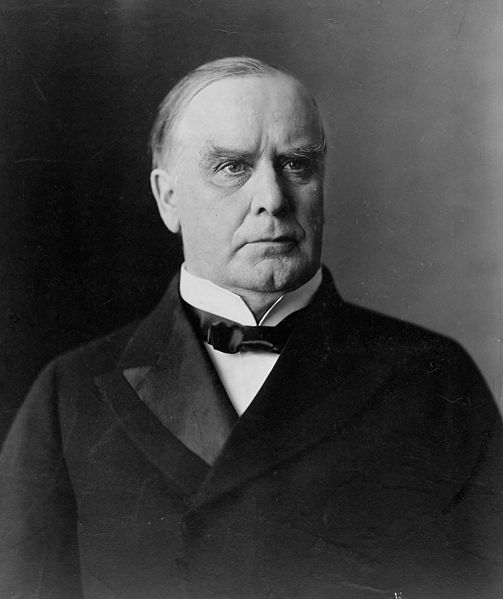
William McKinley

The myth reemerged the other day in a Time magazine online feature listing the “top 10 forgettable presidents” of the United States.  Leading the list was Martin Van Buren. In eight place was William McKinley, about whom Time said:

“McKinley was a savvy politician who listened carefully to the public. Though he opposed it at first, McKinley brought the country to war with Spain in 1898 as Pulitzer and Hearst’s ‘yellow journalism’ juiced the nation’s appetite for a fight. America’s claim to Puerto Rico and Guantanamo Bay count among the war’s legacies.”

So the yellow journalism “juiced” the country’s war appetite, eh?

Like many media-driven myths, this one’s certainly a juicy story–almost too juicy to be false. Like many media myths, it offers a simplistic explanation to a complex question: It is far easier, after all, to blame the yellow press for pushing the country into war than it is to recall the factors accounting for the diplomatic impasse that led the United States and Spain to go to war over Cuba, which at the time was up in arms against Spanish rule.

Significantly, the newspapers of Hearst and Pulitzer–the New York Journal and New York World, respectively– exerted no more than limited agenda-setting influence on the U.S. press in the run-up to the war.

As I wrote in Yellow Journalism:

“A significant body of research indicates that newspapers in small-town and rural America scoffed at, condemned, and ignored the exaggerated and fanciful reports appearing in New York City’s yellow journals before and after the Maine’s destruction” in Havana harbor in mid-February 1898.

The destruction of the battleship U.S.S. Maine killed more than 260 Navy sailors and officers, and helped trigger the war.

“Rather than taking a lead from accounts published in the Journal and World, newspapers in the American heartland turned away from their excesses,” I further wrote.

Moreover, I noted, “claims that the yellow press fomented the Spanish-American War contain almost no discussion about how, specifically, that influence was brought to bear within the McKinley administration.

“The reason for such a gap is straightforward.

“There is almost no evidence that the content of the yellow press, especially during the decisive weeks following the Maine’s destruction, shaped the thinking, influenced the policy formulation, or informed the conduct of key White House officials.”

WJC

‘Yours neatly, sweetly, completely’: Revisiting the Times’ motto contest

In 1897, New York Times, Year studies, Yellow Journalism on February 10, 2010 at 12:06 am

How about this as the motto for the New York Times? “Clean, crisp, bright, snappy; read it daily and be happy.”

Or this? “Bright as a star and there you are.”

Or? “Pure in Purpose, Diligent in Service.”

Or? “You do not want what the New-York Times does not print.”

They were among thousands of entries submitted in a “motto contest” organized by the Times and its new owner, Adolph Ochs, in autumn 1896.

The contest ostensibly was to encourage readers to propose “a phrase more expressive of the Times’ policy” than “All the News That’s Fit to Print,” which Ochs had begun using as a marketing and advertising slogan in early October 1896. By the end of that month, the phrase had taken a modest place in a corner of the Times’ editorial page.

And on February 10, 1897–113 years ago today–“All the News That’s Fit to Print” appeared in the upper left corner, the “left ear,” of the Times’ front page, a place the motto has occupied ever since.

The 1896 motto contest was in reality a way to call attention to the Times in New York’s crowded newspaper market—one dominated by the yellow journalism of William Randolph Hearst and Joseph Pulitzer. Ochs had acquired the beleaguered Times in August 1896 and faced such rough going that Pulitzer’s New York World declared several months later:

“The shadow of death is settling slowly but surely down upon” the Times.

The motto contest, cheesy though it may seem today, stirred a fair amount of attention–and reader interaction–in 1896. The Times promised to pay $100 to the person who proposed in ten words or fewer a slogan deemed better than “All the News That’s Fit to Print,” which had first appeared in early October 1896, spelled out in a row of red lights on an advertising sign above New York’s Madison Square.

Among the entries sent to the Times were clunky such suggestions as: “All the News Worth Telling,” “All the News That Decent People Want,” and “The Fit News That’s Clean and True.”

Other were:

“Full of meat, clean and neat.”

“Instructive to all, offensive to none.”

“The people’s voice, good the choice.”

“Aseptic journalism up to date.”

“Yours neatly, sweetly, and completely.”

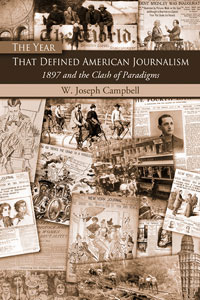
As I wrote in my 2006 book, a year study titled The Year That Defined American Journalism: 1897 and the Clash of Paradigms: “Before the contest ended, the Times altered the stakes by making clear it would not abandon ‘All the News That’s Fit to Print.’

“The Times justified this change of heart by saying no phrase entered in the contest was more apt and expressive than ‘All the News That’s Fit to Print.’ The $100 prize would be awarded, to the person adjudged to have submitted the best entry. But the motto would not be changed.”

Indeed, “All the News That’s Fit to Print” lives on as the most famous slogan in American journalism, the “leitmotif not merely for the Times, but also … for most other general-interest papers in the country,” a columnist for the Wall Street Journal once wrote.

The Times characterized its motto contest not as a grubby publicity stunt but as an opportunity for high-minded rumination about New York City newspapers. The contest, it said, had “set the people of this city to thinking upon the subject of newspaper decency in a more attentive and specific way than has been their custom.”

In any event, a committee of Times staffers winnowed the entries to 150 semi-finalists, which were submitted to Richard Watson Gilder, editor of The Century magazine. Gilder selected four finalists, which were:

  • Always decent; never dull.
  • The news of the day; not the rubbish.
  • A decent newspaper for decent people.
  • All the world’s news, but not a school for scandal.

As I wrote in The Year That Defined American Journalism, Gilder noted “that terms of the contest had changed from the original intent of selecting a slogan that ‘more aptly express the distinguishing characteristics of the New-York Times’ to the more theoretical task of determining which entry ‘would come nearest to it in aptness.’”

That entry, Gilder determined, was submitted by D.M. Redfield of New Haven, Connecticut. Redfield’s suggestion:

“All the world’s news, but not a school for scandal.”

Catchy.

WJC

More than merely sensational

In 1897, Media myths, Yellow Journalism on February 1, 2010 at 8:36 am

Yellow journalism” lives on in as ready shorthand for sensationalism, for reckless and lurid treatment of the news.

“Yellow journalism” is a delicious and versatile sneer, a term that first appeared in print in late January 1897 and routinely invoked in the decades since to describe egregious journalistic misconduct of almost any kind.

But such casual, shorthand characterizations are not very accurate.

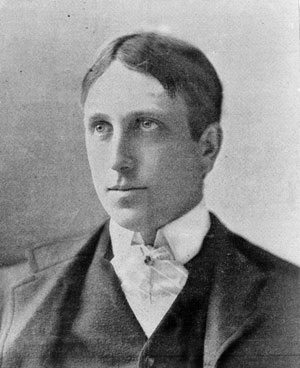
Young W.R. Hearst

They fail to capture or reflect the complexity and vigor of yellow journalism, the leading practitioners of which were the newspapers of William Randolph Hearst and, to a lesser extent, those of Joseph Pulitzer.

Yellow journalism was flamboyant and aggressive, to be sure. Especially so was Hearst’s New York Journal. But to equate “yellow journalism” simply to sensationalism is to misunderstand what a dynamic phenomenon it was.

As I wrote my 2001 book, Yellow Journalism: Puncturing the Myths, Defining the Legacies, “in its most developed and intense form, yellow journalism was characterized by” these features:

  • the frequent use of multicolumn headlines that sometimes stretched across the front page.
  • a variety of topics reported on the front page, including news of politics, war, international diplomacy, sports, and society.
  • the generous and imaginative use of illustrations, including photographs and other graphic representations such as locator maps.
  • bold and experimental layouts, including those in which one report and illustration would dominate the front page. Such layouts sometimes were enhanced by the use of color.
  • a tendency to rely on anonymous sources, particularly in dispatches of leading reporters.
  • a penchant for self-promotion, to call attention eagerly to the paper’s accomplishments. This tendency was notably evident in crusades against monopolies and municipal corruption.

As defined above and as practiced more than a century ago, yellow journalism, I wrote in the book, “certainly could not be called predictable, boring, or uninspired”—complaints of the sort often raised about contemporary American newspapers.

Moreover, yellow journalism “was a product of a lusty, fiercely competitive, and intolerant time, when newspapers routinely traded brickbats and insults,” I wrote.

“The latter practice was remarkably well-developed at the end of the nineteenth century. The Journal and [Pulitzer’s] World, for example, were ever eager to impugn, denounce, and sneer at each other; so, too, were conservative newspapers.”

More generally, “yellow journalism reflected the brashness and the hurried pace of urban America at the turn of the twentieth century,” I wrote.

“It was a lively, provocative, swaggering style of journalism well suited to an innovative and expansive time—a period when the United States first projected its military power beyond the Western Hemisphere in a sustained manner. The recognition was widespread at the end of the nineteenth century that the country was on the cusp of rapid, perhaps even disruptive transformation.”

Yellow journalism, moreover, “was a genre keen to adapt and eager to experiment.” It took risks; it shook up and even shocked the field.

Were that mainstream news media of the 21st century so inclined.

WJC

Yellow journalism: A sneer is born

In 1897, Anniversaries, Spanish-American War, Yellow Journalism on January 31, 2010 at 9:30 am

Erwin Wardman, New York Press

It’s a little-recognized, never-celebrated anniversary in American journalism, granted.

But today marks the 113th year since the term “yellow journalism” first appeared in print, in the New York Press, edited by the austere Ervin Wardman.

The phrase “the Yellow Journalism” appeared in a small headline on the Press’ editorial page on January 31, 1897. The phrase also appeared that day in the Press’ editorial page gossip column, “On the Tip of the Tongue.”

“Yellow journalism” caught on quickly, as a way to denigrate what then was called the “new journalism” of William Randolph Hearst’s New York Journal and of Joseph Pulitzer‘s New York World.  By the end of March 1897, references to “yellow journalism” had appeared in newspapers in Providence, Richmond, and San Francisco.

In the decades since then, “yellow journalism” has become a widely popular sneer, a derisive shorthand for denouncing sensationalism and journalistic misconduct of all kinds, real and imagined. “It is,” as I noted in my 2001 book Yellow Journalism: Puncturing the Myths, Defining the Legacies, “an evocative term that has been diffused internationally, in contexts as diverse as Greece and Nigeria, as Israel and India.”

Precisely how Wardman and the Press landed on the phrase “yellow journalism” is not clear.

The newspaper’s own, brief discussion of the origins was vague and unrevealing: “We called them Yellow because they are Yellow,” it said in 1898 about the Journal and the World.

In the 1890s, the color yellow sometimes was associated with depraved literature, which may have been an inspiration to the Harvard-educated Wardman, a figure largely lost to New York newspaper history.

Wardman was tall and stern-looking. He once was described as showing his “Calvinistic ancestry in every line of his face.” He did little to conceal his disdain for Hearst and Hearst’s journalism.

His contempt was readily apparent in the columns of the Press, of which Wardman became editor in chief in 1896 at the age of 31. (The Press is long defunct; it is not to be confused with the contemporary alternative weekly by the same name.)

Wardman’s Press took to taunting Hearst, Hearst’s mother, and Hearst’s support for Democratic candidate William Jennings Bryan in the 1896 presidential election. Hearst’s Journal was virtually alone among New York newspapers in supporting Bryan’s “free silver” candidacy.

The Press disparaged Hearst, then 34, as a mama’s boy, as “Billy” and “little Willie.” It referred to the Journal as “our silverite, or silver-wrong, contemporary.”

The Press also experimented with pithy if stilted turns of phrase to denounce “new journalism.”

“The ‘new journalism,’” the Press said in early January 1897 “continues to think up a varied assortment of new lies.”

Later in the month, the Press asked in a single-line editorial comment:

“Why not call it nude journalism?”

It clearly was a play on “new journalism” and meant to suggest the absence of “even the veneer of decency.”

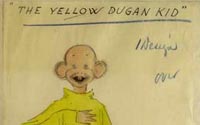
Before long, Wardman and the Press seized upon the phrase “yellow-kid journalism,” which evoked the Hearst-Pulitzer rivalry over a popular cartoon character known as the “Yellow Kid.” Both the Journal and the World at the time were publishing versions of the kid.

The Yellow Kid (Library of Congress)

At the end of January 1897, the phrase “yellow-kid journalism” was modified  to “the Yellow Journalism,” and the sneer was born.

After landing on that sneering pejorative, Wardman turned to it often, invoking the term in brief editorial comments and asides such as: “The Yellow Journalism is now so overripe that the little insects which light upon it quickly turn yellow, too.”

The diffusion of “yellow journalism” was sealed when Hearst’s Journal embraced the term in mid-May 1898, during the Spanish-American War. With typical immodesty, it declared:

“… the sun in heaven is yellow—the sun which is to this earth what the Journal is to American journalism.”

WJC

New Pulitzer biography: An opportunity missed

In 1897, Media myths, Yellow Journalism on January 25, 2010 at 1:35 pm

I recently completed a review of Pulitzer: A Life in Politics, Print, & Power, a forthcoming biography of Joseph Pulitzer, who is routinely—but undeservedly—regarded as an iconic figure in American journalism.

Pulitzer (Library of Congress)

The new biography, by James McGrath Morris, indulges in the cliché of Pulitzer the great innovator. The author calls him the “midwife to the birth of the modern mass media.”

My review, written for the peer-reviewed quarterly journal American Journalism, notes that the book contains ample material for what could have been a long-overdue reinterpretation of Pulitzer, one that would take him down several pegs.

“All the elements are there,” I write, “to depict Pulitzer not as innovator but as a cruel, ruthless, self-absorbed newspaper owner who became a millionaire championing the cause of the dispossessed while eager to rub elbows with the moneyed classes.”

Pulitzer was a hypocrite and an absentee publisher. But the opportunity for a much-needed reinterpretation was missed.

Pulitzer’s correspondence, which Morris tapped extensively, certainly encourages revisionist treatment. As I noted in my 2006 book, The Year That Defined American Journalism:

“Pulitzer’s mean-spirited letters to senior managers do little to support the reputation historians have accorded him, that of a heroic and innovative journalistic icon.”

The new biography also indulges in a media myth in describing William Randolph Hearst, Pulitzer’s rival in New York City journalism in mid- and late 1890s, as an imitator of Pulitzer’s flagship newspaper, the New York World.

It’s quite conventional to make such a claim.

And misleading, too.

Hearst’s significant model was a British journalist named William T. Stead, who in the mid-1880s offered a vision of “government by journalism.” Stead argued that the journalist was “the ultimate depository of power in modern democracy.”

Hearst clearly borrowed from Stead in developing his model of the “journalism of action,” which sought to do much more than gathering, printing, and commenting on the news. As Hearst’s New York Journal put it in 1897, the “journalism of action” obliged a newspaper to inject itself conspicuously and often into public life, to “fitly render any public service within its power.”

It was a breathtaking model of activism that went well beyond the stunt journalism of Pulitzer’s World.

Oddly, the new biography fails to acknowledge Pulitzer’s nod to Hearst’s success with the Journal.

As infirm and disagreeable as Pulitzer had become by 1897, he was not without moments of keen insight. In a letter late that year to his business manager, Pulitzer invoked “Geranium,” his code name for Hearst’s Journal, and declared:

“I personally think Geranium a wonderfully able & attractive and popular paper, perhaps the ablest in the one vital sense, of managing to be talked about; of attracting attention; of constantly furnishing something which will compel people wherever they meet, whether in the drawing room, or in the poor house, elevated car or dinner table, to talk about something in that paper. That is the sort of brains the World needs. Pardon me for saying also, that with all its faults, which I should not like to copy—though they have been exaggerated—it is a newspaper.”

WJC