Tomorrow is the anniversary of the so-called “Cronkite Moment,” which is widely believed to have been an exceptionally powerful and decisive moment in American journalism.
The “Cronkite Moment” occurred February 27, 1968, when CBS News Anchor Walter Cronkite declared on air that the U.S. war effort in Vietnam was mired in stalemate and suggested negotiations as a way to extricate the country from the conflict.
At the White House that night, President Lyndon Johnson supposedly watched the Cronkite program, a special report about Vietnam in the aftermath of the surprise Tet offensive. Upon hearing Cronkite’s pessimistic assessment, Johnson is said to have snapped off the television set and muttered to an aide, or aides:
“If I’ve lost Cronkite, I’ve lost Middle America.”
Or words to that effect.
With Cronkite having turned against the war, the Johnson White House supposedly reeled. And at the end of March 1968, the president announced he would not seek reelection.
It is one of the great stories American journalism tells about itself, a moment when the power of television was trained on foreign policy to make a difference in an unpopular and faraway war.
More accurately, though, it’s one of American journalism’s most enduring and appealing media-driven myths.
As I’ve noted on a number of occasions at Media Myth Alert, and as I write in Getting It Wrong, my forthcoming book on media-driven myths, Johnson did not watch the Cronkite program on Vietnam when it aired that night 42 years ago.
The president that night was in Austin, Texas, at the 51st birthday party of a political ally, Governor John Connally.
About the time Cronkite intoned his downbeat, “mired in stalemate” assessment, Johnson was offering light-hearted banter about Connally’s age, saying:
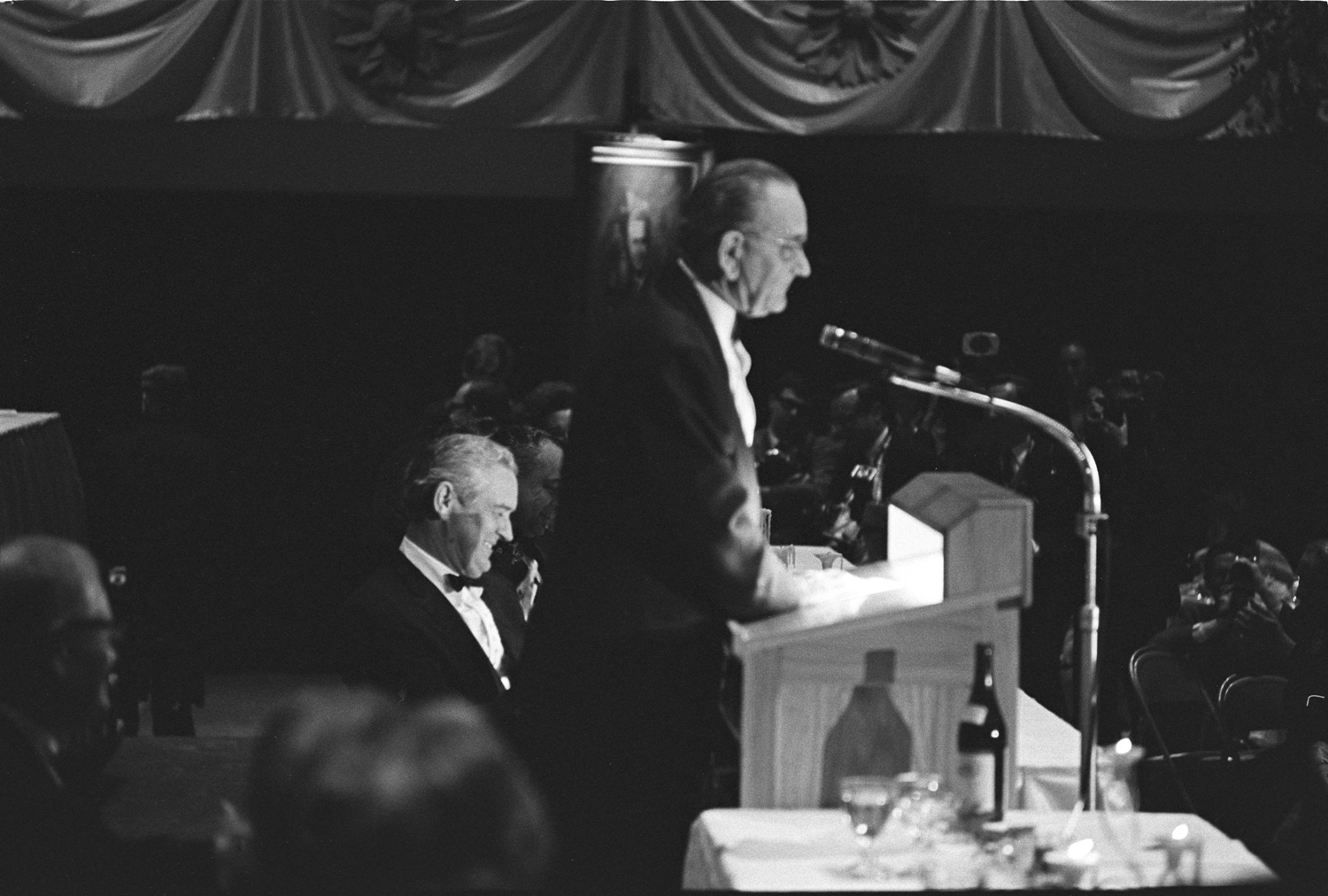
Johnson in Texas, February 27, 1968
“Today you are 51, John. That is the magic number that every man of politics prays for—a simple majority. Throughout the years we have worked long and hard—and I might say late—trying to maintain it, too.”
Earlier in the day, Johnson had delivered a rousing speech in Dallas, in which he characterized the U.S. war effort in Churchillian terms.
“There will be blood, sweat and tears shed,” he said, adding: “I do not believe that America will ever buckle” in pursuit of its objectives in Vietnam.
Even if the president had seen the Cronkite program, it is difficult to imagine how his opinion could have swung so abruptly, from a vigorous defense of the war effort to resignation and despair.
Casting further doubt on the “Cronkite Moment” is uncertainty about what, exactly, Johnson supposedly said in reaction to Cronkite’s editorial comments about the war.
The most common version has him saying: “If I’ve lost Cronkite, I’ve lost Middle America.”
But another version is: “I’ve lost Cronkite, I’ve lost the country.”
Yet another version has it this way: “If I’ve lost Cronkite, I’ve lost the American people.”
Still another version is: “If I’ve lost Cronkite, I’ve lost the war.”
And another goes: “If we lose Cronkite, we lose America.”
And, unaccountably: “If I’ve lost Cronkite, I’ve lost the middle west.”
Version variability of such magnitude signals implausibility.
So why, 42 years on, does it matter whether the “Cronkite Moment” is a myth?
As I write in Getting It Wrong, “Seldom, if ever, do the news media exert truly decisive influences in decisions to go to war or to seek negotiated peace.
“Such decisions typically are driven by forces and factors well beyond the news media’s ability to shape, alter, or significantly influence.”
And so it was with the “Cronkite Moment.”

 Media Myth Alert