W. Joseph Campbell

Archive for the ‘Cronkite Moment’ Category

The ‘Johnson White House reeled’? Not because of Cronkite

In Cronkite Moment, Debunking, Media myths on December 19, 2009 at 12:56 pm

The AOL Television online site today recalls as a “TV moment of 2009” the death five months ago of Walter Cronkite, the famous CBS News anchorman.

The AOL Television post recalls the so-called “Cronkite Moment” of 1968, when the anchorman’s downbeat assessment about the U.S. military effort in Vietnam was said to have had immediate and stunning effects on President Lyndon Johnson and his war policy.

The AOL post says of Cronkite: “In 1968, after extensive on-the-ground reporting, he advocated the withdrawal of American troops from Vietnam. The Johnson White House reeled.”

Reeled?

Hardly.

As I write in my forthcoming book, Getting It Wrong:

“Scrutiny of the evidence associated with the program reveals that Johnson did not have—could not have had—the abrupt yet resigned reaction that so often has been attributed to him. That’s because Johnson did not see the program when it was aired” on February 27, 1968.
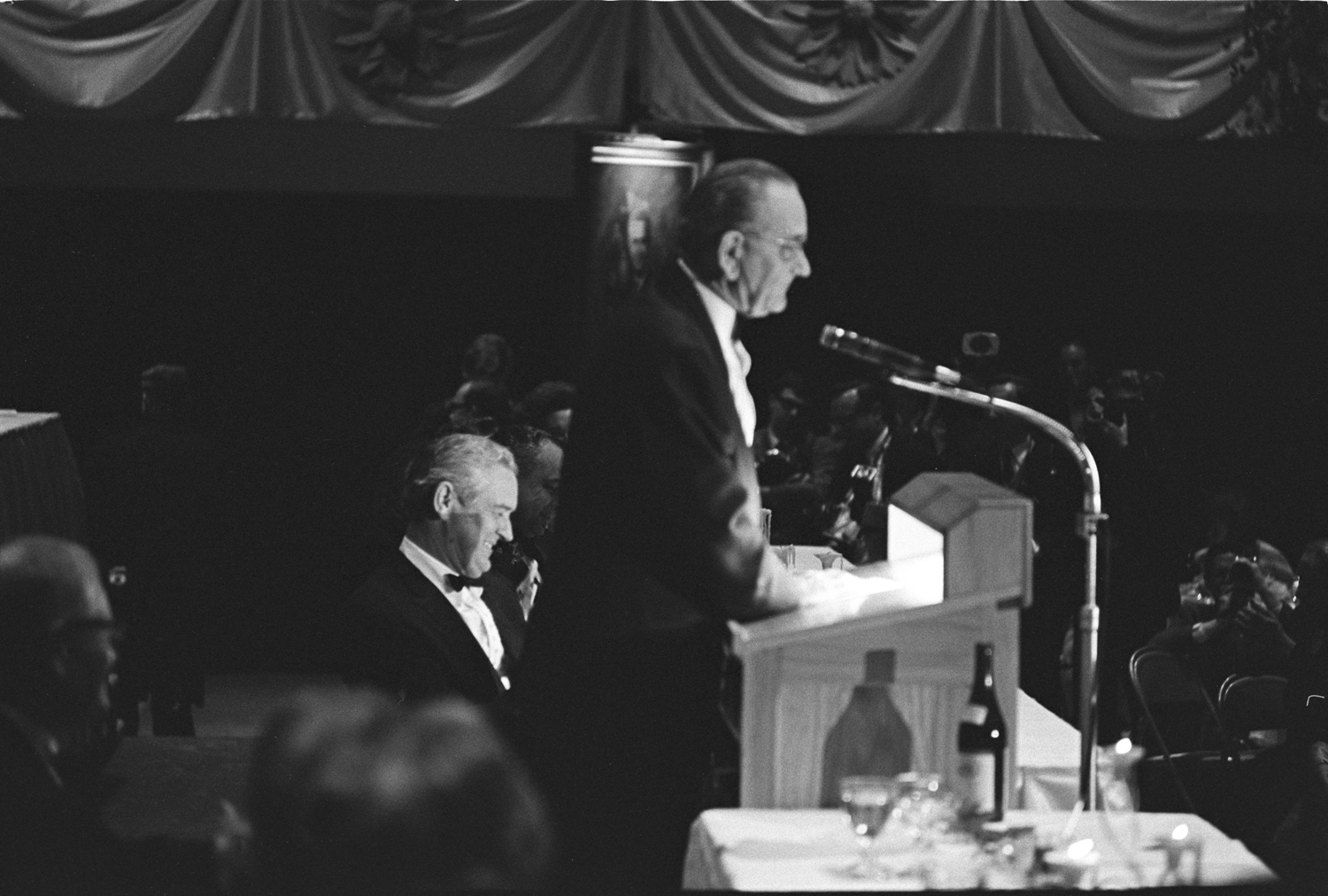
Lyndon Johnson at Connally's birthday party

Johnson then was in Austin, Texas, engaging in light-hearted banter at a black-tie party for Governor John Connally. “Today you are 51, John,” the president said in Austin, at about the time the Cronkite program was ending.

“That is the magic number that every man of politics prays for—a simple majority. Throughout the years we have worked long and hard—and I might say late—trying to maintain it, too.”

Even if he later heard—or heard about— Cronkite’s assessment, it represented no epiphany for Johnson. Indeed, soon after the Cronkite program, the president gave a rousing, lectern-pounding speech in which he urged a “total national effort” to win the war in Vietnam.

So Cronkite’s program scarcely was decisive to American war policy. It certainly did not send the Johnson White House reeling.

It is noteworthy to recall that Cronkite in his program on Vietnam did not urge the immediate withdrawal of U.S. forces.

He hedged, holding open the possibility that the U.S. military efforts might still force the North Vietnamese to the bargaining table. Cronkite suggested the U.S. forces be given a few months more to press the fight in Vietnam, in the wake of the communists’ surprise Tet offensive, stating:

“On the off chance that military and political analysts are right, in the next few months we must test the enemy’s intentions, in case this [Tet offensive] is indeed his last big gasp before negotiations. But it is increasingly clear to this reporter that the only rational way out then will be to negotiate, not as victors, but as an honorable people who lived up to their pledge to defend democracy, and did the best they could.”

What’s more, Cronkite’s assessment was scarcely exceptional or extraordinary.

In his year-study about 1968, Mark Kurlansky wrote that Cronkite’s view was “hardly a radical position” for the time.

Four days before the Cronkite program, the Wall Street Journal said in an editorial that the U.S. war effort in Vietnam “may be doomed” and that “everyone had better be prepared for the bitter taste of defeat beyond America’s power to prevent.” And nearly seven months before the Cronkite program, New York Times correspondent R.W. Apple Jr. cited “disinterested observers” in reporting that the war in Vietnam “is not going well.”

Victory, Apple wrote, “is not close at hand. It may be beyond reach.”

WJC

‘Most famous words in American journalism’? Probably not

In 1897, Cronkite Moment, Media myths, New York Sun on December 15, 2009 at 10:16 am

In a blog post today, Followthemedia.com says the “Yes, Virginia” passage in the  1897 editorial “Is There A Santa Claus?” are “the most famous words in American journalism.”

And it takes Macy’s to task for its Christmas season “Believe” campaign, a sappy promotion that capitalizes on the editorial and its inspiration, Viriginia O’Hanlon. She was the 8-year-old girl whose letter to the New York Sun asking about the exisitence of Santa Claus prompted the famous editorial.

Followthemedia.com says:

“We know this a is a tough retail year but Is nothing sacred – last week Macy’s, the giant US department store chain, enticed women named Virginia into its stores by offering $10 gift certificate as part of its ‘Believe’ campaign based on the most famous words in US journalism, ‘Yes, Virginia, there is a Santa Claus.'”

It adds:

“The company hasn’t said how many certificates it gave out, but it estimated there are more than 500,000 Virginias in the US, and it did try to expand the base by saying first, middle or last names would all be ok. And it really was all in a good cause – to bring people into the store to deliver letters to Santa Claus and for each letter delivered the store donated $1 to the Make-A-Wish charity.

“Of course it would never  enter the minds of store executives that once having enticed people into the store they might linger somewhat and actually do some shopping there? Ah, we just have to stop being so cynical at this time of good cheer!”

Cynicism aside, followthemedia.com raises an interesting point about “the most famous words in American journalism.” Are those words really, “Yes, Virginia, there is a Santa Claus?”

I’m not so sure.

The “Yes, Virginia,” passage is invoked so often, and in so many contexts, that no longer is it readily associated with American journalism. “Yes, Virginia,” long ago became unmoored from its original context, the third of three columns of editorials in the New York Sun on September 21, 1897.

Media-driven myths have propelled other phrases into what is arguably greater renown in American journalism.

Getting It Wrong: Forthcoming 2010

The quote attributed to William Randolph Hearst — “You furnish the pictures, I’ll furnish the war” — may even be more famous than “Yes, Virgina?” As I write in my forthcoming book, Getting It Wrong, the Hearst quote is almost certainly is apocryphal. But it lives on as a comment too rich and too delicious not to be true.

The same goes for the comment often attributed to President Lyndon Johnson, after watching a CBS News special in late February 1968 in which anchorman Walter Cronkite declared the U.S. war effort in Vietnam was mired in stalemate.

Johnson, supposedly, had the sudden revelation that the war was now hopeless and turned to an aide and said, “If I’ve lost Cronkite, I’ve lost middle America.” Or words to that effect. Words that may be more famous and more directly tied to journalism than “Yes, Virginia.”

But the Cronkite-Johnson anecdote is exaggerated, too, as Getting It Wrong discusses. Johnson did not see the program when it aired. And in the days and weeks immediately following the Cronkite program, Johnson continued hawkish calls for national sacrifice to win the war in Vietnam.

Even Cronkite, for many years, said he didn’t believe his comments had much effect on Johnson. Late in his life, though, Cronkite came to embrace the supposed power of the program on Vietnam.

He told Esquire magazine in 2006: “To be honest, I was rather amazed that my reporting from Vietnam had such an effect on history.”

But it didn’t, really.

WJC

Cronkite Moment: What Johnson supposedly said

In Cronkite Moment, Media myths on December 6, 2009 at 12:35 pm

A guest columnist for the Lancaster Eagle Gazette in Ohio today offers a new version of President Lyndon Johnson’s famous comment,  supposedly made in response to Walter Cronkite’s dire assessment in 1968 about the war in Vietnam.

As the story goes, Johnson watched the special televsion program that Cronkite prepared in the aftermath of the North Vietnamese communists’ Tet offensive in February 1968. Cronkite said the U.S. war effort had become “mired in stalemate.” And he closed program by suggesting the time had come to consider opening negotiations to end the war.

For Johnson, Cronkite’s report supposedly was an epiphany. The president realized that the war was all but lost and uttered in dismay:

“If I’ve lost Cronkite, I’ve lost Middle America.”

Other versions have Johnson saying: “If I’ve lost Cronkite, I’ve lost the country.”

Or, “If I’ve lost Cronkite, I’ve lost the American people.”

Or, “If I’ve lost Cronkite, I’ve lost the war.”

The guest columnist in the Lancaster paper has Johnson as saying: “If we lose Cronkite, we lose America.”

What I call acute version variability dogs this anecdote — and it’s one of the indicators that the story is  a media-driven myth. Version variability of  such magnitude is a signal of implausibility. And it’s a marker of a media myth.

As I write in my forthcoming book, Getting It Wrong, the famous, often-cited Cronkite-Johnson anecdote is almost assuredly a media myth.

For starters, Johnson did not see the program when it was aired. He was in Austin, Texas, at the time, offering light-hearted comments at a birthday party for Governor John Connally.

Johnson at Connally's birthday party

Moreover, Johnson’s supposedly downbeat reaction to Cronkite’s on-air assessment about Vietnam clashes sharply with the president’s aggressive characterization about the war. Only hours before the Cronkite program aired, Johnson was in Dallas, Texas, where he delivered a little-recalled but rousing speech on Vietnam, a speech cast in Churchillian terms.

It seems inconceivable that Johnson’s views would have changed so swiftly, so  dramatically, upon hearing the opinions of a television news anchor.

Even if Johnson later heard—or heard about— Cronkite’s assessment, it represented no epiphany. Not long after the Cronkite program, Johnson gave a rousing, lectern-pounding speech in which he urged a “total national effort” to win the war in Vietnam.

No, the Cronkite program in late February 1968 prompted no great change. Nor did it prompt any famous presidential utterances.

WJC

A ‘Cronkite Moment’ sighting

In Cronkite Moment, Media myths on November 12, 2009 at 8:25 am

A commentary posted recently at the American Thinker online site invokes the hardy myth of the “Cronkite Moment,” which stems from Walter Cronkite’s pronouncement in late February 1968 about the war in Vietnam.

At the close of a special televised report, Cronkite, the CBS News anchor, declared that the U.S. military was “mired in stalemate” in Vietnam and suggested that negotiations eventually would have to be opened with the North Vietnamese.

As the American Thinker item notes, Cronkite’s dire assessment supposedly prompted President Lyndon Johnson to declare, “If I’ve lost Cronkite, I’ve lost Middle America.” Or words to that effect. Johnson is said to have watched Cronkite’s program at the White House and is further said to have snapped off the television set in exasperation.

It all makes for a great story, a story of dramatic media influence, of telling truth to power.

But the “Cronkite Moment” is almost assuredly a media myth.

As I describe in my forthcoming book, Getting It Wrong, Johnson wasn’t even at the White House the night of Cronkite’s program on Vietnam. The president didn’t see the show when it aired. He was in Austin, Texas, attending the 51st birthday party of then-Governor John Connally. At about the time Cronkite was intoning his pessimistic assessment about Vietnam, Johnson was making light-hearted remarks about Connally’s age, saying:

“Today you are 51, John. That is the magic number that every man of politics prays for—a simple majority. Throughout the years we have worked long and hard—and I might say late—trying to maintain it, too.”

Johnson_Cronkite moment

WJC