W. Joseph Campbell

Archive for the ‘Photographs’ Category

Enticing the media: More on bra-burning in Toronto, 1979

In Bra-burning, Debunking, Media myths, Photographs on March 4, 2011 at 7:00 am

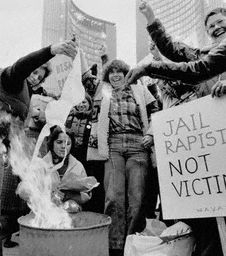
Toronto, 1979 (Bettman/Corbis)

Another participant at the 1979 bra-burning protest in Toronto has offered recollections of the event, at which the group Women Against Violence Against Women protested a controversial police report about the causes of rape.

The participant, Amy Gottlieb, said in an email forwarded to me that the photograph (left) “definitely is not doctored.”

(I had had my suspicions given that it looked almost too good to be true — which can be a marker of an unethically edited photograph and a media-driven myth.)

Gottlieb referred to Pat Murphy, who is shown in the photograph dangling the bra above the hungry flames, and wrote:

“Pat was threatening to burn a bra because the movement was media savvy and felt that weighing in on the stereotype of ‘feminist bra-burners’ was actually an effective way to say: Women will control our own bodies, thank you!

“The bra burning was a way to entice the media as well as [offer] a critique of the police report.”

I spoke recently with Vicki Trerise, who is shown at the far right in the photograph; she, too, said the demonstrators were media-savvy and “knew that if they burned a bra, someone would take their picture.”

Interestingly, the leading Toronto newspapers at the time didn’t mention the bra-burning in reports about the demonstration, which took place near Toronto city hall on March 8, 1979.

The Globe and Mail, in a fairly detailed account published the following day, characterized the demonstration as “boisterous” and reported:

“The women carried signs saying: ‘Take a Rapist to Lunch — Charcoal Broiled’ and ‘Hookers Who Wink Go to the Clink! Men Who Rape Escape.’

“The women, after lighting a fire in a garbage can, to the obvious annoyance of about a dozen watchful constables, shouted: ‘Burn the rapists, burn the city, burn the OPP,” acronym for the Ontario Provincial Police, which had issued the disputed report about rape.

The Globe and Mail also reported: “The women charged that the OPP report was nothing less than state approval of rape and that no serious study of rape had even been done by the Government.

“The women then sang a surprisingly obscene song describing male domination of women and marched off, chanting anti-male slogans ….”

Before the demonstrators moved on, the Globe and Mail reported, a “few chuckles from male onlookers provoked a slight shoving match, including one reporter by a large lady in lavender brandishing a cat-o-nine tails.”

The issue of the Toronto Star of March 9, 1979, carried a brief report about the Women Against Violence Against Women demonstration, noting the protesters’ anger at the police report, which had identified hitchhiking, alcohol consumption, and drug use as causes of many rapes.

“The women lit sparklers and set a garbage can on fire as they booed the report’s findings,” reported the Star, which did not mention the bra-burning.

Lighted sparklers held aloft are clearly visible in the bra-burning photograph. Rights to the photograph are held by the Bettmann/Corbis archive, which says it does not know the identity of the photographer.

It is sometimes claimed said that no bras were ever burned at a feminist protest in the 1960s or 1970s. The photograph of the demonstration in Toronto proves otherwise.

Moreover, I offer evidence in my latest book, Getting It Wrong, that bras were burned, briefly, at the famous women’s liberation protest against the 1968 Miss America pageant in Atlantic City, New Jersey.

“This evidence,” I write in Getting It Wrong, “cannot be taken lightly, dismissed or ignored,” and suggests “that the myth of mass or demonstrative bra-burning needs to be modified.”

The bra-burning in Toronto in 1979 further calls for revision of the notion that feminist bra-burning was a media myth.

WJC

Recent and related:

Meaning what, ‘all the bra-burning’?

In Bra-burning, Debunking, Media myths, Photographs on February 21, 2011 at 8:11 am

Toronto, 1979 (Bettmann/Corbis)

Bra-burning used to commonplace in America, suggested a columnist in yesterday’s Boston Globe.

The column, which deplored the sexualization of American young women, contained this passage:

“American women stood up for their rights 50 years ago. The sexual revolution, too often blamed for what’s wrong with America today, wasn’t only about sexual liberation. It was about equality. We are more than our bodies is what all the bra-burning meant.”

What a minute: “…all the bra-burning”?

Meaning what? There was hardly any bra-burning in America. Ever.

Bra-burning wasn’t, and hasn’t been, a tactic of feminist protests, save for an episode — discussed in my latest book, Getting It Wrong — of what might best be called “bra-smoldering” at Atlantic City, New Jersey, in September 1968.

Getting It Wrong offers evidence that bras were burned, briefly, at a women’s liberation protest of the 1968 Miss America pageant at Atlantic City — but it was no demonstrative display, nothing, I write, akin to the “vivid and popular imagery that many bras went up in flames in flamboyant protest that September day.”

Bra-burning did figure, flamboyantly, at a women’s protest in Toronto in March 1979 (see photo, above).

But as I discussed in a recent post at Media Myth Alert, bra-burning wasn’t a focal point of that demonstration; rather, setting fire to a bra served as a way for media-savvy protesters to call attention to their grievances — specifically, a police report about rape.

Getting It Wrong discusses two other bra-burning episodes.

One was a failed attempted to set fire to a bra at Ohio State in 1999, to protest a cartoon in the student newspaper that poked fun at the university’s women’s studies program.

The other was a bizarre and gratuitous gesture on the Tyra Banks television show in 2008.

“Banks took members of her studio audience into the chill of a winter’s afternoon in New York for a made-for-television stunt about what women could do with ill-fitting brassieres,” I write in Getting It Wrong, adding:

“Banks wore an unzipped gray sweatshirt that revealed a powder-blue sports bra. Most of the other women were clad above the waist only in brassieres. They clutched other bras as they stood before a burn barrel from which flames leapt hungrily. On Banks’ word, the women tossed the bras in their hands into the fire.”

The Boston Globe columnist’s blithe and imprecise reference to bra-burning in a way evokes the role of columnists in the diffusion of the term.

As I write in Getting It Wrong, two columnists had a lot to do with the entry of “bra-burning” into the vernacular.

One was Harriet Van Horne, who wrote, sneeringly, in the New York Post two days after the demonstration at Atlantic City in 1968 that the protesters had screamed in “delight [as] they consigned to the flames such shackling, demeaning items as girdles, bras, high-heeled slippers, hair curlers and false eyelashes.”

Van Horne wasn’t at the protest. Even so, her highly imaginative characterization was taken up a few days later by Art Buchwald, then the leading humor columnist in American journalism.

Buchwald wrote with tongue in check how he had been “flabbergasted to read that about 100 women had picketed the Miss America pageant in Atlantic City against ‘ludicrous beauty standards that had enslaved the American woman.’”

He added: “The final and most tragic part of the protest took place when several of the women publicly burned their brassieres.”

As I point out in Getting It Wrong, Buchwald’s nationally syndicated column about the Atlantic City protest helped introduce the erroneous notion of flamboyant bra-burning to a national audience.

WJC

Recent and related:

Bra-burning in Toronto: Confirmed

In Bay of Pigs, Bra-burning, Debunking, Media myths, Photographs on February 19, 2011 at 12:12 am

It happened, and the photo’s no hoax.

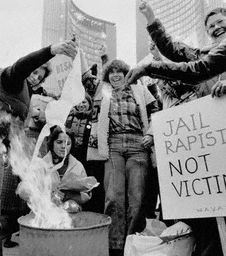
The bra-burning episode pictured at left took place near Toronto city hall on March 8, 1979.

One of the participants, speaking by phone from Vancouver, confirmed the incident, saying, “The photo is authentic. Absolutely. It happened.”

The participant was Vicki Trerise, who is shown at the far right in the photograph, a larger version of which is accessible here.

I had not seen the photograph until February 6; it was posted that day with an article at the London Guardian online site.

I had had doubts about its authenticity.

Given periodic claims that no bras ever were burned at a feminist protest, the image, I suspected, may have been unethically altered.

Not only that, but the photograph seemed almost too good to be true, what with the white bra dangling above lapping flames of the burn barrel.

Trerise, though, assured me the photograph was legitimate. And her confirmation effectively represents a challenge to claims that feminist bra-burning is a media myth.

It happened in Toronto. The photograph shows a moment of demonstrative bra-burning, even though it “wasn’t a focal point” of the protest, Trerise said.

The bra-burning took place near the end of the demonstration, during which the group Women Against Violence Against Women protested what it termed was an illogical report prepared by the Ontario Provincial Police about rape.

Trerise said the demonstrators were media-savvy and “knew that if they burned a bra, someone would take their picture.”

By 1979, “bra-burning” had become part of the vernacular in North America, a dismissive term often invoked “to denigrate women’s liberation and feminist advocacy as trivial and even a bit primitive,” as I note in my latest book, Getting It Wrong.

“Invoking ‘bra-burning,'” I write, “was a convenient means of brushing aside the issues and challenges raised by women’s liberation and discrediting the fledgling movement as shallow and without serious grievance.”

The term emerged in the aftermath of a women’s liberation demonstration outside the Miss America pageant in September 1968 at Atlantic City, New Jersey.

Protest leaders have long insisted that nothing was burned at Atlantic City. However, I present evidence in Getting It Wrong that bras were set afire, briefly, during the demonstration on that long ago September day.

But I acknowledge that the evidence of bra-burning at Atlantic City doesn’t correspond to the “widely held image of angry feminists demonstratively setting fire to their bras and tossing the flaming undergarments into a spectacular bonfire.”

The demonstrators in Toronto in 1979 hardly looked angry; but they were flamboyant.

Trerise said the bra-burning that day “was a bit of a reverse spoof,” a parody of media claims that burning bras was commonplace at feminist protests in the late 1960s and 1970s. “It was like a joke,” she said, and “it wasn’t planned.”

She also said the demonstrators “all had been involved in street activism for many years.”

Dangling the bra above the burn barrel was Pat Murphy, who died in 2003. In the center of the photograph with her right arm upraised was Adrienne Potts.

Murphy and Potts were two members of the so-called “Brunswick Four” — lesbians arrested in 1974, following an episode at a tavern in Toronto where they sang a parody of “I Enjoy Being a Girl.” For “girl,” they had substituted “dyke.”

WJC

Many thanks to FiveFeetofFury for linking to this post

Recent and related:

Is this bra-burning photo authentic?

In Bra-burning, Media myths, Newspapers, Photographs on February 15, 2011 at 8:21 am

Bra-burning in Toronto, 1979 (Bettmann/Corbis)

It is claimed from time to time that burning bras figured in no feminist protest of the late 1960s and 1970s. Bra-burning, it is sometimes said, was little more than a media-concocted myth.

But this photograph, taken near Toronto city hall in March 1979, suggests otherwise. (A larger version of the image is available here.)

Update: The photo is genuine.

The occasion was International Women’s Day and the demonstrators were protesting the contents of a controversial Ontario Provincial Police report about rape.

But why would protesters incensed about a police report burn bras? The connection seems elusive.

And that’s one reason why I wonder about the photo’s authenticity, whether it was improperly edited. I’m not saying it’s a hoax or a ruse; I’m saying I have reservations.

I’ve conducted a good deal of research about feminist bra-burning; my latest book, Getting It Wrong, offers evidence that — assertions to the contrary notwithstanding — bras were burned, briefly, at the famous women’s liberation protest in September 1968 against the Miss America pageant at Atlantic City.

That evidence “cannot be taken lightly, dismissed or ignored,” I write in Getting It Wrong, which debunks 10 prominent media-driven myths — those dubious stories about the news media that masquerade as factual.

I also acknowledge that the evidence of bra-burning at Atlantic City doesn’t corroborate the “widely held image of angry feminists demonstratively setting fire to their bras and tossing the flaming undergarments into a spectacular bonfire.”

I saw the image of bra-burning in Toronto for the first time last week, accompanying an article posted February 6 at the online site of the London Guardian. The image was credited to the Bettmann/Corbis photo archive.

The archive’s online record says the bra-burning photograph was taken in Toronto on March 8, 1979. Information about the photographer and place of publication are not available, however.

Corbis notes that it licenses photographs for sale; it doesn’t vouch for their authenticity.

The image of the Toronto protest certainly seems to pose a further challenge to claims that feminist bra-burning is a media myth. While the demonstrators in the photograph hardly look angry, their protest certainly seems flamboyant, what with flames leaping hungrily from the burn barrel.

The photograph suggests a vivid moment of demonstrative bra-burning.

But, then, maybe those flames are lapping a bit too hungrily at the dangling white bra.

Why hasn’t that bra yet caught fire?

And wouldn’t it have been more logical and emphatic to drop a copy of the controversial police report into the flaming burn barrel?

Interestingly, the leading Toronto newspapers of the time did not mention the bra-burning episode in their reports about the protest.

The Toronto Star of March 9, 1979, said that the demonstrators were outraged by the provincial police report, which had identified hitchhiking, alcohol consumption, and drug use as factors in many rapes.

“The [protesting] women lit sparklers and set a garbage can on fire as they booed the report’s findings,” the report in the Star said, identifying the demonstrators as members of Women Against Violence Against Women.

Lighted sparklers held aloft can be seen in the photograph; the placard shown in the image bears the acronym of Women Against Violence Against Women.

The report in Toronto’s Globe and Mail newspaper was more detailed — but likewise made no mention of the burning bra.

The Globe and Mail said the protest was “boisterous” and aimed at the police report, which the demonstrators dismissed as “‘dazzling in its illogic.'”

The newspaper also reported:

“The women carried signs saying: ‘Take a Rapist to Lunch — Charcoal Broiled’ and ‘Hookers Who Wink Go to the Clink! Men Who Rape Escape.’

“The women, after lighting a fire in a garbage can, to the obvious annoyance of about a dozen watchful constables, shouted: ‘Burn the rapists, burn the city, burn the OPP,” the acronym for Ontario Provincial Police.

The newspaper added: “The women charged that the OPP report was nothing less than state approval of rape and that no serious study of rape had even been done by the Government.

“The women then sang a surprisingly obscene song describing male domination of women and marched off, chanting anti-male slogans ….”

I spoke by phone the other day with Susan G. Cole, who was a member of Women Against Violence Against Women and who said she was at the protest in March 1979.

But Cole said she does not recall the bra-burning.

I shared with her a link to image posted at the Guardian site; Cole said she is not in the photograph but added that she recognized as prominent activists the women shown in the image. “We were so bright and energetic in those days,” Cole said, a bit wistfully.

Women Against Violence Against Women, Cole also said, was theatrical and very creative in its protests, adding that she is “not surprised that these guys were burning bras.”

She suggested that the Toronto demonstrators may have thought that if bras had not been flamboyantly set afire at Atlantic City in 1968, then “let’s do it now.”

I’ve tried without success to reach two of the women in the photograph. One is a lawyer in British Columbia, the other an activist in Toronto.

In the final analysis, if the image is authentic, then it represents impressive evidence of demonstrative bra-burning at a feminist protest in the 1970s. If it’s not, then it’s a well-done photo hoax, a composite that deserves unmasking.

WJC

Many thanks to FiveFeetofFury for linking to this post

Recent and related:

The debunking of the year, 2009

In Debunking, Photographs on January 2, 2010 at 1:22 pm

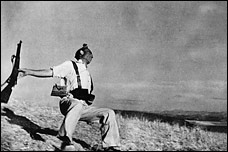
The nod for the most impressive debunking of 2009 has to go to the Spanish researchers who’ve seriously challenged the authenticity of Robert Capa’s famed “Falling Soldier” image, taken during the Spanish Civil War in September 1936.

It purports to show a charging loyalist militiaman at the very moment he is shot to death.

Capa's iconic and dubious image (Robert Capa/Copyright 2001 by Cornell Capa)

The earnest research of a university lecturer in northern Spain, José Manuel Susperregui, as well as that of historian Francisco Moreno, show fairly persuasively that Capa’s photo was shot about 35 miles from Cerro Muriano, where Capa claimed it was taken.

Susperregui, who last year published Sombras de la fotografía (Shadows of Photography), a book in Spanish about his research, maintains that “The Falling Soldier” was taken in Llano de Banda, near the village of Espejo.

The most compelling evidence is the horizon, which shows a ridgeline that nearly matches that in Capa’s photos, which were first published in Vu, a French magazine.  (See the Vu spread here.)

“The landscape around Cerro Muriano looks nothing like that in the photographs,” the London newspaper Guardian quoted Susperregui as saying in  July 2009. “I have no doubt that this was taken in Llano de Banda.”

Susperregui was further quoted as saying:

“My theory is that Capa went to Espejo because he knew it had been an active front. He found nothing going on there, so did the posed photographs. Then he went on to Cerro Muriano, which was active, and took a different set of photographs there of people fleeing the fighting.”

The Guardian has posted an audio slideshow that vividly describes the landscape around Llano de Banda and dramatically underscores the arguments of the Spanish researchers. (It should be noted that doubts about the authenticity of Capa’s “Falling Solider” were raised as long ago as 1975, in Phillip Knightley’s The First Casualty. Knightley’s account quoted an associate of Capa’s as saying the photographer told him the “Falling Soldier” photos were staged.)

As I wrote in a Media Myth Alert posting November 22, “the apparent debunking is a delicious one, given the status and standing that Capa’s photograph has gained over decades. It is considered among the most dramatic wartime photos ever made.”

Not only that, but “Falling Soldier” helped launched Capa’s fabled career in photojournalism. Capa was killed in Indochina in 1954.

The efforts of Susperregui and colleagues may not have received in the United States as much attention as they deserved. But they’re imaginative and intriguing — and they represent the debunking of the year 2009.

WJC

Catching up: Will on Capa

In Furnish the war, Media myths, Photographs on November 22, 2009 at 4:50 pm

I caught up today on several back issues of the Washington Post, including last Sunday’s edition, which carried an insightful column by George Will.

Will himself was catching up on intriguing research that challenges the authenticity of Robert Capa’s famous photograph of the moment a bullet strikes and kills a loyalist militiaman in 1936, during the Spanish Civil War.

Capa's iconic 'instant of death' photo (Robert Capa/Copyright 2001 by Cornell Capa)

Will notes that a Spanish historian “has established that the photo could not have been taken when and where it reportedly was — Sept. 5, 1936, near Cerro Muriano.

“The photo was taken about 35 miles from there. The precise place has been determined by identifying the mountain range in the photo’s background,” Will writes, adding that the historian “says that there was no fighting near there at that time, and concludes that Capa staged the photo.”

The historian is Francisco Moreno and his research into Capa’s iconic image received a fair amount of attention over the summer. According to the Associated Press, Moreno determined that the shape of hills in Capa’s photo matched a hillside just east of the town of Espejo.

This is not necessarily a media-driven myth — stories about and by the news media that are widely believed and often retold but which, on close examination, prove to be apocryphal or wildly exaggerated; they often promote a misleading interpretation of the power and influence of the news media. Few media-driven myths rest on outright fraud, which may have been the case here.

Still, the apparent debunking is a delicious one, given the status and standing that Capa’s photograph has gained over decades. It is considered among the most dramatic wartime photos ever made.

As Will correctly notes, its “greatness evaporates if its veracity is fictitious.”

Capa was a skilled war photographer who was killed in Vietnam in 1954. He supposedly maintained:

“If your pictures aren’t good enough, you’re not close enough.”

Now that’s a great quote: pithy, telling, instructive. Like other memorable quotes in journalism (such as “you furnish the pictures, I’ll furnish the war“)  it  seems almost too good, too neat and tidy, to be true.

I’ve done a bit of research into the derivation of Capa’s quote. And I have never been able to determine when and where he uttered that line.

WJC