W. Joseph Campbell

Archive for March, 2011|Monthly archive page

Enticing the media: More on bra-burning in Toronto, 1979

In Bra-burning, Debunking, Media myths, Photographs on March 4, 2011 at 7:00 am

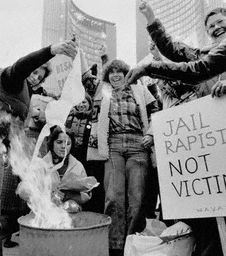
Toronto, 1979 (Bettman/Corbis)

Another participant at the 1979 bra-burning protest in Toronto has offered recollections of the event, at which the group Women Against Violence Against Women protested a controversial police report about the causes of rape.

The participant, Amy Gottlieb, said in an email forwarded to me that the photograph (left) “definitely is not doctored.”

(I had had my suspicions given that it looked almost too good to be true — which can be a marker of an unethically edited photograph and a media-driven myth.)

Gottlieb referred to Pat Murphy, who is shown in the photograph dangling the bra above the hungry flames, and wrote:

“Pat was threatening to burn a bra because the movement was media savvy and felt that weighing in on the stereotype of ‘feminist bra-burners’ was actually an effective way to say: Women will control our own bodies, thank you!

“The bra burning was a way to entice the media as well as [offer] a critique of the police report.”

I spoke recently with Vicki Trerise, who is shown at the far right in the photograph; she, too, said the demonstrators were media-savvy and “knew that if they burned a bra, someone would take their picture.”

Interestingly, the leading Toronto newspapers at the time didn’t mention the bra-burning in reports about the demonstration, which took place near Toronto city hall on March 8, 1979.

The Globe and Mail, in a fairly detailed account published the following day, characterized the demonstration as “boisterous” and reported:

“The women carried signs saying: ‘Take a Rapist to Lunch — Charcoal Broiled’ and ‘Hookers Who Wink Go to the Clink! Men Who Rape Escape.’

“The women, after lighting a fire in a garbage can, to the obvious annoyance of about a dozen watchful constables, shouted: ‘Burn the rapists, burn the city, burn the OPP,” acronym for the Ontario Provincial Police, which had issued the disputed report about rape.

The Globe and Mail also reported: “The women charged that the OPP report was nothing less than state approval of rape and that no serious study of rape had even been done by the Government.

“The women then sang a surprisingly obscene song describing male domination of women and marched off, chanting anti-male slogans ….”

Before the demonstrators moved on, the Globe and Mail reported, a “few chuckles from male onlookers provoked a slight shoving match, including one reporter by a large lady in lavender brandishing a cat-o-nine tails.”

The issue of the Toronto Star of March 9, 1979, carried a brief report about the Women Against Violence Against Women demonstration, noting the protesters’ anger at the police report, which had identified hitchhiking, alcohol consumption, and drug use as causes of many rapes.

“The women lit sparklers and set a garbage can on fire as they booed the report’s findings,” reported the Star, which did not mention the bra-burning.

Lighted sparklers held aloft are clearly visible in the bra-burning photograph. Rights to the photograph are held by the Bettmann/Corbis archive, which says it does not know the identity of the photographer.

It is sometimes claimed said that no bras were ever burned at a feminist protest in the 1960s or 1970s. The photograph of the demonstration in Toronto proves otherwise.

Moreover, I offer evidence in my latest book, Getting It Wrong, that bras were burned, briefly, at the famous women’s liberation protest against the 1968 Miss America pageant in Atlantic City, New Jersey.

“This evidence,” I write in Getting It Wrong, “cannot be taken lightly, dismissed or ignored,” and suggests “that the myth of mass or demonstrative bra-burning needs to be modified.”

The bra-burning in Toronto in 1979 further calls for revision of the notion that feminist bra-burning was a media myth.

WJC

Recent and related:

‘Kill the Irishman’: Glamorizing ’70s Cleveland underworld?

In Cinematic treatments, Media myths, Newspapers on March 2, 2011 at 7:14 am

A lawyer friend in Cleveland told me yesterday that a movie called Kill the Irishman is soon to be released. It’s about a dapper Cleveland mobster named Danny Greene who was  slain in a car-bombing in 1977.

I was quite surprised that the life and death Greene, a swaggering smalltime crime figure in a gritty rustbelt city, would win Hollywood’s attention after all these years. And with such comparative star power, no less: Kill the Irishman features roles by Christopher Walken, Val Kilmer, Paul Sorvino, and Vincent D’Onofrio.

Ray Stevenson plays Greene.

As cinema is wont to do, Kill the Irishman may end up glamorizing and mythologizing Greene and the violent Cleveland underworld of the second half of the 1970s. Publicity material for the movie suggests as much, referring as it does to “Greene’s heroic rise from a tough Cleveland neighborhood to become an enforcer in the local mob.”

I was in Cleveland then, a young reporter for the city’s morning newspaper, the Plain Dealer. The mob scene was murky, chaotic, and hardly glamorous; its figures were scarcely “heroic.”

It did churn up some flamboyant characters, though, including Greene and another rackets figure, Alex (Shondor) Birns, who was killed in a car bombing the night before Easter in March 1975.

I wrote the story about Birns’ bombing death — and Jim Flanagan, the newspaper’s inestimable night city editor, rewrote the lead to say:

“Alex (Shondor) Birns, Cleveland numbers racketeer, was blown to bits at 8 last night seconds after he entered his car parked behind a West Side bar.

“Police, who made the identification, said Birns was hurled through the roof of a 1975 light blue Lincoln Continental Mark IV. The upper torso was found beside the opened front passenger door.”

Blown to bits. Do newspapers still write crime stories that way?

Everyone believed Greene to have been behind Shondor Birns’ death, but no one could finger him.

And a lot of people suspected that it was a matter of time before Greene was killed, too. He flirted with both sides of the law after all. For a time at least, Greene was an informant for the FBI.

Part of Greene’s appeal rested on a catlike ability to dodge attempts on his life.

About six weeks after Birns was blown to bits, Greene survived the bombing of his house on Waterloo Road in Cleveland.

I wrote that story, too, along with a police beat reporter named Mairy Jayn Woge, who commuted to work in Cleveland from somewhere near Pittsburgh.

The article opened this way:

“Cleveland gangland figure Daniel J. (Danny) Greene yesterday survived the second bombing attempt on his life in seven years.

‘Greene, 45, was at his home … when a bomb was thrown through a downstairs window at 3:50 a.m. The explosion destroyed the building that Greene also used as an office to run an industrial consulting firm.”

I remember relishing that line, “Cleveland gangland figure.”

His luck and elusiveness notwithstanding, Greene began to seem more eccentric than significant. He was, as I came to understand it, less important than his reputation. He may have been elbowing his way into the gambling rackets, but Greene really wasn’t such a leading figure in the Cleveland underworld.

He was colorful, though.

Plain Dealer articles described Greene as revealing no fear after escaping the attempt on his life in 1975.

“After that bombing,” one article recalled, “Greene used to sit on a bench in front of his office in a trailer, conducting business and unafraid of being shot down.”

He was killed in October 1977, the victim of what the Plain Dealer called a “trojan horse” bombing. An explosive device packed into a car parked next to Greene’s Lincoln Continental was detonated remotely, killing Greene immediately.

Greene had just completed a visit to the dentist.

I was one of nine Plain Dealer staffers who worked on that story, which carried the headline, “Car bomb kills Danny Greene.” Flanagan, the night city editor, also was credited as having contributed to the report.

Flanagan, a hefty man of Irish descent who wore suspenders and had a heart of gold, was a veteran of Cleveland’s once-lusty newspaper scene. He worked for the afternoon Cleveland News before it folded, and afterward joined the Plain Dealer.

He was steeped in a detail-rich, tabloidesque writing style. And he took time to mentor young reporters, if they were willing. I still have copies of some of my stories that Flanagan rewrote, to which he usually attached detailed notes of explanation.

“Don’t waste space on the obvious,” one note began.

“Remember the old English lesson, avoid adjectives; move the sentence by verbs,” said another.

“Simplify, simplify, simplify,” Flanagan wrote in another note, adding, “Again, I stress using simple, declarative sentences and make your attribution down in the story.”

I suspect Flanagan wrote the sidebar to the story about Greene’s violent death. Either he or Bob Daniels, a gifted rewriteman who called just about everyone “coach.”

The sidebar began this way:

“Daniel John Patrick Greene had the quiet courtesy of an Irish butler but his shillelagh-bold eyes were those of a muscleman. …

“His manner was reserved and polite and he showed compassion for friends.

“But bombs burst around him so frequently and bullets were fired at him so often that his mere appearance in a saloon caused an uneasy atmosphere and a gradual emptying of the bar.”

Vivid writing, delightfully over the top. And it’s just the kind of stuff that Hollywood seems to love.

WJC

Recent and related:

‘Those bra-burning times’: And just when were they?

In Bra-burning, Debunking, Media myths on March 1, 2011 at 8:44 am

Atlantic City, 1968

Bra-burning” is a euphonic term that emerged in the late 1960s to dismiss the women’s liberation movement as trivial, shallow, and even a bit primitive.

The epithet is still used to insult feminist advocacy.

Bra-burning” also lives on as a cliché — “convenient shorthand,” as I write in my mythbusting book, Getting It Wrong, “for describing the upheaval” of the 1960s and 1970s.

The term sometimes is invoked quite casually, as in “the era of bra-burning,” the “hysteria of bra-burning,” and “the bra-burning days of the turbulent 1960s.”

A commentary the other day in the Detroit Free Press offered up “those bra-burning times” in characterizing the 1970s.

The commentary’s author, the Free Press business and autos editor, recalled that in the 1970s, her mother had given her a book titled Women Who Dared to be Different.

“It certainly was a book for those bra-burning times,” she wrote, “and it told the stories of women who pioneered in professions once reserved for men.”

Of particular interest to Media Myth Alert is the casual reference to “those bra-burning times.”

“Bra-burning” may be an enduring turn of phrase. But the act of “bra-burning” neither defined nor figured prominently in feminist protests of the 1970s. Or of the 1960s.

There was hardly any bra-burning back in the day. Or at any time since.

I offer in Getting It Wrong evidence that bras were set afire, briefly, at the famous women’s liberation protest in 1968 against the Miss America pageant at Atlantic City, New Jersey.

The evidence comes from two witness accounts — one of them published in the local newspaper, the Press of Atlantic City, on September 8, 1968, the day after the protest.

That account appeared beneath the byline of a veteran reporter named John L. Boucher and carried the headline:

“Bra-burners blitz boardwalk.”

Boucher’s article referred to the burn barrel that demonstrators had dubbed the “Freedom Trash Can” and stated:

“As the bras, girdles, falsies, curlers, and copies of popular women’s magazines burned in the ‘Freedom Trash Can,’ the demonstration reached the pinnacle of ridicule when the participants paraded a small lamb wearing a gold banner worded ‘Miss America.’”

Boucher’s account, as I note in Getting It Wrong, “did not elaborate about the fire and the articles burning in the Freedom Trash Can, nor did it suggest the fire was all that important. Rather, the article conveyed a sense of astonishment that an event such as the women’s liberation protest could take place near the venue of the pageant.”

That account was buttressed by the recollections of Jon Katz, a prolific writer who in 1968 was a young reporter for the Atlantic City Press.

He was on the boardwalk the day of the protest, gathering material for a sidebar article about reactions to the demonstration.

Katz’s article did not mention the burning bras. But in correspondence with me, Katz has stated:

“I quite clearly remember the ‘Freedom Trash Can,’ and also remember some protestors putting their bras into it along with other articles of clothing, and some Pageant brochures, and setting the can on fire. I am quite certain of this.”

He added: “I recall and remember noting at the time that the fire was small, and quickly was extinguished, and didn’t pose a credible threat to the Boardwalk. I noted this as a reporter in case a fire did erupt ….”

Boucher’s long-overlooked article and Katz’s more recent recollections represent strong evidence that “bras and other items were set afire, if briefly, at the 1968 Miss America protest in Atlantic City,” I write in Getting It Wrong. “This evidence cannot be taken lightly, dismissed or ignored.

“But it must be said as well,” I add, “that the witness accounts of Boucher and Katz lend no support to the far more vivid and popular imagery that many bras went up in flames in flamboyant protest that September day.”

Bra-burning did figure, flamboyantly, at a women’s protest in Toronto in March 1979.

But as I discussed in a recent post at Media Myth Alert, bra-burning wasn’t that demonstration’s focal point. Setting fire to a bra was a way for the media-savvy protesters to call attention to their grievances — specifically, a controversial police report about rape.

Otherwise, the evidence is scant at best of feminist protesters in the 1960s and 1970s setting fire to bras and tossing the flaming undergarments into spectacular bonfires.

WJC

Recent and related: