The tale about the New York Times suppressing its own reporting in the runup to the Bay of Pigs invasion of Cuba isn’t necessarily the most popular of media myths.
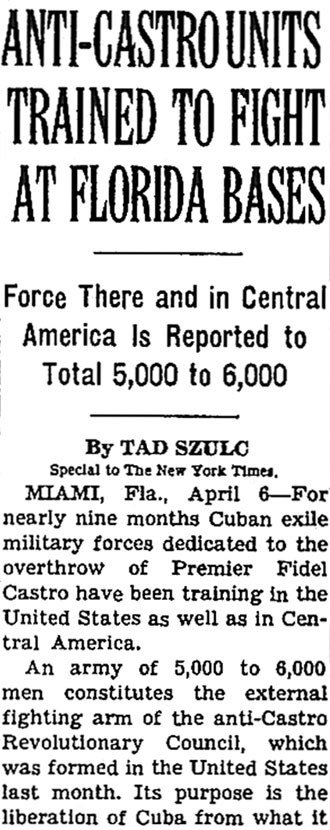
It made page one
It’s not recounted as frequently as, say, the mythical Cronkite Moment of 1968 or the dubious tale about William Randolph Hearst’s vow to “furnish the war” with Spain in 1898.
But the Times-Bay of Pigs suppression myth is a tale tenacious as it is delicious, and it makes a cameo appearance in Freedom of Speech: Mightier than the Sword, a recently published book by a former Timesman, David K. Shipler.
The suppression myth, which is addressed and debunked in my 2010 book, Getting It Wrong: Ten of the Greatest Misreported Stories in American Journalism, has it that the Times bowed to pressure from the administration of President John F. Kennedy and spiked, killed, or otherwise sanitized a detailed report about the pending invasion.
Shipler invokes the suppression tale this way:
“The most famous and catastrophic case of journalists’ abandoning their role in getting the facts out was the Times‘s decision to water down advance information on the Bay of Pigs invasion of Cuba.” He doesn’t say what the Times supposedly held back, or just how that was “catastrophic.”
But he does claim that “a full-throated disclosure might have helped derail the plan, saving lives and preventing a humiliating defeat.”
Speculation aside, Shipler’s right that the ill-fated invasion was a humiliating defeat for the Kennedy administration: A brigade of U.S.-trained foes of the regime of Fidel Castro landed on the beaches of southern Cuba in April 1961 and was rolled up within three days.
But Shipler’s claim about the Times’ having watered down “advance information” is supported by no relevant or persuasive evidence. He cites none in the endnotes of his book.
The Times article that rests at the heart of this media myth was neither suppressed, killed, nor eviscerated.
That article (see above) was written by a veteran correspondent, Tad Szulc, who reported from Miami that 5,000 to 6,000 Cuban exiles had received military training for a mission to topple Castro’s communist regime; the actual number of invaders was closer to 1,400.
Overstatement was hardly the article’s most controversial or memorable element.
Supposedly, editors at the Times caved in to pressure from the White House and emasculated Szulc’s report, removing key elements about the invasion plans.
That Kennedy intervened in the Times’ editorial decisionmaking in April 1961 is widely believed, and lives on as a cautionary tale, as Shipler suggests.
But as I discussed in Getting It Wrong, “the notion that Kennedy asked or persuaded the Times to suppress, hold back, or dilute any of its reports about the pending Bay of Pigs invasion is utter fancy. There is no evidence that Kennedy or his administration knew in advance” about Szulc’s dispatch, which was filed April 6, 1961.
The article was published the following day, above the fold on the Times’ front page.
In his book Without Fear or Favor, an insider’s look at the Times, Harrison Salisbury offered a detailed account about the handling of Szulc’s dispatch.
“The government in April 1961,” Salisbury wrote, “did not … know that The Times was going to publish the Szulc story, although it was aware that The Times and other newsmen were probing in Miami. …. The action which The Times took [in editing Szulc’s report] was on its own responsibility,” the result of internal discussions and deliberations.
The editing was cautious but hardly unreasonable.
A reference to the invasion’s imminence was removed, which served to improve the story’s accuracy. The anti-Castro exile force launched its assault on April 17, 1961, 10 days after Szulc’s report appeared, an interval that hardly connotes “imminence.”
References to the CIA’s role in training the Cuban exiles were omitted from the story in favor of the more nebulous terms “U.S. officials” and “U.S. experts.” Turner Catledge, then the Times managing editor, said the U.S. government had more than a few intelligence agencies, “more than most people realize, and I was hesitant to specify the CIA when we might not be able to document the charge.”
An entirely defensible editorial decision.
The prominence given Szulc’s report was modified, from a planned four-column display to a single column. If the invasion was not believed imminent, then a four-column headline was difficult to justify, Catledge reasoned.
Those decisions were judicious, and certainly not unreasonable.
“Most important,” as Salisbury wrote, “The Times had not killed Szulc’s story. … The Times believed it was more important to publish than to withhold. Publish it did.”
On the front page.
What’s often ignored is that Szulc’s article of April 7, 1961, was no one-off story. It scarcely was the Times’ last word about invasion plans.
As I noted in Getting It Wrong, “Subsequent reporting in the Times, by Szulc and others, kept expanding the realm of what was publicly known about a coming assault against Castro.” Not all the reports were accurate in all their details, but the combined effect was to signal something important was afoot.
For example, on April 8, 1961, the Times published a front-page article about the exiles and their eagerness to topple Castro.
The article appeared beneath the headline, “Castro Foe Says Uprising Is Near,” and quoted the president of the U.S.-based umbrella group of exiles, the Cuban Revolutionary Council.
The following day, the Times front page included a report by Szulc describing how Cuban exile leaders were attempting to paper over differences in advance of what was termed the coming “thrust against Premier Fidel Castro.”
The “first assumption” of the leaders’ plans, Szulc wrote, “is that an invasion by a ‘liberation army,’ now in the final stages of training in Central America and Louisiana, will succeed with the aid of internal uprising in Cuba. It is also assumed that a provisional ‘government in arms’ will be established promptly on the island.”
That essentially was the plan to topple Castro.
Three days later, James Reston, then the newspaper’s Washington bureau chief, wrote in a column that considered the moral dimensions of an assault on the Castro regime. Reston’s column said that “while the papers have been full of reports of U.S. aid to overthrow Castro, the moral and legal aspects of the question have scarcely been mentioned.”
Other news organizations, including the Miami Herald and New York Herald Tribune, reported on pre-invasion preparations as well, all of which prompted Pierre Salinger, Kennedy’s press secretary, to recall in a memoir a few years later:
“To declare in mid-April of 1961 that I knew nothing of the impending military action against Cuba except what I read in the newspapers or heard on the air was to claim an enormous amount of knowledge.”
WJC
More from Media Myth Alert:

 Media Myth Alert