W. Joseph Campbell

Archive for August, 2016|Monthly archive page

‘Scorched by American napalm’: The media myth of ‘Napalm Girl’ endures

In Debunking, Error, Media myths, Newspapers, Photographs on August 22, 2016 at 7:33 am

One of the most memorable photographs of the Vietnam War was “The Terror of War,” better known as “Napalm Girl.”

The image showed a cluster of terrified Vietnamese children fleeing an errant bombing raid near their village, Trang Bang. At the center of the photograph was a naked, 9-year-old girl named Kim Phuc who was badly burned in the napalm attack.
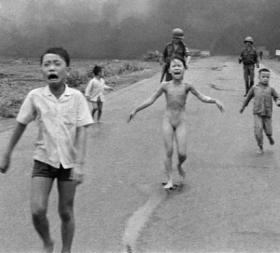
'Napalm girl,' 1972 (Nick Ut/AP)

‘Napalm Girl,’ 1972 (Nick Ut/AP)

The photograph was taken June 8, 1972, by an Associated Press photographer, Nick Ut. The photograph won a Pulitzer Prize in 1973 and much acclaim in the years since then.

It also has given rise to enduring media myths — notably that Ut’s photograph showed the effects of a U.S. bombing raid at Trang Bang, northwest of Saigon, the South Vietnamese capital now known as Ho Chi Minh City.

That myth of the “Napalm Girl” was invoked yesterday in a 900-word profile of Ut in the Los Angeles Times. The article referred in its opening paragraph to Kim Phuc, saying she had been “scorched by American napalm.”

In fact, the aerial napalm attack was carried out by the South Vietnamese Air Force, as news reports at the time made clear.

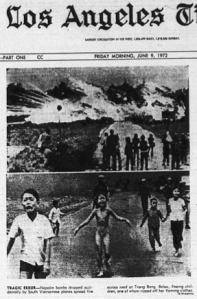
The Los Angeles Times prominently displayed the photograph on its front page of June 9, 1972 (see right), and stated in its caption that the napalm had been “dropped accidentally by South Vietnamese planes.”Screen Shot 2016-08-21 at 9.39.27 AM
The New York Times reported on June 9, 1972, that “a South Vietnamese plane mistakenly dropped flaming napalm right on his troops and a cluster of civilians.” The Chicago Tribune told of “napalm dropped by a Vietnamese air force Skyraider [warplane] diving onto the wrong target.”

Christopher Wain of Britain ITN television network wrote in a dispatch from Trang Bang for the United Press International news service:

“These were South Vietnamese planes dropping napalm on South Vietnamese peasants and troops.”

The myth of American culpability in the attack at Trang Bang has been invoked often over the years. Early this month, for example, a columnist for USAToday referred to Ut’s photograph and said it showed “a naked nine-year-old Vietnamese girl fleeing her village after U.S. forces bombed it with napalm….”

The making of the myth can be traced to the hapless campaign in 1972 of George McGovern, the Democratic nominee for president.

In a televised speech in October 1972, McGovern invoked the image of “the little South Vietnamese girl, Kim, fleeing in terror” and “running naked into the lens of that camera.

“That picture ought to break the heart of every American,” McGovern said. “How can we rest with the grim knowledge that the burning napalm that splashed over little Kim and countless thousands of other children was dropped in the name of America?”

How he determined that Kim Phuc was representative of “countless thousands of other children” sprayed by napalm, McGovern did not say.

But his claim that the napalm had been “dropped in the name of America” insinuated U.S. responsibility for the errant attack — which misstated what had happened at Trang Bang. The aerial attack was carried out by South Vietnamese forces to roust communist troops from bunkers at the outskirts of the village.

The fighting there was an all-Vietnamese encounter.

WJC

More from Media Myth Alert:

About the ‘Murrow Moment’: A ‘tipping point’ that wasn’t

In Debunking, Error, Media myths, Murrow-McCarthy myth, New Yorker, Television on August 13, 2016 at 9:45 am

The “Murrow Moment” has become a fashionable phrase in American journalism, invoked to justify suspending impartiality in reporting on Donald Trump and his often-incendiary, gaffe-prone campaign for president.

Murrow_thumbnail

He of the ‘Murrow Moment’

Invoking the phrase also allows contemporary reporters to associate themselves with the presumed greatness and courage of Edward R. Murrow, a legendary journalist for CBS News in the 1940s and 1950s. “Murrow Moment” is an allusion to a half-hour television program in 1954 when Murrow took on Joseph R. McCarthy, a menacing, red-baiting U.S. senator from Wisconsin.

“Murrow Moment” has been in circulation for a couple of months, at least since an essay at Huffington Post invoked the phrase. It has picked up intensity in recent weeks, following a commentary published in Columbia Journalism Review under the headline, “For journalists covering Trump, a Murrow moment.”

“After months of holding back,” the commentary declared, “modern-day journalists are acting a lot like Murrow, pushing explicitly against Donald Trump, the … Republican presidential nominee.”

The commentary gave prominent reference to Murrow’s program about McCarthy, stating:

“As Edward R. Murrow wrapped up his now-famous special report condemning Joseph McCarthy in 1954, he looked into the camera and said words that could apply today. ‘He didn’t create this situation of fear—he merely exploited it, and rather successfully,’ Murrow said of McCarthy. Most of Murrow’s argument relied on McCarthy’s own words, but in the end Murrow shed his journalistic detachment to offer a prescription: ‘This is no time for men who oppose Senator McCarthy’s methods to keep silent—or for those who approve,’ he said. ‘We cannot defend freedom abroad by deserting it at home.'”

Screen Shot 2016-08-12 at 6.26.02 PM

Columbia Journalism Review headline

In reality, Murrow’s half-hour report on McCarthy in 1954 wasn’t all that extraordinary.

Courageous, it was not.

But over the years the program has taken on mythical dimension, that it was, in the words of another recent Huffington Post essay, a “tipping point” that “helped bring about the end of McCarthy.”

Murrow’s program was a lacerating attack on McCarthy. But it was no “tipping point,” for reasons that include:

  • Murrow took on McCarthy years after other journalists directed pointed and sustained attention to McCarthy’s brutish tactics — and in some instances paid a price for having done so. As I noted in my media-mythbusting book, Getting It Wrong, McCarthy had no more implacable critic in journalism than Drew Pearson of the syndicated muckraking column, “Washington Merry-Go-Round.” Pearson first challenged McCarthy in February 1950, shortly after the senator began his communists-in-government campaign, and persisted in questioning the substance of McCarthy’s accusations. That was four years before Murrow’s program.
    McCarthy became so unnerved by Pearson’s work that he physically assaulted the columnist in December 1950, in the cloakroom of the exclusive Sulgrave Club on DuPont Circle in Washington, D.C. Then-senator Richard M. Nixon broke up the confrontation.
  • ŸŸŸMcCarthy’s favorability rating had hit the skids well before Murrow’s program, which aired March 9, 1954. As I discussed in Getting It Wrong, Gallup Poll data show that McCarthy’s appeal crested in December 1953, when 53 percent of Americans said they had a favorable view of him. McCarthy’s favorable rating dropped to 40 percent by early January 1954, and to 39 percent in February 1954, when an almost identical number of Americans viewed him unfavorably. By mid-March 1954, the proportion had shifted to 32 percent favorable and 47 percent unfavorable.
  • Murrow’s program benefited from coincidental good timing, airing during the week when the senator’s fortunes took a prominent and decisive turn for the worse — for reasons unrelated to Murrow.
    “The pivotal moment of the decisive week,” I wrote in Getting It Wrong, was “the disclosure … about the Army’s allegations that McCarthy and his subcommittee’s counsel, Roy Cohn. The Army charged they had exerted pressure in an attempt to gain favored treatment for G. David Schine, Cohn’s friend and assistant who had been drafted into military service.” The Army’s complaint became the subject of televised hearings in spring and summer 1954, which hastened McCarthy’s downfall. His conduct was condemned by the Senate in December 1954.

Interestingly, Murrow in 1954 downplayed the presumptive effects of his program about McCarthy. According to Jay Nelson Tuck, television critic for the then-liberal New York Post, Murrow was “almost a little shame faced at being saluted for his courage in the McCarthy matter.”

Tuck further wrote that Murrow “said he had said nothing that … anyone might not have said without a raised eyebrow only a few years ago.”

Fred Friendly, Murrow’s collaborator and co-producer, also rejected the notion that the program on McCarthy was dispositive to the senator’s decline. Friendly wrote in his memoir, Due to Circumstances Beyond Our Control:

“To say that the Murrow broadcast of March 9, 1954, was the decisive blow against Senator McCarthy’s power is as inaccurate as it is to say that Joseph R. McCarthy … single-handedly gave birth to McCarthyism.”

The “Murrow moment” commentary in Columbia Journalism Review included a reference to Murrow’s having “shed his journalistic detachment” in calling out McCarthy in 1954.

The passage brought to mind an eye-opening discussion in A.M. Sperber’s biography of Murrow, in which she reported that Murrow had privately advised Adlai Stevenson during the 1956 presidential campaign on “the finer points of speaking to the camera.”

Sperber wrote in Murrow: His Life and Times that even though the Republican incumbent, Dwight D. Eisenhower, was sure to win to reelection,  Murrow agreed “to help the Democrats.” Sperber described Murrow’s decision as “a radical departure from his usual practice.”

The idea, Sperber wrote, was “to effect a liaison between the broadcaster and the candidate, to discuss the use of TV in the forthcoming campaign.”

She noted that the Murrow-Stevenson “connection was kept under wraps,” that the “understanding” between the broadcaster and Stevenson advisers was that Murrow “was acting as a private citizen” and that the matter was to be “kept quiet.”

So why did Murrow discreetly “shed his journalistic detachment” to advise Stevenson?

“He wouldn’t say,” Sperber wrote, adding that Murrow’s “friends, knowing his detestation of [John] Foster Dulles, were not surprised.” Dulles, a political conservative, was Eisenhower’s secretary of state and Time magazine’s “Man of the Year” in 1954.

Murrow’s coaching of Stevenson came to little, Sperber wrote. They met in a New York studio in June 1956 and Murrow “sweated over the candidate, trying to inculcate the finer points of speaking to the camera. Stevenson barely endured it, chiding campaign manager George Ball about the money this was costing the Democrats.”

Sperber also wrote that Murrow “dictated a few ideas for issue-oriented TV spots” but they were “never put to use.”

Additionally, according to a New Yorker article in 2006, Murrow thought “seriously about running for the Senate from New York as a Democrat” in 1958 and “consulted privately with both [CBS chief executive William] Paley and Harry Truman,” the Democratic former president, before deciding not to seek the office.

WJC

More from Media Myth Alert: