W. Joseph Campbell

Archive for the ‘New York Sun’ Category

What became of Virginia O’Hanlon?

In 1897, New York Sun, New York Times, Newspapers, Year studies on December 25, 2010 at 8:13 am

Virginia

Virginia O’Hanlon was 8-years-old when she gained a measure of fame that would last her lifetime.

Shortly after her birthday in July 1897, young Virginia wrote to the New York Sun, posing the timeless question: “Is there a Santa Claus?

It took several weeks, but her innocent letter gave rise to the most famous editorial in American journalism. The Sun answered Virginia’s query on September 21, 1897, in an essay destined to become a classic.

The essay was assigned an inconspicuous place in the Sun, appearing in the third of three columns of editorials beneath the headline, “Is There A Santa Claus?

Its most memorable passage sought to reassure Virginia–and, as it turned out, generations of youngsters since then.

“Yes, Virginia,” it declared, “there is a Santa Claus. He exists as certainly as love and generosity and devotion exist, and you know that they abound and give to your life its highest beauty and joy. Alas! how dreary would be the world if there were no Santa Claus. It would be as dreary as if there were no Virginias.”

The editorial closed with further reassurance:

“No Santa Claus! Thank God! he lives, and he lives forever. A thousand years from now, Virginia, nay, ten times ten thousand years from now, he will continue to make glad the heart of childhood.”

As I note in my 2006 book, a year-study titled The Year That Defined American Journalism: 1897 and the Clash of Paradigms, Virginia O’Hanlon as an adult embraced the recognition and modest fame that came with her part in inspiring “Is There A Santa Claus?” (She once said in jest that she was “anonymous from January to November.”)

The editorial, she told an interviewer in 1959, when she was 67, “gave me a special place in life I didn’t deserve. It also made me try to live up to the philosophy of the editorial and to try to make glad the heart of childhood.”

She occasionally read the editorial at Christmas programs, as she did in 1933 and 1937 at Hunter College, her alma mater. Virginia earned a bachelor’s degree there in 1910 and a master’s degree two years later at Columbia University.

She was a teacher in the New York City schools, and became a principal at a school for handicapped children after earning a doctorate from Fordham University in 1935.

At her retirement in 1959, the New York Times observed that Virginia was “one of those rare persons whose given name alone has instant meaning for millions.”

In December 1960, Virginia went on the Perry Como Show and said she had lived “a wonderfully full life.” She told Como in a brief interview that her letter to the Sun had been “answered for me thousands of times.”

She was married for a time to Edward Douglas by whom she had a daughter, Laura Temple. For two years in the 1930s, Temple worked in the advertising office of the Sun.

“They all knew who I was,” she was quoted years as saying about the Sun staff. “And we all had the same feeling about the editorial that my mother had—that it was a classic.”

Virginia O’Hanlon Douglas was 81 when she died at a nursing home in upstate New York.

Her death in May 1971 was reported on the front page of the New York Times beneath the headline:

Virginia O’Hanlon, Santa’s friend, dies.”

Virginia's gravesite (Photo by George Vollmuth, 2009)

She was buried in North Chatham, New York.

At the approach of Christmas in recent years, the North Chatham Historical Society has conducted a reading at Virginia’s gravesite of the letter that brought her fame and of the editorial that it inspired.

WJC

Recent and related:

At Christmas: The remarkable trajectory of an 1897 editorial

In 1897, Debunking, Media myths, New York Sun, Newspapers on December 24, 2010 at 7:52 am

WJC and pal: Merry Christmas

Christmas Eve is a fine occasion to consider how an obscure essay published more than 120 years ago in a combative New York City newspaper became the most memorable editorial in American journalism.

The editorial is the timeless tribute to childhood and the Christmas spirit, “Is There A Santa Claus?

Its trajectory from obscurity is remarkable.

The essay appeared in the New York Sun, in response to a letter from 8-year-old Virginia O’Hanlon, who implored:

“Please tell me the truth; is there a Santa Claus?”

The Sun in reply was reassuring.

“Yes, Virginia,” the editorial declared, “there is a Santa Claus. He exists as certainly as love and generosity and devotion exist, and you know that they abound and give to your life its highest beauty and joy. Alas! how dreary would be the world if there were no Santa Claus. It would be as dreary as if there were no Virginias.”

The editorial was published not at Christmas but in September 1897, in the third of three columns of editorials in the Sun–a newspaper that relished the rough and tumble of late 19th century American journalism.

As I noted in my 2006 book, The Year That Defined American Journalism: 1897 and the Clash of Paradigms, the Sun in its editorials in the late 19th century “was more inclined to vituperation and personal attack than to evoke the eloquence and lyricism” that distinguished “Is There A Santa Claus?”

Indeed, the trade journal Fourth Estate observed in 1897 that the Sun was never happy unless it was on the attack. Given such tendencies, I wrote, “the delicate charm of ‘Is There A Santa Claus?’ was decidedly out of place” in the columns of the Sun.

Moreover, the Sun was slow–reluctant, even–to embrace the editorial, usually rebuffing readers’ requests to reprint “Is There A Santa Claus?”

After its initial appearance on September 21, 1897, the essay was not published again in the Sun until December 1902.  The newspaper did so then with a trace of annoyance, declaring:

“Since its original publication, the Sun has refrained from reprinting the article on Santa Claus which appeared several years ago, but this year requests for its reproduction have been so numerous that we yield.

“Scrap books,” the Sun added in a gratuitous swipe, “seem to be wearing out.”

Over the years, though, readers persisted in their requests, asking the Sun every year at Christmastime to reprint “Is There A Santa Claus?”

And as I wrote in The Year That Defined American Journalism, the newspaper ultimately gave in, “tacitly acknowledging that editors are not always as perceptive as their readers in identifying journalism of significance and lasting value.”

In 1924, the newspaper’s then-owner, Frank Munsey, ordered “Is There A Santa Claus?” to appear as the lead editorial on Christmas Eve. In the years that followed, until the newspaper folded in 1950, “Is There A Santa Claus?” was the lead editorial in the Sun on December 23 or 24.

It remains a favorite, 113 years on.

Reasons for the editorial’s enduring popularity are several. Among them are:

  • The editorial is a cheering, reaffirming story, one without villains or sinister elements.
  • It represents a connection to distant time: It is reassuring, somehow, to know that what was appealing in 1897 remains appealing today.
  • It offers a reminder to adults about Christmases past, and the time when they, too, were believers.
  • It has been a way for generations of parents to address the skepticism of their children about Santa Claus. They can point to the editorial and its timeless answer to an inevitable question–and not have to fib much about Santa’s existence.

Interestingly, the essay was written by a veteran and childless journalist named Francis P. Church whose authorship wasn’t widely known until soon after his death in April 1906.

The Sun revealed that Church had written the editorial in what was an eloquent, posthumous tribute.

“At this time,” the newspaper said, “with the sense of personal loss strong upon us, we know of no better or briefer way to make the friends of the Sun feel that they too have lost a friend than to violate custom by indicating him as the author of the beautiful … editorial article affirming the existence of Santa Claus, in reply to the question of a little girl.”

WJC

Recent and related:

‘Yes, Virginia,’ on CBS: No classic

In 1897, Anniversaries, Debunking, Media myths, New York Sun, Newspapers, Year studies on December 18, 2010 at 7:44 am

I wrote a year ago about the charmless CBS animated Christmas special, Yes, Virginia, a show based on Virginia O’Hanlon’s famous letter to the New York Sun in 1897 that prompted American journalism’s best-known editorial.

The show aired again last night; watching it was headache-inducing.

It utterly lacks the serendipity, anticipation, disappointment, and surprise that characterized the real back story to Virginia’s 1897 letter.

Her appeal to the Sun — “Please tell me the truth; is there a Santa Claus?”–gave rise to an editorial published beneath the headline, “Is There A Santa Claus?”

The editorial’s most memorable and most-quoted passage declared:

“Yes, Virginia, there is a Santa Claus. He exists as certainly as love and generosity and devotion exist, and you know that they abound and give to your life its highest beauty and joy. Alas! how dreary would be the world if there were no Santa Claus. It would be as dreary as if there were no Virginias.”

As I noted last year at Media Myth Alert, CBS took great liberties with the back story in offering up a tedious half-hour show that was neither accurate nor entertaining. It’s a distortion of a charming story.

Francis P. Church

The animated Virginia is waddling, round-headed, and unaccountably obsessed with the existence of Santa Claus. Francis P. Church, the retiring journalist who wrote the famous editorial, is depicted–no, misrepresented–as scowling, dismissive, and hard-hearted.

Neither character is convincing. Neither is realistic.

The animated Church is identified as the editor of the Sun, which is shown as a tabloid newspaper. Church was not the editor; he was an editorial writer. And the Sun was no tabloid.

The CBS show also had Virginia writing her letter, and the Sun publishing its reply, in December, as Christmas approached.

In fact, the letter was written in the summer of 1897, and the Sun published the editorial on September 21, 1897 — obscurely, in the third of three columns on editorials on an inside page (and not in big, sensation-stirring headlines across the front page, as the CBS show had it).

As I discuss in my 2006 book–a year-study titled The Year That Defined American Journalism: 1897 and the Clash of Paradigms–Virginia O’Hanlon said that she addressed her letter to the Sun’s question-and-answer column, and waited impatiently for the newspaper to publish a response.

She recalled that the Sun did not promptly take up her inquiry. Far from being obsessed, little Virginia stopped thinking about it after a while.

“After writing to the Sun,” she told an audience in Connecticut many years later, “I looked every day for the simple answer I expected. When it didn’t appear, I got disappointed and forgot about it.”

At the Sun, Virginia’s letter probably was overlooked, or misplaced, for an extended period.

That there was such a gap seems certain, given O’Hanlon’s recollections about waiting and waiting for a reply, and the accounts that say Church wrote the editorial in “a short time” or “hastily, in the course of the day’s work.”

Virginia O'Hanlon

What reconciles the two accounts—O’Hanlon’s prolonged wait and Church’s quickly written response—is that the Sun for a time had misplaced the letter that inspired a classic editorial, one that would recall the newspaper long after it folded in 1950.

The real back story to Virginia’s letter is far richer than the cheerless, vapid fare that CBS offered up.

Unlike the 1897 editorial, the wretched animated show is destined to be no classic.

WJC

Recent and related:

As inevitable as ‘Yes, Virginia,’ at the holidays

In 1897, Debunking, Furnish the war, Media myths, New York Sun, New York Times, Newspapers, Year studies, Yellow Journalism on December 15, 2010 at 8:59 am

The approach of the year-end holidays brings inevitable reference to American  journalism’s most famous editorial, “Is There A Santa Claus?”

Virginia O'Hanlon

The lyrical and timeless tribute to childhood and the Christmas spirit was first published in 1897 in the old New York Sun, in response to the inquiry of an 8-year-old girl, Virginia O’Hanlon.

“Please tell me the truth,” she implored, “is there a Santa Claus?”

The Sun in reply was reassuring:

“Yes, Virginia, there is a Santa Claus. He exists as certainly as love and generosity and devotion exist, and you know that they abound and give to your life its highest beauty and joy.”

Almost as inevitable as the editorial’s reappearance this time of year are sightings of myths and misconceptions associated with “Is There A Santa Claus?”

Today, for example, an online reference site for journalists, Followthemedia.com, says in an essay that “Is There a Santa Claus?” was published on the front page of the Sun, on September 21, 1897.

The date is correct. But the famous editorial was given obscure placement in its debut. As I wrote in my 2006 book, The Year That Defined American Journalism: 1897 and the Clash of Paradigms:

“‘Is There a Santa Claus?’ appeared inconspicuously in the third of three columns of editorials in the New York Sun on 21 September 1987. It was subordinate to seven other commentaries that day, on such matters as ‘British Ships in American Waters,’ the ambiguities in Connecticut’s election law, and the features of the chainless bicycle anticipated in 1898.”

“Is There A Santa Claus” appeared on page six, the editorial page of the Sun.

Interestingly, the oddly timed editorial about Santa Claus–appearing as it did more than three months before Christmas–prompted no comment from the many newspaper rivals to the Sun.

That’s somewhat curious because the New York City press of the late 19th century was prone–indeed, eager–to comment on, and disparage, the content of their rivals.  That’s how the enduring sneer “yellow journalism” was coined, in early 1897.

In its headline today, Followthemedia suggests the editorial’s most-quoted passage — “Yes, Virginia, there is a Santa Claus” — are the words most famous in American journalism.

Maybe.

But a stronger case can be made for  the New York Times logo, “All the News That’s Fit to Print,” which in 1897 took a permanent place in the upper left corner of the newspaper’s front page, a spot known in journalism as the “left ear.”

As I noted in a blog post nearly a year ago: “The ‘Yes, Virginia,’ passage is invoked so often, and in so many contexts, that no longer is it readily associated with American journalism. ‘Yes, Virginia,’ long ago became unmoored from its original context, the third of three columns of editorials in the New York Sun on September 21, 1897.”

I also suggested then that the famous vow attributed to William Randolph Hearst–“You furnish the pictures, I’ll furnish the war“–may be more famous in journalism than “Yes, Virginia.”

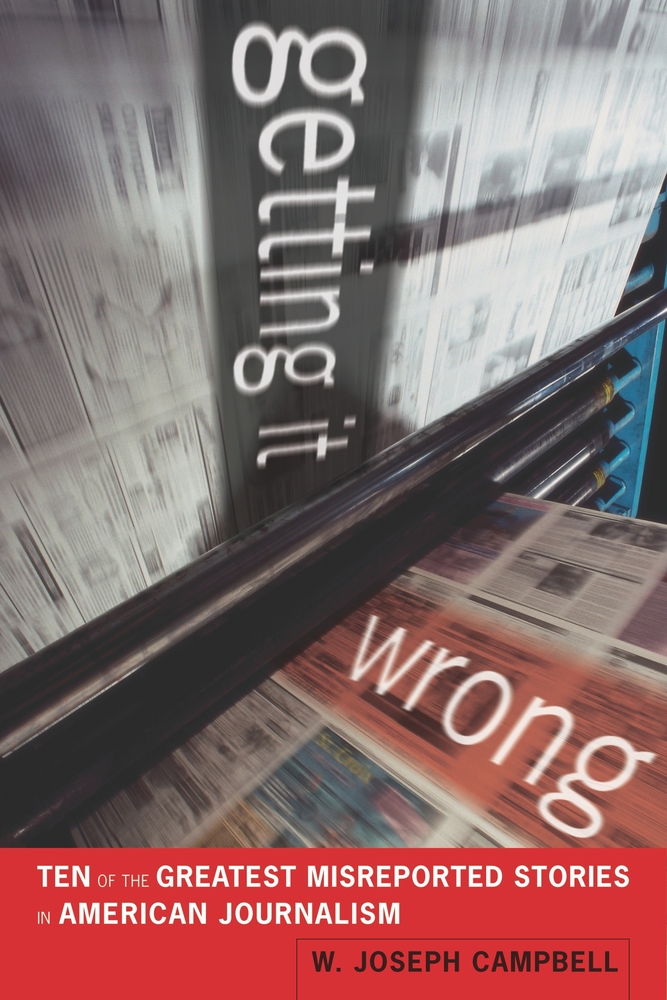
The Hearstian vow, as I write in my latest book, Getting It Wrong, is almost certainly apocryphal. But like many media-driven myths, it lives on as an anecdote too delicious not to be true.

What is striking and perhaps exceptional about “Is There A Santa Claus?” is its timeless appeal–how generations of readers have found solace, joy, and inspiration in its passages.

A letter-writer to the Sun in 1914 said, for example: “Though I am getting old,” the editorial’s “thoughts and expressions fill my heart with overflowing joy.”

In 1926, a letter-writer told the Sun that “Is There A Santa Claus?” offered “fine relief from the commercialism and unsentimental greed” of the Christmas season.

In 1940, a writer to the Sun likened the editorial to “a ray of hope on the path to human understanding in our troubled times.”

WJC

Recent and related:

Saturday at Newseum: Telling the back story to ‘Yes, Virginia’

In 1897, Media myths, New York Sun, Newspapers, Year studies on December 10, 2010 at 4:44 pm

I’ll be discussing American journalism’s best-known, most-reprinted editorial at a program tomorrow afternoon at the Newseum, the $450 million museum of news on Pennsylvania Avenue in Washington.

The editorial is, of course, the timeless tribute to childhood and the Christmas spirit that ran 113 years ago in the old New York Sun beneath the headline, “Is There A Santa Claus?”

I’ll be speaking about the back story to the classic editorial at 3:30 p.m. in the Newseum’s Knight studio, near the close of what is billed as “‘Yes, Virginia,’ Family Day.” The essay often is referred to as “Yes, Virginia,” owing to its most famous passage–“Yes, Virginia, there is a Santa Claus.”

As I note in my 2006 book, The Year That Defined American Journalism: 1897 and the Clash of Paradigms, the editorial was rather obscure and inconspicuous in its first appearance.  “Is There A Santa Claus?” was published in the third of three columns of tightly packed commentaries on topics that ranged from the ambiguities in Connecticut’s election law to the features of the chainless bicycle anticipated in 1898.

The editorial’s timing was odd and incongruous, too. “Is There A Santa Claus?” first appeared in the Sun on September 21, 1897–more than three months before Christmas.

As I write in The Year That Defined American Journalism, the best explanation for the puzzling timing “lies in the excited speculation of a little girl who, after celebrating her birthday in mid-summer, began to wonder about the gifts she would receive at Christmas.”

The little girl was Virginia O’Hanlon who, in her excited speculation, wrote to the Sun, saying:

“Some of my little friends say there is no Santa Claus. … Please tell me the truth; is there a Santa Claus?”

Virginia O'Hanlon

As she recalled years later, the letter was sent soon after her 8th birthday in July 1897. But the editorial reply in the Sun didn’t appear until more than two months had passed.

“After writing to the Sun,” she told an audience in 1959, “I looked every day for the simple answer I expected. When it didn’t appear, I got disappointed and forgot about it.”

Apparently, the Sun had misplaced or overlooked her letter. It eventually turned up on the desk of Edward P. Mitchell, the editorial page editor, who asked Francis P. Church to craft a reply.

Years later, Mitchell wrote that Church, a retiring, taciturn journalist, “bristled and pooh-poohed” at the request but finally “took the letter and turned with an air of resignation to his desk” to write.

It took Church less than a day to draft the editorial that would ensure him enduring posthumous fame. (His authorship wasn’t disclosed by the Sun until shortly after his death in 1906.)

“Virginia,” Church wrote in the editorial, “your little friends are wrong. They have been affected by the skepticism of a skeptical age. They do not believe except they see. They think that nothing can be which is not comprehensible by their little minds.”

After ruminating about the dimensions of human imagination, Church opened a new paragraph and wrote the editorial’s most memorable passages:

“Yes, Virginia, there is a Santa Claus. He exists as certainly as love and generosity and devotion exist, and you know that they abound and give to your life its highest beauty and joy. Alas! how dreary would be the world if there were no Santa Claus. It would be as dreary as if there were no Virginias.”

It sometimes is claimed that “Is There A Santa Claus?” was an instant sensation. In fact, it attracted no immediate attention. As I write in The Year That Defined American Journalism:

“Although it was published at a time when newspaper editors routinely commented on—and often disparaged—the work and content of their rivals, the oddly timed editorial prompted no comment from the Sun’s rivals in New York City.”

But “readers noted it and found it memorable,” I add. “In untold numbers over the years, readers asked the Sun to reprint the essay.” While it took years, the newspaper grudgingly acquiesced.

From 1924 until the newspaper’s last Christmas before folding in 1950, “Is There A Santa Claus?” was the lead editorial in the Sun on December 23 or 24.

“Ultimately,” I note, “the newspaper gave in—tacitly acknowledging that editors are not always as perceptive as their readers in identifying journalism of significance and lasting value.”

WJC

Recent and related:

Editorial writers and ‘Is There A Santa Claus?’ What they say today

In 1897, New York Sun on December 25, 2009 at 3:45 pm

New Hampshire Public Radio’s “Word of Mouth” program yesterday aired a quite interesting segment about what editorial writers say these days about the most famous editorial in American journalism, “Is There A Santa Claus?”

It made for thoughtful listening.

And that’s not just because the producer, Avishay Artsy, included some of my observations.

Virginia O'Hanlon

The famous editorial was written in 1897 by Francis P. Church of the New York Sun. The editorial was prompted by a letter from Virginia O’Hanlon, an eight-year-old New York City girl who implored the Sun:

“Please tell me the truth; is there a Santa Claus?”

In time, Church’s editorial — which included the memorable (if now cliched) passage, “Yes, Virginia, there is a Santa Claus” — became an unrivaled classic in American journalism.

As I pointed out in the “Word of Mouth” segment, the editorial “is very cerebral, almost written above the head of an eight year old. But it’s also written in a fashion that he, Francis P. Church, the author, was not condescending. He’s not talking down to her, and that was a real trick he pulled off there.”

Church’s editorial invoked a romanticism seldom found in newspaper editorials, the “Word of Mouth” segment noted in quoting Drew Cline, editorial page editor at the New Hampshire Union Leader.

Church, Cline said, “takes such a unique approach in connecting the unseen world, the world of fantasy and romance to her regular life. And I just thought that was so beautiful. But I just don’t think you could see anything like that today. I just think that connection with the romantic idealism of that era is so far gone at this point.”

Cline also noted that these days, an eight-year-old surely not write to a newspaper but instead “would go to her parents’ computer and Google ‘Santa, real,’ and see what comes up.”

Ron Dzonkowski at the Detroit Free Press suggested that questions about Santa’s existence may be especially pressing to children in Michigan this Christmas, given the state’s beleaguered economy.

“We have by far the worst economy in the nation, the auto industry is in the middle of an enormous shakeout,” Dzonkowski said on “Word of Mouth.”

“We will have lost one million jobs in this state in the decade from 2001 to 2010. And so I suspect that there already are a number of young children in this state that already have been told by their parents, ‘don’t expect too much from Santa Claus this year.’ And so that may have planted the question in their minds, is there really a Santa Claus?”

Peter Cannelos of the Boston Globe said Church’s editorial remains relevant in another respect.

The essay signals, Cannelos said, “what we as newspapers should do and what can be a real lynchpin of our survival and our redefinition of our mission going forward. And that is we should speak to the community in a way that reflects broad recognition of the community values, and speak for people who don’t have a voice.”

Well, maybe.

But rather than speaking for people who lack a voice, Church more likely was guided by the view, current in the 1890s, that editorials should strive for boldness. “Better no editorials than dreary ones,” a journalists’ trade publication had advised in 1894. “Audacity is a necessary feature of every good editorial.”

Audacity certainly characterized “Is There A Santa Claus?” The editorial was published September 21, 1897, more than three months before Christmas.

Perhaps most striking is how generations  of readers have found solace, joy, and inspiration in the editorial’s passages.

“Though I am getting old,” said a letter-writer to the Sun in 1914, the editorial’s “thoughts and expressions fill my heart with overflowing joy.”

A letter-writer said in 1926 that the editorial offered “a fine relief from the commercialism and unsentimental greed” of the Christmas season.

And in 1940, a writer to the Sun likened the editorial to “a ray of hope on the path to human understanding in our troubled times.”

Merry Christmas.

WJC

Recalling Francis P. Church: No self-promoting author, he

In 1897, New York Sun on December 24, 2009 at 3:40 pm

Christmas Eve certainly is a fitting moment to recall Francis P. Church, one of the few editorial writers whose name is to known to generations of Americans.

Church of the Sun (Courtesy Century Club)

Church wrote the most-reprinted editorial in American journalism, “Is There A Santa Claus?” The editorial appeared in the New York Sun in 1897, and over time became recognized as an unrivaled classic, a timeless and lyrical tribute to childhood, faith, and the Christmas spirit.

Church, ironically, was a reticent, retiring man, little known outside a tight circle of friends and colleagues.

He was no self-promoter.

As I wrote in my 2006 book, The Year That Defined American Journalism: 1897 and the Clash of Paradigms, Church shunned the spotlight and venerated the anonymity of the editorial page. He probably wouldn’t have appreciated being identified as the man who wrote “Is There A Santa Claus?”

His authorship was revealed soon after his death in April 1906, in what, for the Sun, was eloquent and extraordinary tribute. In an editorial note, the newspaper said:

“At this time, with the sense of personal loss strong upon us, we know of no better or briefer way to make the friends of the Sun feel that they too have lost a friend than to violate custom by indicating him as the author of the beautiful and often republished editorial article affirming the existence of Santa Claus, in reply to the question of a little girl.”

The little girl was Virginia O’Hanlon, who wrote to the Sun shortly after her eighth birthday in July 1897, imploring: “Please tell me the truth; is there a Santa Claus?”

The task of writing a reply fell to Church, who then was 58-years-old. He and his wife never had children.

Church was said to have taken on the assignment grudgingly.

Edward P. Mitchell, the Sun’s editorial page editor, recalled in his book that Church “bristled and pooh-poohed at the subject when I suggested he write a reply to Virginia O’Hanlon; but he took the letter and turned with an air of resignation to his desk” to write.

Church quickly produced a 500-word reply, without a hint that his editorial would become a classic, and would ensure him a measure of enduring and posthumous fame.

“Virginia,” Church wrote, “your little friends are wrong. They have been affected by the skepticism of a skeptical age. They do not believe except they see. They think that nothing can be which is not comprehensible by their little minds. All minds, Virginia, whether they be men’s or children’s, are little.”

After ruminating a little about the limitations and narrow dimensions of human imagination, Church began a new paragraph and wrote the editorial’s most lasting and memorable lines:

“Yes, Virginia, there is a Santa Claus. He exists as certainly as love and generosity and devotion exist, and you know that they abound and give to your life its highest beauty and joy. Alas! how dreary would be the world if there were no Santa Claus. It would be as dreary as if there were no Virginias.”

Church closed the editorial with this reassurance:

“No Santa Claus! Thank God! he lives, and he lives forever. A thousand years from now, Virginia, nay, ten times ten thousand years from now, he will continue to make glad the heart of childhood.”

The editorial that became an unrivaled classic in American journalism was essentially buried in its first appearance: It was published in the third of three legs (or columns) of editorials on September 21, 1897.

“Is There A Santa Claus?” was subordinate that day to seven other commentaries, which discussed matters such as “British Ships in American Waters,” ambiguities in Connecticut’s election law, and features of the chainless bicycle anticipated in 1898.

Although it was published at a time when newspaper editors routinely commented on—and often disparaged—the work and content of their rivals, the oddly timed editorial about Santa Claus prompted no comment from the Sun’s competitor newspapers in New York City.

But readers noted it, and found it memorable. In untold numbers over the years, they urged the Sun to reprint the essay.

Requests often came from parents of young children, such as the letter-writer in 1918 whom the Sun identified only as D.F.C.:

“I am an old time reader of the Sun and have a little girl, Anna, who seemingly is doubtful about there being a ‘Santa Claus.’ I have told her that if she looks in the Sun on Christmas morning she will be convinced by reading the famous reply of one of your staff writers to little Virginia O’Hanlon, which I have oftentimes read with much pleasure. Please do not fail to reprint it in your coming Christmas number.”

It is unlikely Church would have been much pleased by the Sun’s disclosing his authorship.

He was a guarded, reticent man who respected and even cultivated, the anonymity of editorial-writing. Church spent more than thirty years writing editorials for the Sun. He joined the newspaper fulltime in 1878 after the demise of Galaxy, a literary magazine he established with his brother.

According to J.R. Duryee, a friend whose testimonial the Sun published in April 1906, “Mr. Church by nature and training was reticent about himself, highly sensitive and retiring. Even with intimates he rarely permitted himself to express freely his inner thought.

“I doubt if an editor was ever more consistently loyal in maintaining the privacy of the sources of his journal’s statements,” Duryee wrote. “In our talks together, I have frequently referred to an editorial my intuition told me was from his pen, but never could induce him to own the writing. … I have never known a literary man as ingenuous as he in his self-repression.”

In what he presumed to have been Church’s work, Duryee said he found the imprint of “gentle humor” and “a simple, chaste style.”

His work in “a lighter vein,” Duryee wrote, possessed “rare charm” and was notable in its delicacy of touch.

Duryee did not say so, specifically, but he could well have been referring to “Is There A Santa Claus?”

Merry Christmas.

WJC

Adapting ‘Yes, Virginia’: Interestingly done

In 1897, New York Sun on December 23, 2009 at 11:13 am

The editorial “Is There A Santa Claus?” is inarguably the most famous in American journalism.

It was published September 21, 1897, in the New York Sun, in response to the query of a New York City girl named Virginia O’Hanlon. She had written to the newspaper shortly after her eighth birthday, asking:

“Some of my little friends say there is no Santa Claus. Papa says ‘if you see it in the Sun, it’s so.’ Please tell me the truth; is there a Santa Claus?”

The editorial written in reply reassured the little girl and included these memorable passages:

Virginia O'Hanlon

“Yes, Virginia, there is a Santa Claus. He exists as certainly as love and generosity and devotion exist, and you know that they abound and give to your life its highest beauty and joy. Alas! how dreary would be the world if there were no Santa Claus. It would be as dreary as if there were no Virginias.”

Over the years, the phrase “Yes, Virginia,” has become a cliche, invoked in contexts of all kinds, most of them unrelated to the editorial, Christmastime, and American journalism.

The editorial has become the centerpiece of a number of enduring myths. And it has inspired no small amount of imitation, some of it flip, most of it utterly forgettable.

A notable exception, though, was the “Yes, Virginia,” adaptation posted last week by technology writer Michael S. Malone at his “Silicon Insider”  column at ABCNews.com.

Malone’s takeoff was amusing, even ingenious. He pitched the column as a  reply to a 21st century Virginia O’Hanlon, who had written to ABCNews.com, asking:

“Some of my friends say there is no Santa Claus. My dad says, ‘If you read it on the Web, it must be so.’ Please tell me the truth, is there a Santa Claus?”

In a reply embedded with knowing references to iphones, quarks, and Facebook, Malone wrote:

“Yes, Virginia, there is a Santa Claus. I know if you surf the Web you’ll be linked to more web pages and blogs that suggest that he is just a myth or worse, a joke than that he is real. Saddest of all are those sites that argue that Santa Claus is impossible, that reindeer can’t fly or that no one could visit so many homes in a single night. These last stories are written by confused adults who don’t believe in miracles and want to force children to think as they do. They call it ‘being realistic.’ …

“Oh, Virginia, there are so many miracles. Think of that computer chip in your Wii or iPhone that goes through as many thoughts in a second as you will have heartbeats in your entire life. Or of those thousands of people in the world now who carry around transplanted hearts and livers and lungs. Or those amazing rovers that explored the surface of Mars. Even that H1N1 flu shot you just got. These are miracles, Virginia, every one of them. …

“Not believe in Santa Claus! You might as well not believe in Facebook, or electrons, or black holes. Nobody sees Santa Claus, but that doesn’t mean there is no Santa Claus. No one has seen a quark either, or a computer bit, but that’s no proof they aren’t there. The most real things in the world are those that neither children nor adults can see. Great new discoveries and wonderful acts of human kindness are made every day. Nobody can conceive or imagine all the wonders that are unseen or unseeable in this world. …

“No Santa Claus? Of course there is. He has been with us now for a thousand years. As long as little boys and girls like you believe in miracles, Santa Claus will gladden the heart of childhood. And he will live forever.”

Malone’s column may not be quite as stirring, evocative, or cerebral as the Sun‘s 1897 original. But it’s an althogether imaginative, accessible, and even wry adaptation.

And it’s well worth a second read.

WJC

More myths of ‘Yes, Virginia’

In 1897, Debunking, Media myths, New York Sun on December 20, 2009 at 2:13 pm

A couple of tenacious myths associated with American journalism’s most famous editorial, “Is There A Santa Claus?,” made another appearance today.

The West Milford Messenger in New Jersey reprinted the editorial in its entirety and then added a few observations, which are in error.

The newspaper said the editorial, which first appeared in the the New York Sun of September 21, 1897, “was an immediate sensation” and “was reprinted annually until 1949 when the paper went out of business.”

The New York Sun

Well, no, not really.

The editorial wasn’t “an immediate sensation.” Nor was it reprinted annually by the Sun, which ceased publication in 1950. Those mistakes are often enough associated with “Is There A Santa Claus?,” though.

As described in my 2006 book, The Year That Defined American Journalism: 1897 and the Clash of Paradigms, the editorial stirred no comment by other newspapers at the time. And in 1897, the New York City press routinely commented on—and often disparaged—the work and content of their rivals.

But the oddly timed editorial that contained the passage, “Yes, Virginia, there is a Santa Claus,” prompted no comment from the Sun’s rivals in New York.

Moreover, “Is There A Santa Claus?” was diffidently embraced by the Sun.

In the ten years from 1898–1907, “Is There A Santa Claus?” was reprinted in the Sun at Christmastime only twice.

The first time was in 1902. On that occasion, the Sun reprinted the editorial with more than a hint of annoyance, stating:

“Since its original publication, the Sun has refrained from reprinting the article on Santa Claus which appeared several years ago, but this year requests for its reproduction have been so numerous that we yield.” The newspaper added this gratuitous swipe:

“Scrap books seem to be wearing out.”

Francis P. Church of the Sun

The Sun next reprinted the editorial in December 1906, as a tribute to its author, Francis P. Church, who died eight months before.

The Sun then said it was reprinting the editorial “at the request of many friends of the Sun, of Santa Claus, of the little Virginias of yesterday and to-day, and of the author of the essay, the late F.P. Church.”

But it wasn’t until the early 1920s when the editorial begin appearing prominently, and without fail, at Christmastime in the Sun.

In the years that followed, readers implored the Sun not to fail to reprint the editorial.

“It will neither be Christmas nor the Sun without it,” declared one reader in 1927.

A letter-writer told the Sun in 1926 that “Is There A Santa Claus?” offered “a fine relief from the commercialism and unsentimental greed” of the Christmas season.

“Every year, as I grow a little older,” another reader wrote in 1940, “I find added significance in its profound thoughts.”

WJC

‘Most famous words in American journalism’? Probably not

In 1897, Cronkite Moment, Media myths, New York Sun on December 15, 2009 at 10:16 am

In a blog post today, Followthemedia.com says the “Yes, Virginia” passage in the  1897 editorial “Is There A Santa Claus?” are “the most famous words in American journalism.”

And it takes Macy’s to task for its Christmas season “Believe” campaign, a sappy promotion that capitalizes on the editorial and its inspiration, Viriginia O’Hanlon. She was the 8-year-old girl whose letter to the New York Sun asking about the exisitence of Santa Claus prompted the famous editorial.

Followthemedia.com says:

“We know this a is a tough retail year but Is nothing sacred – last week Macy’s, the giant US department store chain, enticed women named Virginia into its stores by offering $10 gift certificate as part of its ‘Believe’ campaign based on the most famous words in US journalism, ‘Yes, Virginia, there is a Santa Claus.'”

It adds:

“The company hasn’t said how many certificates it gave out, but it estimated there are more than 500,000 Virginias in the US, and it did try to expand the base by saying first, middle or last names would all be ok. And it really was all in a good cause – to bring people into the store to deliver letters to Santa Claus and for each letter delivered the store donated $1 to the Make-A-Wish charity.

“Of course it would never  enter the minds of store executives that once having enticed people into the store they might linger somewhat and actually do some shopping there? Ah, we just have to stop being so cynical at this time of good cheer!”

Cynicism aside, followthemedia.com raises an interesting point about “the most famous words in American journalism.” Are those words really, “Yes, Virginia, there is a Santa Claus?”

I’m not so sure.

The “Yes, Virginia,” passage is invoked so often, and in so many contexts, that no longer is it readily associated with American journalism. “Yes, Virginia,” long ago became unmoored from its original context, the third of three columns of editorials in the New York Sun on September 21, 1897.

Media-driven myths have propelled other phrases into what is arguably greater renown in American journalism.

Getting It Wrong: Forthcoming 2010

The quote attributed to William Randolph Hearst — “You furnish the pictures, I’ll furnish the war” — may even be more famous than “Yes, Virgina?” As I write in my forthcoming book, Getting It Wrong, the Hearst quote is almost certainly is apocryphal. But it lives on as a comment too rich and too delicious not to be true.

The same goes for the comment often attributed to President Lyndon Johnson, after watching a CBS News special in late February 1968 in which anchorman Walter Cronkite declared the U.S. war effort in Vietnam was mired in stalemate.

Johnson, supposedly, had the sudden revelation that the war was now hopeless and turned to an aide and said, “If I’ve lost Cronkite, I’ve lost middle America.” Or words to that effect. Words that may be more famous and more directly tied to journalism than “Yes, Virginia.”

But the Cronkite-Johnson anecdote is exaggerated, too, as Getting It Wrong discusses. Johnson did not see the program when it aired. And in the days and weeks immediately following the Cronkite program, Johnson continued hawkish calls for national sacrifice to win the war in Vietnam.

Even Cronkite, for many years, said he didn’t believe his comments had much effect on Johnson. Late in his life, though, Cronkite came to embrace the supposed power of the program on Vietnam.

He told Esquire magazine in 2006: “To be honest, I was rather amazed that my reporting from Vietnam had such an effect on history.”

But it didn’t, really.

WJC