W. Joseph Campbell

Archive for the ‘Watergate myth’ Category

The hero-journalist myth of Watergate

In Debunking, Media myths, Washington Post, Watergate myth on February 7, 2010 at 10:00 am

What I call “the dominant popular narrative” of the Watergate scandal made an appearance the other day, in a posting at the popular Huffington Post blog.

The occasion was a withering attack on James O’Keefe, the activist-undercover journalist arrested last month posing as a telephone repairman at the New Orleans offices of U.S. Senator Mary Landrieu.

The Huffington Post item unfavorably compared O’Keefe to Bob Woodward and Carl Bernstein, who reported most prominently on the Watergate scandal for the Washington Post in the early 1970s. The item declared:

“Woodward and Bernstein brought down a president and they didn’t have to break into anyone’s office.”

Neither did O’Keefe. But it is striking how routinely and off-handedly Woodward and Bernstein are credited with such an accomplishment, especially when the record of Watergate shows that the Post‘s reporting had a marginal effect on forcing Richard Nixon’s resignation from the presidency.

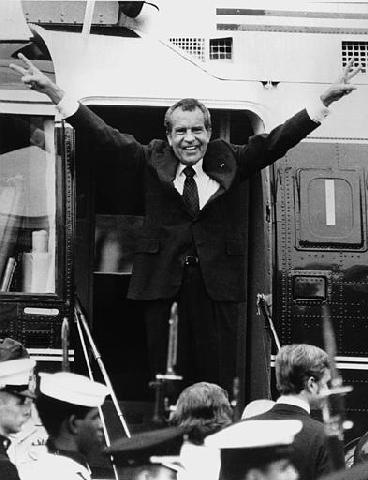
Nixon resigns, 1974

Also striking is how the  Post has acknowledged as much from time to time over the years.

Howard Kurtz, the newspaper’s media reporter, wrote in 2005, for example:

“Despite the mythology, The Post didn’t force Richard Nixon from office—there were also two special prosecutors, a determined judge, bipartisan House and Senate committees, the belated honesty of [former White House lawyer] John Dean and those infamous White House tapes.”

Nixon likely would have completed his term if not for the recordings of his conversations in the Oval Office, conversations that captured his guilty role in authorizing a coverup of the Watergate scandal.

The Senate Select Committee on Watergate–not Woodward and Bernstein–uncovered the existence of the White House tapes. The special federal prosecutors on Watergate (one of whom Nixon ordered fired) pressed for the release of the tapes. And the U.S. Supreme Court unanimously ordered Nixon to turn over the  tapes subpoenaed by the special prosecutor.

“The fact is, an incredible array of powerful actors all converged on Nixon at once—the FBI, prosecutors, congressional investigators, the judicial system,” a leading historian of Watergate, Stanley I. Kutler, has written.

Even so, the heroic-journalist myth long ago became the most familiar storyline, the dominant narrative of Watergate.
That’s partly because few Americans are familiar with the intricacies of the epic scandal, one that sent to jail nearly 20 men who were associated with Nixon’s presidency or his 1972 reelection campaign.

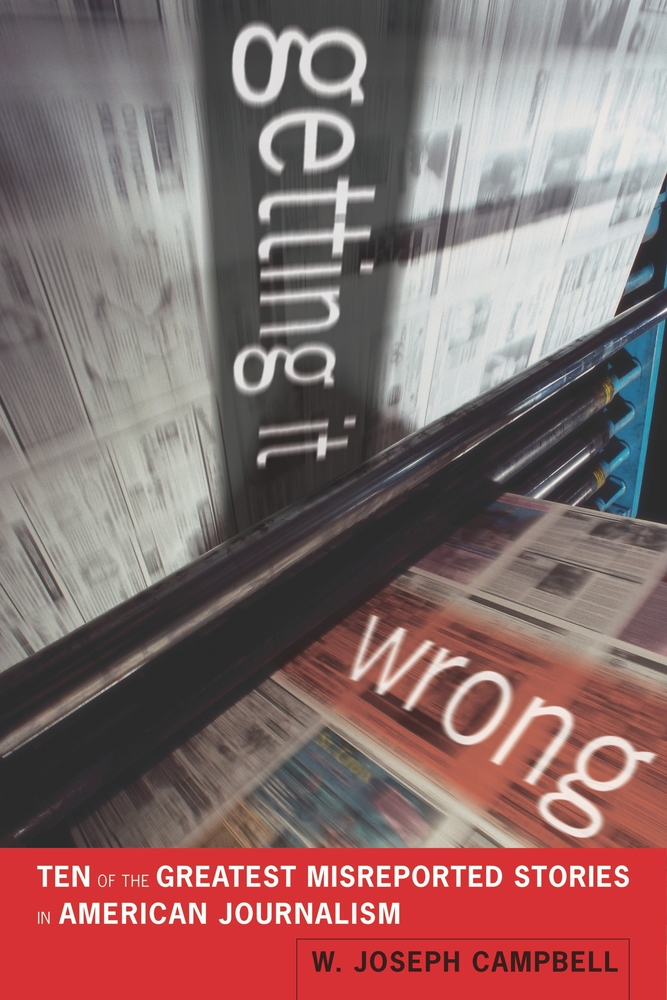
The myth of the heroic-journalist, I write in Getting It Wrong, my forthcoming book about media-driven myths, thus serves as ready short-hand “for grasping the scandal’s essence while avoiding its forbidding complexity.”

I also note in Getting It Wrong:

“How the Post and its reporters uncovered Watergate is deeply ingrained in American journalism as one of the field’s most important and self-reverential stories.”

But it is a misleading interpretation, one that minimizes the more powerful and decisive forces that unraveled the scandal and ended Nixon’s corrupt presidency in the summer of 1974.

WJC

The Watergate myth: Why debunking matters

In Debunking, Media myths, Washington Post, Watergate myth on January 27, 2010 at 8:05 am

My recent post about the heroic-journalist myth of Watergate prompted a few blinkered, ahistoric observations.

Among was this comment, posted at Romenesko‘s feedback site:

“Who cares?” the comment reads. “Watergate was in the early 1970s. …  Arguing the point now about what role a paper played almost 40 years later in a presidency that a significant number of people have no recollections of? Ya gotta admire those authors willing to tackle cutting-edge topics.”

So why does it matter? Why is addressing and debunking the heroic-journalist myth of Watergate — the notion that intrepid reporters for the Washington Post brought down Richard Nixon’s corrupt presidency — still important?

Several reasons present themselves, not the least of which is the vigor that characterizes the Watergate myth: It lives on in textbooks, in classrooms, in newsrooms. It’s a very robust myth, little-restrained in its reach and infiltration.

A hint of its reach came yesterday, in an email from former master’s student of mine, who himself now teaches journalism. He described how he approaches the Watergate story:

“I usually start the class discussion by asking the students to write a sentence that begins with ‘Watergate is the story of…’

“Inevitably, several students write something like ‘Watergate is the story of two young reporters who brought down a corrupt president.’ We then spend the rest of the class period challenging that historical narrative.”

Not only is this a great pedagogic technique; the student responses suggest how ingrained the Watergate myth has become.

A further reason debunking matters is that the Watergate myth severely misinterprets the news media’s capacity to exert decisive influence.

As I write in my forthcoming book, Getting It Wrong, media “myths are neither trivial nor innocuous. … Notably, they tend to distort understanding about the role and function of journalism in American society, conferring on the news media far more power and influence than they necessarily wield.

“Media myths often emerge from an eagerness to find influence and lasting significance in what journalists do and tend to extend credit where credit is not entirely due. The heroic-journalist myth of Watergate is a telling example.”

Indeed, the Watergate myth points unequivocally to presumed power of the news media, that they can expose corruption at the highest levels and thus make a significant and lasting difference.

As Jay Rosen, blogger and media scholar, wrote quite eloquently a few years ago, the heroic-journalist myth of Watergate stands as “the redemptive tale believers learn to tell about the press and what it can do for the American people.

“It is a story of national salvation: truth their only weapons, journalists save the day.”

What’s more, to debunk myths is to be aligned with a fundamental objective of journalism—that of seeking to get it right. The task of debunking is to insist on a demarcation between fact and fiction, and to assert there is intrinsic value in setting the record straight.

And finally, it’s not as if journalism’s past is irrelevant. It’s unevenly taught and poorly understood, a lot of it. But it’s scarcely irrelevant. Not in the digital century, when the media landscape is being so dramatically redrawn.

WJC

The Post ‘took down a president’? That’s a myth

In Debunking, Media myths, Washington Post, Watergate myth on January 24, 2010 at 6:58 pm

Nixon after his resignation, 1974

The Washington Post has tried from time to time over the years to distance itself from the media myth that its coverage of the Watergate scandal brought down Richard Nixon’s corrupt presidency.

The newspaper’s publisher at the time of Watergate, Katharine Graham, said at a program at the Newseum in 1997:

“Sometimes people accuse us of bringing down a president, which of course we didn’t do. The processes that caused [Nixon’s] resignation were constitutional.”

Michael Getler, then the newspaper’s ombudsman, wrote in a column in 2005:

“Ultimately, it was not The Post, but the FBI, a Congress acting in bipartisan fashion and the courts that brought down the Nixon administration. They saw Watergate and the attempt to cover it up as a vast abuse of power and attempted corruption of U.S. institutions.”

Still, the media myth that it was the Post — and, specifically, reporters Bob Woodward and Carl Bernstein — who exposed Nixon’s corrupt ways can be too tempting and too perfect to resist.

Such was the case in today’s edition of the Post, in a commentary by Dana Milbank, who declared that “in the mid-1970s,” the Post “took down a president.”

It was a passing reference in a commentary that challenged the dire assessment about the Post published in latest issue of New Republic.

Still, the “took down a president” passage hints at latent hubris and suggests how the Watergate meme can be used as a not-so-subtle reminder of greatness by Post loyalists and insiders.

But as I write in my forthcoming book, Getting It Wrong, to argue that the Post took down Nixon is to “misunderstand the scandal and to indulge in a particularly beguiling media-driven myth.”

It is, I further write, a misleading interpretation that “minimizes the far more decisive forces that unraveled the scandal and forced Nixon from office.”

What I call the “heroic-journalist myth of Watergate” took hold for a number of reasons, among them the sheer complexity of the scandal. Not only was Nixon turned from office but  19 men associated with his presidency or his 1972 reelection campaign went to jail.

The “heoric-journalist” myth has become, I also write in Getting It Wrong, “a proxy for grasping the scandal’s essence while avoiding its forbidding complexity.” That the Post and its reporters supposedly uncovered Watergate “is deeply ingrained in American journalism as one of the field’s most important and self-reverential stories.”

Despite, that is, the periodic protestations from the Post.

Hearty thanks to Jim Romenesko for linking to this post.

WJC

Cinema and the tenacity of media myths

In Cinematic treatments, Debunking, Murrow-McCarthy myth, Watergate myth on January 17, 2010 at 12:41 pm

What explains the tenacity of many are media-driven myths? Why are many of them so resistant to debunking?

One important factor, and one that I explore in my forthcoming book, Getting It Wrong, is high-quality cinematic treatment of popular media-centered stories.

The notion that Washington Post reporters Bob Woodward and  Carl Bernstein brought down Richard Nixon’s corrupt presidency was cemented by the 1976 motion picture, All the President’s Men. The movie was based on the reporters’ bestselling book by the same name, which appeared in June 1974, just as the Watergate scandal was nearing its dénouement with Nixon’s resignation.

The misguided, mediacentric view that Edward R. Murrow’s reporting in 1954 abruptly ended the communists-in-government witchhunt of Senator Joseph R. McCarthy is another myth that the cinema has solidified.

McCarthy in 1954 (Library of Congress)

Getting It Wrong describes how Murrow “was very late in confronting McCarthy” and how “he did so only after other journalists had challenged the senator and his tactics for months, even years.”

As I further write in Getting It Wrong, the Murrow-McCarthy myth “was sealed for another generation with the release in 2005 of Good Night, and Good Luck,” a movie that offered a dramatic version of the back story to Murrow’s See It Now program on McCarthy.

See It Now was Murrow’s weekly, news-oriented documentary program on CBS; the 30-minute show on McCarthy and his tactics aired March 9, 1954. Supposedly, it was so compelling that it stopped the demagogic senator in his tracks.

While Good Night, and Good Luck never explicitly said as much, it lent just that impression—that Murrow courageously and single-handedly ended McCarthy’s reign of terror. That’s how many critics interpreted Good Night, and Good Luck, and that view was reiterated recently in a post at the “Irish Central” online site.

The post described Good Night and Good Luck as telling “the story of ace reporter Edward Murrow who brought down the great witch hunter Joe McCarthy” and praised the movie’s director-star, George Clooney. (Clooney played the role of a slightly pudgy, ever-earnest Fred Friendly, Murrow’s producer.)

That post is an example of just how ingrained the Murrow-McCarthy myth has become — and how effectively high-quality cinematic treatments can be in hardening media myths against debunking.

The cinema is far from the only factor accounting for the tenacity of media myths.

But because movies can powerfully influence how historical events are collectively remembered, they lengthen the odds that some media-driven myths can ever be rolled back.

WJC