W. Joseph Campbell

Newspaper endorsements don’t much matter — except maybe at the margins

In 1897, Newspapers on November 5, 2012 at 6:54 am

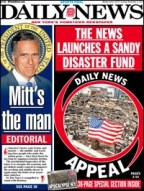
Romney endorsed by New York Daily News

It’s long been apparent that newspaper endorsements for high political office are rarely decisive.

Back in 1897, when print made up the mass media, newspapers were shocked when their endorsements had little impact on the outcome of the New York City mayoral election.

The Tammany Hall candidate, an obscure judge named Robert A. Van Wyck, won the election decisively — without giving a speech and without receiving the editorial support of the city’s leading newspapers.

Nowadays, in a world of myriad digital options, many U.S. daily newspapers are but shells of their former selves. Few of them really presume to set an agenda for their communities and their endorsements for high political office are all but irrelevant. More than a handful of newspapers no longer endorse candidates for president.

Still, it is conceivable that newspaper endorsements could make a difference in close elections in a few places in tomorrow’s presidential election. Enough readers could take cues from newspaper endorsements to tip the outcome in very tight races — as perhaps in Iowa and Florida.

It’s speculative, but not implausible.

In Iowa and Florida, prominent newspapers that endorsed Barack Obama in 2008 are backing Republican Mitt Romney this year. And the Obama-Romney race is close in both states. Polling data compiled and aggregated at RealClearPolitics indicate that Obama leads by three percentage points in Iowa and that Romney is narrowly ahead in Florida.

The largest-circulation newspaper in Iowa, the Des Moines Register, has endorsed Romney, citing his “strong record of achievement in both the private and public sectors.”

In Florida, the Orlando Sentinel and the Fort Lauderdale Sun-Sentinel have come out for Romney.

The Sentinel asserted in its editorial endorsement: “We have little confidence that Obama would be more successful managing the economy and the budget in the next four years. For that reason, though we endorsed him in 2008, we are recommending Romney in this race.”

And the Sun-Sentinel said: “When President Obama came into office in 2009, the economy was in freefall and though untested, he inspired us with his promise of hope and change. Now, four years later, we have little reason to believe he can turn things around.

“So while we endorsed Obama in 2008, we recommend voters choose Republican Mitt Romney on Nov. 6.”

That those newspapers have turned away from Obama probably matters much only to a few readers. But editorial endorsements that sway even a few readers could make a difference if the statewide race is very close.

This point was made the other day by a leading political analyst and numbers-cruncher, Michael Barone. Writing in the Washington Examiner, Barone said the Des Moines Register’s endorsement “could make a significant difference” in the outcome in Iowa.

Some indirect evidence suggests that newspaper endorsements can signal the outcomes of close races.

Greg Mitchell, formerly editor of the trade journal Editor & Publisher, noted in a recent commentary at the Nation that just before the presidential election in 2008,  he “went out on a limb and predicted which candidates would win in the thirteen key ‘toss-up’ states based purely on newspaper endorsements in those states — not polls or common sense or anything else.”

Mitchell said he “got them right, except for one.”

Based on newspaper endorsements in swing states this year, Mitchell has predicted that Obama will narrowly defeat Romney. Mitchell’s breakdown has five swing states for Obama, five for Romney, and one (Virginia) undecided, which seems more like a toss-up.

In any case, data compiled by the American Presidency Project at the University of California, Santa Barbara, show that 12 newspapers that endorsed Obama in 2008 are supporting Romney this year. They include the New York Daily News, the country’s fifth-largest newspaper, and Newsday of Long Island, the 13th largest daily.

Those endorsements aren’t likely to matter much, though, given that Obama is a sure bet to carry New York State.

WJC

Social-media triumphalism and its myth-busting limits

In Anniversaries, Debunking, Error, Media myths, Media myths and radio, War of the Worlds on October 31, 2012 at 3:50 pm

Social media’s capacity to demolish media myths soon after they emerge was impressively on display this week as megastorm Sandy swept ashore in New Jersey and disrupted life throughout the Northeast and Mid-Atlantic.

Got it notably wrong

Erroneous reports were many as the storm reached the East Coast on Monday. As the Guardian of London noted today, “the spread of such misinformation was abetted by journalists, who were once taught the importance of verifying every source.”

Notably wrong was the report on CNN’s “Piers Morgan Tonight” news program Monday that Sandy had breached the heart of American capitalism and covered the floor of the New York Stock Exchange in Manhattan with three feet of water.

But that account and a similar report on the hype-prone Weather Channel were promptly disputed, and soon repudiated, in a barrage of posts on Twitter.

In demolishing the bogus reports, Twitter demonstrated a capacity for “savage self-correction,” as John Herrman declared in a post yesterday at the BuzzFeed online site.

Herrman wrote:

“In response to thousands of retweets of erroneous Weather Channel and CNN reports that the New York Stock Exchange had been flooded with ‘three feet’ of water, Twitter users, some reporters and many not, were relentless: photos of the outside of the building, flood-free, were posted. Knowledgeable parties weighed in.”

And the misreporting soon was corrected.

Herrman hailed Twitter as “a fact-processing machine on a grand scale, propagating then destroying rumors at a neck-snapping pace. To dwell on the obnoxiousness of the noise is to miss the result: that we end up with more facts, sooner, with less ambiguity.”

His point is well-taken. On more than a few occasions, Twitter has demonstrated a striking capacity to debunk embryonic media myths — including those myths it helped set loose.

The bogus quotation attributed to the Rev. Dr. Martin Luther King after the slaying last year of terrorist leader Osama bin Laden comes to mind. The made-up passage — “I will mourn the loss of thousands of precious lives, but I will not rejoice in the death of one, not even an enemy” — circulated widely on Facebook and Twitter before their corrective forces effectively demolished it.

But limits to social-media triumphalism must be noted.  The corrective power of platforms such as Twitter reaches only so far.

Once established, media myths are exceedingly difficult to uproot. These myths have amply demonstrated that they can withstand the power of social media.

Welles and ‘War of the Worlds’

Take, for example, Halloween’s most famous media myth — the notion that Orson Welles’ War of the Worlds radio dramatization in 1938 touched off nationwide panic and mass hysteria. It’s a hoary media myth that’s just too embedded — and too delicious — to be destroyed.

No amount of Tweeting is likely to dismantle this myth, one of 10 that I debunk in my latest book, Getting It Wrong. It’s too engrained in popular culture — and in the news media — to go the way of CNN’s botched report about the flooded stock exchange floor.

The 74th anniversary of the original broadcast of The War of the Worlds was yesterday and Twitter percolated with reminders about the program and references to the panic it supposedly created. Tweets challenging the narrative of panic and hysteria were in a distinct minority.

Linked to more than a few Tweets yesterday was a tip sheet describing seven lessons that The War of the Worlds dramatization holds for social media.

The tip sheet seems more than a little convoluted, though. Among its observations was this:

“If you are lucky, the publicity often exceeds the actual event  …. The panic [of The War of the Worlds program] has become legendary, even though there is quite a bit of evidence to suggest it wasn’t nearly as widespread as reported at the time. But, it put the program on the map, and launched a relatively unknown 23-year old name[d] Orson Welles into the public eye.”

Even that’s not quite true. Although he was 23 at the time of the broadcast, Welles’ had already made the cover of Time magazine.

WJC

Recent and related:

Debates are over, media myth lives on

In Debunking, Media myths on October 28, 2012 at 12:05 pm

The runup to the three presidential debates this month inevitably was accompanied by references to the 1960 encounter between John F. Kennedy and Richard M. Nixon — and to references to the media myth distorts understanding of the historic confrontation 52 years ago.

Debates are over, myth lives on

Even days after the final debate between President Barack Obama and Republican challenger Mitt Romney, the 1960 debate myth still swirls.

The myth has it that television viewers thought Kennedy won the first debate of that campaign while radio listeners believed Nixon prevailed.

It’s a dubious bit of political lore that long ago became a defining feature of that debate. And it lives on as a reminder about how appearances supposedly trump substance in American presidential politics.

The notion of viewer-listener disagreement in the first Kennedy-Nixon debate is implausible for several reasons, including the absence of representative polling data that confirmed such a disparity.

What likely was more decisive than appearance in that debate was Nixon’s willingness to be conciliatory, to concur with Kennedy. In his opening statement, Nixon seemed to second the points raised by Kennedy, who had spoken first.

Nixon said:

“The things that Senator Kennedy has said many of us can agree with. … There is no question but that this nation cannot stand still; because we are in a deadly competition, a competition not only with the men in the Kremlin, but the men in Peking. We’re ahead in this competition, as Senator Kennedy, I think, has implied. But when you’re in a race, the only way to stay ahead is to move ahead. And I subscribe completely to the spirit that Senator Kennedy has expressed tonight, the spirit that the United States should move ahead.”

But in discussing the debate more than 50 years later, it’s far easier to reach for the myth of viewer-listener disagreement than it is to recall Nixon’s ill-advised tactics.

This was suggested in a lengthy commentary about the Obama-Romney debates, posted the other day at the online site of the liberal American Prospect political magazine.

The commentary invoked the first Kennedy-Nixon debate in stating:

“As for wishing these suckers were serious policy discussions, I can’t think of a single presidential debate that’s ever been decided on those grounds. Even in 1960, when the jousting between Kennedy and Nixon was relatively substantive, JFK triumphed purely on image, one proof being that people who only heard their confrontations on radio famously thought Nixon had cleaned his clock.”

The commentary offered no evidence to support the claim of clock-cleaning-on-the-radio.

That’s because there is no persuasive, contemporaneous evidence to that effect.

The notion of viewer-listener disagreement was demolished in a journal article published 25 years ago by scholars David L. Vancil and Sue D. Pendell.

Their article, published in Central States Speech Journal, noted that accounts of viewer-listener disagreement about the Kennedy-Nixon debate invariably were anecdotal and impressionistic — and hardly representative of the American electorate in 1960.

The polling organization Sindlinger & Co. did report that its survey respondents who listened to the debate on radio thought Nixon won, by a 2-to-1 margin.

But as  Vancil and Pendell pointed out, Sindlinger’s sample of radio listeners included just 282 respondents — of whom 178 offered an opinion about the debate winner. The numbers were far too few to permit meaningful generalizations or conclusions.

Like many media myths, the notion of listener-viewer disagreement is so delicious that it must have been true.

The New Republic hinted at such sentiment on Monday, the day of the final Obama-Romney debate, in an essay that stated: “[P]erhaps it’s safe to say that 1960 was the year we learned that looks and demeanor, as seen on TV, were just as important as speech when it came to winning over voters.”

In making the claim, the New Republic essay cited an intriguing experiment, reported in 2003, in which 171 summer students at the University of Minnesota either viewed a video of the first Kennedy-Nixon debate or listened to an audio recording of the encounter.

None of the participants had prior knowledge about the Kennedy-Nixon debate, according to the researcher, James Druckman.

He reported finding that television viewers in his experiment “were significantly more likely to believe Kennedy won the debate than audio listeners.”

This, he declared, represented “the first clear empirical evidence consistent with the widespread assertion of viewer-listener disagreement in the first Kennedy-Nixon debate.”

But in a footnote, Druckman reported that 81 percent of the viewers in his experiment thought Kennedy won; so did 60 percent of listeners.

That finding is inconsistent with the central element of alleged viewer-listener disagreement — that Kennedy won among television viewers while Nixon won among radio listeners.

What’s more, participants in Druckman’s experiment skewed Democratic: The “sample did underrepresent Republicans,” he wrote in another footnote. As such, participants may have been more readily sympathetic to Kennedy, the Democratic candidate, than to Nixon, the Republican.

Druckman also acknowledged that “younger people”  in the early 21st century may have processed “televised information differently” from viewers in 1960. To be sure, applying the experiment’s results to viewers and listeners of the presidential debate in 1960 is impossible.

WJC

Recent and related: