W. Joseph Campbell

Posts Tagged ‘1968’

Mythical ‘Cronkite Moment’ is ‘believed because it’s believable’

In Cronkite Moment, Debunking, Media myths on November 2, 2010 at 5:15 pm

Johnson and 'Cronkite Moment'

The Wall Street Journal‘s “Best of the Web” online feature yesterday invoked the mythical “Cronkite Moment” of 1968, recalling it as “the oft-told story of President Johnson lamenting, ‘If I’ve lost [Walter] Cronkite, I’ve lost Middle America.'”

Best of the Web,” which is compiled and written by James Taranto, noted that the Cronkite-Johnson anecdote “is almost certainly apocryphal, but it was widely believed because it was believable.”

It’s a telling point: The tale is believed–and is often retold–because it is believable. Like other media-driven myths, the “Cronkite Moment” resides on the cusp of plausibility.

The anecdote tells of Lyndon Johnson’s supposed reaction to Cronkite’s on-air assessment that the U.S. war effort in Vietnam was “mired in stalemate” and that negotiations might prove to be the way out. Johnson reputedly watched the program at the White House and, upon hearing Cronkite’s show-ending commentary, leaned over and switched off the television and said to an aide or aides:

“If I’ve lost Cronkite, I’ve lost Middle America.”

Or words to that effect. Versions vary markedly as to what the president supposedly said.

Cronkite’s assessment reputedly was an epiphany to the president, who after the “Cronkite Moment” altered war policy and decided against seeking reelection. In the aftermath of Cronkite’s “mired in stalemate” assessment, American public opinion also swung against the war.

Or so the story has it.

But as I write in my latest book, Getting It Wrong, Cronkite’s report, which aired on CBS on February 27, 1968, had none of those effects–principally because Johnson did not see the show program when it aired.

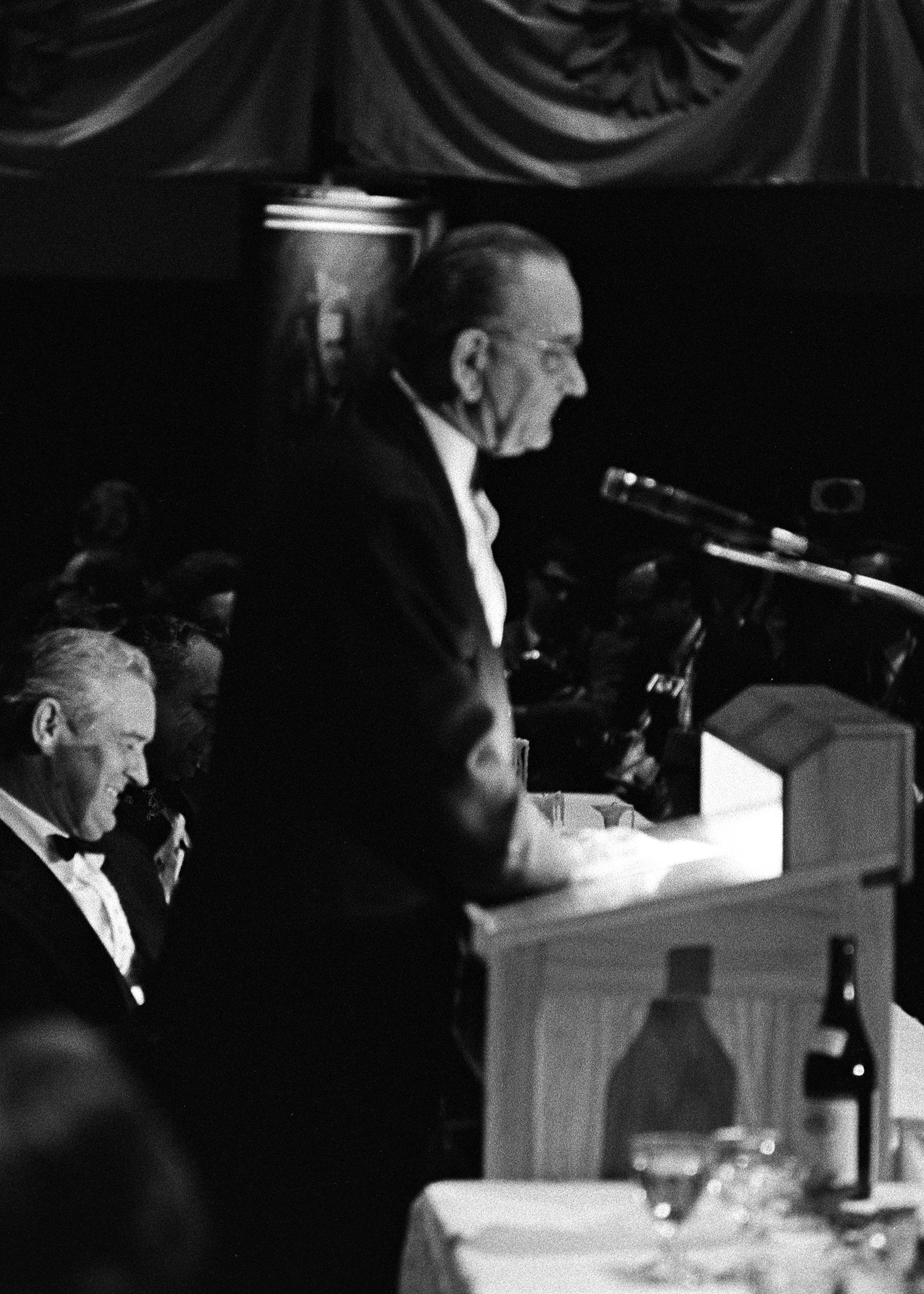
The president at the time was in Austin, Texas, attending the 51st birthday party of Governor John Connally, a longtime political ally (see photo, above).

There’s no evidence that Johnson later saw the program on videotape, or what he thought of it, if he did see it.

We do know, though, that Johnson was openly hawkish about the war in the days and weeks immediately following Cronkite’s report. As I point out in Getting It Wrong, in mid-March 1968, Johnson gave a rousing, lectern-pounding speech in which he urged a “total national effort” to win the war in Vietnam.

So Johnson was hardly throwing up his hands in despair. That he remained hawkish signals how the “Cronkite Moment” represented no epiphany for the president.

Taranto’s quite right about the anecdote’s being “believed because it was believable.” Although it’s doubtful whether Cronkite ever was “the most trusted” man in America, he was a force in American broadcast journalism in the 1960s and 1970s, a time when network television news mostly was delivered on just three or four channels.

The Cronkite-Johnson story also lives on because it is so readily grasped and easily recalled. As I write in Getting It Wrong, prominent media myths are tenacious because they are reductive–they tend to “minimize or negate complexity in historical events and offer simplistic and misleading interpretations instead.”

The Cronkite-Johnson anecdote is a simplistic tale, but it also affirms the supposed power of the news media in American life. On important issues, the anecdote says, the news media can tell truth to power. They can be vital, even courageous forces in shaping and executing policy.

But all of those powerful effects begin to dissolve when it’s pointed out that Johnson never saw Cronkite’s program in the first place.

WJC

Recent and related:

Turbulent times and the myth of ‘bra burning’

In Bra-burning, Debunking, Media myths on November 1, 2010 at 11:47 am

Bra-burning,” I note in my latest book, Getting It Wrong, has long been a “convenient shorthand for describing the upheaval of the 1960s and early 1970s” in America.

At the 'Freedom Trash Can'

The term, I write, is often “casually invoked as a defining phrase, or cliché, of those troubled times—as in ‘the era of bra-burning,’ ‘the hysteria of bra-burning,’ the time of ‘raucous bra burning,’ when there were ‘bra burnings across the land,’ [and] ‘the bra-burning days of the turbulent 1960s’….”

The Dunkirk Observer newspaper in western New York State yesterday added to that refrain, asserting in a commentary about women’s liberation:

“The 1960s and 70s witnessed some more turbulent times in this liberation movement, including bra burning and other forms of protest.”

As I discuss in Getting It Wrong–which debunks 10 prominent media-driven myths–the notion of bra-burning stems from the women’s liberation protest at Atlantic City on September 7, 1968. About 100 or so demonstrators gathered on the boardwalk there to protest the Miss America pageant as a mindless spectacle degrading to women.

Leaders of the protest have long insisted that no bras were set afire that day–or at any time as part of a women’s liberation protest. Robin Morgan, lead organizer of the Atlantic City protest, has asserted, for example:

“There were no bras burned. That’s a media myth.”

However, Getting It Wrong offers evidence that bras and other items were burned–or at least smoldered–for a short time during the protest, a centerpiece of which was a burn barrel the demonstrators called the “Freedom Trash Can” (see photo, above).

Into the burn barrel they tossed such items as bras, girdles, and high-heeled shoes, as well as copies of Playboy and Cosmopolitan magazines.

My research, as described in Getting It Wrong, found a long-overlooked contemporaneous account in the Press of Atlantic City that said bras and other items in the Freedom Trash Can were set afire that day.

That account was written by a veteran reporter named John Boucher and published September 8, 1968, beneath the headline:

Bra-burners blitz boardwalk.”

Boucher’s article, which appeared on page 4 of the Press, was separately endorsed years later by Jon Katz, who in 1968 was a young reporter for the Atlantic City newspaper. He also covered the women’s liberation protest.

“I quite clearly remember the ‘Freedom Trash Can,’ and also remember some protestors putting their bras into it along with other articles of clothing, and some [Miss America] Pageant brochures, and setting the can on fire,” Katz said in an interview with me.

“I am quite certain of this.”

Katz also said:

“I recall and remember noting at the time that the fire was small, and quickly was extinguished, and didn’t pose a credible threat to the Boardwalk.”

As I point out in Getting It Wrong, the witness accounts of Boucher and Katz offer no support for “the far more vivid and popular imagery that many bras went up in flames” in a bonfire on the Boardwalk.

At most, “bra-burning” was confined to that single occasion at Atlantic City in 1968. Even then, it was more akin to bra-smoldering than a fiery spectacle in which demonstrators twirled flaming bras over their heads.

WJC

Recent and related:

‘Getting It Wrong’ goes on ‘PJM Political’

In Cronkite Moment, Debunking, Furnish the war, Hurricane Katrina, Media myths on October 10, 2010 at 10:24 am

I had a fine interview recently with Silicon Valley blogger Ed Driscoll for the Pajamas Media radio show, PJM Political.

The interview aired yesterday on Sirus-XM radio’s POTUS channel.

Topic: My new book, Getting It Wrong, which debunks 10 prominent media-driven myths, those dubious and improbable tales about the news media that masquerade as factual.

Driscoll, who conducts a thoughtful and well-prepared interview, led me through a discussion of several myths addressed in Getting It Wrong, including the Cronkite Moment” of 1968.

That was when, supposedly, the on-air analysis of CBS anchorman Walter Cronkite prompted President Lyndon Johnson to change his thinking about the Vietnam War and led him to decide against seeking reelection.

“That’s simply not true,” I pointed out. “Lyndon Johnson didn’t even see the [Cronkite] program when it aired in February 1968. And his decision not to seek reelection was driven by other forces and factors. Cronkite really was irrelevant to that equation, to that decision.

“But yet it lives on, as an example of media power, the media telling truth to power. And it’s a misleading interpretation, it’s a misreading of history.”

Driscoll said that the chapters of Getting It Wrong “have a sort of curious” set of bookends, in that they begin with a discussion of William Randolph Hearst’s famous vow to “furnish the war” with Spain and end with a look at the exaggerated, over-the-top coverage of Hurricane Katrina’s aftermath.

“Was this sort of book-ending intentional?” Driscoll asked.

It was an insightful question–and the first time an interviewer had asked about the book’s conceptual component.

I noted that the “original framework of the book had it organized more thematically, by ‘media and war’ and ‘media and government,'” and so on.

That framework was discarded, I said, “for a more chronological approach. So the bookends were driven more by chronology than anything else.”

We discussed how Orson Welles‘ cinematic masterpiece, Citizen Kane, helped cement the “furnish the war” myth in the public’s consciousness. Kane includes a scene that paraphrases Hearst’s purported vow.

The “furnish-the-war” anecdote about Hearst is dubious in many respects, I said, adding:

“Yet it lives on as an example of Hearst as the war-monger, as an example of the media–at its most malignant, in an extreme–can bring about a war that the country otherwise wouldn’t have fought.”

I mentioned how media-driven myths can be thought of as the “junk food of journalism,” which prompted Driscoll to ask:

What’s wrong with the American people being fed a little junk food? What’s wrong with being fed a few media myths?

There are several reasons, I replied.

Notably, “these myths tend to misrepresent the role of the news media in American society. They tend to grant the news media far more power and far more influence than they really do exert in American life.”

I added:

“Most people believe the media are powerful agents and powerful entities and often refer to some of the myths that I address, and debunk, in Getting It Wrong. They refer to them in support of this mistaken notion.”

In wrapping up the interview, Driscoll referred to Media Myth Alert as “a nifty blog.”

It was a generous plug that was much appreciated.

WJC

Recent and related:

Encore: Sighting the mythical ‘Cronkite Moment’

In Cronkite Moment, Debunking, Media myths, New York Times on September 23, 2010 at 5:43 am

Cronkite in Vietnam

Sighting the “Cronkite Moment” is fairly easy game.

After all, few media-driven myths are invoked as routinely or as matter-of-factly as the legendary occasion when CBS anchorman Walter Cronkite altered U.S. policy with his downbeat, on-air assessment of the war in Vietnam.

The “Cronkite Moment” stems from a special report that aired February 27, 1968. At the end of the half-hour show, Cronkite intoned that the U.S. war effort was “mired in stalemate” and suggested that negotiations might eventually offer a way out for American forces.

The myth–which is debunked in my new book, Getting It Wrong–lies in the purported reaction to Cronkite’s assessment.

At the White House, President Lyndon Johnson supposedly watched the program and, upon hearing the anchorman’s closing remarks, reached over and snapped off the television set, declaring:

“If I’ve lost Cronkite, I’ve lost Middle America.”

Or words to that effect: Versions vary as to what the president purportedly said.

“If I’ve lost Cronkite, I’ve lost Middle America” was the version invoked the other day in a commentary posted at the Daily Caller online site, in a recent sighting of the myth.

The commentary–which discussed former Secretary of State Colin Powell’s recent criticism of President Barack Obama–opened by invoking the “Cronkite Moment,” stating:

“‘If I’ve lost Walter Cronkite, I’ve lost Middle America,’ said President Lyndon B. Johnson at the time of the Communist Tet Offensive in Vietnam in 1968. Walter Cronkite was then the CBS News anchor man, often described as ‘the most trusted man in America.’ Just a few weeks after he said that, LBJ withdrew from his party’s nomination contest.”
But as I note in Getting It Wrong, Johnson did not see the Cronkite program when it aired. Nor was the president at the White House.

He was in Austin, Texas, on the campus of the University of Texas, attending the 51st birthday party of a longtime political ally, Governor John Connally.

About the time Cronkite offered his “mired in stalemate” assessment, Johnson was joking about Connally’s age, saying:

“Today you are 51, John. That is the magic number that every man of politics prays for—a simple majority.”

It wasn’t the most humorous joke ever told by a president. But Johnson clearly wasn’t throwing his hands up in despair about his failed war policy.

He wasn’t lamenting “If I’ve lost Cronkite….”

There is, moreover, no evidence that Johnson later saw the Cronkite program on videotape.

“The power of the ‘Cronkite moment,'” I write in Getting It Wrong, “resides in the sudden, unexpected, and decisive effect it supposedly had on the president:  Such an effect would have been absent, or greatly diminished, had Johnson seen the program on videotape at some later date.”

But even if Johnson later heard—or heard about— Cronkite’s assessment, it represented no epiphany for him.

Not long after the program, Johnson gave a rousing, lectern-pounding speech in which he urged a “total national effort” to win the war in Vietnam. So in the days and even weeks immediately after the Cronkite program, Johnson remained publicly hawkish on the war.

What’s more, Cronkite’s assessment about the U.S. predicament in Vietnam was scarcely original or exceptional in early 1968.

Jack Gould, the New York Times’ television critic, noted in a review of the Cronkite’s program that the anchorman’s assessment “did not contain striking revelations” but served instead “to underscore afresh the limitless difficulties lying ahead and the mounting problems attending United States involvement.”

It’s revealing to note that nearly seven months before the “Cronkite Moment,” the New York Times published on its front page as analysis that said victory in Vietnam “is not close at hand. It may be beyond reach.” The Times analysis was published in August 1967 beneath the headline:

Vietnam: The Signs of Stalemate.”

As for Johnson’s announcing he would not seek reelection, Cronkite’s program was a non-factor in that decision.

Johnson’s announcement came at the end of March 1968, a month after Cronkite’s program–and a couple of weeks after the president’s poor showing as a write-in candidate in the Democratic primary in New Hampshire.

What’s more, there’s strong evidence that Johnson never intended to seek reelection, that he had privately decided in 1967, or even not sooner, against another campaign for the presidency.

<!–[if !mso]> The power of the “Cronkite moment” resides in the sudden, unexpected, and decisive effect it supposedly had on the president:[i] Such an effect would have been absent, or greatly diminished, had Johnson had seen the program on videotape at some later date


[i] See, for example, Jeffrey Lord, who wrote at the American Spectator’s online site: “The effect was almost immediate. In the White House, the President of the United States looked grimly at his television and in a remark that would become famous said, ‘If I’ve lost Cronkite, I’ve lost middle America.’” Lord, “The Limbaugh-Hannity Administration,” American Spectator (3 February 2009), posted at: http://spectator.org/archives/2009/02/03/the-limbaugh-hannity-administr.

New book on Tet invokes mythical ‘Cronkite Moment’

In Cronkite Moment, Debunking, Media myths on September 15, 2010 at 7:06 am

Cronkite in Vietnam, 1968

A provocative new book on the 1968 Tet offensive, titled This Time We Win, devotes a chapter to “The Walter Cronkite Moment,” that mythical occasion when the CBS anchorman’s on-air assessment that the war in Vietnam was “mired in stalemate” supposedly had decisive effect on the U.S. president.

The “Cronkite Moment” also is a chapter in my latest book, Getting It Wrong, which debunks 10 prominent media-driven myths–those dubious and improbable tales about the news media that masquerade as factual.

I note in Getting It Wrong that the “Cronkite Moment,” under scrutiny, “dissolves as illusory—a chimera, a media-driven myth.”

This Time We Win is the work of James S. Robbins, an editorial writer on defense issues for the Washington Times. Robbins doesn’t exactly embrace the “Cronkite Moment,” but offers it instead with qualification, writing:

“It is said that after watching Cronkite’s documentary President [Lyndon] Johnson said to his aides, ‘If I’ve lost Cronkite, I’ve lost Middle America.’ Five weeks later Johnson decided not to run for reelection based on this belief. So the legend goes. This is the Holy Grail for a reporter, that a documentary, newscast, article, picture, or other product shapes history on a grand scale.”

Robbins further writes:

“But did Johnson lose Middle America? Did sensationalistic or misleading press coverage turn the country against the President and against the war?”

His answer: “In a word, no.”

He’s quite right about that.

But Robbins might well have asked a more direct, searching, and relevant question:

“Was there really a ‘Cronkite Moment’ at all?”

The answer is, in a word, no. The anecdote’s pivotal, defining, and most delicious element is in error.

Cronkite certainly did take to the air on February 27, 1968, in a special report about Vietnam, where U.S. forces and South Vietnamese allies had repelled a broad offensive that the North Vietnamese and the Viet Cong launched a month before, at the Tet lunar new year.

Cronkite closed his report that night with an editorial comment that said the U.S. war effort was “mired in stalemate.” He suggested that a negotiated settlement might eventually be the way out.

Central to the anecdote’s power and enduring appeal is that Johnson, at the White House, was watching the program and, upon hearing Cronkite’s assessment, snapped off the television set and muttered to an aide or aides:

“If I’ve lost Cronkite, I’ve lost Middle America.”

It supposedly was an epiphany for the president, a burst of clarity and insight about an unwinnable war.

But as I write in Getting It Wrong, “Scrutiny of the evidence associated with the program reveals that Johnson did not have—could not have had—the abrupt yet resigned reaction that so often has been attributed to him.”

Johnson was not at the White House that night.

He wasn’t in front of a television set, either.

Johnson then was in Austin, Texas, at the 51st birthday party of Governor John Connally, one of his political allies.

About the time Cronkite declared the war “mired in stalemate,” Johnson was offering light-hearted banter, saying: “Today you are 51, John. That is the magic number that every man of politics prays for—a simple majority.”

Johnson’s memoir, The Vantage Point, is silent about the Cronkite program, offering no clue about whether the president ever saw it on videotape or, if he did, what he thought of it.

And as I note in Getting It Wrong, “The power of the ‘Cronkite moment’ resides in the sudden, unexpected, and decisive effect it supposedly had on the president.

“Such an effect would have been absent, or greatly diminished, had Johnson seen the program on videotape at some later date.”

Moreover, in the days and weeks immediately following Cronkite’s pessimistic assessment, Johnson remained outwardly hawkish about the war.

On March 18, 1968, for example, he delivered a rousing speech in Minneapolis in which he urged “a total national effort” to win the war in Vietnam. The president also declared:

“We love nothing more than peace, but we hate nothing worse than surrender and cowardice.”

He criticized critics as wanting the United States to “tuck our tail and violate our commitments” to South Vietnamese allies.

Johnson’s aggressive remarks are difficult to square with his supposedly downcast, self-pitying reaction to Cronkite’s assessment about Vietnam.

That the “Cronkite Moment” turns out to be a media myth is not so surprising, I write in Getting It Wrong.

“Seldom, if ever, do the news media exert truly decisive influences in decisions to go to war or to seek negotiated peace,” I note. “Such decisions typically are driven by forces and factors well beyond the news media’s ability to shape, alter, or significantly influence.”

So it was in Vietnam.

WJC

Related:

‘Cronkite Moment’ makes ‘Best of the Web’

In Cronkite Moment, Debunking, Media myths on September 11, 2010 at 8:41 am

The lead item yesterday of the Wall Street Journal‘s online “Best of the Web” roundup invoked the legendary “Cronkite Moment,” one of American journalism’s hardiest and best-known media-driven myths.

Cronkite in Vietnam, 1968

Only “Best of the Web” presented the anecdote as if it were factual, stating:

“‘If I’ve lost Cronkite,’ Lyndon B. Johnson is said to have lamented in 1968, ‘I’ve lost Middle America.'”

The passage set up an observation about President Barack Obama’s declining popularity:

“Obama has been losing Middle America, slowly but steadily, almost since the day he took office, in large part because he has taken his cues from a community of notions whose attitude toward Middle America ranges from indulgent condescension to outright hostility.”

Obama’s fallen popularity is of but passing and academic interest to Media Myth Alert. Far more intriguing is this latest affirmation of the casual yet confident use of the “Cronkite Moment.”

Its appearance in “Best of the Web” was the latest in a spate of recent sitings of the “Cronkite Moment.”

In the past few weeks, Al Neuharth, founder of USA Today; Cal Thomas, a conservative syndicated columnist, and  David Zurawik, veteran television writer for the Baltimore Sun, all have invoked the anecdote in commentaries as if it were true.

Such frequent use signals not only the irresistible allure of the “Cronkite Moment,” it suggests the anecdote’s appeal across the political spectrum. Neuharth, for example, typically writes from the left; Thomas and “Best of the Web” offer analyses from the right.

I examine the “Cronkite Moment” in my new book, Getting It Wrong, which addresses and debunks 10 prominent media-driven myths–apocryphal or improbable tales about the news media that masquerade as factual.

The “Cronkite Moment” refers to the special report about the Vietnam War that was presented by CBS anchorman Walter Cronkite and aired February 27, 1968.

Near the end of his report, Cronkite asserted that the U.S. war effort was “mired in stalemate” and suggested negotiations might offer a “rational” way out of Vietnam.

Supposedly, President Lyndon Johnson watched the Cronkite program at the White House and, upon hearing the anchorman’s assessment, experienced the flash of insight that his war policy had hit the rocks.

“If I’ve lost Cronkite,” Johnson reputedly said, “I’ve lost Middle America.”

As I point out in Getting It Wrong, accounts vary markedly as to what Johnson supposedly said in reacting to Cronkite’s commentary.

Some accounts have the president saying: “I’ve lost Cronkite, I’ve lost the country.”

Or: “If I’ve lost Cronkite, I’ve lost the American people.”

Or: “If I’ve lost Cronkite, I’ve lost the war.”

Or: “If we lose Cronkite, we lose America.”

Most common is: “If I lost Cronkite, I’ve lost Middle America,” the version used by “Best of the Web.”

But version variability of such magnitude, I write in Getting It Wrong, signals implausibility.

It’s a marker of a media-driven myth.

Moreover, Johnson was not at the White House the night Cronkite’s special report aired. Nor was the president in front of a television set.

He was on the campus of the University of Texas at Austin, attending the 51st birthday party of Governor John Connally, a long-time political ally.

As I note in Getting It Wrong, at about the time Cronkite offered his “mired in stalemate” editorial comment, Johnson was engaging in mildly humorous banter about Connally’s age.

“Today you are 51, John,” he said. “That is the magic number that every man of politics prays for—a simple majority. Throughout the years we have worked long and hard—and I might say late—trying to maintain it, too.”

Even if Johnson saw the Cronkite program later, on videotape, the president “gave no indication of having taken the anchorman’s message to heart,” I write in Getting It Wrong, noting:

“Just three days after the [Cronkite] program aired, Johnson vowed in remarks at a testimonial dinner in Texas that the United States would ‘not cut and run’ from Vietnam. ‘We’re not going to be Quislings,’ the president said, invoking the surname of a Norwegian politician who helped the Nazis take over his country. ‘And we’re not going to be appeasers….’”

So even if he later heard, or heard about, Cronkite’s assessment about Vietnam, it represented no epiphany for Johnson, no stunning revelation about policy gone awry.

Interestingly, the legend of the “Cronkite Moment” began to take hold and gain circulation several years after Johnson’s death in 1973. It was in 1968 neither an instant sensation nor a stunning assessment. “Mired in stalemate” was hardly a novel interpretation at the time.

Indeed, the New York Times had used “stalemate” in a front-page assessment of the war effort in early August 1967, nearly seven months before the “Cronkite Moment.”

WJC

Related:

Loving the ‘Cronkite Moment,’ and indulging in a media myth

In Cronkite Moment, Debunking, Media myths on September 10, 2010 at 10:52 am

The mythical “Cronkite Moment” of 1968–when CBS anchorman Walter Cronkite offered a supposedly withering assessment of the war in Vietnam–is cherished in American journalism.

Johnson and the 'Cronkite Moment'

The occasion supposedly was so exceptional and so memorably potent that it merits special reverence: The “Cronkite Moment.”

It’s not surprising that reverential bows are frequently made to the “Cronkite Moment.”

Such was the case just yesterday. Separate commentaries–one at a TV blog sponsored by the Baltimore Sun and the other in a column at MarketWatch–invoked the moment when Cronkite’s telling insight supposedly altered U.S. war policy.

But as I discuss in my new book, Getting It Wrong, the “Cronkite Moment” is an anecdote of two components–one part true, the other part false.

It’s true that Cronkite took to the air on February 27, 1968, in a special report about the war in Vietnam, where U.S. forces and South Vietnamese allies had just repelled a broad and surprising offensive by the North Vietnamese and the Viet Cong.

Cronkite closed his report that night by declaring the U.S. war effort was “mired in stalemate” and suggested a negotiated settlement might eventually be the way out.

At the White House, President Lyndon Johnson is said to have watched the Cronkite show and, upon hearing the anchorman’s closing “mired in stalemate” comment, snapped off the television set and muttered to an aide or aides:

“If I’ve lost Cronkite, I’ve lost Middle America.”

That’s the not-true component.

As I point out in Getting It Wrong, Johnson wasn’t at the White House that night. He wasn’t in front of a television set, either.

Johnson was in Austin, Texas, offering light-hearted comments at the 51st birthday party of Governor John Connally, one of his political allies.

About the time Cronkite was intoning “mired in stalemate,” Johnson was saying in jest: “Today you are 51, John. That is the magic number that every man of politics prays for—a simple majority.”

Johnson’s memoir, The Vantage Point, is silent about the Cronkite program, offering no clue about whether the president ever saw it or, if he did, what he thought of it. Indeed, there is no evidence that Johnson later saw the Cronkite program on videotape.

And as I note in Getting It Wrong, “The power of the ‘Cronkite moment’ resides in the sudden, unexpected, and decisive effect it supposedly had on the president.

“Such an effect would have been absent, or greatly diminished, had Johnson had seen the program on videotape at some later date.”

For many reasons, then, the “Cronkite Moment” is a dubious anecdote, a media-driven myth.

But that hasn’t much diminished its appeal.

As is the case with many media-driven myths, the “Cronkite Moment” is too delicious, too seemingly perfect to resist. It finds application in a striking variety of ways.

Take, for example, yesterday’s post at the Baltimore Sun-sponsored blog, “Z on TV.”

The writer, David Zurawik, invoked the “Cronkite Moment” in discussing the Fox News announcement that it would not to cover the Quran-burning spectacle proposed by the once-obscure Rev. Terry Jones in Gainesville, Florida. And Zurawik wondered whether the Fox decision was a reason Jones said yesterday he was canceling the planned Quran-burning.

“I am only half kidding,” Zurawik wrote, “when I reference Lyndon Johnson’s lament in 1968 after he watched CBS anchorman Walter Cronkite criticize the American war effort in Vietnam: ‘That’s it. If I’ve lost Cronkite, I’ve lost Middle America.’

“I wonder if Pastor Jones was thinking, ‘Without Fox News there to cover it, what’s the point?’ Or, ‘If I lost Fox News …'”

The column posted yesterday MarketWatch.com also signaled the hardy versatility of the “Cronkite Moment.”

The author, Andrew Leckey, discussed Chinese sensitivity to criticism in the U.S. news media. And he referred to a question once  posed to him “by the Chinese host on a special talk show” that focused on Cronkite.

The question, Leckey wrote, was why was there no journalist of Cronkite’s stature in the United States who was able to draw to an end the war in Iraq as Cronkite did in Vietnam?

Leckey didn’t say how he replied.

The best and accurate answer would have been that Cronkite did not bring about an end to the war in Vietnam. The last U.S. combat troops left Vietnam in 1973–nearly five years after the purported “Cronkite Moment.”

As I note in Getting It Wrong, the “Cronkite Moment,” under scrutiny “dissolves as illusory—a chimera, a media-driven myth.

“That it does is not so surprising. Seldom, if ever, do the news media exert truly decisive influences in decisions to go to war or to seek negotiated peace.”

WJC

Related:

The editor and the protest: Bra-burning’s intriguing sidebar

In Anniversaries, Bra-burning, Debunking, Media myths, New York Times, Newspapers on September 8, 2010 at 7:27 am

The women’s liberation demonstration at Atlantic City in 1968–the event that gave rise to the legend of bra-burning–had a little-known sidebar that featured Charlotte Curtis, a prominent and pathbreaking editor for the New York Times.

Curtis, according to the Press of Atlantic City, was to have been a judge at the Miss America Pageant but backed out to cover the women’s liberation protest that took place September 7, 1968.

Curtis biography

The protest was on the boardwalk, near the Convention Center, where Miss America was crowned. The women’s liberation demonstrators denounced the pageant as a mindless spectacle demeaning to women.

And they carried placards bearing such slogans as:

“Up Against the Wall, Miss America,” “Miss America Sells It,” and “Miss America Goes Down.”

How the protest on the boardwalk gave rise to the “nuanced myth” of bra-burning–or bra-smoldering–is discussed in my new book, Getting It Wrong, which debunks 10 prominent media-driven myths.

The protest’s principal organizer, Robin Morgan, later discussed Curtis’ participatory role in covering the event–and described Curtis’ eagerness not to alert Times editors about how she helped demonstrators who had been arrested.

In her 2001 memoir, Saturday’s Child, Morgan recalled that Curtis rode with the demonstrators by bus from New York to Atlantic City.

Curtis, then the Times women’s editor, was “elegantly dressed in black (gloves, pearls, and heels) amid our colorful informality, gamely warbling ‘We Shall Overcome’ with us as we bounced along in the rattletrap buses.

“She stayed all day on the hot boardwalk with us, brought us cool drinks, laughed and applauded when we would recognize and respond to women journalists only,” Morgan wrote.

(The women’s liberation demonstrators would not speak to male reporters covering the event. Morgan later wrote that the protest’s “most enduring contribution” may have been the decision “to recognize only newswomen.”)

That night, a handful of demonstrators attended the Miss America pageant, briefly disrupted the event, and were arrested.

Morgan recalled how she went “from precinct to precinct in search of where our friends were being held. Finally, at 3 a.m., I learned they’d been released hours earlier on cash bail put up personally by ‘some older woman’ named Charlotte Curtis.

“When I phoned the next day to thank her, she asked me to keep it quiet, as ‘these dreary grey guys running the Times’ would not be amused.”

Her request “to keep it quiet” may well have been because Curtis had not only taken a role in the demonstration, but had written about it, too.

Her article for the Times appeared 42 years ago today and quoted Morgan as saying, “We told [the Atlantic City mayor] we wouldn’t do anything dangerous—just a symbolic bra-burning.”

Morgan has long insisted that the demonstrators set nothing afire that day. But her ambiguous comment to Curtis about “a symbolic bra-burning” no doubt helped propel the notion that bras were burned in a public spectacle on the boardwalk.

Curtis then was 39-years-old and well on her way to a memorable career. In all, she spent 25 years at the Times, including a stint as associate editor in charge of the daily op-ed page of opinion.

At her death in 1987, the Times eulogized Curtis as a “strong-willed, indefatigable Vassar graduate with an incisive wit.”

The anecdote about her role at the 1968 women’s liberation protest went unreported until 1999, when the Times published a letter by Morgan, who wrote to take issue with a characterization that Curtis had been “scornful of the feminist movement.”

“Actually, for a woman of her generation and prominence,” Morgan wrote in the letter to the Times, “Curtis was unusually supportive of women and feminist ideas and actions.”

Morgan proceeded to relate the anecdote about Curtis at the 1968 protest at Atlantic City.

“Charlotte Curtis had a style all her own,” Morgan wrote. “She was a lady. And she was a feminist. In her, this was no contradiction.”

WJC

Related:

Bra-burning: The morphing of a media myth

In Anniversaries, Bra-burning, Debunking, Media myths on September 7, 2010 at 9:01 am

Today is the 42d anniversary of the women’s liberation protest at Atlantic City, the event that gave rise to what I call the “nuanced myth” of bra-burning.

Atlantic City, September 7, 1968


Or “bra-smoldering.”

As I discuss in my new book, Getting It Wrong, “bra-burning” is a media myth that has morphed and taken on fresh significance in the years since 1968. “Bra-burning” the epithet has lost some of its sting.

The legend of bra-burning began to take hold in the days and weeks following the women’s liberation protest September 7, 1968, on the Atlantic City boardwalk.

Some 100 demonstrators gathered there, as one participant put it, “to protest the degrading image of women perpetuated by the Miss America pageant,” which took place that night inside the city’s Convention Center.

A centerpiece of the protest was the so-called “Freedom Trash Can” into which demonstrators placed such “instruments of torture” as brassieres, girdles, and high-heeled shoes.

Organizers of the protest have long insisted that nothing was burned during the demonstration.

But my research, as described in Getting It Wrong, found a long-overlooked contemporaneous account in the Press of Atlantic City that said bras and other items in the Freedom Trash Can were set afire that day.

Boucher (1949 photo)


That account was written by a veteran reporter named John Boucher and published September 8, 1968. The account was separately endorsed years later by Jon Katz, who in 1968 was a young reporter for the Press and who covered the women’s liberation demonstration.

“I quite clearly remember the ‘Freedom Trash Can,’ and also remember some protestors putting their bras into it along with other articles of clothing, and some Pageant brochures, and setting the can on fire,” Katz said in an interview with me in 2007. “I am quite certain of this.”

However, the witness accounts of Boucher and Katz don’t lend support to “the far more vivid and popular imagery that many bras went up in flames” in a fiery spectacle that September day, I write.

The legend of bra-burning has endured more than 40 years and, as media scholar Thomas Lieb has pointed out, it seems certain to survive the Baby Boomer generation that propelled it into the public domain.

For many years after 1968, “bra-burning” was a term of scorn and derision, a handy way to dismiss the feminist movement and its goals of gender equality.

As I write in Getting It Wrong:

“Invoking ‘bra-burning’ was a convenient means of brushing aside the issues and challenges raised by women’s liberation and discrediting the fledgling movement as shallow and without serious grievance.”

But as I further write in Getting It Wrong,  the term in recent years slowly “has become associated with female empowerment—a metaphor for assertiveness, audacity, and dedication to women’s rights.”

A recent example appeared in the Guardian of London, which referred to bra-burning as a “brilliant … piece of political theatre.”

Another and more puzzling example of bra-burning’s changing significance took place in February 2008 on the Tyra Banks afternoon television show.

I note in Getting It Wrong how “Banks took members of her studio audience into the chill of a winter’s afternoon in New York for a made-for-television stunt about what women could do with ill-fitting brassieres.

“Banks wore an unzipped gray sweatshirt that revealed a powder-blue sports bra. Most of the other women were clad above the waist only in brassieres. They clutched other bras as they stood before a burn barrel from which flames leapt hungrily. On Banks’ word, the women tossed the bras in their hands into the fire.”

More substantively, it is not that unusual to hear female college students these days describe bra-burning as a powerful metaphor for boldness and cheek.

“For many of them,” I write in Getting It Wrong, “‘bra-burning’ has few negative associations. They find little reason to cringe at the epithet.

“Rather, they view ‘bra-burning’ as bold symbolism that connotes a refusal to conform to standards and expectations set by others— sentiments that certainly echo the views of the women who tossed undergarments into the Freedom Trash Can” 42 years ago today.

WJC

Related:

Remembering bra-burning–er, make that bra-smoldering

In Anniversaries, Bra-burning, Debunking, Media myths, Newspapers on September 6, 2010 at 7:20 am

The legend of “bra-burning” emerged 42 years ago this week in the aftermath of a women’s liberation demonstration on the boardwalk at Atlantic City.

Atlantic City, September 7, 1968

As I discuss in Getting It Wrong, my new book debunking prominent media-driven myths, bra-burning is a “nuanced myth.”

Getting It Wrong offers evidence that bras and other items were burned–or at least smoldered–for a short time during the protest September 7, 1968, which was called to denounce the Miss America pageant at Atlantic City as a mindless spectacle that demeaned women.

The demonstration’s organizers have long insisted that nothing was set afire at the Atlantic City protest, which, as scholars such as  Thomas Lieb have noted, is regarded as decisive in the emergence of the women’s movement of the late 20th century.

Feminists have long claimed that “bra-burning” was an injurious turn of phrase, intended to denigrate the women’s movement and belittle its objectives of gender equality.

A centerpiece of the women’s liberation protest at Atlantic City was the so-called “Freedom Trash Can” (see photo, above), into which demonstrators placed what they called “instruments of torture,” such as brassieres, girdles, and high-heeled shoes, as well as copies of Playboy and Cosmopolitan magazines.

My research, as described in Getting It Wrong, found a long-overlooked contemporaneous account in the Press of Atlantic City that said bras and other items in the Freedom Trash Can were set afire that day.

That account was written by a veteran reporter named John Boucher and published September 8, 1968, beneath the headline:

Bra-burners blitz boardwalk.”

That account, which appeared on page 4, was separately endorsed years later by Jon Katz, who in 1968 was a young reporter for the Press. He also covered the women’s liberation protest.

“I quite clearly remember the ‘Freedom Trash Can,’ and also remember some protestors putting their bras into it along with other articles of clothing, and some Pageant brochures, and setting the can on fire,” Katz said in an interview with me while I was researching Getting It Wrong.

“I am quite certain of this.”

Katz also told me:

“I recall and remember noting at the time that the fire was small, and quickly was extinguished, and didn’t pose a credible threat to the Boardwalk.”

As I point out in Getting It Wrong, the witness accounts of Boucher and Katz “lend no support to the far more vivid and popular imagery that many bras went up in flames” in a fiery spectacle that September day.

Their accounts, I write, don’t corroborate the “widely held image of angry feminists demonstratively setting fire to their bras and tossing the flaming undergarments into a spectacular bonfire.”

Such imagery can be traced to imaginative and sardonic newspaper columns published shortly after the Miss America protest.

Harriet Van Horne, writing in the New York Post a few days after the demonstration, declared:

“My feeling about the liberation ladies is that they’ve been scarred by consorting with the wrong men. Men who do not understand the way to a woman’s heart, i.e., to make her feel utterly feminine, desirable and almost too delicate for this hard world. … No wonder she goes to Atlantic City and burns her bra.”

Van Horne, who was not at the protest, also wrote that the highlight of the demonstration “was a bonfire in a Freedom Trash Can. With screams of delight they consigned to the flames such shackling, demeaning items as girdles, bras, high-heeled slippers, hair curlers and false eyelashes.” (Emphasis added.)

The widely read humor columnist, Art Buchwald, took up the riff a few days later, writing in his nationally syndicated column that he had been “flabbergasted to read that about 100 women had picketed the Miss America pageant in Atlantic City against ‘ludicrous beauty standards that had enslaved’ the American woman.”

Buchwald added: “The final and most tragic part of the protest took place when several of the women publicly burned their brassieres.”

The columns by Van Horne and Buchwald introduced to national audiences the notion that bra-burning was flamboyant at Atlantic City. The columns conjured, I write in Getting It Wrong, “a powerful mental image of angry women setting fire to bras and twirling them, defiantly, for all on the boardwalk to see.”

Didn’t happen.

At most, bras smoldered in the Freedom Trash Can.

So what’s the significance of the Boucher and Katz accounts, as described in Getting It Wrong?

At very least, I write, they “offer fresh dimension to the bra-burning legend.

“They represent two witness accounts that bras and other items were burned, or at least smoldered, in the Freedom Trash Can. There is now evidence that bras and other items were set afire, if briefly, at the 1968 Miss America protest in Atlantic City.”

It’s evidence that cannot be taken lightly, dismissed, or ignored, as it signals that the narrative about bra-burning needs to be modified.

WJC

Related: