W. Joseph Campbell

Posts Tagged ‘Furnish the war’

A media myth tamed — or at least controlled

In Cronkite Moment, Debunking, Furnish the war, Media myths on January 3, 2010 at 4:58 pm

Many media-driven myths seem to defy debunking.

The tale of William Randolph Hearst’s supposed vow to “furnish the war” with Spain is a telling example. So is the notion that Walter Cronkite’s downbeat report in 1968 about the U.S. military effort in Vietnam forced President Lyndon Johnson to rethink American war policy.

Both media myths live on and on.

As I write in my forthcoming book Getting It Wrong, these “and other media myths endure, because in part they are reductive: They offer unambiguous, easily remembered explanations about complex historic events. Similarly, media myths invite indulgence in the ‘golden age fallacy,’ the flawed but enticing belief that there really was a time when journalism and its practitioners were respected and inspiring.”

While many media myths are indeed tenacious, the efforts of the Annenberg Public Policy Center over the past 10 years suggest that some myths can be curbed or contained, if not defeated entirely.

The Phildelphia-based Annenberg Center has worked to debunk the notion that suicides rise during the year-end holidays.

Such a connection may seem logical, given the stresses of the holiday season. But the data point otherwise: Suicides most often peak in the United States during the spring and fall, according to the Centers for Disease Control and Prevention.

(See the CDCP’sl 2009 data sheet on suicides here.)

The Annenberg Center tracks newspaper reports for mentions of a holiday season-suicide link. Its analysis of reporting during the 2008–09 holiday season found that 37.5 percent of 64 newspaper articles asserted such a linkage. A majority, 62.5 percent, disputed or challenged the presumed holiday season-suicide connection.

The difference over 10 years is quite dramatic. In 1999–2000, the first year of the Annenberg Center’s study on the topic, 77 percent of 101 newspapers articles asserted a holiday season-suicide link.

The pattern has been a bit erratic in the intervening years, Annenberg Center data show.

In 2006–07, for example, just 9 percent of 32 articles asserted a holiday season-suicide link. The following season, however, 51 percent of 43 articles claimed there was such a connection.

Data for the 2009–2010 season are still being compiled. But a quick check of the LexisNexis database suggests that newspaper articles published in late 2009 more often challenged than claimed a holiday season-suicide link.

A notable example was an article in USA Today in late November which noted:

“You could blame George Bailey” for the myth. “In the 1946 holiday film It’s a Wonderful Life, that fictional character contemplated suicide on Christmas Eve, possibly giving birth to the idea that suicides climb during the winter holidays.”

The Washington Times suggested a similar explanation in an article published two days before Christmas.

Like many media-driven myths, the dubious holiday season-suicide link is neither harmless nor trivial.

The Annenberg Center says:

“Perpetuating the myth not only misinforms readers but it also misses an opportunity to educate the public about the most likely sources of suicide risk, including major depression and substance abuse.”

Still, the Center’s data offer a measure of encouragement that media-driven myths are not entirely beyond taming.
WJC

‘Furnish the war,’ en espagnol

In 1897, Debunking, Furnish the war, Spanish-American War on December 30, 2009 at 11:54 am

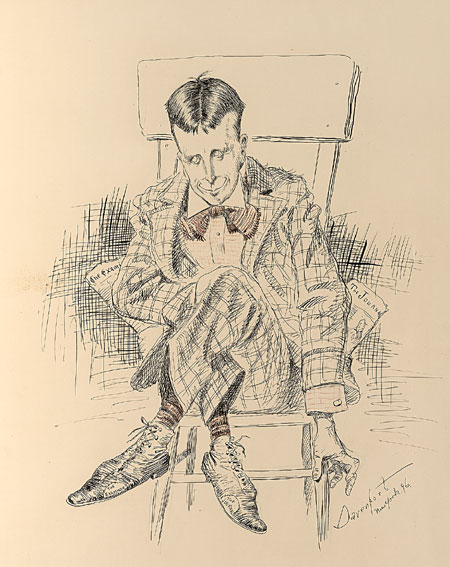
Hearst, under the pen of Homer Davenport, 1896

William Randolph Hearst’s purported vow to “furnish the war” with Spain is such a delicious and tenacious media-driven myth that it’s hardly surprising it has crossed over to other languages.

Spanish among them.

Just the other day, the online publication elmercuriodigital.es posted a commentary that invoked the Hearst quote. It read in part:

“El dibujante, Frederic Remington, telegrafió a su jefe pidiéndole autorización para regresar, pues no había ninguna guerra, y por lo tanto no había nada para cubrir. ‘Todo en calma. No habrá guerra’, dijo Remington. La respuesta del empresario periodístico fue célebre: ‘Le ruego que se quede. Proporcione ilustraciones, yo proporcionaré la guerra’.”

The passage recounts the essential portion of the anecdote, that the artist Frederic Remington, on assignment to Cuba for Hearst’s New York Journal, supposedly found “everything … quiet” and, in a cable to Hearst, asked permission to return.

In reply, as the myth has it, Hearst told Remington: “Please remain. You furnish the pictures, and I’ll furnish the war.”

As I write in my forthcoming book, Getting It Wrong:

“Hearst’s famous vow to ‘furnish the war’ has achieved unique status as an adaptable, hardy, all-purpose anecdote, useful in illustrating any number of media sins and shortcomings. It has been invoked to illustrate the media’s willingness to compromise impartiality, promote political agendas, and indulge in sensationalism. It has been used, more broadly, to suggest the media’s capacity to inject malign influence into international affairs.”

It lives on, I further write, “despite a nearly complete absence of supporting documentation.

“It lives on even though telegrams supposedly exchanged by Remington and Hearst have never turned up. It lives on even though Hearst denied ever sending such a message.”

And it lives on despite an irreconcilable internal inconsistency. Hearst had assigned Remington and the correspondent Richard Harding Davis to Cuba at the end of 1896. After several delays, they arrived in January 1897 — 15 months before the start of the Spanish-American War.

Anyone reading U.S. newspapers in early 1897 would have been well aware that Cuba was the theater of a nasty war, a rebellion against Spain’s armed forces which, by the time Remington and Davis arrived, had reached island-wide proportion.

So it would have been incongruous and inconceivable for Hearst to have vowed to “furnish the war” when war was the very reason he sent Remington and Davis to Cuba in the first place.

WJC

<!–[if !mso]> <! st1\:*{behavior:url(#ieooui) } –>

“Please remain. You furnish the pictures, and I’ll furnish the war.”[i]


[i] See Creelman, On the Great Highway, 177–178.

Catching up: Will on Capa

In Furnish the war, Media myths, Photographs on November 22, 2009 at 4:50 pm

I caught up today on several back issues of the Washington Post, including last Sunday’s edition, which carried an insightful column by George Will.

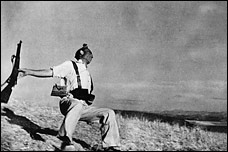
Will himself was catching up on intriguing research that challenges the authenticity of Robert Capa’s famous photograph of the moment a bullet strikes and kills a loyalist militiaman in 1936, during the Spanish Civil War.

Capa's iconic 'instant of death' photo (Robert Capa/Copyright 2001 by Cornell Capa)

Will notes that a Spanish historian “has established that the photo could not have been taken when and where it reportedly was — Sept. 5, 1936, near Cerro Muriano.

“The photo was taken about 35 miles from there. The precise place has been determined by identifying the mountain range in the photo’s background,” Will writes, adding that the historian “says that there was no fighting near there at that time, and concludes that Capa staged the photo.”

The historian is Francisco Moreno and his research into Capa’s iconic image received a fair amount of attention over the summer. According to the Associated Press, Moreno determined that the shape of hills in Capa’s photo matched a hillside just east of the town of Espejo.

This is not necessarily a media-driven myth — stories about and by the news media that are widely believed and often retold but which, on close examination, prove to be apocryphal or wildly exaggerated; they often promote a misleading interpretation of the power and influence of the news media. Few media-driven myths rest on outright fraud, which may have been the case here.

Still, the apparent debunking is a delicious one, given the status and standing that Capa’s photograph has gained over decades. It is considered among the most dramatic wartime photos ever made.

As Will correctly notes, its “greatness evaporates if its veracity is fictitious.”

Capa was a skilled war photographer who was killed in Vietnam in 1954. He supposedly maintained:

“If your pictures aren’t good enough, you’re not close enough.”

Now that’s a great quote: pithy, telling, instructive. Like other memorable quotes in journalism (such as “you furnish the pictures, I’ll furnish the war“)  it  seems almost too good, too neat and tidy, to be true.

I’ve done a bit of research into the derivation of Capa’s quote. And I have never been able to determine when and where he uttered that line.

WJC

‘Furnish the war’ lives on, and on

In Furnish the war, Media myths on November 9, 2009 at 10:22 am

The  media-driven myth of William Randolph Hearst’s purported vow to “furnish the war” with Spain is as delicious as it is tenacious.

The myth is cited in the “E-bits” column in the November 2009 issue of The Digital Journalist. The columnist writes: “The godfather of yellow journalism, Hearst purportedly said to an illustrator he sent to cover a revolution that wasn’t happening in 1898, ‘You furnish the pictures, I’ll furnish the war.'”

It’s a story almost too good not to be true, almost too delicious to be false.

But it’s almost certainly apocryphal. As I write in the forthcoming Getting It Wrong,  the story lives on despite a nearly complete absence of supporting documentation. It lives on even though the telegram that supposedly contained Hearst’s vow has never turned up. It lives on even though Hearst denied ever sending such a message.

It lives on despite an irreconcilable internal inconsistency: It would have been absurd for Hearst to vow to “furnish the war” because war—specifically, the Cuban rebellion against Spain’s colonial rule—was the very reason Hearst sent the illustrator, Frederic Remington, to Cuba in the first place. Remington was in Cuba in early 1897, at a time when anyone reading U.S. newspapers would have been well aware that Cuba was a theater of a nasty war. By then, Spain had sent nearly 200,000 soldiers in a failed attempt to put down the rebellion, which in 1898 gave rise to the Spanish-American War.

Hearst’s famous vow has achieved unique status as an all-purpose anecdote, useful in illustrating any number of media sins and shortcomings. It has been invoked to illustrate the media’s willingness to compromise impartiality, promote political agendas, and indulge in sensationalism. It has been used, more broadly, to suggest the media’s capacity to inject malign influence into international affairs.

And it’s as tenacious as any media-driven myth.

WJC