W. Joseph Campbell

Posts Tagged ‘History’

‘Accurately, it turned out’? Hardly, in the Jefferson-Hemings allegations

In Debunking, Media myths, Scandal on February 13, 2012 at 9:30 am

Media critic Jonathan Alter treated as settled history the other day the disputed and probably dubious claim that President Thomas Jefferson took as a mistress a slave named Sally Hemings.

In a  column for Bloomberg News, Alter wrote:

“Politics has been a contact sport since at least the election of 1804, when President Thomas Jefferson was accused (accurately, it turned out) of having an affair with ‘Dusky Sally’ Hemings, a slave.”

Accurately, it turned out?

That may hew to the dominant narrative about the purported Jefferson-Hemings liaison. But it’s far from proven, far from “accurate.”

Indeed, it’s quite unlikely.

Key evidence in the controversy centers around DNA testing conducted in 1998. The evidence indicated that the former president was among more than two dozen Jefferson men who were in Virginia at the time Hemings’ youngest child, Eston, was conceived in 1807.

Thomas Jefferson then was 64-years-old, making him an unlikely paternity candidate.

The DNA results were widely misreported when released, giving rise to the mistaken notion that the tests had confirmed Jefferson’s paternity.

However, as a detailed scholarly study published last year points out:

“The problem [in misinterpreting the DNA evidence] lies not only with a news media prone to over simplifying and sensationalizing complex stories.  Numerous prominent scholars have contributed to the misunderstanding by characterizing the DNA study as ‘confirming’ or ‘clinching’ the case for Thomas Jefferson’s paternity.”

The scholarly study, an impressive work titled The Jefferson-Hemings Controversy: Report of the Scholars Commission, further notes that the DNA tests “were never designed to prove, and in fact could not have proven, that Thomas Jefferson was the father of any of Sally Hemings’ children.”

The book — which has received scant attention from mainstream American media — presents a circumstantial case pointing to Jefferson’s younger brother, Randolph (or his sons), in the question of Eston Hemings’ paternity.

Randolph Jefferson, the book says, was known to have socialized with the slaves at Monticello, Thomas Jefferson’s home in Virginia.

Randolph Jefferson was a dozen years younger than the president, and the available record offers no evidence that Thomas Jefferson “enjoyed socializing at night with Monticello slaves,” the book says.

The scholars commission that compiled the volume describes the case as closed by no means.

Indeed, the scholars commission writes in The Jefferson-Hemings Controversy that a “more rational conclusion, from the totality of the evidence before us, is that Sally Hemings was not Thomas Jefferson’s lover, and her children were not his children.”

To assert otherwise — to insist on the accuracy of claims about Jefferson’s purported sexual relationship with a slave — is to indulge in a sort of sloppy, take-it-for-granted kind of reporting.

Sloppy, take-it-for-granted reporting can be a factor in the emergence and durability of media-driven myths, the subject of my latest book, Getting It Wrong.

I note in Getting It Wrong, for example, that hurried and sloppy reporting propelled the media myth of “crack babies,” in which journalists in the 1980s and 1990s “pushed too hard and eagerly on preliminary and inconclusive research. And the horrors they predicted, that ‘crack babies‘ would grow up to be a vast, permanently dependent class — a ‘bio-underclass’ of staggering dimension — proved quite wrong.”

Decidedly wrong.

WJC

Recent and related:

Online at BBC News: Recalling the derivation of ‘All the news that’s fit to print’

In 1897, Anniversaries, New York Times, Newspapers, Yellow Journalism on February 11, 2012 at 12:10 am

The most famous seven words in American journalism — “All the news that’s fit to print” — took a permanent place 115 years ago yesterday in the upper left corner, or left “ear,” of the New York Times masthead.

On front page for 115 years

And I recalled that occasion in a piece for the BBC News online site, writing:

“The motto appeared on the Times’ front page without notice, commentary, or fanfare. In the years since, the phrase has been admired as a timeless statement of purpose, interpreted as a ‘war cry’ for honest journalism, and scoffed at as pretentious, overweening, and impossibly vague.

“Even the Times hasn’t been entirely consistent in its embrace and interpretation of those seven words. In 1901, at the 50th anniversary of its founding, the Times referred to ‘All the news that’s fit to print’ as its ‘covenant. In 2001, a Times article commemorating the newspaper’s 150th anniversary said of the motto:

“’What, exactly, does it mean? You decide. The phrase has been debated, and endlessly parodied, both inside and outside the Times for more than a century.’

“On occasion, the motto has been taken far too seriously, as in 1960 when Wright Patman, a U.S. congressman from Texas, asked the Federal Trade Commission to investigate whether ‘All the news that’s fit to print’ amounted to false and misleading advertising.

“’Surely this questionable claim has a tendency to make the public believe, and probably does make the public believe, that the New York Times is superior to other newspapers,’ Patman wrote.

“The Trade Commission declined to investigate, saying: ‘We do not believe there are any apparent objective standards by which to measure whether “news” is or is not “fit to print.”’

“No matter how it’s interpreted, the motto certainly is remarkable in its permanence. One-hundred fifteen years on the front page has invested the motto with a certain gravitas. It often has been associated with fairness, restraint, and impartiality — objectives that nominally define mainstream American journalism.

“A commentary in the Wall Street Journal in 2001 addressed those sentiments, describing the motto as the ‘leitmotif not merely for the Times, but also, by a process of osmosis and emulation, for most other general-interest papers in the country, as well as for much of the broadcast media.

“Interestingly, the ‘leitmotif’ of American journalism had its origins in marketing and advertising.

“’All the news that’s fit to print’ first appeared on an illuminated advertising sign, spelled out in red lights above New York’s Madison Square in early October 1896. That was about six weeks after Adolph S. Ochs had acquired the newspaper in bankruptcy court.

“Ochs, patriarch of the family that still controls and publishes the Times, had come to New York from Tennessee. His task was to differentiate the Times from its larger, aggressive, and wealthier rivals — notably the yellow press of William Randolph Hearst and Joseph Pulitzer. It was a tall order, given the beleaguered status of the Times in New York’s crowded newspaper market.

“Ochs possessed a keen sense of promotion and turned to a number of techniques to call attention to the Times. The illuminated sign at Madison Square was one. An even more successful promotion was a contest inviting readers to propose a better motto.

“In late October 1896, the Times announced it was offering $100 for the phrase of ten words or fewer that ‘more aptly’ captured the newspaper’s ‘distinguishing characteristics’ than ‘All the news that’s fit to print.’

“Hundreds of entries poured in. …  As the contest unfolded in the fall of 1896, the Times amended the rules, making clear it would not abandon ‘All the news that’s fit to print’ but would still pay $100 for the best suggestion. And entries kept coming in.

“A committee of Times staff narrowed the field to 150, which in turn was winnowed to four by the motto contest judge, Richard W. Gilder, editor of The Century magazine. The finalists were:

  • “Always decent; never dull”
  • “The news of the day; not the rubbish”
  • “A decent newspaper for decent people”
  • “All the world’s news, but not a School for Scandal”

“The latter entry, Gilder determined, was the best of the lot, and the Times paid the prize money to the author of the phrase, D.M. Redfield of New Haven, Connecticut.

“What exactly prompted Ochs to move ‘All the news that’s fit to print’ to the front page 115 years ago is not entirely clear. But his intent was unmistakable — to throw down a challenge to the yellow press, a challenge that Ochs ultimately won. The Times has long outlived the New York newspapers of Hearst and Pulitzer.

“So the motto lives on as a reminder, as a daily rebuke to the flamboyant extremes of fin-de-siècle American journalism that helped inspire ‘All the news that’s fit to print.'”

WJC

Recent and related:

Just what we need: Barbra Streisand, media critic

In Cronkite Moment, Debunking, Media myths, Murrow-McCarthy myth on February 5, 2012 at 9:25 am

Celebrities and movie stars rarely make thoughtful, searching media critics, as Barbra Streisand demonstrated in a tedious and predictable essay the other day at Huffington Post.

The actress indulged a bit in the golden age fallacy, recalling broadcast journalists Edward R. Murrow and Walter Cronkite as exemplary newsmen whose talents these days are sorely missed.

“Americans,” Streisand wrote, “are busy, working hard to support and provide for their families. They don’t have time to parcel out fact from fiction. They depend on the Fourth Estate to guide them and to hold individuals running for office, especially the highest office in our country, accountable.”

The claim that Americans “depend on the Fourth Estate to guide them” is surely overstated, given evidence that many Americans go newsless and ignore media content altogether.

Streisand went on, extolling media icons of the past:

Murrow

“Journalists like Walter Cronkite and Edward R. Murrow knew it was their duty to know the facts and disseminate them to the public. That responsibility in today’s media world seems to be diminishing.”

Murrow, who came to fame on CBS radio in the 1940s and on CBS television in 1950s, was no white knight, though. He hardly was above the political fray.

As I note in my media mythbusting book, Getting It Wrong, Murrow privately donated time and expertise in acquainting Adlai Stevenson, the 1956 Democratic presidential candidate, with television.

I cite A.M. Sperber, one of Murrow’s leading biographers, who wrote that Murrow agreed “to help the Democrats” in offering Stevenson tips on “the finer points of speaking to the camera.”

Sperber, who characterized Murrow’s move “a radical departure from his usual practice,” said Stevenson “barely endured” the tutoring.

What’s more, Murrow is the subject of one of American journalism’s more savory and tenacious myths — that he stood up to the red-baiting senator, Joseph R. McCarthy, when no other journalist would, or dared.

Which is nonsense.

As I discuss in Getting It Wrong, Murrow was quite late in confronting McCarthy, doing so long after a number of journalists – including the muckraking columnist Drew Pearson– had become persistent and searching critics of the senator, his record, and his tactics.

Cronkite, the famous CBS News anchorman from 1963 to 1981, likewise is the subject of a durable media-driven myth — that his editorializing about the war in Vietnam in February 1968 forced President Lyndon B. Johnson to realize the folly of his policy.

Legend has it that Johnson was watching at the White House when Cronkite pronounced the U.S. military “mired in stalemate” in Vietnam. Cronkite also suggested the negotiations might offer a way out of the morass.

Upon hearing Cronkite’s downbeat assessment, Johnson supposedly leaned over and snapped off the television set, telling an aide or aides, “If I’ve lost Cronkite, I’ve lost Middle America.”

Or something to that effect. Versions vary, markedly.

But as I discuss in Getting It Wrong, Johnson did not see the program in which Cronkite made his editorial comment.

Johnson in Austin: Didn't see Cronkite show

Johnson at the time was in Austin, Texas, attending the 51st birthday party of Governor John Connally, a longtime political ally. About the time Cronkite was intoning “mired in stalemate,” Johnson was joking about Connally’s age, saying:

“Today you are 51, John. That is the magic number that every man of politics prays for—a simple majority.”

It’s illogical to argue that Johnson could have been much moved by a television report he hadn’t seen.

Granted, Cronkite’s editorial comment about Vietnam — tepid though it was — represented something of a departure for the avuncular anchorman. He usually tried to play it straight, because he had to.

As media critic Jack Shafer pointed out shortly after Cronkite’s death in 2009, the anchorman’s impartiality was partly a function of the federal “Fairness Doctrine,” which sought to encourage balanced reporting on the air.

Shafer wrote that “between 1949 and 1987 — which come pretty close to bookending Cronkite’s TV career — news broadcasters were governed by the federal ‘Fairness Doctrine.’ The doctrine required broadcast station licensees to address controversial issues of public importance but also to allow contrasting points of view to be included in the discussion.

“One way around the Fairness Doctrine was to tamp down controversy,” which he notes, the three U.S. television networks of the time “often did.”

So, no: Murrow and Cronkite weren’t exactly paragons of play-it-straight journalism. Pining for them while deploring today’s freewheeling media landscape is neither very sophisticated nor very useful.

Nor even fair to the historical record.

WJC

Recent and related:

‘Yellow journalism’: The back story to a sneer, 115 years on

In 1897, Anniversaries, Spanish-American War, Yellow Journalism on January 31, 2012 at 6:35 am

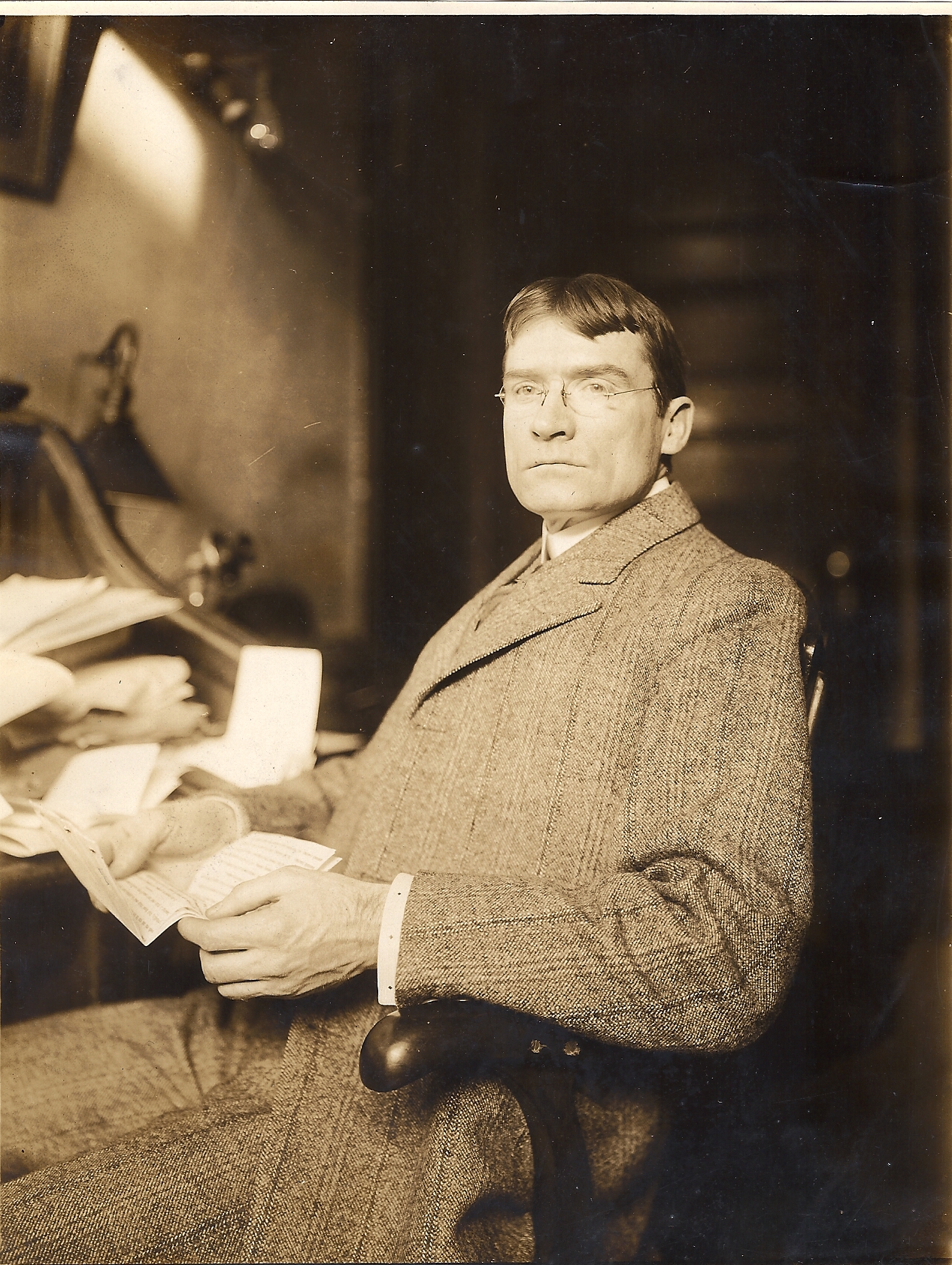
Wardman: Gave us 'yellow journalism'

Yellow journalism” is a disparaging epithet often invoked in journalism, even though its derivation is little known.

This is the back story to a sneer that trips easily off the tongue with scorn and condescension.

The first verified use of the term was 115 years ago today, when “yellow journalism” appeared in the old New York Press.

The phrase “the Yellow Journalism” appeared in a small headline on the Press’ editorial page on January 31, 1897. The phrase also appeared that day in the newspaper;s editorial page gossip column, “On the Tip of the Tongue.”

Yellow journalism” was quickly embraced in American newspapering, as a way to disparage and denigrate the freewheeling practices of William Randolph Hearst and his New York Journal as well as Joseph Pulitzer and the New York World.

Within weeks of the first use of the term, references to “yellow journalism” had appeared in newspapers in Providence, Richmond, and San Francisco.

In the 115 years since then, “yellow journalism” has turned into a derisive if vague shorthand for denouncing sensationalism and journalistic misconduct of all kinds.

“It is,” I wrote in my 2001 book, Yellow Journalism: Puncturing the Myths, Defining the Legacies, “an evocative term that has been diffused internationally, in contexts as diverse as Greece and Nigeria, as Israel and India.”

I also noted that yellow journalism emerged in “a lusty, fiercely competitive, and intolerant time, when newspapers routinely traded brickbats and insults” and even threats.

Just how Wardman and the Press came up with “yellow journalism” is not clear.

The newspaper’s own, brief discussion of the term’s derivation was decidedly unrevealing. “We called them Yellow because they are Yellow,” the Press said in 1898 in a comment about the Journal and the World.

In the 1890s, the color yellow sometimes was associated with depraved literature, which may have been an inspiration to Wardman, an austere figure largely lost to New York newspaper history. (The New York Times said in 1923 in its obituary of Wardman: “Like many another anonymous worker in journalism, his name was not often conspicuously before the public, and he was content to sink his personality in that of the papers which he served.”)

Wardman, who earned a bachelor’s degree in three years at Harvard University, once was described as showing “Calvinistic ancestry in every line of his face.” He did little to conceal his contempt for Hearst and Hearst’s flamboyant style of journalism.

Disdain routinely spilled into the columns of the Press, of which Wardman became editor in chief in 1896 at the age of 31. (The Press ceased publication in 1916.)

The Press took to taunting Hearst, Hearst’s mother, and Hearst’s support for Democratic candidate William Jennings Bryan in the 1896 presidential election. Hearst’s Journal was virtually alone among New York newspapers in supporting Bryan’s “free silver” candidacy.

The Press taunted Hearst, then 34, as a mama’s boy and “little Willie.” It referred to the Journal as “our silverite, or silver-wrong, contemporary.”

The Press also experimented with pithy if stilted turns of phrase to denounce “new journalism,” Hearst’s preferred term to characterize his style of newspapering.

“The ‘new journalism,’” the Press said in early January 1897 “continues to think up a varied assortment of new lies.”

Later in the month, the Press asked in a single-line editorial comment:

“Why not call it nude journalism?”

It clearly was a play on “new journalism” and was meant to suggest the absence of “even the veneer of decency.”

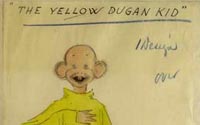
It wasn’t long before Wardman and the Press seized upon the phrase “yellow-kid journalism,” which evoked the Hearst-Pulitzer rivalry over a popular cartoon character known as the “Yellow Kid.” Both the Journal and the World at the time were publishing versions of the kid.

The Yellow Kid (Library of Congress)

At the end of January 1897, the phrase “yellow-kid journalism” was modified  to “the Yellow Journalism,” and the sneer was born.

Wardman turned often to this delicious pejorative, invoking it in a number of brief editorial comments such as:

“The Yellow Journalism is now so overripe that the little insects which light upon it quickly turn yellow, too.”

The diffusion of “yellow journalism” was confirmed when Hearst’s Journal embraced the term in mid-May 1898, during the Spanish-American War. With typical immodesty, it declared:

“… the sun in heaven is yellow—the sun which is to this earth what the Journal is to American journalism.”

WJC

Adapted from an essay posted in 2010 at Media Myth Alert.

Recent and related:

ABC unaccountably excludes Bill Clinton from lineup of pols who led ‘double lives’

In Debunking, Media myths, Scandal on January 21, 2012 at 10:39 am

ABC News offered yesterday a risible lineup of two-timing politicians that omitted Bill Clinton, the philandering 42nd president, but included Thomas Jefferson, about whom the evidence of sexual dalliance is thin at best.

ABC’s roster of “the top eight politicians who led double lives” was posted online and promised “a look at some … tawdry affairs and public scandals” — and how the politicians implicated “weathered the storm.”

In addition to Jefferson, ABC included Grover Cleveland, the U.S. president in the 1880s and 1890s who fathered a child out of wedlock, and Eliot Spitzer, who as governor of New York consorted with a high-priced call girl.

The ABC roster also included an obscure and mostly forgotten former politician, Vito Fossella, a five-term New York congressman who in 2008 acknowledged fathering a child in an extramarital affair.

Given that the likes of Fossella made the list, it’s inexplicable that Clinton was omitted.

Clinton’s tawdry sexual affair with Monica Lewinsky, a White House intern, began in mid-November 1995 and continued intermittently until March 1997.

Disclosures of the Clinton-Lewinsky dalliance, and falsehoods he told under oath about the affair, nearly destroyed Clinton’s presidency.

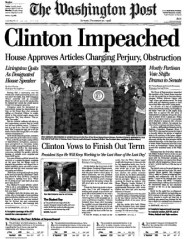
He was impeached in December 1998 on two counts — lying under oath and obstructing justice to cover up the affair — but acquitted by the U.S. Senate in February 1999 and served out the 23 months remaining in his term.

Separately, a federal judge found Clinton in contempt of court for having lied under oath about the Lewinsky affair. Clinton was barred from practicing law for five years and ordered to pay nearly $90,000 to the lawyers of Paula Jones, who had accused him of sexual harassment while he was governor of Arkansas.

Clinton was the second U.S. president impeached in office. The other was Andrew Johnson, in 1868.

ABC’s including Jefferson in its “double lives” roster was little short of baffling: Indeed, its writeup about Jefferson’s purported sexual liaison with a slave-mistress named Sally Hemings offered no small amount of exculpatory evidence.

In fact, the writeup referred to “the myth of Jefferson’s double life” and noted:

“To this day, Jefferson’s paternity of any of her children has not been established with any absolute certainty.”

ABC also pointed out that a recent and detailed study about the purported Jefferson-Hemings affair which “did not show much support for the accusations” of a sexual liaison.

That study, a 400-page work titled The Jefferson-Hemings Controversy: Report of the Scholars Commission, was compiled by a commission of Jefferson scholars charged with puncturing the myriad misunderstandings about the third president and a slave whom he rarely mentioned in his letters.

Among the misunderstandings was the DNA testing released in 1998 — about the time Clinton was facing impeachment charges — confirmed that Jefferson fathered children by Hemings.

“While the tests were professionally done by distinguished experts,” the scholars commission pointed out, “they were never designed to prove, and in fact could not have proven, that Thomas Jefferson was the father of any of Sally Hemings’ children.

“The tests merely establish a strong probability that Sally Hemings’ youngest son, Eston, was fathered by one of the more than two dozen Jefferson men in Virginia at the time ….”

One of the more than two dozen Jefferson men.

Yet, news media reports at the time characterized the DNA tests as offering “compelling evidence” of a sexual relationship between Jefferson and Hemings.

The scholars commission — a panel of 13 experts organized by the Thomas Jefferson Heritage Society — said that circumstantial evidence points more powerfully to Jefferson’s younger brother, Randolph (or his sons), in the paternity question.

Randolph Jefferson, the book says, was known to have socialized with the slaves at Monticello, Thomas Jefferson’s home near Charlottesville, VA.

Randolph Jefferson was a dozen years younger than the president, and the available record offers no evidence that Thomas Jefferson “enjoyed socializing at night with Monticello slaves,” the book points out.

Eston Hemings’ was conceived around August 1807, when Thomas Jefferson was 64 and in declining health — factors that further diminish the likelihood of his paternity.

Also making ABC’s roster of politicians who led “double lives” were Mark Sanford, a former governor of South Carolina; John Edwards, a former U.S. senator from North Carolina; Arnold Schwarzenegger, a former governor of California, and Anthony Wiener, a former congressman from New York City.

WJC

Many thanks to Instapundit
Glenn Reynolds for linking to this post.

Recent and related:

Virginia (of ‘Yes, Virginia’) tells of her famous letter, 97 years ago

In 1897, Anniversaries, New York Sun, Newspapers on December 23, 2011 at 4:55 am

Young Virginia O'Hanlon

In a newspaper database of the Library of Congress, I found a long-overlooked interview conducted 97 years ago with Virginia O’Hanlon, who as an 8-year-old in 1897 wrote the letter that prompted the most famous newspaper editorial in American journalism.

O’Hanlon said in the interview on Christmas Eve 1914 that she had sent her letter despite her father’s admonition:

“A newspaper has no time to waste on a little girl.”

The editorial that became a classic was published in the old New York Sun, in response to Virginia’s imploring: “Please tell me the truth. Is there a Santa Claus?”

The Sun in its timeless reply reassured young Virginia as well as generations of children who have read the editorial, which memorably declares:

“Yes, Virginia, there is a Santa Claus. He exists as certainly as love and generosity and devotion exist, and you know that they abound and give to your life its highest beauty and joy. Alas! how dreary would be the world if there were no Santa Claus. It would be as dreary as if there were no Virginias.”

The editorial’s closing passages were similarly reassuring in saying:

“No Santa Claus! Thank God! he lives, and he lives forever. A thousand years from now, Virginia, nay, ten times ten thousand years from now, he will continue to make glad the heart of childhood.”

In the interview with the Sun 97 years ago, Virginia O’Hanlon discussed her motivation in writing to the newspaper and her proud reaction when the essay was published — comments that offer revealing insight about the back story to the famous editorial.

“I think that I have never been so happy in my life as when the Sun told me that there was a Santa Claus and that he would live forever,” she said in the interview.

Virginia O’Hanlon was then 25-years-old and had been married 18 months to Edwin Malcolm Douglas. Her only child, Laura Virginia Douglas, was nine months old.

O’Hanlon said in the 1914 interview that she decided to write to the Sun in part because of its importance in her family’s household.

She said her father, Philip, “was always talking about the Sun and how you could always find what you wanted in the Sun, and how mother, who loved whist, wrote letters to the whist editor.”

O’Hanlon recalled telling her father: “I am going to write to the Sun and ask it to tell me the truth, the honest to goodness truth, about Santa Claus,” whose existence her schoolmates had scoffed at.

She added: “If the Sun says there isn’t any [Santa Claus] I’ll believe it; if it tells me Santa Claus is real I’ll make those girls at school sorry they ever teased me.

“Father laughed,” she recalled, quoting him as saying:

“The Sun is too busy writing about Presidents and Governors and important people, Virgina. … A newspaper has no time to waste on a little girl. Write if you want to, but don’t be disappointed if you never hear from your letter.”

“Well,” Virginia said, “I sat down and wrote a short letter, trying to say just what was in my heart. Day after day I looked for a letter in reply. I never for a minute thought the Sun would print a long editorial mentioning me by name and using my whole letter.

“Father teased me now and then,” she said, “but I kept hoping and finally” her letter was answered, in an essay published September 21, 1897, in the third of three columns of editorials.

(O’Hanlon indicated on another occasion that she wrote her letter shortly after her eighth birthday in July 1897. “My birthday was in July and, as a child, I just existed from July to December, wondering what Santa Claus would bring me,” she told an audience of Connecticut high school students in 1959. “I think I was a brat.”)

Word that the newspaper had published an editorial to answer her letter prompted Philip O’Hanlon to rush from their home on West 95th Street in Manhattan to buy a stack of that day’s Sun.

“Father hustled out and came back loaded down like a pack mule,” she said. “He scattered them all over town, I think, he was so proud.

“And me? It spoiled me for a while until I was big enough to understand that I, Virginia O’Hanlon, didn’t count for much in the editorial but that the important thing was the beautiful thoughts expressed by Mr. Church and the charming English in which he put his philosophy.”

She was referring to Francis P. Church, a veteran journalist who wrote the essay in the course of a day’s work, without an inkling it would become a classic.

His authorship was revealed by the Sun shortly after his death in April 1906.

The Sun’s editorial, O’Hanlon said in the interview, “was a wonderful thing in my life, and I mean it to be a wonderful thing in my baby’s. As soon as she masters her A B C’s, it will be the first thing she will read.”

The comment anticipated the commitment of her descendants who, over the years, have embraced the obligations associated with the much-remembered and often-reprinted editorial.

O’Hanlon’s grandchildren, notably, have become what the New York Times last year described as “ambassadors of the Christmas spirit, crossing the country to appear at events honoring her, and reading the letter and the response to children in schools and to their own children at home.”

Virginia O’Hanlon was 81 when she died in 1971. The Times reported her death on its front page.

But by then, though, the Sun had ceased to exist as an independent publication. It was merged with another New York newspaper, the World-Telegram, in January 1950.

WJC

Recent and related:

‘Yes, Virginia’: History does trump TV animation

In 1897, Debunking, Media myths on December 9, 2011 at 11:28 am

CBS is to air tonight its vapid Christmas season special, “Yes Virginia,” which is based on the old New York Sun’s timeless editorial reply to an 8-year-old girl, who in 1897 inquired about the existence of Santa Claus.

The charmless, animated CBS program takes great liberties with the real back story to the “Yes, Virginia” editorial, which was published in the Sun on September 21, 1897, in the third of three columns on editorials.

The Sun’s editorial was a response to young Virginia O’Hanlon who shortly after her 8th birthday in July 1897 wrote to the newspaper, imploring:

“Please tell me the truth; is there a Santa Claus?”

Francis P. Church

The Sun’s reply, written by a retiring editorial writer named Francis P. Church, said in part:

“Yes, Virginia, there is a Santa Claus. He exists as certainly as love and generosity and devotion exist, and you know that they abound and give to your life its highest beauty and joy. Alas! how dreary would be the world if there were no Santa Claus. It would be as dreary as if there were no Virginias.”

In the CBS interpretation, Virginia is waddling, round-headed, and strangely obsessed with the existence of Santa Claus.

Church, the editorial’s author, is depicted as scowling, abrupt, hard-hearted.

Neither portrayal is convincing, neither is realistic.

Church is cast as the editor of the Sun, which is shown as a tabloid newspaper. Church wasn’t editor; he was an editorial writer. And the Sun of 1897 was no tabloid.

What’s more, the CBS show had Virginia writing her letter, and the Sun publishing its reply, in December, as Christmas approached.

Not so.

As I discussed in my 2006 book, The Year That Defined American Journalism: 1897 and the Clash of Paradigms, Virginia wrote the letter in the summer of 1897. The Sun published its editorial-reply on page 6 of its issue of September 21, 1897.

What became the famous essay in American journalism was, in its first appearance, inconspicuous and obscure: It certainly was not introduced with large headlines on the front page, as the CBS show has it.

Its headline posted a timeless question:

“Is There A Santa Claus?”

The editorial was no instant sensation. It was not an immediate hit. And the Sun did not reprint the editorial every year at Christmastime, as is commonly believed.

Indeed, it took years for the newspaper to embrace “Is There A Santa Claus?”

As I noted in The Year That Defined American Journalism, it wasn’t until the mid-1920s when the Sun began routinely publishing the essay in its editorial columns at Christmastime.

What helped kept the editorial alive were the newspaper’s readers.

They found it memorable. They found joy, solace, and inspiration in the passages of “Is There A Santa Claus?”

In untold numbers over the years, readers asked the Sun to reprint the essay.

A letter-writer told the newspaper in 1926 that the editorial offered “fine relief from the commercialism and unsentimental greed” of the Christmas season.

In 1940, a writer to the Sun likened the essay to “a ray of hope on the path to human understanding in our troubled times.”

The CBS program hints at none of that. It offers no indication that the editorial’s fame rests at least in part on generations of readers who, collectively, proved to be far more perceptive than editors of the Sun in identifying the essay’s significance and enduring appeal.

If anything, the tedious CBS show demonstrates anew that history’s back story is often far richer, and far more interesting, than TV fare.

There’s of course little surprise in that observation. As Richard Bernstein wrote in 1989 in a terrific essay about movies and history:

“There are, after all, times when the facts speak far more dramatically than any fictionalized account of them ever could.”

WJC

Recent and related:

Cronkite, Johnson, and the deceptive ‘yardstick’

In Cronkite Moment, Debunking, Media myths on December 7, 2011 at 11:25 am

Cronkite: Wasn't watching Cronkite

The Huffington Post blog bit on the mythical “Cronkite Moment” yesterday, declaring it “a yardstick for how much things have changed.”

That is, how news media once were trusted and respected and influential. Nowadays, not so much.

But if the “Cronkite Moment” is a yardstick of any kind, it’s a measure of how profoundly the media myth has become embedded in the lore of American journalism.

The purported “Cronkite Moment” was on February 27, 1968, when CBS News anchorman Walter Cronkite declared the U.S. military was “mired in stalemate” in Vietnam and suggested that negotiations ultimately might offer a way out.

President Lyndon B. Johnson, as the myth has it, watched the Cronkite report at the White House and, upon hearing the “mired in stalemate” assessment, declared:

“If I’ve lost Cronkite, I’ve lost Middle America.” (Or something to that effect.)

The Huffington Post essay invoked the president’s purported comment in referring to the presumptive “Cronkite Moment,” asserting:

“LBJ famously commented, ‘If I’ve lost Cronkite, I’ve lost Middle America,’ after the beloved journalist called the war ‘unwinnable.’ Several weeks later, Johnson announced that he would not seek reelection as president.”

That paragraph embraces some of the most prominent myths and misunderstandings that have grown up around the presumptive “Cronkite Moment.” Let’s peel them back.

First, Cronkite did not declare the war in Vietnam “unwinnable.” He said the U.S. military was “mired in stalemate” — which hardly was a novel or stunning assessment in early 1968. Many news organizations in fact had used “stalemate” months before Cronkite’s program to characterize the war.

Second, Johnson’s decision not to seek reelection in 1968 had nothing to do with Cronkite’s program. Indeed, there’s strong evidence that Johnson never intended to seek another term, that in 1967, or even earlier, he had decided against another campaign for the presidency.

Johnson wrote in his memoir, The Vantage Point: “Long before I settled on the proper forum to make my announcement, I had told a number of people of my intention not to run again.”

Third, and perhaps most important, is that Johnson did not see Cronkite’s report about Vietnam when it aired.

As I discuss in my latest book, Getting It Wrong, Johnson at the time wasn’t at the White House but at a black-tie party in Austin, Texas, marking the 51st birthday of Governor John Connally.

The president wasn’t agonizing that night over the supposed loss of Cronkite’s support; he wasn’t lamenting having “lost Cronkite.”

Instead, Johnson was offering light-hearted comments about Connally’s age, saying:

“Today you are 51, John. That is the magic number that every man of politics prays for—a simple majority. Throughout the years we have worked long and hard—and I might say late—trying to maintain it, too.”

As I note in Getting It Wrong, there’s no evidence Johnson saw the Cronkite program at a later date, on videotape.

Even if he had, it made no difference to his thinking about Vietnam.

Not long after Cronkite’s program, Johnson delivered a rousing speech in Minneapolis, where he urged “a total national effort” to win the war in Vietnam. That speech was given March 18, 1968, and in it, the president declared:

“We love nothing more than peace, but we hate nothing worse than surrender and cowardice.”

Under scrutiny, then, the presumptive “Cronkite Moment” dissolves as illusory. And not  surprisingly so.

As I point out in Getting It Wrong:

“Seldom, if ever, do the news media exert truly decisive influences in decisions to go to war or to seek negotiated peace. Such decisions typically are driven by forces and factors well beyond the news media’s ability to shape, alter, or significantly influence. So it was in Vietnam, where the war ground on for years after the “Cronkite moment.”

WJC

Recent and related:

What ‘lesson’ from Cronkite?

In Cronkite Moment, Debunking, Media myths on November 18, 2011 at 2:20 am

The presumptive “Cronkite Moment” of 1968 has gained significance far beyond what little influence it exerted at the time.

Cronkite in Vietnam

The “Cronkite Moment” came February 27, 1968, when CBS News anchorman Walter Cronkite declared in a special report that the U.S. military was “mired in stalemate” in Vietnam and said negotiations might eventually offer a way out.

As I point out in my latest book, Getting It Wrong, the program has “become the stuff of legend — certainly among the most unforgettable moments in American journalism.”

The gauzy legend was embraced yesterday in a commentary at the “Philly Post,” a blog of Philadelphia Magazine.

The commentary argued that journalists should emphasize truth-seeking rather than impartiality in their reporting, and invoked the “Cronkite Moment” to support that claim.

“In one of his most famous newscasts,  the ‘most trusted man in America’  threw objectivity out the window” and offered the “mired in stalemate” assessment about Vietnam, the commentary said, adding:

“In calling it like he saw it, Cronkite was not being impartial, but that doesn’t mean he was being biased. He was stating the conclusion he was led to by the evidence; and Americans — at least those sensible enough to listen— respected him for it. Among the many lessons modern journalists can learn from Cronkite, this is perhaps the most important.”

So that was Cronkite’s “most important” lesson?

A thin lesson it was, then.

As I note in Getting It Wrong, Cronkite’s “mired in stalemate” assessment  “was neither notable nor extraordinary” in early 1968.

That’s because “stalemate” had been in use by U.S. news media months before the so-called “Cronkite Moment.”

In August 1967, for example, the New York Times said in a news analysis that the war in Vietnam “is not going well.”

U.S. victory, the Times said, “is not close at hand. It may be beyond reach.”

The Times’ analysis was published on the front page, beneath the headline:

Vietnam: The Signs of Stalemate.”

Also in August 1967, the syndicated columnist James J. Kilpatrick wrote:

“So long as the present ground rules obtain in Vietnam, this war will drag along its indecisive way. … [T]he condition is stalemate.”

And a few weeks before Cronkite’s on-air commentary, the Times declared in an editorial:

“Politically as well as militarily, stalemate increasingly appears as the unavoidable outcome of the Vietnam struggle.”

The real lesson of the “Cronkite Moment” was how the vaunted anchorman trailed the emerging media consensus about the war, turning to “stalemate” only after the characterization had been tested and invoked often, by other news organizations.

Cronkite also trailed public opinion as it turned against the war.

A Gallup poll in October 1967 reported, for the first time, that a plurality of Americans — 47 percent — felt sending troops to fight in Vietnam had been a mistake.

A little more than two years earlier, only 24 percent of respondents said they thought sending American forces to Vietnam had been a mistake.

So in his assessment about Vietnam, Cronkite was neither brave nor cutting edge.

Nor legendary at all.

WJC

Recent and related:

Accepting the Dicken-Garcia Award for Distinguished Scholarship in Journalism History

In Debunking, Furnish the war, Media myths on November 12, 2011 at 7:49 am

I was honored yesterday to receive the Hazel Dicken-Garcia Award for Distinguished Scholarship in Journalism History, an honor given by the organizers of the annual Symposium on 19th Century Press, the Civil War, and Free Expression, a conference convened in Chattanooga.

The award recognizes my work in journalism history, including the books Getting It Wrong, The Year That Defined American Journalism, and Yellow Journalism: Puncturing the Myths, Defining the Legacies.

The award’s namesake, Hazel Dicken-Garcia, is a retired journalism historian at the University of Minnesota who wrote Journalistic Standards in Nineteenth Century America and is regarded as one of the field’s leading lights.

In accepting the award, which is administered by David B. Sachsman of the University of Tennessee-Chattanooga, I spoke about the importance of myth-busting in media history. I told the conference-goers that “the health and integrity of the field, at least in part, rides on historians’ fulfilling an obligation to bust myths, to seek to set straight the historical record to the extent that’s possible.

“After all,” I added, “to bust myths is to wage war against simplistic and reductive explanations — and to recognize and insist upon the complexity of the historical record.”

I also spoke about my research into media-driven myths, those prominent, well-known stories about and/or by the news media that are widely believed and often retold but which, under scrutiny, prove to be apocryphal or wildly exaggerated.

I noted that media  myths can be thought of as the junk food of journalism – tasty and alluring, perhaps, but not terribly nutritious, and not terribly healthy.

“Media myths,” I said, “are inescapably media-centric; as such, they tend to distort our understanding of the history, roles, and functions of journalism in American society; media myths typically confer on the news media far more power and influence than they necessarily wield.”

Media myths, I added, “often spring from the timeless appeal to distill and simplify, the appeal of condensed, readily digestible historical accounts that are easily grasped, and a delight to retell.”

As examples, I discussed the famous tale about William Randolph Hearst’s purported vow at the end of the 19th century to “furnish the war” with Spain and a Civil War-era quotation attributed to Chicago newspaper editor Wilbur F. Storey, who supposedly told a correspondent to  “telegraph fully all news; and when there is no news, send rumors.”

Both tales, I noted, are based on very thin documentation. Both have serious evidentiary problems.

Hearst’s purported vow was supposedly made in an exchange of telegrams with the artist Frederic Remington, on assignment for Hearst’s New York Journal in early 1897 to draw sketches of the Cuban rebellion against Spanish colonial rule.

I noted in my talk how it would have made no sense for Hearst to have vowed to “furnish the war” when war — the Cuban rebellion — was the very reason he sent Remington to Cuba.

Hearst

Not only that, but the telegrams supposedly exchanged by Hearst and Remington have never turned up; Hearst denied ever making such a vow, and Remington apparently never publicly discussed the matter.

“It’s almost certain that no such telegrams were ever sent,” I said.

The “send rumors” anecdote from the Civil War era is likewise improbable — although undeniably appealing and relevant even today.

“The quotation not only suggests journalism’s inclination to compromise ethics in the gathering of news,” I said, but “it speaks also to the profession’s unending appetite for rumor, gossip, and hearsay.”

The anecdote revolves around instructions supposedly sent in 1864 by Wilbur F. Storey, editor of the Chicago Times, to a correspondent near Nashville, Franc B. Wilkie.

The lone source for Storey’s supposed instructions Wilkie’s memoir,  Personal Reminiscence, which was published in 1891. That was 27 years after the instructions supposedly were sent.

Not only that, but by 1891, Storey had been dead seven years.

I noted that among the reasons for doubting that Storey ever sent such instructions is that they would have been superfluous. It would have made no sense for Storey to have told Wilkie to “send rumors” because the Chicago Times — like many newspapers during the Civil War — routinely printed rumors about battles, about troop movements, and about political developments — and identified them as rumor.

It would have been an unnecessary message, to advise a seasoned correspondent like Wilkie to “send rumors.”

“Simply put,”  I said, “Wilkie would have required no reminder from Storey to ‘telegraph fully all news; and when there is no news, send rumors.'”

I closed my remarks by saying that debunking media myths is  reminder “to be wary about conclusiveness.”

History, I said, “is neither static nor infallible. … There’s plenty of room for skepticism, plenty of room for testing assumptions — for applying tests of evidence and logic to well-known tales and dominant narratives.”

WJC

Recent and related: