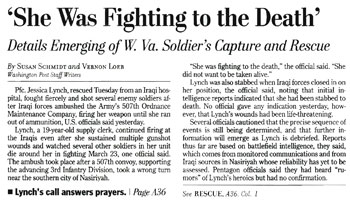
It will be seven years tomorrow since the Washington Post published its erroneous front-page report about Jessica Lynch, the Army private whom the newspaper had said “fought fiercely” in an early engagement of the Iraq War.
“‘She Was Fighting to the Death,'” the Post‘s headline said of Lynch, then a 19-year-0ld supply clerk in the Army’s 507th Maintenance Company.
The Post cited “U.S. officials” who otherwise were unidentified as saying Lynch had “continued firing at the Iraqis even after she sustained multiple gunshot wounds and watched several other soldiers in her unit die around her in fighting” at Nasiriyah on March 23, 2003.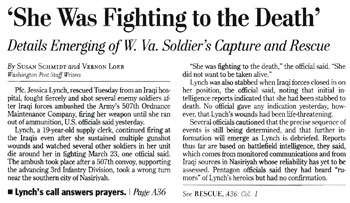
The Post further cited the unnamed sources in reporting that Lynch had “shot several enemy soldiers after Iraqi forces ambushed” the 507th and kept “firing her weapon until she ran out of ammunition.”
None of it was true, however.
Lynch never fired a shot at Nasiriyah; her rifle jammed during the attack. She suffered shattering injuries when a rocket-propelled grenade struck her Humvee, causing the vehicle to crash. But she wasn’t shot.
Lynch was taken prisoner and treated at an Iraqi hospital, from where she was rescued April 1, 2003, by a U.S. special operations team.
As I write in Getting It Wrong, my forthcoming book about media-driven myths, “The Post’s erroneous hero-warrior tale thrust Lynch into an international spotlight that has never fully receded.”
The Post, though, has never disclosed identity of the source or sources for its bogus “fighting to the death” report, which was published April, 3, 2003.
Over the years, speculation has been that the U.S. military leaked the hero-warrior tale about Lynch. But one of the reporters on the story, Vernon Loeb, has said the Pentagon wasn’t the source.
“I could never get anybody from the Pentagon to talk about those reports at all,” Loeb said on an NPR program in late 2003. “I got indications that they had, in fact, received those intelligence reports, but the Pentagon was completely unwilling to comment on those reports at all. They wouldn’t say anything about Jessica Lynch.”
He added that “we wrote a story that turned out to be wrong because intelligence information we were given was wrong.”
So who were the Post‘s sources? Who supplied the erroneous details about Lynch?
When I reached him by phone in 2008 to talk about the Lynch case, Loeb hung up on me.
The author Jon Krakauer claimed in a book published last year that a former White House operative named Jim Wilkinson “arranged to give the Washington Post exclusive access to classified intelligence that was the basis for the now-discredited ‘She Was Fighting to the Death’ story that ran on the front page of that newspaper.”
Krakauer, writing in Where Men Win Glory: The Odyssey of Pat Tillman, called Wilkinson a “master propagandist” and said he “deserves top billing for creating the myth of Jessica Lynch.”
Krakauer’s book identified no specific sources for its claims about Wilkinson, who at the time of Lynch’s capture and rescue was director of strategic communications for General Tommy Franks, then the commander of U.S. forces in Iraq.
I recently spoke by phone with Wilkinson, now a managing partner for the Brunswick Group in San Francisco. He vigorously disputed Krakauer’s account as “factually incorrect” and insisted that “not one shred of evidence” links him to leaking the erroneous report to the Post.
Wilkinson also said:
“Tommy Franks would have killed me” had he been the Post’s source for the erroneous report about Lynch.
Wilkinson’s denial has the ring of authenticity, especially so his point about Tommy Franks. The tenor of Franks’ memoir, American Soldier, makes it clear that Wilkinson’s subordinate and advisory role would have ended abruptly had he crossed the general.
So seven years on, the Post‘s bogus report about Jessica Lynch reverberates still.




 Media Myth Alert