W. Joseph Campbell

Posts Tagged ‘McCarthy’

Blithely invoking the Murrow-McCarthy myth

In Debunking, Media myths, Murrow-McCarthy myth, Watergate myth on March 3, 2010 at 11:15 am

It’s fairly remarkable how blithely and routinely media myths can be invoked.

A reminder of that appeared in a column posted today in the Times-News, a newspaper in Twin Falls, Idaho. The column, which ruminated about the use of middle initials, opened this way:
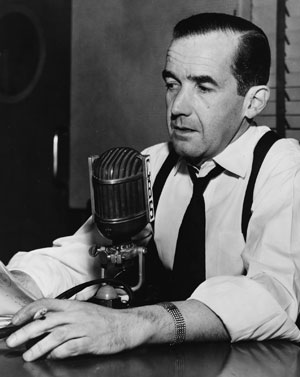
Murrow in 1954 (Library of Congress)

“When I was a young journalist, the most revered person in my profession was Edward R. Murrow, the CBS News reporter who brought down Sen. Joseph McCarthy.”

Brought down McCarthy.

It’s a story as famous and revered in American journalism as the notion that intrepid young reporters for the Washington Post brought down the corrupt presidency of Richard Nixon.

Both tales are exaggerated.

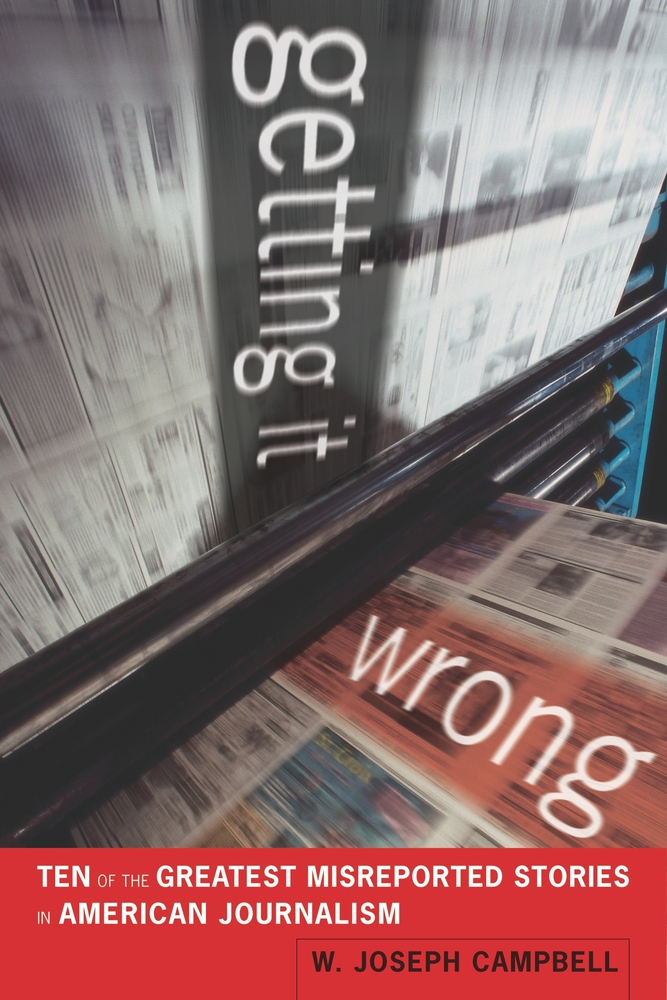
And both are media-driven myths that are examined in my forthcoming book, Getting It Wrong.

Murrow was a leading and ultimately a legendary figure in American broadcasting who in the 1950s  stood up to McCarthy, the Red-baiting junior senator from Wisconsin, when, supposedly, no one else would, or dared. In so doing, the story goes, Murrow brought an abrupt end to senator’s witchhunt for communists in the U.S. government.

The vehicle for Murrow’s brave exposé was his 30-minute television program, See It Now, which aired on CBS.

As I write in Getting It Wrong:

“Long before the See It Now program, several prominent journalists—including the Washington-based syndicated columnist Drew Pearson—had become persistent and searching critics of McCarthy, his record, and his tactics.”

Pearson, who wrote the widely published “Washington Merry-Go-Round” column, was the most assertive and, ultimately, acerbic of McCarthy’s media critics. He challenged McCarthy’s claims as early as 1950, soon after the senator began charging that communists had infiltrated the U.S. State Department.

McCarthy became so angered by Pearson’s searching columns that he threatened the columnist with physical harm–and followed through in December 1950 in the cloakroom of the exclusive Sulgrave Club on DuPont Circle in Washington. There, he slapped or tried to knee Pearson in the groin.

All that came long before Murrow confronted McCarthy on See It Now in 1954.

By 1954, I note in Getting It Wrong, “it wasn’t as if Americans … were hoping for someone to step up and expose McCarthy, or waiting for a white knight like Murrow to tell them about the toxic threat the senator posed.”

Pearson and others had been doing so for years.
WJC

Journalists changing history: A double dose of media myth

In Debunking, Media myths, Murrow-McCarthy myth, Washington Post, Watergate myth on February 19, 2010 at 9:06 am

The Buffalo News today offers readers a double dose of media myth, in a column ruminating about the journalism of Diane Sawyer, the anchor of “ABC World News Tonight.”

The myths invoked have nothing to do with Sawyer (who used to work at the Nixon White House and was mentioned a few times as perhaps the elusive “Deep Throat” source who figured in the Washington Post‘s Watergate reporting; “Deep Throat” turned out to be Mark Felt of the FBI).

A double dose of myth in a single column is striking in that it’s fairly uncommon. In this case, the myths invoked are about Watergate and about Edward R. Murrow, the legendary CBS News journalist.

Both are myths addressed, and dismantled, in my forthcoming book, Getting It Wrong.

About Watergate, the column says “it was, to use the current expression, a total ‘game-changer’ in newsrooms, journalism schools, etc., and not entirely to the good. It established journalism as an effective force in—essentially— removing a sitting president.”

And about Murrow, the column declares: “he helped change history by denouncing Sen. Joseph McCarthy.”

Watergate, first: That the press, and specifically the Washington Post, unraveled the intricate scandal that ended Richard Nixon’s corrupt presidency is one of the most self-reverential stories American journalism tells about itself.

But it is a dubious and misleading claim.

As I write in Getting It Wrong:

“To roll up a scandal of such dimension required the collective if not always the coordinated forces of special prosecutors, federal judges, both houses of Congress, the Supreme Court, as well as the Justice Department and the FBI.

“Even then, Nixon likely would have served out his term if not for the audiotape recordings he secretly made of most conversations in the Oval Office of the White House. Only when compelled by the Supreme Court did Nixon surrender those recordings, which captured him plotting the cover-up and authorizing payments of thousands of dollars in hush money.”

Amid the tableau of prosecutors, courts, federal investigations, and bipartisan congressional panels, the contributions of the American press were modest, and certainly not decisive to Watergate’s outcome.

The Murrow-McCarthy myth is another self-reverential tale of the power of journalism to alter history through reportorial exposé, in this case through the steady eye of television.

As I further write in Getting It Wrong, Murrow supposedly “confronted and took down the most feared and loathsome American political figure of the Cold War, Joseph R. McCarthy, the Red-baiting Republican senator from Wisconsin,” when no one else dared to take him on.

The myth revolves around Murrow’s See It Now television program about McCarthy, which aired March 9, 1954. Interestingly Murrow and his co-producer, Fred Friendly, were resisted claims that the show was pivotal.

Jay Nelson Tuck, the television critic for the New York Post, wrote not long after the program aired that Murrow felt “almost a little shame faced at being saluted for his courage in the McCarthy matter.

“He said he had said nothing that … anyone might not have said without a raised eyebrow only a few years ago,” Tuck wrote.

And Friendly wrote in his memoir, published in 1967:

“To say that the Murrow broadcast of March 9, 1954, was the decisive blow against Senator McCarthy’s power is as inaccurate as it is to say that Joseph R. McCarthy … single-handedly gave birth to McCarthyism.”

I note in Getting It Wrong that the legendary status associated with the See It Now program has “obscured and diminished the contributions of journalists who took on McCarthy years earlier, at a time when doing so was quite risky.”

Notable among them was Drew Pearson who wrote the muckraking “Washington Merry Go Round” column.

Pearson’s columns began addressing, dissecting, and dismissing McCarthy’s claims as early as February 1950–more than four years before Murrow’s famous program.

WJC

It took Murrow? Not in stopping McCarthy

In Debunking, Media myths, Murrow-McCarthy myth on February 4, 2010 at 10:51 pm

Legendary broadcast journalist Edward R. Murrow is a touchstone for courage in journalism, a model against which contemporary journalists almost always are found wanting.

Murrow in 1954 (Library of Congress)

Emblematic of Murrow’s courage was his standing up to Joseph R. McCarthy, the Red-baiting Republican senator from Wisconsin, at a time when, supposedly, no one else dared.

The occasion was Murrow’s 30-minute See It Now television program on CBS. The program aired March 9, 1954, and focused on McCarthy’s bullying tactics and taste for half-truth and reckless exaggeration.

That Murrow’s See It Now program brought down McCarthy is a great story. It’s also a delicious and tenacious  media-driven myth, one embraced and advanced by worshipful biographers, journalists, Murrow admirers, and even some media critics.

The myth was reiterated today in a commentary posted at the Cleveland Leader online alternative news outlet.

“It took a major media figure as Edward R. Murrow,” the commentary declared, “to strike the blow to reveal the truth of Sen. McCarthy.”

Well, not exactly.

As I write in Getting It Wrong, my forthcoming book about media-driven myths, Murrow “was very late in confronting McCarthy” and “did so only after other journalists had challenged the senator and his tactics for months, even years.”

I note that Eric Sevareid, Murrow’s friend and CBS colleague, chafed at the misleading interpretation, noting that Murrow’s program “came very late in the day.”

In an interview published in 1978, Sevareid added:

“The youngsters read back and they think only one person in broadcasting and the press stood up to McCarthy and this has made a lot of people feel very upset, including me, because that program came awfully late.”

Sevareid was correct. Interestingly, even Murrow acknowledged his role in taking down McCarthy was exaggerated. “It’s a sad state of affairs when people think I was courageous,” Murrow told Newsweek shortly after the See It Now show on McCarthy.

Well before that program aired,  a number prominent journalists—the Washington-based syndicated columnist Drew Pearson among them—had become “persistent and searching critics of McCarthy, his record, and his tactics,” I write in Getting It Wrong.

Pearson, I note, “first wrote about McCarthy’s wild allegations [about communists in government] on February 18, 1950, just days after McCarthy had begun raising them. Pearson called McCarthy the ‘harum-scarum’ senator and said that when he ‘finally was pinned down, he could produce … only four names of State Department officials whom he claimed were communists.'”

And none of the charges held water, Pearson wrote.

The legendary status associated with Murrow and his See It Now program has obscured and diminished the contributions of journalists such as Pearson who took on McCarthy long before March 1954, when doing so held no small risk.

It’s one of the hazards of media-driven myths: they can extend credit where credit is not entirely due.

WJC

Murrow the brave? Not in McCarthy days

In Debunking, Media myths, Murrow-McCarthy myth on January 29, 2010 at 7:22 pm

Legendary CBS newsman Edward R. Murrow is given credit in a blog post today for having shown “great courage” during the days of McCarthyism in the 1950s.

In fact, Murrow was quite late to challenge Senator Joseph R. McCarthy, only doing so years after syndicated columnist Drew Pearson, among others, had taken on the demagogue.

Joe McCarthy, 1954

Even so, the notion that Murrow took down McCarthy in a television exposé in March 1954 lives on as an especially tenacious media-driven myth.

It’s a strange one, too, because the myth took hold despite the protestations of Murrow and his producer, Fred Friendly.

As I note in my forthcoming book, Getting It Wrong:

“Murrow said he recognized his accomplishments were modest, that at best he had reinforced what others had long said about McCarthy.”

But a posting today at the Rutherford Institute‘s “Speak Truth to Power” blog indulges the media myth, stating:

“Amid the Red Scare of the 1950s and the Joseph McCarthy era, people were often afraid to speak out against the paranoia being propagated through the media and the government. Fear and paranoia had come to grip much of the American population, and there was a horrible chill in the air.

“But with great courage, Murrow spoke up” on March 9, 1954, on his television documentary television program, show See It Now.

Murrow certainly showed courage during his career in broadcasting. He became a household name in the United States for his coverage from London during Nazi air raids in World War II.

But in early 1954, as I write in Getting It Wrong, “it wasn’t as if Americans … were hoping for someone to step up and expose McCarthy, or waiting for a white knight like Murrow to tell them about the toxic threat the senator posed.

“By then, McCarthy and his tactics were well-known” and the senator had even “become a target of withering ridicule—a sign of diminished capacity to inspire dread.”

I further write in the book, which is due out in summer 2010:

“Long before the See It Now program, several prominent journalists—including the Washington-based syndicated columnist Drew Pearson—had become persistent and searching critics of McCarthy, his record, and his tactics.”

Pearson first challenged McCarthy in 1950, shortly after the senator began his communists-in-government campaign.

McCarthy's nemesis, Drew Pearson

As I say, Murrow and Friendly, his collaborator on See It Now, acknowledged the program on McCarthy was neither decisive nor necessarily brave.

Friendly wrote in his 1967 memoir, Due to Circumstances Beyond Our Control:

“To say that the Murrow broadcast of March 9, 1954, was the decisive blow against Senator McCarthy’s power is as inaccurate as it is to say that Joseph R. McCarthy … single-handedly gave birth to McCarthyism.”

And Murrow told Newsweek a few weeks after the program:

“It’s a sad state of affairs when people think I was courageous.”

WJC

Slaying the McCarthy dragon? It wasn’t Murrow

In Debunking, Media myths, Murrow-McCarthy myth on January 10, 2010 at 2:46 pm

Few lessons in American journalism are as inspiring — but, in the end, as misplaced — as the notion of Edward R. Murrow’s slaying the dragon of McCarthyism in a single television program in 1954.

It’s a great story, how Murrow, the legendary figure of American broadcasting, stood up to Senator Joseph R. McCarthy, when no one else would, or dared, and in so doing, brought an abrupt end to senator’s witchhunt for communists in the U.S. government.

Murrow in 1954 (Library of Congress)

It’s a tale that dates to the evening of March 9, 1954, and Murrow’s “Special Report on Joseph R. McCarthy,” which aired on the CBS television show, See It Now.

The epic confrontation of Murrow and McCarthy was recalled the other day in a commentary posted at the online edition of a Philipine newspaper, the News Today.

The commentary invoked the dragon metaphor, stating in part:

“Edward Murrow slew the dragon that was McCarthyism, ushering in the pure air of freedom enjoyed by his fellow Americans be they from the left, right, or center. Witch-hunting was thrashed to damnation, and Joseph McCarthy exited in ignominy.”

It is a great story; indeed, it’s one of the most treasured in American journalism.

But as I write in my forthcoming book, Getting It Wrong, the notion that Murrow took down McCarthy and ended the senator’s witchhunting ways is a tenacious media-driven myth, one that obscures the more important contributions of journalists other than Murrow in McCarthy’s demise.

As I also write in Getting It Wrong:

“Long before the See It Now program” in March 1954, “several prominent journalists—including the Washington-based syndicated columnist Drew Pearson—had become persistent and searching critics of McCarthy, his record, and his tactics.”

Pearson’s contributions to unraveling the scourge of McCarthyism are, however, little recalled these days.

Interestingly, the media myth of Murrow v. McCarthy took hold despite the protestations of its central figures.

In the days and weeks following the See It Now program on McCarthy, Murrow said he recognized his accomplishments were modest, that at best he had reinforced what others had long said about McCarthy.

Jay Nelson Tuck, the television critic for the New York Post, wrote that Murrow felt “almost a little shame faced at being saluted for his courage in the McCarthy matter. He said he had said nothing that … anyone might not have said without a raised eyebrow only a few years ago.”

Murrow told Newsweek magazine: “It’s a sad state of affairs when people think I was courageous.”

Murrow’s collaborator and co-producer, Fred W. Friendly, also rejected claims the program was pivotal or decisive, writing in his 1967 memoir:

“To say that the Murrow broadcast of March 9, 1954, was the decisive blow against Senator McCarthy’s power is as inaccurate as it is to say that Joseph R. McCarthy … single-handedly gave birth to McCarthyism.”

So why has the Murrow-McCarthy myth become so tenacious?

There are several reasons. A particularly persuasive explanation, in my view, is that mythologizing Murrow’s See It Now program on McCarthy serves, as I write in Getting It Wrong, “to affirm television’s sometimes-tenuous claim to seriousness of purpose.

“Enveloping the program in heroic terms is a way to identify and celebrate the potential of broadcast journalism, which often has been criticized for superficiality and a taste for the trivial. As it became an inescapable presence in American living rooms in the 1950s, television needed a hero and a heroic moment. Murrow and his ‘Report on Joseph R. McCarthy’ were both ….”

This is a point that communications scholar Gary Edgerton has addressed notably well, having written in 1992:

“In a deep and heartfelt sense, Murrow is the electronic media’s hero for self-justification. Commemorating a ‘patron saint of American broadcasting’ is also an act of testimony to the tenets of fairness, commitment, conscience courage, and social responsibility which compose the Murrow tradition for broadcast journalism.”

Besides, it wasn’t as if Americans in early 1954 were hoping for someone to step up and expose McCarthy, or waiting for a white knight like Murrow to tell them about the toxic threat the senator posed. It was quite well-known by then.

WJC