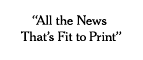
Tomorrow makes 114 years on the front page for the best-known slogan in American journalism.
114 years on the front
The slogan, of course, is “All the News That’s Fit to Print,” which first appeared February 10, 1897, in the upper left corner (the left ear) of the front page New York Times.
I’ve called them the most famous seven words in American journalism and they have been endlessly parodied and analyzed since 1897. Even admirers of the Times have conceded that “All the News That’s Fit to Print” is “overweening” and even “elliptical.”
As I discussed in my 2006 book, The Year That Defined American Journalism: 1897 and the Clash of Paradigms, the motto has given rise to some lofty claims over the years. In 1901, at the 50th anniversary of its founding, the Times referred to “All the News That’s Fit to Print” as its “covenant.”
In 2001, a columnist for the Wall Street Journal described the motto as the “leitmotif not merely for the Times, but also, by a process of osmosis and emulation, for most other general-interest papers in the country, as well as for much of the broadcast media.”
Adolph Ochs began using the slogan soon after acquiring control of the then-beleaguered Times in August 1896. At first, Ochs made use of “All the News That’s Fit to Print” as an advertising and marketing device.
The slogan’s debut came in early October 1896, spelled out in a row of red lights on an advertising sign the Times had rented at New York’s Madison Square.
Four months later, without fanfare or explanation, the slogan appeared in the “left ear” of the front page. It has appeared in that place of prominence ever since.
In touting “All the News That’s Fit to Print,” Ochs clearly sought to distance the Times from the yellow press of William Randolph Hearst and Joseph Pulitzer. Their flamboyant newspapers dominated New York City’s media landscape in the late 1890s.
Ochs was nothing if not aggressive in promoting the Times and in seeking to position the newspaper as a sober counterweight to the activism and excesses of the yellow press.
To that end, he launched in late October 1896 a contest inviting readers to propose “a phrase more expressive of the Times’ policy” than “All the News That’s Fit to Print,” which by then had taken a modest place in a corner of the Times’ editorial page.
The Times promised to pay $100 to the person who proposed in ten words or fewer a slogan deemed better than “All the News That’s Fit to Print.”
The motto contest, cheesy though it may seem today, stirred a fair amount of attention–and reader interaction–in 1896.
Among the thousands of entries sent to the Times were such clunky suggestions as “All the News Worth Telling,” “All the News That Decent People Want,” and “The Fit News That’s Clean and True.”
Among the others:
“Full of meat, clean and neat.”
“Instructive to all, offensive to none.”
“The people’s voice, good the choice.”
“Aseptic journalism up to date.”
“Yours neatly, sweetly, and completely.”
As I wrote in The Year That Defined American Journalism: “Before the contest ended, the Times altered the stakes by making clear it would not abandon ‘All the News That’s Fit to Print.’
“The Times,” I wrote, “justified this change of heart by saying no phrase entered in the contest was more apt and expressive than ‘All the News That’s Fit to Print.’ The $100 prize would be awarded, to the person adjudged to have submitted the best entry. But the motto would not be changed.”
But the entries kept rolling in. Other suggestions included:
“Bright as a star and there you are.”
“All the news to instruct and amuse.”
“Pure in purpose, diligent in service.”
“You do not want what the New-York Times does not print.”
“All that’s new, true, and clever.”
Another entry was inspired by rival titles in fin-de-siècle New York:
“Out heralds The Herald, informs The World, extinguishes The Sun.” (That suggestion is evocative of the slogan of New York Newsday, a tabloid that ceased publication in 1995 after 10 years: “On top of the News, ahead of the Times.”)
As the motto contest neared its close in early November 1896, the Times noted that that some people had “sent in diagrams and even pictures.
“While these exhibit both skill and thought,” the newspaper said, “they cannot be accepted, because they are not wanted.”
A committee of Times staffers winnowed the entries to 150 semi-finalists, which were submitted to Richard Watson Gilder, editor of The Century magazine. Gilder selected these as finalists:
- Always decent; never dull.
- The news of the day; not the rubbish.
- A decent newspaper for decent people.
- All the world’s news, but not a school for scandal.
As I wrote in The Year That Defined American Journalism, Gilder noted “that terms of the contest had changed from the original intent of selecting a slogan that ‘more aptly express the distinguishing characteristics of the New-York Times’ to the more theoretical task of determining which entry ‘would come nearest to it in aptness.’”
That entry, Gilder determined, had been submitted by D.M. Redfield of New Haven, Connecticut. Redfield’s suggestion:
“All the world’s news, but not a school for scandal.”
Catchy, that.
Many thanks to Jim Romenesko for linking to this post
Recent and related:
- ‘Follow the money’: Why the made-up Watergate line endures
- New York Times practices ‘yellow journalism’? How so?
- The ‘anniversary’ of a media myth: ‘I’ll furnish the war’
- Two myths and today’s New York Times
- Fact-checking Keller on NYT-Bay of Pigs suppression myth
- More than merely sensational
- Yellow journalism: A sneer is born
- 1897 flashback: Committing ‘jailbreaking journalism’
- ‘War Lovers’: A myth-indulging disappointment
- Obama, journalism history, and ‘folks like Hearst’
- Blaming assassination on political rhetoric: No new tactic
- Media myths, the ‘junk food of journalism’
- ‘Persuasive and entertaining’: WSJ reviews ‘Getting It Wrong’


 Media Myth Alert
Bay of Pigs, Commentary, Cuba, Debunking, Fact-checking, Getting It Wrong, History, Journalism, Keller, Media, Media-driven myths, New York Times, News, Research
Fact-checking Keller on NYT-Bay of Pigs suppression myth
In Anniversaries, Bay of Pigs, Debunking, Media myths, New York Times on January 28, 2011 at 11:57 am'Publish it did'
In an article to be published Sunday, Bill Keller, executive editor of the New York Times, rubs shoulders with a tenacious media myth linked to the newspaper’s reporting in the run-up to the Bay of Pigs invasion nearly 50 years ago.
I devote a chapter to the New York Times-Bay of Pigs suppression myth in my latest, mythbusting book, Getting It Wrong.
The suppression myth has it that the Times, at the request of President John F. Kennedy, suppressed or emasculated its reporting about the pending Bay of Pigs invasion of Cuba.
But as I discuss in Getting It Wrong, in the 10 days before the ill-fated assault, the Times published several detailed reports on its front page discussing an invasion and exiles’ calls to topple Fidel Castro. And, I note, there is no evidence that Kennedy either asked or persuaded the Times to suppress, hold back, or dilute any of its pre-invasion reporting.
“The anecdote about the Times’ self-censorship is potent, compelling, instructive, and timeless,” I write in Getting It Wrong . “It also is apocryphal, a media-driven myth.”
Keller, though, repeats the myth in a lengthy article to run in the Times Sunday magazine about his newspaper’s dealings with Julian Assange, head of Wikileaks, which not long ago disclosed the contents of thousands of classified U.S. diplomatic cables.
Keller invokes the Bay of Pigs as an example of the newspaper’s having erred “on the side of keeping secrets.”
He writes:
“I’m the first to admit that news organizations, including this one, sometimes get things wrong. We can be overly credulous (as in some of the prewar reporting about Iraq’s supposed weapons of mass destruction) or overly cynical about official claims and motives. We may err on the side of keeping secrets (President Kennedy reportedly wished, after the fact, that The Times had published what it knew about the planned Bay of Pigs invasion, which possibly would have helped avert a bloody debacle) or on the side of exposing them. We make the best judgments we can.”
Had Keller consulted the newspaper’s database of reporting about the run-up to the Bay of Pigs invasion in April 1961, he would have found that the Times reported in detail, if not always accurately, about the preparations to infiltrate a U.S.-trained brigade of Cuban exiles in an attempt to topple Fidel Castro.
The invasion failed, and the anti-Castro exiles were mostly killed or captured. The foreign policy debacle came less than three months into Kennedy’s presidency.
As I write in Getting It Wrong, “the notion that Kennedy asked or persuaded the Times to suppress, hold back, or dilute any of its reports about the pending Bay of Pigs invasion is utter fancy. There is no evidence that Kennedy or his administration knew in advance about the Times report of April 7, 1961, a front-page article that lies at the heart of this media myth” (see image, above).
The report was filed from Miami by veteran Timesman Tad Szulc who, I write, “pieced together the outline of CIA-backed plans to attempt to topple Castro with an invasion force of Cuban exiles who had been trained in Guatemala.”
The invasion plans, Szulc found, were an open secret in Miami. “It was,” he was later to say, “the most open operation which you can imagine.”
On April 6, 1961, Szulc filed a dispatch to New York, reporting that 5,000 to 6,000 Cuban exiles had been trained in a plan to overthrow Castro, that invasion plans were in their final stages, and that the operation had been organized and directed by the CIA.
Szulc’s dispatch report ran more than 1,000 words and, I write in Getting It Wrong, “set off a flurry of intense consultations among senior editors.” Their deliberations revolved around three elements: Szulc’s characterization that the invasion was imminent, the reference to the operation being CIA-directed, and the prominence the report should receive on the Times front page.
In the end, the references to the invasion’s imminence were dropped; it was more prediction than fact, as James Reston, the Times Washington bureau chief at time, pointed out. (The invasion was launched April 17, 1961, 11 days after Szulc filed his dispatch.)
The reference to CIA also was dropped, in favor of the more nebulous terms phrases, “U.S. officials” and “U.S. experts. The then-managing editor, Turner Catledge, later wrote that the decision was based on the reality the government had more than a few intelligence agencies, “and I was hesitant to specify the CIA when we might not be able to document the charge.”
As for the report’s prominence, the decision was to publish Szulc’s story on the front page, beneath a single-column headline, instead of a four-column headline. Given that the invasion wasn’t deemed imminent, a four-column headline was difficult to justify.
I write in Getting It Wrong that although “the headline size was modified, Szulc’s report hardly can be said to have been played down. It certainly had not been spiked, diluted, or emasculated. Szulc’s report, as Catledge wrote, made ‘perfectly clear to any intelligent reader that the U.S. government was training an army of Cuban exiles who intended to invade Cuba.'”
As Timesman Harrison Salisbury wrote in Without Fear or Favor, his insider’s account of the Times:
“The government in April 1961 did not … know that The Times was going to publish the Szulc story, although it was aware that The Times and other newsmen were probing in Miami. … The action which The Times took [in editing Szulc’s report] was on its own responsibility,” the result of internal discussions and deliberations recognizable to anyone familiar with the give-and-take of newsroom decision-making.
But most important, as Salisbury pointed out, “The Times had not killed Szulc’s story. … The Times believed it was more important to publish than to withhold.
“Publish it did.”
As for Kennedy’s remark, that he wished the Times “had run everything on Cuba”: The comment was vague and self-serving, an attempt to deflect blame from his administration’s first-rate foreign policy disaster.
Besides, what was it that the Times supposedly held back? The president didn’t specify.
Nor does Keller.
WJC
Many thanks to Instapundit Glenn Reynolds for linking to this post
Recent and related:
[i] Arthur Schlesinger, the historian and Kennedy adviser, claimed that Szulc’s story had been “emasculated” by Times editors. See “Rebuttal Is Made by Schlesinger,” New York Times (14 June 1966): 15.
Share this: