W. Joseph Campbell

Posts Tagged ‘Year studies’

‘War Lovers’: A myth-indulging disappointment

In 1897, Furnish the war, Media myths, Spanish-American War, Yellow Journalism on May 2, 2010 at 3:37 pm

I had a chance today to thumb through The War Lovers, the widely reviewed new book by Evan Thomas about the run-up to Spanish-American War.

But I didn’t buy it. It’s a myth-indulging disappointment.
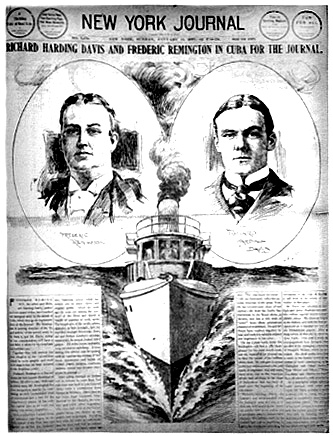
Remington in Cuba

In sections of the book about the yellow press period at the end of the 19th century, Thomas ignored–or was unaware of–recent scholarship that has cast serious doubt on anecdotes he included.

Notably, Thomas embraced the media-driven myth of William Randolph Hearst’s purported vow to “furnish the war” with Spain–a vow supposedly contained in a telegram to the artist Frederic Remington, on assignment in Cuba.

It is perhaps American journalism’s best-known tale. But as I wrote in my 2001 book, Yellow Journalism: Puncturing the Myths, Defining the Legacies, the anecdote almost certainly is apocryphal.

It lives on despite a nearly complete absence of supporting documentation. It lives on even though the telegram Hearst’s reputedly sent has never turned up. It lives on even though Hearst denied ever sending such a message.

And it lives on despite an obvious and irreconcilable internal inconsistency: It would have been absurd for Hearst to have vowed to “furnish the war” because war—specifically, the Cuban rebellion against Spain’s colonial rule—was the reason Hearst sent Remington to Cuba in the first place.

Remington was there in early 1897, at a time when anyone reading U.S. newspapers would have been quite aware that Cuba for two years had been a theater of a very nasty war. By 1897, Spain had sent nearly 200,000 soldiers to Cuba in a failed attempt to put down the rebellion, which in 1898 gave rise to the Spanish-American War.

Thomas–whose biography at Amazon.com says he “is one of the most respected historians and journalists writing today”–overlooked almost all of that.

He cited as his authority James Creelman, the pompous, hyperbolic reporter for Hearst’s New York Journal who recounted the anecdote, without documentation, in his 1901 memoir, On the Great Highway.

Creelman presented the “furnish the war” anecdote in an admiring way, saying it demonstrated how Hearst’s “yellow journalism” had an eye toward the future and was good at anticipating events. But over the years, the vow has taken on the more sinister overtones, of the sort that Thomas invoked in his book.

The anecdote’s evolution over the past 110 years is discussed in Chapter One of Getting It Wrong, my forthcoming book on media-driven myths.

Creelman, by the way, wasn’t with Remington in Cuba in early 1897. He wasn’t in New York with Hearst, either. Creelman was in Europe, as the Journal‘s special correspondent on the continent. So he would not have had first-hand knowledge about the “furnish the war” telegram, had Hearst sent it to Remington in Cuba.

Thomas indulged in another myth of yellow journalism, one that centers around what I call the greatest escape narrative in American media history.

In what also is known as the case of “jail-breaking journalism,” Hearst’s Journal organized the escape in 1897 of a 19-year-old Cuban political prisoner named Evangelina Cisneros.

By then, she had been held in a Havana jail, without trial, for 15 months on suspicion of conspiring to kill a senior Spanish military officer. Cisneros claimed the officer had made her the target of unwelcome sexual advances.

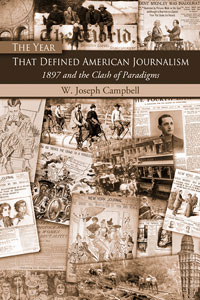
As I described in my 2006 book, a year-study titled The Year That Defined American Journalism: 1897 and the Clash of Paradigms,  Hearst sent a reporter named Karl Decker to Cuba, ostensibly as the Journal correspondent in Havana.

In reality, Decker was under orders to organize the rescue of Cisneros.

With the quiet help of U.S. diplomatic personnel in Cuba, and with the vital support of a clandestine smuggling network in Havana, Decker succeeded: He and two accomplices broke Cisneros out of jail in early October 1897. She was smuggled aboard a passenger steamer to New York City, where Hearst organized a delirious reception for her.

Thomas claimed that Decker, in articles the Journal published about jailbreak, “neglected to inform readers that he had bribed the guards, who arranged the theater of the escape as a way to save face.”
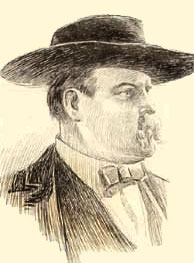
Decker

Such claims have circulated since 1897, mostly as a way to denigrate the Journal and its brazen accomplishment. Decker did say he tried, but failed, to bribe the jailer.

As is noted in The Year That Defined American Journalism, the evidentiary record to support the claim that bribes were paid is very, very thin.

“No one has identified to whom bribes were paid, how much, by what method, and how the purported payoffs secured the enduring silence of the authorities,” I wrote, adding:

“The allegations or suspicions of bribery rest more on assertion—and newspaper rivals’ contempt for the Journal—than on specific, persuasive documentation.”

It’s a good story, though. Like many media-driven myths, the Decker-bribery tale is delicious and enticing.

But it withers under scrutiny.
WJC

‘Getting It Wrong’ at Kensington’s ‘Day of the Book’

In 1897, Debunking, Media myths, Year studies on April 25, 2010 at 8:19 am

I participated today in the “Day of the Book” festival in the antique row section of  Kensington, MD.

The event represented first book-event exposure for Getting It Wrong, my forthcoming book that addresses, and debunks, 10 prominent media-driven myths.

Getting It Wrong will be published this summer by University of California Press. Chapter One may be read here.

Also on display at the “Day of the Book” was my year study, The Year That Defined American Journalism: 1897 and the Clash of Paradigms, which was published in 2006. The book tells the story of a decisive year in American journalism.

Book signing in Kensington (AMR photo)

Principal organizer of the “Day of the Book” was Kensington Row Bookshop and at least 80 authors and poets had registered for the event.

The threat of rain kept some of them away. But nasty weather was a no-show and a fine time was had.

I enjoyed meeting several other local authors, including Bernadette LeDoux-Brodsky,  a Parisienne who used to teach French at Georgetown University; Bob Gregg, a retired dean and professor at American University, and Ben Farmer, a young author who graduated a few years ago from Kenyon College.

Bernadette said the ambiance in Kensington evoked for her the cafe scene of streets in Paris–sans les apéritifs, of course. She sold copies of her Ici et Ailleurs: Parisienne dans le Maryland. Bob sold several of his novels, among them The Scarecrow in the Vineyard. And the gregarious Ben Farmer seemed to make a lot of friends as well several sales of his new novel, Evangeline.

For me, the event was mostly a chance to gauge interest in Getting It Wrong. And more men than women stopped by to chat about the book and/or take a flyer.

There also was some mild interest in The Year That Defined American Journalism (see book-signing photo, above).

The dog in the picture? That’s Lil, our bichon frise. She was at the book fair, too, and proved to be quite the magnet.

WJC

Today’s Boston Marathon: Recalling the 1897 inaugural run

In 1897, Anniversaries, Year studies, Yellow Journalism on April 19, 2010 at 7:17 pm

An ESPN columnist said it well today:

“The Boston Marathon turned 114 years old on Monday, but it never gets old.”

Indeed. The Boston Marathon is perhaps the most famous and prestigious race of its kind in the United States.

The first running of the storied marathon was in 1897, the year that defined American journalism.  The race was one of the year’s landmark moments.

As I wrote in a book by that title, the inaugural Boston Marathon was run April 19, 1897, having been “inspired by the revival of the marathon race at the first modern Olympic games in 1896.”

The course, I noted in The Year That Defined American Journalism, began in Ashland, Massachusetts, and was 24.5 miles long–about 1.5 miles shorter than that of a contemporary marathon race.

Fifteen men were in the field in 1897.

Some  of them, said the Boston Post, in revealing a delicious sense for detail, “looked as if they could spare a few pounds.”

Winner of the 1897 Boston Marathon

Along the course that spring day, “the runners answered the cheers of spectators with bows and waves.”

The winner of the inaugural run was John J. McDermott of the Pastime Athletic Club in New York. He finished the course in 2 hours, 55 minutes, and 10 seconds, which the Boston Globe said exceeded the record time of the 1896 Olympics.

McDermott supposedly dropped nine pounds during the race, suffered severe leg cramps, and was forced to cut through a funeral procession as the marathon neared the finish line, where some 3,000 spectators awaited.

“This probably will be my last long race,” McDermott said afterward. “I hate to quit now, because I will be called a quitter and a coward, but look at my feet.

“Do you blame me for wanting to stop it? I only walked about a quarter of a mile in the whole distance and it was 20 miles before I lagged a step.”

But, he added, “I think I shall be all right tomorrow.”

McDermott entered the 1898 edition of Boston Marathon, and finished fourth.

WJC

<!–[if !mso]>

The winner was John J. McDermott of the Pastime Athletic Club in New York, who finished the course in 2 hours, 55 minutes, and 10 seconds, which the Boston Globe said exceeded the record time of the 1896 Olympics.[i] McDermott dropped nine pounds, suffered severe leg cramps, and was forced to cut through a funeral procession on the last leg of the race. Some 3,000 spectators awaited at the finish line.[ii] “This probably will be my last long race,” McDermott said afterward. “I hate to quit now, because I will be called a quitter and a coward, but look at my feet. Do you blame me for wanting to stop it? I only walked about a quarter of a mile in the whole distance and it was 20 miles before I lagged a step. I think I shall be all right tomorrow.”


[i]. “Record Time,” Boston Globe (20 April 1897): 1.

[ii]. The crowd estimate appeared in “Beat the Greeks,” Boston Post (20 April 1897): 8.

The murky derivation of ‘All the News That’s Fit to Print’

In 1897, Media myths, New York Times, Year studies on February 11, 2010 at 8:39 am

Prominent and famous though it is, the derivation of “All the News That’s Fit to Print,” the New York Times’ famous motto, is shrouded in a bit of media myth.

The version the Times advanced at its centenary in 1951, in a house newsletter called Times Talk, described the motto as “a hybrid.” Times Talk said Adolph Ochs, who acquired the then-beleaguered Times in 1896, borrowed a key portion of the slogan from the Philadelphia Times.

The Times Talk account was cited by Susan E. Tifft and Alex S. Jones in their prodigious study, The Trust: The Private and Powerful Family Behind The New York Times.

Supposedly, Ochs borrowed “All the News,” the motto of the Philadelphia Times, appended “That’s Fit to Print,” and thus concocted the most famous seven-word phrase in American journalism.

The account, however, is incorrect.

The Philadelphia Times never used “All the News” as its motto during the summer and fall of 1896, when Ochs acquired control of the Times and began using “All the News That’s Fit to Print” as a marketing and advertising slogan.

A thorough review of issues of the Philadelphia Times published in the summer and fall of 1896 showed that the newspaper carried a number of promotional statements, none of which was particularly pithy, or memorable.

As I wrote in my 2006 book, a year study titled The Year That Defined American Journalism: 1897 and the Clash of Paradigms, the nearest approximation to “All the News” was this rambling assertion, which appeared a few times beneath the front page nameplate of the Philadelphia Times:

“If You Want All the News of Every Description Attractively Presented You Will Read the Times.”

That clunky phrase appeared in the Philadelphia Times on August 4, 11, and 17, 1896. Ochs, according to Tifft and Jones, was installed as the New York Times publisher on August 18, 1896.

“All the News That’s Fit to Print” did not makes its début until early October 1896, spelled out in a row of red lights on an advertising sign above New York’s Madison Square.

Later that month, “All The News That’s Fit to Print” appeared in New York Times advertisements published in the trade journal Fourth Estate. By the end of October 1896, the phrase had taken a place in a corner of the Times’ editorial page.

And 113 years ago yesterday, on February 10, 1897, the Times moved the phrase without notice or fanfare to the upper left corner, the left “ear,” of its front page—a place of prominence that it has occupied ever since.

What prompted the motto’s move to the front page is not entirely clear. But the intent seems undeniable: To offer a rebuke to the bold, self-promoting yellow journalism of William Randolph Hearst and Joseph Pulitzer.

But it appears that “All the News That’s Fit to Print” was Ochs’ creation, as Harrison E. Salisbury maintained in Without Fear or Favor: The New York Times and Its Times, an impressive insider’s study of the Times. (Salisbury cited as his source an Ochs manuscript in the Times archives.)

By the way, I quote Salisbury’s Without Fear or Favor in Getting It Wrong, my forthcoming book about media-driven myths.

Without Fear or Favor was a useful source in the chapter in Getting It Wrong that addresses the myth surrounding the Times’ reporting in the run-up to the Bay of Pigs invasion in April 1961.

WJC

A nod to ‘Big Years’

In 1897, Year studies on December 13, 2009 at 8:21 pm

The “Outlook” section of today’s Washington Post carries an interesting look at recent books about important years.  “Year studies,” as they’re known in the academy.

The Post article, by the “Outlook” editor Carlos Lozada, noted that several studies were published in 2009 about years that changed the world or changed everything. “In an homage to anniversaries divisible by 10,” Lozada wrote, these books “focus on 1959, 1969, 1979 and, of course, 1989 (though ’99 is absent. Too soon?).”

As it turns out, he added, “there is plenty of competition in the Big Years department; identifying history’s most consequential calendar is a well-worn genre for journalists and historians, producing books such as David McCullough’s ‘1776,’ Margaret MacMillan’s ‘Paris 1919,’ Ray Huang’s brilliantly titled ‘1587: A Year of No Significance’ and countless more.”

Lozada might well have mentioned the first year study about U.S. media — my 2006 book, The Year That Defined American Journalism: 1897 and the Clash of Paradigms.

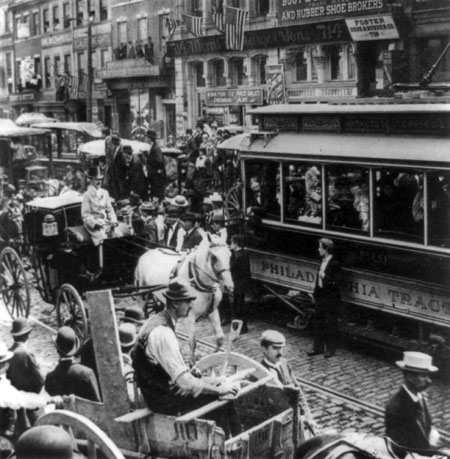
Philadelphia street scene in 1897

As I wrote in The Year That Defined American Journalism:

“Significantly, 1897 was the year when American journalism came face-to-face with a choice among three rival and incompatible visions, or paradigms, for the profession’s future. The emergence of these rival visions is central to the exceptionality of 1897. The choices that materialized then were to set a course for American journalism in the twentieth century and beyond.

“The most dramatic of the three paradigms was the self-activated, participatory model of [William Randolph] Hearst’s yellow journalism. Hearst called it the ‘journalism of action’ or the ‘journalism that acts.’ It was a paradigm of agency and engagement that went beyond gathering and publishing the news. Hearst’s New York Journal, the leading exemplar of the activist paradigm, argued that newspapers were obliged to inject themselves, conspicuously and vigorously, in righting the wrongs of public life, and in filling the void of government inaction and incompetence. …

“The antithesis of the ‘journalism of action’ was the conservative, counter-activist paradigm represented by the New York Times [of Adolph Ochs] and its lofty commitment to ‘All the News That’s Fit to Print.’ The Times model emphasized the detached, impartial, yet authoritative treatment of news. Unlike its conservative counterparts such as the New York Sun, the Times was not reluctant to adapt innovative technologies of the 1890s. The Times in 1897 made memorable use of halftone photographs in its upscale Sunday magazine supplement, presenting the images in a sober, restrained manner quite unlike the flashy treatment typical of Hearst’s yellow journalism.

The Year That Defined American Journalism: About the 'Big Year,' 1897

“The most eccentric of the three paradigms was non-journalistic, even anti-journalistic: It was a literary approach pursued by Lincoln Steffens upon his becoming city editor of the New York Commercial Advertiser in late 1897. Deliberately, and even demonstratively, Steffens shunned veteran newspapermen and instead recruited college-educated writers who had little or no experience in journalism. He then sent them out to write, to hone their talent by telling stories about the joys, hardships, and serendipity of life in New York City.”

Eighteen-ninety-seven also was the year of publication of what became American journalism’s best-known, most-reprinted editorial, the New York Sun‘s “Is There A Santa Claus?” It also was the year when the term “yellow journalism” first appeared in print, in the old New York Press. And the Times motto, “All the news that’s fit to print,” was given a permanent berth on the newspaper’s front page in 1897.

Moreover, the cinema in 1897 was in its “novelty year.” The presidential inauguration of William McKinley in March 1897 was the first to be captured on film.

But back to Lozada: He closed his article by ruminating about whether 2009 eventually will be recalled as a “Big Year.”

At this point, of course, who can tell? Lozada’s take: “it may not be a 1776 or a 1989, but 2009 seems destined to go down as a year of at least some significance. What for? Who knows. We just live here. Fortunately, it needn’t be for something that actually happened in these past 12 months, but perhaps for some future event that will be linked to our calendar.”

Not everyone finds the year study very appealing. A snarky review published during the summer in Canada’s National Post began by noting:

“Lately, it seems not a year goes by without a new book proclaiming a certain 12-month period the Most Important Year Ever.” That’s a fair point.

But in mild defense of the year-study approach, allow me to say that The Year That Defined American Journalism brought a measure of methodological freshness to journalism history. Before then, the single-year study had been neglected or overlooked in the field.

WJC