W. Joseph Campbell

Archive for July, 2013|Monthly archive page

Correction or clarification needed in WaPo reference to Nixon’s ‘secret plan’ on Vietnam

In Debunking, Error, Media myths, Washington Post on July 27, 2013 at 1:57 pm
WaPo_HThomas obit_2013

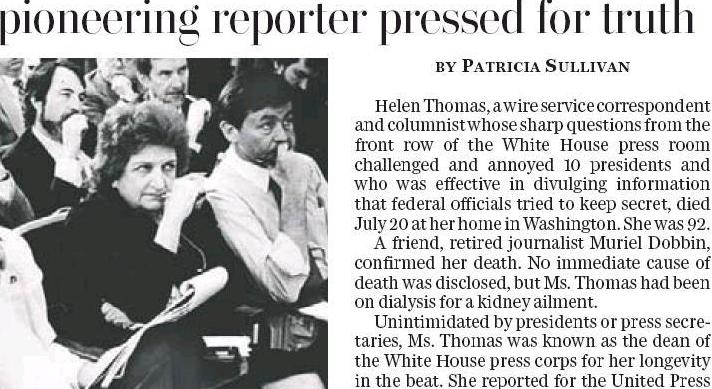
Portion of WaPo’s front-page obit about Thomas

The Washington Post needs to correct or clarify a questionable claim in its recent glowing obituary about journalist Helen Thomas.

The obituary stated that Thomas once “asked President Richard M. Nixon point-blank” about “his secret plan to end the Vietnam War.”

I have asked the obituary’ author, Patricia Sullivan, when and where Thomas posed such a question, but Sullivan has not offered a direct reply.

As noted in a Media Myth Alert post on Sunday, the nearest reference I could find to Thomas’ having raised such a question was at a White House news conference on January 27, 1969. According to a transcript the Post published the following day, Thomas asked:

“Mr. President, what is your peace plan for Vietnam?” She did not ask about a secret plan.

The issue here is larger than a likely error in a front-page obituary.

The more important issue centers around the notion that Nixon campaigned for the presidency in 1968 saying he had a “secret plan” to end the Vietnam War. That notion is historically imprecise. Yet it circulates still, as evidence supposedly of Nixon’s duplicity.

There’s better evidence of his duplicity than the “secret plan” chestnut. Simply put, Nixon did not tout a “secret plan” for Vietnam during his 1968 campaign.

I sent Sullivan an email a week ago (when the obituary was posted online), asking when and where Thomas had questioned Nixon about a “secret plan.” Five days later, Sullivan replied by email, saying:

“I recall the Nixon years and his promise during his candidacy that he had a plan to end the Vietnam War, which he would not explain in detail. Hence it was dubbed his ‘secret plan’ to end the war, and is widely referenced as such in the news articles of the time, many of which I reviewed while writing this obit (in 2008).”

I sent Sullivan a follow-up email, asking again when and where Thomas questioned Nixon about a “secret plan.” She has not replied to that query.

Meantime, I consulted a database containing full-text content of leading U.S. daily newspapers, and found almost no reporting in 1968 and early 1969 about Nixon’s having, or claiming to have, a “secret plan.”

The combined search terms “Nixon,” “secret plan” and “Vietnam” produced only three returns — an advertisement taken out by Democrats,  an article about Nelson Rockefeller’s plans to run for president, and a brief wire service item in the Post that quoted a Democratic congressman as urging Nixon to discuss his “secret plan” on Vietnam. The search period was January  1, 1968, through February 1, 1969, a time span covering the 1968 campaign, Nixon’s inauguration, and his news conference in late January 1969. Newspapers in the database include the New York TimesLos Angeles Times, Baltimore Sun, Chicago Tribune, Wall Street  Journal, and the Washington Post.

Searching the same period for “Nixon,” “secret plans” and “Vietnam” produced one return, an article published in the Los Angeles Times in which Nixon insisted he had “no gimmicks or secret plans” for ending the war.

The article further quoted Nixon as saying:

“If I had any way to end the war, I would pass it on to President [Lyndon] Johnson.” (Nixon’s comments came a few days before Johnson announced he would not seek reelection.).

The database search makes clear that Nixon’s having a “secret plan” was not, contrary to Sullivan’s claim in her email, “widely referenced” in news articles at that time.

Additionally, neither The Making of the President 1968  nor The Selling of the President — major book-length treatments about the 1968 presidential election — contain the phrase “secret plan” or “secret plans.” (Neither phrase turned up in applying the Amazon.com “search inside” feature to those books.)

If Sullivan can point to an occasion when Thomas asked Nixon “point-blank” about having a “secret plan” on Vietnam, then that would represent an interesting if modest contribution to our understanding about Nixon’s campaign in 1968. It would indicate that journalists then suspected he was less than candid and forthcoming about his intended war policy.

If, on the other hand, Sullivan cannot identify such an occasion, then a correction seems in order.

As I say, the Post’s obituary was glowing, so glowing it took until the 12th paragraph to mention Thomas’ anti-Semitic remarks in 2010 — hateful words that effectively ended her career.

A far more searching and clear-eyed assessment of Thomas and her journalism was offered in Jonathan S. Tobin’s essay for Commentary magazine.

“Thomas’s prejudice was not a minor flaw,” Tobin wrote, referring to her anti-Semitic comments. “It was a symptom not only of her Jew-hatred but also of a style of journalism that was brutally partisan and confrontational.”

Thomas, he wrote, deserves a “share of the credit for the creation of an ugly spirit of partisanship that characterizes much of the press.”

Indeed.

WJC

More from Media Myth Alert:

WaPo, Helen Thomas, and Nixon’s ‘secret plan’

In Debunking, Error, Media myths, Newspapers, Washington Post on July 21, 2013 at 11:55 am

Today’s Washington Post carries a lengthy obituary about Helen Thomas, lauding the 92-year-old former White House reporter who died yesterday for her “unparalleled experience covering the presidency.”

A glowing tribute to Helen Thomas

WaPo’s glowing tribute to Helen Thomas

What caught the eye of Media Myth Alert was the Post’s unsourced claim that Thomas had once asked President Richard M. Nixon “point-blank what his secret plan to end the Vietnam War was.” I sent an email yesterday to Patricia Sullivan, author of Thomas obituary, asking about the unsourced claim; she has not replied.

The only proximate reference I could find to Thomas’s having posed such a question was at a White House news conference on January 27, 1969. Given her seniority, Thomas was granted the first question.

“Mr. President,” she asked, “what is your peace plan for Vietnam?” Peace plan, not secret plan.

According to a transcript of the news conference that the Washington Post published the following day, Nixon focused his response on the Vietnam peace talks then underway in Paris.

The issue here is greater than a possible error in a glowing tribute — so glowing that the obituary waits until the 12th paragraph to mention Thomas’ ugly remarks about Jews, which ended her career in 2010.

The notion that Nixon campaigned for the presidency in 1968 on a “secret plan” to end the Vietnam War is a hoary assertion that circulates still, often invoked as telling evidence of Nixon’s duplicity. The claim is of thin grounding.

Helen Thomas embraced the tale, though, writing in her wretched 2006 book, Watchdogs of Democracy?:

“Throughout that campaign in 1968 … Nixon said he had a ‘secret’ plan to end the war. Reporters never got to ask him what it was. Not until he got into the White House did we learn it was Vietnamization — to try to turn the fighting over to the South Vietnamese.”

But Nixon was asked during the campaign whether he had a secret plan to end the war.  According to a report published by the Los Angeles Times on March 28, 1968, Nixon replied that he had “no gimmicks or secret plans.”

He also said: “If I had any way to end the war, I would pass it on to President [Lyndon] Johnson.” (Nixon’s comments were made a few days before Johnson announced he would not seek reelection.)

A fairly detailed assessment of the “secret war” tale was published in 2000 by William Safire, a columnist for the New York Times and a former Nixon speechwriter. Safire wrote:

“That sinister phrase — secret plan — has resonance to veteran rhetoricians and students of presidential campaigns. In the 1968 primaries, candidate Richard Nixon was searching for a way to promise he would extricate the U.S. from its increasingly unpopular involvement in Vietnam. The key verb to be used was end, though it would be nice to get the verb win in some proximity to it.

“One speechwriter came up with the formulation that ‘new leadership will end the war and win the peace in the Pacific.’ Nixon made it part of his stump speech, and the juxtaposition of end and win — though it did not claim to intend to win the war, but only the peace ….

“When a U.P.I. reporter pressed Nixon for specifics, the candidate demurred; the reporter wrote that it seemed Nixon was determined to keep his plan secret, though he did not quote Nixon as having said either secret or plan. But …  it became widely accepted that Nixon had said, ‘I have a secret plan to end the war.'”

The lead paragraph of the United Press International report to which Safire referred stated:

“Former Vice President Richard M. Nixon vowed Tuesday [March 5, 1968] that if elected president, he would ‘end the war’ in Vietnam. He did not spell out how.”

It does sound a bit slippery, a bit Nixonian. But it’s no claim of a “secret plan.” So there seems little substance to the notion, which Thomas embraced in her book, that Nixon campaigned in 1968 on a “secret plan” to end the war.

WJC

More from Media Myth Alert:

The Nixon tapes: A pivotal Watergate story that WaPo missed

In Anniversaries, Error, Media myths, Newspapers, Scandal, Washington Post, Watergate myth on July 14, 2013 at 8:45 am

Forty years ago this week, Alexander Butterfield told a U.S. Senate select committee investigating the Watergate scandal that President Richard Nixon had installed a secret audiotaping system in his offices.

Butterfield’s disclosure was one of the most decisive moments in the Watergate. It focused the scandal’s multiple investigations into a months-long pursuit of the tapes — one of which clearly revealed Nixon’s role in attempting to cover up the crimes of Watergate. That revelation forced his resignation in August 1974.

The disclosure of Nixon’s audiotaping system was a major story which the Washington Post — often and inaccurately credited with having “uncovered” or “broken” the Watergate scandal — missed badly.

How the Post fumbled that story makes for an intriguing sidebar at the anniversary of Butterfield’s stunning disclosure. The newspaper’s lead Watergate reporters, Bob Woodward and Carl Bernstein, described in a book about their reporting how leads about the taping system were not pursued.

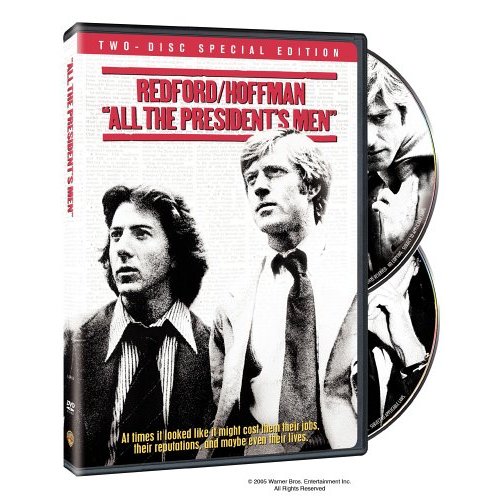
The book, All the President’s Men, says that Woodward had found out about private testimony that Butterfield had given to staff members of the select committee and he called Ben Bradlee, the Post’s executive editor, for guidance.

The call to Bradlee was on a Saturday night. After outlining what he knew, Woodward, according to the book, said:

“We’ll go to work on it, if you want.”
In reply, Bradlee is quoted as saying with some slight irritation, “Well, I don’t know.”

How would you rate the prospective story? Woodward asked him.

“B-plus,” Bradlee replied.

Woodward figured a B-plus wasn’t much, according to the book.

“See what more you can find out, but I wouldn’t bust one on it,” Bradlee is quoted as instructing Woodward.

And Woodward didn’t “bust one.”

Two days later, on July 16, 1973, Butterfield made his reluctant disclosure at a public session of the Senate select committee.

The following day, according to All the President’s Men, Bradlee conceded that the lead about the taping system was “more than a B-plus.”

The anecdote from All the President’s Men is suggestive of the overall minor role that the Post played in uncovering Watergate. As I point out in my media-mythbusting book, Getting It Wrong, unraveling a scandal of the dimension of Watergate “required the collective if not always the coordinated forces of special prosecutors, federal judges, both houses of Congress, the Supreme Court, as well as the Justice Department and the FBI.

“Even then, Nixon likely would have served out his term if not for the audiotape recordings he secretly made of most conversations in the Oval Office of the White House. Only when compelled by the Supreme Court did Nixon surrender those recordings, which captured him plotting the cover-up” of Watergate’s signal crime, the breakin in June 1972 at the headquarters of the Democratic National Committee.

All the President’s Men was revealing in other ways about the work and conduct of Woodward and Bernstein. Media critic Jack Shafer, in a column in 2004, revisited a number of reporting flaws and ethical lapses that Woodward and Bernstein acknowledged in their book.

It’s a roster of transgressions that is too-little remembered.

WJC

More from Media Myth Alert:

Vomit humor and scandal: Inane ‘Drunk History’ TV show promotes Watergate media myth

In Cinematic treatments, Debunking, Media myths, Scandal, Washington Post, Watergate myth on July 8, 2013 at 8:10 am

Drunk History, a new cable TV show based on the inane premise that history is entertaining when told by inebriated narrators, isn’t meant to be taken seriously.

Obviously.

Drunk History, which  debuts tomorrow night on DrunkHistory_logoComedy Central (the pilot is available online), features what the show’s  Web site says is an “often incoherent narration of our nation’s history.”

If the first episode is an indication, incoherent history makes for faint humor. Even worse, the inaugural show promotes a notably tenacious media myth in offering a chaotic look at the Watergate scandal of 1972-74.

In doing so, Drunk History draws heavily, if erratically, on the 1976 film, All the President’s Men. The movie focused on Bob Woodward and Carl Bernstein’s Watergate reporting for the Washington Post — and was central to the rise of the myth that Woodward and Bernstein brought down the corrupt presidency of Richard Nixon.

The movie as inspiration

The media myth of Watergate has helped make accessible to contemporary audiences a complex scandal that unfolded 40 years ago. But it’s an inaccurate interpretation; not even the Washington Post embraces it, as I point out in my mythbusting book, Getting It Wrong.

As Woodward said in an interview several years ago with American Journalism Review:

To say the press brought down Nixon, that’s horseshit.”

But back to the blurry first episode of Drunk History: Woodward is shown meeting “Deep Throat,” his secret Watergate source, in an underground garage in suburban Virginia. And he throws up on the source’s shoes.

Vomit humor: Now that’s inspired.

Woodward then asks “Deep Throat” — who was a senior FBI official named W. Mark Felt — for help in understanding the scandal.

“Put the pieces together, you dumbass,” Felt snaps. “It’s all in front of you. Do the work. Just be careful. Watergate is the tip of the iceberg.”

In the compressed Drunk History version of Watergate, Nixon soon realizes he has no choice but to resign.

“And in the end,” the narrator says, “you can toss aside Richard Nixon for all his cynicism, you can toss aside Mark Felt for all his cynicism, but you can’t toss aside Robert Woodward, and to a lesser extent, Carl Bernstein, for the truth that they exposed for America.”

That’s really not a bad touch, tweaking the pompous Bernstein for having had a “lesser” role in Watergate. Which is not entirely inaccurate, given that Felt was Woodward’s source. Bernstein first met Felt in 2008, shortly before Felt’s death.

“Well,” the narrator says, “we told the story of Watergate. There’s no way I could possibly misconstrue it as not the greatest journalistic endeavor ever told. Robert Woodward would be proud.”

Watergate was scarcely that.

Unraveling the scandal, as I write in Getting It Wrong, “required the collective if not always the coordinated forces of special prosecutors, federal judges, both houses of Congress, the Supreme Court, as well as the Justice Department and the FBI.

“Even then, Nixon likely would have served out his term if not for the audiotape recordings he secretly made of most conversations in the Oval Office of the White House. Only when compelled by the Supreme Court did Nixon surrender those recordings,” which captured him plotting to cover up the seminal crime of Watergate, the breakin in June 1972 at the headquarters in Washington of the Democratic National Committee.

So against the complex tableau of special prosecutors, federal investigations, and bipartisan congressional panels, Woodward and Bernstein’s contributions in unraveling the scandal were modest at best, and certainly not decisive to Watergate’s outcome.

In its tipsy way, Drunk History pokes at the conventions of documentary history, as the New Yorker has noted. Otherwise, there’s little to cheer about the show, which was a Web-based series before moving to cable. Whatever humor Drunk History projects isn’t likely to be sustaining.

A far more humorous send-up of Watergate — and of Woodward and Bernstein — is the underappreciated 1999 film, Dick. Although Woodward and Bernstein are not the central characters, the movie depicts them as antagonistic incompetents who bungle their way to a Pulitzer Prize.

WJC

Many thanks to Instapundit
Glenn Reynolds for linking to this post

More from Media Myth Alert: