W. Joseph Campbell

Archive for September, 2014|Monthly archive page

The Wategate myth that offers something for everyone

In Debunking, Error, Media myths, Newspapers, Scandal, Washington Post, Watergate myth on September 27, 2014 at 1:47 pm

The heroic-journalist narrative of Watergate — the mythical and simplistic notion that the reporting of Bob Woodward and Carl Bernstein for the Washington Post brought down Richard M. Nixon’s corrupt presidency — is one of those rare tales that commands appeal across the political spectrum.
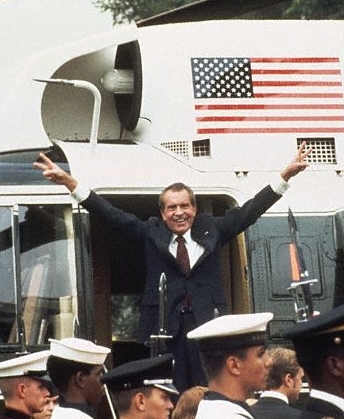
Nixon got Nixon

Nixon got Nixon

Conservative commentators sometimes invoke the narrative in bashing the news media as agenda-driven and untrustworthy. Left-wing outlets are known to embrace the meme as an ostensible example of crusading journalism that made a difference.

Both impulses were in evidence this week.

Rush Limbaugh, the conservative talk radio host, referred to Woodward and Bernstein during his show yesterday, saying they exemplified a tendency in American journalism to lust after career-shattering exposés.

“If you take somebody out,” Limbaugh said, according to a transcript of his program, “if you expose a fraud or a cheat — or if you just take out somebody that you don’t like who has a lot of power — if you as a journalist are instrumental in doing that, then you are considered worthy of advancement in that industry, and it’s best exemplified by Watergate. Woodward and Bernstein and getting Nixon, forcing Nixon to resign.”

Earlier in the week and across the spectrum, the New York Times profiled the Post’s new publisher, Frederick J. Ryan Jr., and took the occasion to recall one his predecessors, Katharine Graham. She was, the Times article noted, the publisher during the Watergate period who “famously stood up to the White House and helped bring down a president.”

Left unsaid by the talk show host and by the Times was just how the work of Woodward, Bernstein, and Graham led to Nixon’s ouster in the Watergate scandal, which broke in June 1972 with a burglary at the headquarters of the Democratic National Committee.

Truth is, their work didn’t lead to Nixon’s resignation in August 1974. Or much contribute to his fall.

As Ben Bradlee, the Post’s Watergate-era executive editor, once put it in referring to the secret White House tapes that demonstrated the president’s culpability in attempting to cover up the burglary:

“[I]t must be remembered that Nixon got Nixon. The Post didn’t get Nixon.”

Or as Bob Woodward has said, in earthier terms:

To say the press brought down Nixon, that’s horse shit.”

Or as Katharine Graham herself said at the 25th anniversary of the Watergate breakin:

“Sometimes people accuse us of bringing down a president, which of course we didn’t do. The processes that caused [Nixon’s] resignation were constitutional.”

Graham was quite right: Unraveling a scandal of the density and complexity of Watergate required, as I wrote in media mythbusting book, Getting It Wrong, subpoena power and “the collective if not always the coordinated forces of special prosecutors, federal judges, both houses of Congress, the Supreme Court, as well as the Justice Department and the FBI.”

And even then, despite the forces arrayed against him, Nixon probably would have survived Watergate and served out his term as president if not for the White House tapes — the disclosure of which was made not by Woodward and Bernstein but by Alexander Butterfield, a former Nixon aide, during questioning before a Senate select committee investigating the scandal.

The heroic-journalist trope is a simplified version of the scandal that cuts through complexities and intricacies to make Watergate accessible. It offers a narrative that’s appealing, memorable, and easy to grasp.

And it offers something for everyone.

WJC

More from Media Myth Alert:

Seeking context for Obama’s war, finding media myth

In Debunking, Error, Media myths, Newspapers, Quotes on September 24, 2014 at 8:03 pm

In reaching for historical context to assess President Barack Obama’s war against Islamic militants in Iraq and Syria, a columnist for the Washington Examiner summoned a hoary media myth — that of Richard Nixon’s putative “secret plan” to end the war in Vietnam.

Examiner logo“Obama wasn’t the first president to promise peace and deliver war,” Timothy P. Carney wrote in his column posted today. “Woodrow Wilson ran for reelection on keeping America out of the Great War. Nixon promised a secret plan to exit Vietnam quickly.”

Missing from Carney’s discussion were details about when Nixon made such a promise, and what the “secret plan”  entailed.

Those elements are missing because Nixon never promised a “secret plan” on Vietnam.

Even so, the chestnut still circulates as purported evidence of Nixon’s guile, shiftiness, and venality. It dates to the presidential primary election campaign of 1968 and a speech in New Hampshire. There, in early March 1968, Nixon vowed that “new leadership” in Washington — a Nixon administration, in other words — would “end the war” in Vietnam.

In reporting on the speech, the wire service United Press International pointed out that Nixon “did not spell out how” he would “end the war.” The UPI dispatch also noted that “Nixon’s promise evoked Dwight D. Eisenhower’s pledge in 1952, when Nixon was his running mate, to end the war in Korea.”

Nixon may have been vague in those remarks about Vietnam but he made no claim to possess a “secret plan” to end the war. Nor did he campaign for the presidency saying he had one.

That he did not is clear in a search of a full-text database of leading U.S. newspapers in 1968 — among them the New York Times, Washington Post, Los Angeles Times, Baltimore Sun, Wall Street Journal, and Chicago Tribune. The search terms “Nixon” and “secret plan” returned no articles from January 1967 to January 1969 that Nixon quoted as touting or promising a “secret plan” for Vietnam. (The search period embraced Nixon’s campaign and its immediate aftermath.)

Surely, had Nixon run for president saying he had “secret plan,” the country’s leading newspapers in 1968 would have noted it.

Nixon was asked about having a secret plan, according to an article published March 28, 1968, in the Los Angeles Times. He replied that he had “no gimmicks or secret plans” for Vietnam.

What 'secret plan'?

What ‘secret plan’?

He also said on that occasion:

“If I had any way to end the war, I would pass it on to President [Lyndon] Johnson.” (Nixon’s remarks were made just a few days before Johnson announced he would not seek reelection.)

Nixon may or may not have had a “secret plan” in mind in 1968. But if so, he did not discuss it openly. And he certainly did not make it a campaign promise.

Like many other media myths, the “secret plan” anecdote is a dubious bit of popular history that can be too delicious to resist. It is, as William Safire, a former Nixon speechwriter and New York Times columnist, once wrote, a “non-quotation [that] never seems to go away.”

WJC

More from Media Myth Alert:

NYTimes Mag and the heroic-journalist myth of Watergate

In Debunking, Error, Media myths, New York Times, Washington Post, Watergate myth on September 18, 2014 at 3:46 pm

You might think that New York Times Magazine is so closely edited that it would avoid trafficking in media-driven mythsNYT_Twitter_Magazine_400x400.

A passage in the issue due out Sunday gives lie to such an expectation.

The passage indulges in the heroic-journalist myth of the Watergate scandal — the mistaken notion that the dogged reporting of Bob Woodward and Carl Bernstein for the Washington Post brought down the corrupt presidency of Richard M. Nixon in 1974.

The passage says of Woodward and Bernstein:

“They had actually managed to take down a mendacious American president, and in doing so they came to symbolize the hope and heroism of a new generation.”

That passage appears in an otherwise fascinating account of the unraveling of then-Senator Gary Hart in a sex scandal in 1987. The article, adapted from a forthcoming book by Matt Bai, offers a none-too-pretty portrayal of the journalism that exposed Hart’s dalliance with a model named Donna Rice.

What most interests Media Myth Alert is the article’s almost-casual reference to Woodward and Bernstein and their putative takedown of Nixon.

And that, quite simply, is a wrong-headed, media-centric interpretation of Watergate. It didn’t happen that way — as principals at the Washington Post itself have pointed out from time to time over the years.

In 1997, for example, the Post’s publisher during and after Watergate, Katharine Graham, declared:

“Sometimes people accuse us of bringing down a president, which of course we didn’t do.”

She added, quite accurately: “The processes that caused [Nixon’s] resignation were constitutional.”

In earthier terms, Woodward concurred, saying in an interview in 2004:

To say the press brought down Nixon, that’s horse shit.”

Woodward on another occasion complained in an interview with the PBS “Frontline” program that “the mythologizing of our role in Watergate has gone to the point of absurdity, where journalists write … that I, single-handedly, brought down Richard Nixon. Totally absurd.

“The Washington Post stories had some part in a chain of events … that were part of a very long and complicated process over many years.”

We ought to take Woodward at his word.

But too often, the heroic-journalist trope proves too delicious and too handy to be resisted.

As I discussed in my media-mythbusting book, Getting It Wrong, the trope endures because it represents an easily accessible, though quite misleading, synthesis of a scandal that was daunting in its complexity.

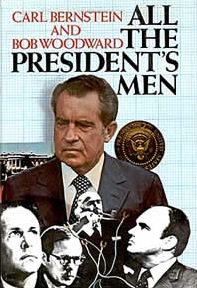
There are other important reasons the trope lives on. They include the impeccable good timing of All the President’s Men, Woodward and Bernstein’s best-selling book about their Watergate reporting; the popularity of the cinematic version of their book, and the years-long speculation about the identity of Woodward’s well-placed secret Watergate source who was code-named “Deep Throat.”All_the_President's_Men

The book came out in June 1974, just as the Watergate scandal was approaching its denouement with Nixon’s resignation. It reached the top of the New York Times best-seller list late that month — and remained there until mid-November 1974, three months after Nixon quit.

The cinematic treatment of All the President’s Men was released in April 1976 to mostly rave reviews. The New York Times critic wrote that “not until ‘All The President’s Men,’ the riveting screen adaptation of the Watergate book by Carl Bernstein and Bob Woodward, has any film come remotely close to being an accurate picture of American journalism at its best.”

The film focused on the work of Woodward and Bernstein, ignoring and even denigrating the vastly more significant contributions of other forces and agencies in uncovering the scandal — federal prosecutors, federal judges, federal grand jurors, bipartisan congressional panels, and the FBI.

The book and its screen version introduced the shadowy, conflicted character known as “Deep Throat,” whose identity was the subject of not-infrequent speculation over the years. That guessing game had the effect of keeping Woodward and Bernstein “in the public eye far longer than they otherwise would have been,” I pointed out  in Getting It Wrong.

In 2005, W. Mark Felt, formerly the second-ranking official at the FBI, identified himself as “Deep Throat.” Felt by then was in his early 90s and suffering dementia.

The book, the movie, and the years-long guessing game combined to help ensure the appeal and the tenacity of the heroic-journalist myth. As the passage in the Times magazine suggests, the myth lives on, erroneous shorthand for how Nixon fell in Watergate.

WJC

More from Media Myth Alert:


What was Rush Limbaugh talking about?

In Debunking, Error, Media myths, Photographs on September 13, 2014 at 4:18 pm

The conservative talk radio host, Rush Limbaugh, ruminated on his show yesterday about the power of images — and seemed to err in describing an iconic photograph of the Vietnam War.

In response to a caller’s observation that “the Vietnam War changed when somebody got shot live on the air” — an evident reference to Eddie Adams’ “Saigon Execution” photograph — Limbaugh declared:

Nick Ut's Pulitzer-winning image (AP/Boston Globe)

Nick Ut’s ‘Napalm Girl’ (AP)

“The Vietnam War, I’ll tell you what began the end of the Vietnam War. It was not Walter Cronkite saying that some operation failed.  It was a picture of young children burned by Agent Orange fleeing an explosion in Time magazine.  That’s what did it.  … Naked girl running away from disaster with her skin burned by Agent Orange.”

It’s most likely the voluble Limbaugh was referring to “Napalm Girl,” the award-winning photograph taken in June 1972 by Nick Ut of the Associated Press. (At least one radio station thought he was referring to that image, too.)

“Napalm Girl” showed a cluster of Vietnamese children, the terror-stricken victims of a misdirected napalm attack by the South Vietnamese Air Force. At the center of photograph was a 9-year-old girl named Kim Phuc, naked and screaming from the burns she suffered.

Except for the reference to chemical defoliant Agent Orange, “Napalm Girl” — formally titled “The Terror of War” — is the photograph that most closely corresponds to Limbaugh’s description: “Naked girl running away from disaster with her skin burned by Agent Orange.”

More problematic than mistaking the details of one of the Vietnam’s most searing images was Limbaugh’s blithe claim of the photo’s power, that the image — any image — possessed such impact as to mark the beginning of the end of the war.

That’s hardly the case.

By June 1972 when Ut’s photo was taken, the war was essentially over already for U.S. military forces in Vietnam. Nearly all U.S. combat units had been removed from the country. By mid-year 1972, about 49,000 American troops were in Vietnam, well off the peak of 549,000 in early 1969. U.S. casualties were lower, too — from 4,221 killed in 1970 to 1,380 killed in 1971. President Richard Nixon’s policy of “Vietnamization” — of turning over the war effort to South Vietnamese forces — was in full flower.

None of that is attributable to the effects of “Napalm Girl.” Indeed, the beginning of the end for the U.S. military in Vietnam came well before the photograph was taken.

Even so, it’s not uncommon to exaggerate the photograph’s influence; it’s as if the image was so powerful that its effects likewise must be profound.

For example, the Associated Press declared in a retrospective article in 2012, 40 years after the photo was taken, that “Napalm Girl” helped “to end one of the most divisive wars in American history.”

And more recently, Ut was quoted as saying: “When I pressed the button, I knew. This picture will stop the war.”

It didn’t, of course. The war ended in April 1975, when North Vietnamese forces overwhelmed South Vietnamese troops and seized the South Vietnamese capital, Saigon.

WJC

More from Media Myth Alert:

Ouster of WaPo publisher prompts reference to newspaper’s mythical role in Watergate

In Debunking, Error, Media myths, Newspapers, Scandal, Washington Post, Watergate myth on September 2, 2014 at 10:11 pm

News that Jeff Bezos is ousting the publisher of the Washington Post about a year after he purchased the newspaper prompted recollections of the Post’s better days — recollections both exaggerated and erroneous.

A landmark?

Marginal on Watergate

The recollections centered around the newspaper’s reporting of the Watergate scandal, which culminated 40 years ago last month in the resignation of President Richard M. Nixon.

It was the Post’s onetime archrival, the New York Times, that indulged today in the most excessive overstatement.

In its initial online report about the departure of Katharine Weymouth as publisher, the Times stated that “she was the last major link to the Graham family, which had become a Washington institution and had presided over The Post’s most glorious era — the decades surrounding the Watergate scandal, in which it was instrumental in forcing the resignation of President Richard M. Nixon.”

While Weymouth’s departure, effective October 1, is intriguing — it means that Bezos, the multibillionaire founder and CEO of Amazon.com, is imposing his will on what has become in recent years a thin and faded newspaper — Media Myth Alert is most interested in the mischaracterization of the Post’s role in Watergate.

The newspaper assuredly was not, as the Times claimed, “instrumental in forcing the resignation of President Richard M. Nixon.”

The Post’s investigative reporting on Watergate linked Nixon’s reelection committee to the seminal crime of Watergate, the foiled burglary in June 1972 at the headquarters of the Democratic National Committee. The Post also implicated the likes of John Mitchell, the former attorney general who was Nixon’s campaign manager, in the scandal.

Such reports helped the Post win a Pulitzer Prize in 1973. But they were hardly enough to threaten Nixon’s presidency.

Indeed, as I discussed in my media-mythbusting book, Getting It Wrong, the Post’s contributions in reporting on the unfolding scandal in 1972-73 were “modest, and certainly not decisive.”

Unseating Nixon, I further noted in Getting It Wrong, “required the collective if not always the coordinated forces of special prosecutors, federal judges, both houses of Congress, the Supreme Court, as well as the Justice Department and the FBI.”

And even then, Nixon likely would have survived the scandal were it not for the audiotapes he surreptitiously made of many conversations in the Oval Office. Only when compelled by the U.S. Supreme Court did Nixon surrender the tapes that clearly depicted him as taking an active role in plotting the coverup of the Watergate breakin.

Interestingly, it was not reporters for the Post but investigators for a select committee of the U.S. Senate who learned of and forced the disclosure about the existence of the tapes. It was, in other words, a pivotal Watergate story that the Post missed.

The Post lagged on other decisive Watergate stories, notably the existence of the White House coverup of the breakin.

And the story that Bob Woodward and Carl Bernstein, the Post’s lead Watergate reporters, still say they are most proud of was in error on crucial details.

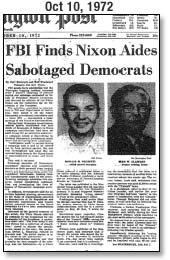
WaPo front_Oct10_72

Washington Post, October 10, 1972

That story was published October 10, 1972, beneath the headline, “FBI Finds Nixon Aides Sabotaged Democrats.” It claimed — erroneously — that the FBI had determined some 50 political saboteurs had traveled the country, disrupting Democratic candidates mounting challenges to Nixon. Internal FBI memoranda disputed key elements of the Post’s story as conjecture or “absolutely false.”

So “modest at best” aptly characterizes the Post’s contributions in unraveling Watergate.

The newspaper most certainly did not bring down Nixon.

The departure of Weymouth, and her replacement by Frederick J. Ryan Jr., once an official in the administration of President Ronald Reagan, was accompanied by another interesting sidebar: That of Bezos’ refusal to discuss the move with a reporter for the Post.

As Huffington Post observed:

“Bezos kept up a dubious practice of refusing comment to the journalists he pays when it was announced … that he had replaced the Post’s publisher, Katharine Weymouth, with former Politico executive and Reagan administration official Fred Ryan. … Anybody expecting openness and transparency from Bezos, however, would be disappointed, as the Post’s own story made clear.”

The Post’s article said the statement by Bezos announcing the change in publishers “‘did not give reasons for the change or its timing. Bezos declined to comment through a spokesman.”

How clumsy.

WJC

More from Media Myth Alert: