W. Joseph Campbell

Archive for the ‘Jessica Lynch’ Category

10 weeks on: Still no word from WaPo about apparent digital scrubbing of Lynch articles

In Debunking, Jessica Lynch, Media myths, Washington Post on July 6, 2012 at 7:45 am

Where’s the digital version?

The Washington Post ombudsman noted in a column last month that it is “increasingly difficult for iconoclastic, questioning voices to be heard, whether left, right or center.”

The ombudsman, Patrick Pexton, urged the Post and other news organizations “to seek out and cover the unconventional and outsider voices — whether citizen or expert, whether right, center or left. They’re out there; we just have to listen.”

Trouble is, Pexton, himself, doesn’t always much care for “questioning voices” — such as the questions that I’ve raised with him periodically for the past 10 weeks.

Those questions relate to the apparent digital scrubbing of the Post’s botched reporting about Jessica Lynch and her purported heroics early in the Iraq War.

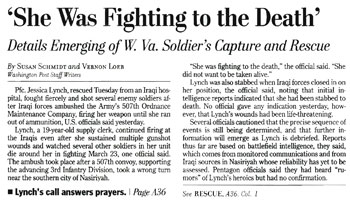
The Post on April 3, 2003, published a stunning report on its front page (see above) about the supposed heroism of Lynch, a 19-year-old Army supply clerk, during an ambush at Nasiriyah in southern Iraq.

The Post’s report said Lynch had fought fiercely and “continued firing at the Iraqis even after she sustained multiple gunshot wounds and watched several other soldiers in her unit die around her” in the fighting, which took place March 23, 2003.

The electrifying report — which the Post headlined “She was fighting to the death” — was picked up by news organizations around the world.

But soon it became apparent that the Post’s hero-warrior story was utterly wrong in all important details. Lynch never fired a shot in Iraq; she was neither shot nor stabbed, as the Post had reported, but badly injured in the crash of a Humvee as it fled the ambush.

The botched hero-warrior story is unavailable at the Post’s online site. Until a few weeks ago, clicking on a link to that report did turn up the story’s headline, byline, and publication detail. But otherwise, it was an empty link: It contained no content.

Now, not even the headline, byline, and publication date are available. The link opens to a page that declares in large headlines: “Page Not Found” and “We’re unable to locate the page you requested.”

So changes recently have been made that expunge any reference to the hero-warrior story.

I pointed this out in an email to Pexton a week ago. He has not replied.

In his most recent correspondence with me, an email sent May 30, Pexton wrote:

“This is a stickier problem than I initially thought. It could be as innocent as the Post has moved masses amount of files three times in the past ten years to different servers. Or it could be deliberate.  …  I have one newsroom employee researching this and an IT person checking on it. When I have an answer, I’ll let you know.”

Pexton turned prickly in that email, making clear he did not appreciate my turning to social media to call attention to this matter.

He expressed objections to the Twitter message I sent on May 25, calling attention to a blog post of the same day that four weeks had passed and the Post had offered no explanation for the apparent scrubbing of the Lynch  content.

“Tweeting about your frustration over the time it is taking is a disincentive for me to push harder on it,” Pexton wrote in his email of May 30. “Most readers are polite and understanding. Why should I put your request ahead of others when you choose to coerce and bully?”

Coerce and bully? C’mon. My inquiries about the Lynch stories are much more akin to the “questioning voices” that Pexton has encouraged the Post to seek out and embrace.

More than five weeks have since passed he sent that prickly email. Pexton has offered no explanation as to why the Lynch content has been excised from the Post’s online site.

“I will get an answer for you if it is obtainable and I will let you know when I do,” he wrote on May 30. “That’s the best I can do. If that’s not to your liking, then I apologize but that is your issue, not mine.”

Woah. It’s not important to him whether the Post has scrubbed digital reminders of an acutely embarrassing story?

The Post, after all, called out Vanity Fair in April for digitally scrubbing a flattering profile of the wife of  Bashar al-Asad, Syria’s dictator. At that time, the Post described Vogue’s removal of the digital version of the profile as “an almost-unheard-of step for a mainstream media organization.”

Interestingly, some Lynch-related content from 2003 remains freely available online — notably this article, at the Post’s link-rich Iraq War archive.

I’ve asked Pexton: Would the Post and its readers not be better served by being consistent about its Lynch-related content?

And I have suggested to him that “my request can be distilled thusly:

“Why is some Lynch-related content from 2003 freely available online (see here), while content more embarrassing to the Post (see empty links here, here, and here) not available? Shouldn’t those empty links be restored, and added to the Post’s link-rich Iraq War archive, where Lynch’s name and image already appear?”

He has given no direct responses to those questions.

So what’s to be concluded, 10 weeks after my initial inquiry to Pexton?

Not unlike Vanity Fair, the Post appears to have scrubbed the digital reminders of an embarrassing misstep, of a high-profile story that the newspaper got utterly wrong.

It’s also pretty clear the Post has no interest in making freely available online its botched reporting about Jessica Lynch.

It’s pretty clear, too, that Pexton doesn’t eagerly follow through on his rhetoric about the value and importance of “iconoclastic, questioning voices.”

WJC

Many thanks to Instapundit
Glenn Reynolds for linking to this post.

Recent or related:

Misremembering the Jessica Lynch case, on Memorial Day

In Debunking, Jessica Lynch, Media myths on May 28, 2012 at 5:11 pm

It’s astonishing how engrained the false narrative has become that the Pentagon made up the hero-warrior tale about Army private Jessica Lynch in the early days of the Iraq War.

It is often invoked — and typically without any reference to specific sources.

(Newseum image)

Take, for example, the top-of-the-front-page article today in today’s The State newspaper in South Carolina, which refers to unspecified “critics” who “charge that the Pentagon exaggerated her wounds by saying she was shot and stabbed when she wasn’t.”

As I’ve noted many times at Media Myth Alert, the Pentagon wasn’t the source for the bogus tale about Lynch’s heroics in an ambush at Nasiriyah in southern Iraq.

It was the Washington Post that thrust the story into the public domain in a dramatic account published on its front page on April 3, 2003.

The Post’s report said Lynch, then a 19-year-old supply clerk in the Army’s 507th Maintenance Company, fired at attacking Iraqis “even after she sustained multiple gunshot wounds and watched several other soldiers in her unit die around her in fighting” on March 23, 2003.

The story, which was picked up by news organizations around the world, was embarrassingly wrong in all important details. Lynch, it quickly turned out, was neither shot nor stabbed, as the Post had reported. She did not fire a shot in the ambush. She suffered severe injuries in the crash of a Humvee as it tried to flee the ambush.

Lynch was taken prisoner and treated at an Iraqi hospital, from where she was rescued April 1, 2003, by a U.S. special operations team.

As Lynch herself insists, she was no hero (although she has said she could have embraced the Post’s hero-warrior tale and no one would’ve been the wiser).

We know the Pentagon wasn’t the source of the Post’s exaggerated tale: Vernon Loeb, one of the reporters who wrote the story, said so in an interview on Fresh Air, an NPR radio program, in mid-December 2003.

In the interview, Loeb said flatly:

“Our sources for that story were not Pentagon sources.”

Loeb also said that he “could never get anybody from the Pentagon to talk about” the Lynch case.

“They wouldn’t say anything about Jessica Lynch,” Loeb declared, adding:

“I just didn’t see the Pentagon trying to create a hero where there was none. I mean …they never showed any interest in doing that, to me.”

Loeb said the details about Lynch’s supposed heroics came from “some really good intelligence sources” in Washington, D.C. — sources whom the Post has never specifically identified, although it should.

The State’s article is pegged to Memorial Day and recalls the death at Nasiriyah of Sgt. George Buggs. He was the first serviceman from South Carolina killed in Iraq.

The article notes that “Buggs’ death is now forgotten by most except family and friends. … But his story is both intertwined and overshadowed by one of the most tragic and controversial events in modern U.S. military history — the capture and rescue of a young soldier from West Virginia named Jessica Lynch.”

The article invokes those nameless “critics” in saying they “charged that the United States government exaggerated the facts of the rescue, manipulated the media and exploited Lynch to build public support for a war many thought was unnecessary.”

Such claims are erroneous in at least two important respects.

One, the Defense Department’s acting inspector general reported finding no evidence to support the notion that Lynch’s rescue “was a staged media event.” Rather, the inspector general’s report said the rescue operation was “a valid mission” to recover a prisoner of war “under combat conditions.” It further stated that the “level of force used by [the special forces team] to perform the mission was consistent with the anticipated resistance and established doctrine.”

Two, the U.S. government had little reason to exploit the Lynch case as a means “to build public support”  for the Iraq War. As I point out in my 2010 book, Getting It Wrong:

“It may be little-recalled now, but the U.S.-led invasion of Iraq was widely supported by the American public. Polling data from March and April 2003, the opening days and weeks of the war, show an overwhelming percentage of Americans supported the conflict and believed the war effort, overall, was going well.”

Among those public opinion polls was a Washington Post-ABC News survey conducted in late March and early April 2003. The poll found that eight of ten Americans felt the war effort was going well, and 71 percent approved of the Bush administration’s handling of the Iraq situation.

I further note in Getting It Wrong:

“At the time of the Lynch rescue, U.S. forces were closing in on Baghdad. So it defies logic to argue that the American military would have singled out and hyped the Lynch rescue for morale-building purposes when its central and vastly more important wartime objective was within reach.”

WJC

Recent and related:

Four weeks on: No answer from WaPo about empty links to Jessica Lynch stories

In Debunking, Jessica Lynch, Media myths, Newspapers, Washington Post on May 25, 2012 at 6:55 am

Lynch photo at WaPo’s Iraq archive

Want to read the Washington Post article of April 10, 2003, about the fall of Baghdad to U.S. forces? The article’s online link is here.

How about the Post’s report about the Iraqi lawyer who helped lead U.S. rescuers to Jessica Lynch, the Army private taken prisoner and hospitalized following a deadly ambush in the war’s early days? Here’s the link to that story,  which the Post published on its front page April 4, 2003.

How about the Post’s front-page article of the day before, which told of Lynch’s supposed heroism in the ambush, how she had fought fiercely and “continued firing at the Iraqis even after she sustained multiple gunshot wounds and watched several other soldiers in her unit die around her”?

It was an electrifying report, one picked up by news organizations around the world.

But it turned out that the Post’s hero-warrior tale about Lynch was embarrassingly wrong in all important details. Lynch never fired a shot in Iraq; she was neither shot nor stabbed, as the Post had reported, but badly injured in the crash of a Humvee as it fled the ambush.

Try finding the botched hero-warrior story at the Post’s online site. All that turns up is a headline, byline, and date of publication. Otherwise, it’s an empty link. No content, in other words.

That’s also true for a column published April 20, 2003, by Michael Getler, the newspaper’s then-ombudsman, who criticized the hero-warrior story: Another empty, no-content link.

Same for the Post’s partial rollback of the hero-warrior story, published in mid-June 2003: Also an empty link.

So what gives? Why is some of the Post’s content about the Iraq War — and Jessica Lynch — freely available online while the more embarrassing material shows up as empty links?

Is this a matter of digital scrubbing, akin to Vogue magazine’s excising of a flattering profile of the wife of the Syrian dictator, Bashar al-Asad? The Post last month described the Vogue matter as “an almost-unheard-of step for a mainstream media organization.”

Periodically over the past four weeks, I’ve asked the Post’s ombudsman, Patrick Pexton, about the digitally unavailable versions of the newspaper’s reports about Lynch.

Pexton has  promised to look into my questions.

But four weeks on, he has yet to offer a substantive reply.

I have asked him: “Does the embarrassment quotient explain this apparent inconsistency?” That is, is the Post too embarrassed by its botched reporting about Lynch to make the links freely available online?

I suspect it is.

In his most recent email to me, on May 16, Pexton said he receives “200 to 300 e-mails per day and we’re always behind. We are working on trying to get you some answers on this.”

I replied the following day, thanking him for the update and saying I hoped to hear from him soon.

I also wrote:

“I believe my request can be distilled thusly:

“Why is some Lynch-related content from 2003 freely available online (see here), while content more embarrassing to the Post (see empty links here, here, and here) not available? Shouldn’t those empty links be restored, and added to the Post’s link-rich Iraq War archive, where Lynch’s name and image already appear?”

That email produced no response from Pexton, however.

The Post‘s digital archive of the Iraq War offers a functioning link to the article about the Iraqi lawyer who helped guide rescuers to Lynch.

In fact, the only U.S. soldier identified by name and image at the archive is Jessica Lynch.

I discuss the Post’s reporting of the Lynch case in a chapter in my latest book, Getting It Wrong.

WJC

Many thanks for Instapundit
Glenn Reynolds for linking to this post

Recent and related:

Two weeks on: Still waiting for WaPo on missing Jessica Lynch online content

In Debunking, Jessica Lynch, Media myths, Newspapers, Washington Post on May 11, 2012 at 9:41 am

Lynch photo at WaPo’s Iraq archive

Two weeks ago, the Washington Post ombudsman promised to look into questions I had posed about the unavailable digital versions of the newspaper’s embarrassingly wrong reports about Jessica Lynch’s supposed heroics during the Iraq War.

I’m still waiting a response from the ombudsman, Patrick Pexton.

At issue are empty links for at least three articles and commentaries about Lynch that appeared in the Post in 2003 — all of which are keenly embarrassing to the newspaper. Among them is the Post’s infamous “Fighting to the Death” story of April 3, 2003, which is at the heart of the bogus hero-warrior tale about Lynch.

That story — which isn’t available at the Post’s online site — described Lynch’s purported derring-do on the battlefield, saying she fought fiercely in an ambush in Nasiriyah and was captured only after running out of ammunition.

As it turned out, the story was utterly wrong in all important details. Lynch never fired a shot in Iraq; she was neither shot nor stabbed, as the Post had reported, but badly injured in the crash of a Humvee as it fled the ambush. (I discuss the Post’s handling of the Lynch case in a chapter in my latest book, Getting It Wrong.)

Another element of the Post’s narrative about Lynch that’s missing online is a column written several days later by Michael Getler, then the newspaper’s ombudsman. Getler criticized the hero-warrior story, noting that readers thought it suspicious.

In mid-June 2003, the Post grudgingly walked back from aspects of its hero-warrior tale — an embarrassment that media critic Christopher Hansen characterized as “the journalistic equivalent of Napoleon’s retreat from Moscow.”

The Post’s walk-back article also is unavailable online.

But at least one of the Post’s  stories about Lynch in 2003 is freely available online, as I’ve noted in email messages to Pexton.

That article — which is decidedly non-embarrassing to the Post — was published April 4, 2003; there’s a functioning link to it at the newspaper’s link-rich digital archive about the Iraq War. Interestingly, the only U.S. soldier identified by name and image at the archive site is Jessica Lynch.

So why aren’t the Post’s other reports about Lynch available at that online archive? If some Lynch-related content from 2003 is freely available, why not the rest? Wouldn’t restoring all Lynch content make the digital archive richer, more comprehensive, and more balanced?

I believe it would.

I’ve asked Pexton: “Does the embarrassment quotient explain this apparent inconsistency?” In other words, is the Post too embarrassed by its botched reporting about Lynch to make the links freely available online?

I suspect so.

Pexton did say in an email 14 days ago that his looking into my questions “will take some considerable time to research, but I’ll check into it. It’s very hard to trace some of this back when The Post has gone through several computer systems since that time, but I’ll make an effort.”

In reply, I suggested that the matter could be readily distilled by focusing on this question:

“Why is some Lynch-related content from 2003 freely available online (see here), while other and more embarrassing content (see empty links here, here, and here) not available?”

I sent Pexton follow-up email messages on May 1 and May 7. In those email, I asked why the empty links about the Lynch case couldn’t be restored and added to the digital archive about the Iraq War.

I have received no reply.

And that’s a bit odd because Pexton, in a column in March, pointedly urged Post staffers to be responsive to inquiries, writing:

“Return the blessed phone calls and e-mails from readers! And do it with courtesy, respect and politeness, even when the caller, or writer, is persistent or even unpleasant. Please.”

That’s advice too good to be ignored.

WJC

Recent and related:

Digitally scrubbing WaPo’s embarrassment on Jessica Lynch?

In Debunking, Jessica Lynch, Media myths, Washington Post on April 27, 2012 at 2:15 pm

The Washington Post carried a fine story yesterday about Vogue magazine’s apparent removal from its online site of an unaccountably flattering profile of Asma al-Assad, wife of Syrian dictator Bashar al-Assad.

Where's the digital version?

The Post said the 3,200-word puff piece in Vogue “apparently proved so embarrassing to the magazine that it scrubbed it from its Web site, an almost-unheard-of step for a mainstream media organization and a generally acknowledged violation of digital etiquette.”

That observation — “violation of digital etiquette” — evoked for me the unavailability online of the Post’s embarrassingly wrong-headed reports in 2003 about Jessica Lynch and her supposed heroism early in the Iraq War.

In an electrifying account published on its front page April 3, 2003, the Post reported that Lynch, then a 19-year-old Army private, had fought fiercely in the ambush of her unit in Nasiriyah, in southern Iraq.

Lynch, according to the Post,  “continued firing at the Iraqis even after she sustained multiple gunshot wounds and watched several other soldiers in her unit die around her in the fighting,” which took place March 23, 2003.

The hero-warrior tale about Lynch turned out to be utterly wrong in all crucial details. She was neither shot nor stabbed, as the Post reported; she suffered shattering injuries in the crash of a Humvee fleeing the ambush.

Lynch was taken prisoner and moved to an Iraqi hospital where she lingered near death until her rescue by U.S. special forces on April 1, 2003.

The Post’s hero-warrior tale appeared two days later.

But try finding the Post’s digitized version of that story. Here’s the link; but clicking through turns up the article’s headline, byline, date of publication, and page placement. But no text.

(The Post’s story is available in full at the online site of the Pittsburgh Post-Gazette.)

Later in April 2003, the Post’s then-ombudsman, Michael Getler, published a critical column about the hero-warrior story, noting that “several readers wrote to complain, saying they did not doubt ‘the gravity of Lynch’s situation,’ as one put it, but that The Post, ‘using unnamed sources,’ was ‘creating a sensationalist story riddled with inaccuracies.’ ‘I smell an agenda,’ said one reader, suspecting wartime ‘propaganda.’ Another was suspicious of the ‘Hollywood-like telling of the story.'”

Try finding Getler’s column online.

Here’s the link; but in this case, too, just the headline, byline, publication date, and page reference are available.

In mid-June 2003, the Post revisited and grudgingly walked back from aspects of its hero-warrior story about Lynch. One media critic characterized the article as “the journalistic equivalent of Napoleon’s retreat from Moscow.”

(And as I point out in my latest book, Getting It Wrong, the walk-back story “included a nervy attempt by the Post to deflect blame from its central role in spreading the hero-warrior myth of Jessica Lynch.”

(The Post, I note, “faulted the U.S. military and the administration of President George Bush for failing to correct an error for which the Post was responsible. ‘Neither the Pentagon nor the White House publicly dispelled the more romanticized initial version of her capture,’ the Post said, ‘helping to foster the myth surrounding Lynch and fuel accusations that the Bush administration stage-managed parts of Lynch’s story.’  It was an astounding assertion: The Post, alone, was responsible for propagating the ‘romanticized initial version’ that created the hero-warrior myth. To claim the Pentagon and the White House should have done more to dispel that report was, in short, exceedingly brazen.”)

Well, good luck in finding the Post’s walk-back story online.

Here’s the link; but, again, only the headline, byline, publication date, and page reference show up.

So has the Post excised the digital reminders of an embarrassing misstep, of a dramatic story that it thoroughly and singularly botched? Has it, at a minimum, committed a “violation of digital etiquette”?

Rather looks like it. (The Post’s ombudsman, Patrick Pexton, promised to “check into” my questions. He also said in an email today: “It’s very hard to trace some of this back when The Post has gone through several computer systems since that time, but I’ll make an effort.”)

Separately, I’ve been told that Post stories published before 2005 have largely been placed behind a paywall. For the most part, that is, they’re not freely available online.

But some special sections are accessible online without payment — and they include the Post’s link-rich “War in Iraq” digital archive.

And in a box at the lower right corner of the digital archive is an Army photograph of none other than Jessica Lynch.

Lynch photo at WaPo's Iraq War archive

The box carries the headline, “Saving Pfc Lynch,” and offers a link to an article published in the Post April 4, 2003, a day after the botched hero-warrior tale.

The April 4 article ran to 1,500 words in discussing the Iraqi lawyer who helped set in motion Lynch’s rescue.

And that article is available in full.

WJC

Recent and related:

Why WaPo should reveal sources on bogus Jessica Lynch tale

In Debunking, Jessica Lynch, Media myths, Washington Post on April 3, 2012 at 12:36 pm

On this date in 2003, the Washington Post published on its front page the electrifying but stunningly wrong hero-warrior tale about Pfc. Jessica Lynch, a botched report that carried the headline:

She was fighting to the death

Lynch, then a 19-year-old Army supply clerk, had fought fiercely in the attack of her unit in Nasiriyah, in southern Iraq, according to the Post, which cited anonymous “U.S. officials” as its sources.

One of them told the Post that Lynch had suffered gunshot and stab wounds “and watched several other soldiers in her unit die around her” in the ambush March 23, 2003.

It was exhilarating stuff and the Post’s report was picked up by news organizations around the world.

But it was wrong in almost all important details. Lynch was neither shot nor stabbed. She did not fire a shot in the ambush. She suffered crushing injuries in the crash of a Humvee as it attempted to flee the ambush.

She was taken prisoner and treated at an Iraqi hospital, from where she was rescued April 1, 2003, by a U.S. special operations team.

As Lynch herself insists, she was no hero (although she has said she could have embraced the hero-warrior tale and no one would’ve been the wiser).

Years later, it’s time for the Post to disclose just who it was that led it astray. It’s time to reveal the sources on the bogus story about Lynch.

It may be akin to sacrilege to argue that a newspaper should lift the veil of anonymity. But reasons  for making something of an exception in the Lynch case are several and compelling.

For one, news organizations owe little to anonymous sources that provide bad information. The grant of confidentiality isn’t meant to be a vehicle for diffusing falsehood.

In this case, the embarrassment quotient remains high enough for the Post to identify its Lynch sources — if not by name, then by affiliation.

Another compelling reason to lift the veil of anonymity is that the veil has been partly lifted already. One of the reporters on the botched story, Vernon Loeb, is on record as saying who the sources were not.

So it should be a small step to saying who they were.

Loeb, in an interview on NPR’s “Fresh Air” program in December 2003, stated unequivocally:

“Our sources for that story were not Pentagon sources.”

He also said he “could never get anybody from the Pentagon to talk about” the Lynch case.

“They wouldn’t say anything about Jessica Lynch,” Loeb said, adding:

“I just didn’t see the Pentagon trying to create a hero where there was none,” he added. “I mean …they never showed any interest in doing that, to me.”

Loeb also described them as “some really good intelligence sources” in Washington.

Despite Loeb’s insistence that the sources weren’t Pentagon sources, the narrative has taken hold that the military made up the story about Lynch’s heroics and somehow persuaded the Post to buy it.

This has become the dominant narrative of the Lynch case, as I point out in my book, Getting It Wrong.

By identifying its sources on the Lynch story, the Post could demolish the military-made-it-up narrative and, by doing so, strike a blow for accuracy and truth-telling.

There’s another compelling reason for the Post to lift anonymity in this case: The newspaper’s long silence on its sourcing has allowed twisted and erroneous claims to circulate as factual.

Notable in this regard are the claims Jon Krakauer made in his 2009 book Where Men Win Glory about Jim Wilkinson, an aide to the commander of U.S. forces in Iraq in 2003, General Tommy Franks.

Krakauer wrote that Wilkinson “duped reporters and editors at the Washington Post” by giving them exclusive access to the bogus tale about Lynch’s battlefield heroics.

Krakauer in the book also called Wilkinson a “master propagandist” and said he was “the guy who deserved top billing for creating the myth of Jessica Lynch.”

Wilkinson denied Krakauer’s allegations and met with the author to discuss a retraction.

Krakauer quietly retreated from his unattributed charges about Wilkinson, removing the unflattering passages from a recent paperback edition of Where Men Win Glory. That edition also contains a footnote, saying:

“Earlier editions of this book stated that it was Jim Wilkinson ‘who arranged to give the Washington Post exclusive access’ to this leaked intelligence [about Jessica Lynch]. This is incorrect. Wilkinson had nothing to do with the leak.”

Had the Post been transparent about the sourcing on its Lynch story,  Krakauer’s unsubstantiated allegations likely never would have been raised.

WJC

Many thanks to Instapundit
Glenn Reynolds for linking to this post.

Recent and related:

Liz Trotta mangles Jessica Lynch ‘fairy tale’

In Debunking, Jessica Lynch, Media myths, Washington Post on February 20, 2012 at 10:12 am

Veteran broadcast journalist Liz Trotta went on Fox News yesterday to condemn plans to ease restrictions on women in Army combat positions.

In doing so, Trotta referred to — and mangled — key elements of the saga of Jessica Lynch, the Army private thrust into an international spotlight by a newspaper’s botched report about her battlefield heroics in Iraq in March 2003.

Trotta said in an appearance on the Fox program “America’s News HQ” that “the political correctness infecting the Pentagon has resulted in silly and dishonest fairy tales about female heroism. Has anyone forgotten the Jessica Lynch story?

“A PFC captured by the Iraqis and by all accounts, including her own, not mistreated. Yet the Pentagon saw fit to send in the SEALs to rescue her from a hospital in a videotaped operation that seemed headed straight to Hollywood.”

Whoa.

Let’s call out the errors there: Lynch was mistreated, and videotaping her rescue was routine practice in high-priority military operations —  not done with Hollywood in mind.

By Lynch’s own account — contained in a book by Rick Bragg and titled I Am a Soldier, Too — she was knocked out in the crash of a Humvee in attempting to escape an ambush in Nasiriyah, in southern Iraq. While unconscious, Lynch “was a victim of anal sexual assault,” the book says, adding:

“The records do not tell whether her captors assaulted her almost lifeless, broken body after she was lifted from the wreckage [of the Humvee], or if they assaulted her and then broke her bones into splinters until she was almost dead.”

She was rescued from an Iraqi hospital on April 1, 2003, in an operation that included not only Navy SEALS but Marines and Army Rangers as well.

It was the first rescue of a captured American solder from behind enemy lines since World War II.

I discuss the mythology of the Lynch case in my latest book, Getting It Wrong, noting that the Defense Department’s inspector general found no evidence to support the notion Lynch’s rescue “was a staged media event.”

The then-acting inspector general, Thomas F. Gimble, said in a report to Congress in 2007 that the rescue operation was determined to have been “a valid mission” to recover a prisoner of war “under combat conditions.”

That the rescue was videotaped was not unusual, Gimble said, noting that combat cameramen routinely filmed high-priority operations. In the Lynch case, he said, there was “no indication that any service member was acting for the camera during the rescue mission.”

Gimble also said the extrication team “fully expected to meet stiff resistance” in mounting the rescue.

Trotta’s mangled account was the latest in a succession of erroneous characterizations about the Lynch case, which burst into prominence April 3, 2003, in a sensational, front-page report in the Washington Post.

The newspaper cited otherwise unidentified “U.S. officials” and said Lynch, a supply clerk, had fought fiercely in the ambush at Nasiriyah, that she had “continued firing at the Iraqis even after she sustained multiple gunshot wounds and watched several other soldiers in her unit die around her ….”

The Post quoted one of the anonymous officials as saying: “She was fighting to the death. She did not want to be taken alive.”

But the report was bogus. Little of it was true.

Lynch, who was not in a combat unit, never fired a shot in the ambush; her weapon jammed.

Not was she shot, as the Post reported. She suffered shattering injuries in the crash of the Humvee.

The Post, moreover, has never adequately explained how it erred so utterly in its hero-warrior story about Lynch, a story that was picked up by news organizations around the world.

More recently, in an interview with Lynch last month, Fox News anchorman Shepard Smith claimed without providing evidence that “the government” had made up the tale about Lynch’s battlefield heroics in Iraq.

He ignored the singular role of the Washington Post in placing the hero-warrior tale about Lynch into the public domain.

WJC

Recent and related:

Fox News reiterates dubious Lynch-source claim, ignores WaPo role

In Debunking, Jessica Lynch, Washington Post on January 16, 2012 at 3:52 pm

Fox News repeated today its dubious claim about the source of the mythical hero-warrior tale about Jessica Lynch, saying without supporting evidence that the “U.S. government” was behind the bogus story.

The Fox News claim was offered in an online commentary posted four days after an anchor for the cable network, Shepard Smith, made a similarly vague assertion in a televised interview with Lynch.

In both the commentary and the interview, Fox ignored the singular role of the Washington Post in placing the hero-warrior tale about Lynch into the public domain in what was a sensational, front page story published April 3, 2003.

The Post erroneously reported that Lynch, an Army supply clerk, had fought fiercely in the ambush of her unit in Nasiriyah, in southern Iraq. In fact, Lynch never fired a shot in the attack.

In the years since, the Post has never fully explained how it got the story so utterly wrong, effectively permitting a tenacious false narrative to take hold that the “government” — or the “military” — concocted the story for cynical propaganda purposes.

The commentary posted today at the Fox News online site ruminated about the quality of heroes and declared:

“Truth is an unavoidable casualty in catastrophe.

“Just last week former Private Jessica Lynch appeared on the FOX News Channel to share her side of the story of her famous capture and rescue in Iraq in 2003. The U.S. government initially claimed that then 19-year-old Lynch kept firing her weapon during an Iraqi ambush on her convoy in which she was the lone survivor.”

As I noted at Media Myth Alert last week in discussing Smith’s comments, the inclination by commentators on the political left and the right has been to overlook  the journalistic origins of the bogus hero-warrior tale about Lynch and assign blame vaguely to such faceless entities as “the government” or “the military.”

I further noted that never when such claims are raised is a specific culprit singled out. Just as rarely is the Post’s botched reporting on the bogus hero-warrior tale recalled or much discussed.

But quite simply, to ignore the Post’s central role in the tale about Lynch is to mislead and to assign fault improperly.

The Post’s report about Lynch was published beneath the headline:

“‘She was fighting to the death.'”

The report cited “U.S. officials” as sources in saying:

“Lynch, a 19-year-old supply clerk, continued firing at the Iraqis even after she sustained multiple gunshot wounds and watched several other soldiers in her unit die around her in fighting” in Nasiriyah on March 23, 2003.

While the Post has never specifically identified the “U.S. officials” to whom it referred in the Lynch story, it is clear the Pentagon had little to do with pushing or promoting the story.

We know this from Vernon Loeb, one of the Post reporters on the botched story about Lynch.

In an interview on an NPR program in December 2003, Loeb referred to the newspaper’s  sources on the Lynch story as “some really good intelligence sources here in Washington” who had received “indications that she had, you know, fired back and resisted her capture and actually been shot and possibly stabbed doing so.”

Loeb also said:

“Our sources for that story were not Pentagon sources.  And, in fact, I could never get anybody from the Pentagon to talk about those [battlefield intelligence] reports at all. I got indications that they had, in fact, received those intelligence reports, but the Pentagon was completely unwilling to comment on those reports at all.

“They wouldn’t say anything about Jessica Lynch.

“I’ve never believed that, at least as far as the story we wrote goes, that it was a Pentagon attempt to create a hero there.”

And as I discuss in my latest book, Getting It Wrong, Loeb on another occasion was quoted as saying:

”Far from promoting stories about Lynch, the military didn’t like the story.”

So from where did this false narrative arise about Lynch?

A contributing factor certainly was the claim by best-selling author Jon Krakauer, who inaccurately asserted that the Post’s source was a former White House official named Jim Wilkinson. In 2003, Wilkinson was director of strategic communications for General Tommy Franks, commander of U.S. forces in Iraq.

In his 2009 book,  Where Men Win Glory: The Odyssey of Pat Tillman, Krakauer wrote that Wilkinson was “a master propagandist” who “duped reporters and editors at the Washington Post.”

Wilkinson vigorously denied the unattributed claims and Krakauer last year quietly rolled back the assertions. A correction was inserted in a recent printing of the paperback edition of Where Men Win Glory, stating:

“Earlier editions of this book stated that it was Jim Wilkinson ‘who arranged to give the Washington Post exclusive access’ to this leaked intelligence [about Jessica Lynch]. This is incorrect. Wilkinson had nothing to do with the leak.”

WJC

Recent and related:

Shep Smith ignores WaPo, blames ‘government’ for bogus Lynch-hero story

In Debunking, Jessica Lynch, Media myths, Washington Post on January 13, 2012 at 11:04 am

Shepard Smith interviewed former Army private Jessica Lynch on his Fox News afternoon program yesterday and indulged in the notion that “the government” deviously made up the tale about Lynch’s battlefield heroics early in the Iraq War.

Smith

Smith, however, made no attempt to specify to whom in “the government” may have concocted the tale.

Moreover, he ignored the singular role of the Washington Post, which thrust the bogus hero-warrior tale about Lynch into the public domain in a sensational, page-one story published April 3, 2003.

The Post’s report — which was picked up by news organizations around the world — said Lynch had fought fiercely in the ambush of her unit in Nasiriyah, Iraq, that she kept firing at her attackers even though her comrades were killed all around her.

The Post’s article was reported mostly in Washington and was published beneath the headline:

Lynch

“‘She was fighting to the death.'”

It was an electrifying account, but thoroughly wrong in crucial details.

Lynch had not fired a shot in the attack. She was injured not by gunfire but in the crash of her Humvee in attempting to flee the ambush. She was captured and hospitalized by the Iraqis, and rescued nine days later by U.S. special forces.

Smith’s interview with Lynch offered further evidence of an inclination, shared by commentators on the political left as well as the right, to overlook  the journalistic origins of the bogus hero-warrior tale about Lynch and to ascribe blame, vaguely and conspiratorially, to entities such as “the government” or “the military.”

Never when such claims are raised is a culprit identified. And rarely is the Post’s botched reporting recalled or much discussed.

But to overlook the newspaper’s central role in the bogus tale about Lynch is not only misleading, it’s unaccountably sloppy.

For her part, Lynch did not challenge Smith’s vague claims that “the government” concocted the tale about her heroism in Iraq.

“When you were captured,” Smith asked her, “that whole government story came out. Uh, you as one — shoot ’em up, rescuing everyone. That’s not what happened. And you called out the government on its lies. How did you get the strength and wherewithal to do that?”

Lynch replied:

“I felt that I had to because I knew those weren’t the accurate stories. And I just wouldn’t be able to live with myself…”

Lynch said “it would have been so easy for me to take credit” for the battlefield heroics wrongly attributed to her, “to go along with their stories, but that’s not who I am, that’s not how I was raised.”

Smith also asked:

“Have you had contact with anyone from the then-government of the United States that did all that?”

No, replied Lynch, “I feel it’s in the past. I’ve done my part in setting the record straight.”

But the record hardly has been set straight.

As yesterday’s interview suggests, the notion that the U.S. government concocted the hero-warrior tale for propaganda purposes has emerged as the popular dominant narrative of the Lynch case, obscuring evidence that the government — notably the Pentagon — had little to do with pushing the bogus tale.

Vernon Loeb, one of the authors of the Post’s report about Lynch, said in an interview on NPR in December 2003 said the newspaper’s sources for the Lynch story “were not Pentagon sources.”

He said the Post was “told by some really good intelligence sources here in Washington that, you know, there were indications that she had, you know, fired back and resisted her capture and actually been shot and possibly stabbed doing so.

“None of this turned out to be the case as we, you know, quickly learned.  But, you know, we basically told our readers that day [April 3, 2003] what the U.S. intelligence community was telling senior members of the U.S. government. It just kind of goes back to the old adage that, you know, initial reports from the battlefield are almost always wrong.”

Loeb, who then was the Post’s defense correspondent, also said in the interview:

“I could never get anybody from the Pentagon to talk about those reports at all. I got indications that they had, in fact, received those intelligence reports, but the Pentagon was completely unwilling to comment on those reports at all. They wouldn’t say anything about Jessica Lynch.

“I’ve never believed that, at least as far as the story we wrote goes, that it was a Pentagon attempt to create a hero there.”

The hoopla associated with the Lynch case, I point out in my latest book, Getting It Wrong, has “had the effect of blurring recognition of the American soldier whose actions at Nasiriyah were heroic and probably were misattributed to Lynch, initially.

“He was Sergeant Donald Walters, a cook in the 507thMaintenance Company,” Lynch’s Army unit.

Donald Walters

In the ambush at Nasiriyah, “Walters either stayed behind, or was left behind, to lay down covering fire as his fellow soldiers tried to make their escape,” I write. “Walters fought his attackers in a fashion that the Post attributed to Lynch.”

Walters fought until he was out of ammunition; he was taken prisoner and soon after executed by his captors.

The Army eventually acknowledged that Walters’ conduct “likely prevented his unit from suffering additional casualties and loss of life” and posthumously awarded him the Silver Star, the U.S. military’s third-highest decoration for valor.

Interestingly, Lynch seldom mentions Donald Walters; she made no reference to him yesterday during her interview with Smith.

WJC

Recent and relevant:

Abrupt WaPo rollback stirs fresh questions about anonymous source use

In Debunking, Jessica Lynch, Washington Post on January 11, 2012 at 12:14 pm

The Washington Post offered online readers a dramatic example of “whiplash journalism” yesterday, reporting that the goal of U.S. sanctions against Iran was to topple the regime in Tehran then rolling back that stunning report.

Left thoroughly unclear was how the Post got the story so utterly wrong in the first place.

The original report, though based on the paraphrased remarks of a single anonymous source, seemed to signal a U.S. policy departure that would “reverberate around the world,” as Blake Hounsell, managing editor of Foreign Policy, promptly pointed out at the journal’s “Passport” blog.

Hounsell called it “a bombshell revelation” — if true.

The original report certainly seemed of bombshell quality; its opening paragraph declared:

“The goal of U.S. and other sanctions against Iran is regime collapse, a senior U.S. intelligence official said, offering the clearest indication yet that the Obama administration is at least as intent on unseating Iran’s government as it is on engaging with it.”

(The report was touted at the Post’s CheckpointWash” Twitter feed, which stated: “Goal of US sanctions on Iran is regime collapse, senior US intel official says.”)

But later in the day, the Post amended — and considerably softened — its report to say:

“The Obama administration sees economic sanctions against Iran as building public discontent that will help compel the government to abandon an alleged nuclear weapons program, according to a senior U.S. intelligence official.”

Discontent in Iran is quite pronounced already, so the Post’s revised version added little that’s new.

But quite puzzling is that the newspaper’s reporting could reach such dramatically differing interpretations on a leading foreign policy issue. The two-sentence correction appended to the revised version served only to deepen confusion.

The correction read:

“An earlier version of this article incorrectly reported that a U.S. intelligence official had described regime collapse as a goal of U.S. and other sanctions against Iran. An updated version clarifies the official’s remarks.”

Huh?

Did the Post reporters on the story not understand what their source — the “senior U.S. intelligence official” — was telling them? Did the source exaggerate under the cover of anonymity? Did the blanket of anonymity grant him license to speculate incautiously, or to go beyond his brief?

By email today, I asked Patrick Pexton, the Post’s ombudsman or reader’s representative, if he knew how or why the two versions of the same story differed so sharply.

Pexton has not replied to my inquiry. replied, saying he would look into the matter.

I also asked Pexton whether the Post’s rollback represented another example of playing fast and loose with the newspaper’s policy on anonymous sources. I believe it may.

Pexton’s predecessor as ombudsman, Andrew Alexander, noted in a column in 2010 that “too often it seems The Post grants anonymity at the drop of a hat.”

That may have been the case on the Iran-sanctions reporting: A too-quick grant of anonymity.

Alexander further wrote in the column:

“The Post’s internal policies set a high threshold for granting anonymity. It ‘should not be done casually or automatically.’ … If sources refuse to go on the record, ‘the reporter should consider seeking the information elsewhere.'”

That guidance seems not to have been followed in the Iran-sanctions report, which, in the confusion caused by relying on an anonymous source, is reminiscent of the enduring messiness created by another sensational Post story — its botched report in 2003 about Jessica Lynch’s purported battlefield heroics.

The Lynch story — a Post exclusive that was picked up by news organizations around the world — was based on anonymous sources whom the newspaper identified merely as “U.S. officials.”

The Post indirectly quoted one of the anonymous sources as saying Lynch, then a 19-year-old Army supply clerk, “continued firing” at her attackers “even after she sustained multiple gunshot wounds and watched several other soldiers in her unit die around her in fighting” in southern Iraq on March 23, 2003.

That source was quoted directly as saying:

“She was fighting to the death. She did not want to be taken alive.”

The comment inspired the memorable headline that accompanied the hero-warrior story:

“‘She was fighting to the death.'”

But the Post’s report about Lynch’s derring-do proved utterly wrong.

Lynch had not fired a shot in the attack; she cowered in the back of a fleeing Humvee which was struck by a rocket-propelled grenade and crashed, killing four of her Army comrades and leaving her unconscious and badly injured.

Lynch was taken to an Iraqi hospital, from where she was rescued nine days later, in a raid mounted by U.S. special forces.

The Post’s erroneous story about Lynch was has had enduring consequences.

The newspaper’s unwillingness to explain just how it got the hero-warrior story so utterly wrong, as well as its unwillingness to identify the sources who led it astray, have given rise to the tenacious false narrative that the military ginned up the story to bolster support for the war.

We know that it’s a false narrative from one of the reporters on the Lynch story, Vernon Loeb, who said in an interview with NPR in December 2003:

“Our sources for that story were not Pentagon sources.”

He also said in the interview that military officials “wouldn’t say anything about Jessica Lynch. I’ve never believed that, at least as far as the story we wrote goes, that it was a Pentagon attempt to create a hero there. … I just didn’t see the Pentagon trying to create a hero where there was none.”

Even so, the false narrative took hold and lives on, an ugly media-driven myth.

WJC

Many thanks to Instapundit
Glenn Reynolds for linking to this post.

Recent and related: