W. Joseph Campbell

Archive for the ‘Scandal’ Category

Did Watergate’s ‘Deep Throat’ know he was ‘Deep Throat’?

In Anniversaries, Debunking, Scandal, Washington Post, Watergate myth on April 15, 2012 at 11:48 am

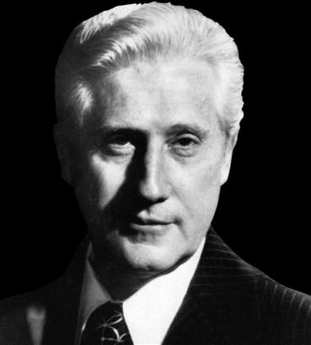
Felt: Did he know he was 'Deep Throat'?

Barry Sussman, the Washington Post’s Watergate editor in the early 1970s, raises a provocative question about the newspaper’s famous high-level source, W. Mark Felt, a senior FBI official when the Watergate scandal was unfolding.

Did Felt realize that the Post regarded him as “Deep Throat,” as a vital source in reporting the unfolding Watergate scandal? Sussman asks.

The question is pertinent and intriguing, Sussman writes in a recent commentary at the Nieman Watchdog blog, because Felt as a source offered “so little” to Bob Woodward, one of the Post’s lead reporters on Watergate.

And yet it is widely believed Felt offered vital information to Woodward about the emergent scandal.

Although Sussman doesn’t specifically address it, the implication of his observation is that “Deep Throat” may have been more composite than a single source — a literary device to infuse drama in All the President’s Men, the book Woodward wrote with Post colleague Carl Bernstein about their Watergate reporting.

It has long been suspected, though never confirmed, that “Deep Throat” was a composite.

Adrian Havill, the author of Deep Truth, a deliciously scathing biography of Woodward and Bernstein, speculated that “Deep Throat” was “a hybrid of three or four main sources.”

Edward Jay Epstein, in his fine 1976 essay about the Post and Watergate, stated he believed “Deep Throat” was “a composite character.”

More recently, James Rosen, chief Washington correspondent for Fox News, speculated in a book review that “‘Deep Throat’ was more than just Mark Felt.”

Prodded by his family, Felt came forward in 2005 and pronounced himself the source who had been “Deep Throat.” Woodward soon confirmed Felt’s self-disclosure.

But Felt was frail and suffering from dementia. He was forgetful and seldom able to carry on prolonged interviews. (Woodward quoted Felt’s daughter as saying in 2002 that Felt “goes in and out of lucidity.”)

Sussman, as he has on other occasions, asserts that “Deep Throat wasn’t an important source at all” to the Post.

“He was nice to have around, helpful on occasion,” Sussman writes, adding that Woodward and Bernstein “have blown up Felt’s importance for almost four decades or nodded in assent when others did….”

Sussman acknowledges he didn’t know that Felt was supposedly “Deep Throat” before 2005. He also notes that Felt, who died in 2008, often denied having been “Deep Throat.”

And that’s true. In a memoir published in 1979, Felt insisted: “I never leaked information to Woodward and Bernstein or to anyone else!”

Years later, Felt told a Connecticut newspaper that had he been “Deep Throat,” he “would have done it better.”

Felt may have been a liar. Or, as Sussman says, he may not have fully understood that he was considered the source whom the Post referred to as “Deep Throat.”

Sussman’s commentary was prompted by a recent book titled Leak, which claims that Felt was a crucial if sometimes duplicitous source for Woodward on Watergate. (Bernstein, by the way, met Felt only weeks Felt’s death.)

Sussman asserts that Leak “is way off base when it comes to the Post.”

The author of Leak, Max Holland, “accepts a key part of the Watergate myth that really is hokum – that Deep Throat was an important, sine qua non source for the Washington Post,” Sussman writes.

“He not only accepts it; it is his basic premise. This is where his book runs into trouble.”

So why does all this matter now, nearly 40 years after the Watergate scandal began unfolding?

It matters because the mystery of “Deep Throat” was central to establishing the heroic-journalist myth of Watergate, the enduring if misleading notion that Woodward and Bernstein, through their dogged reporting, brought down Richard Nixon’s corrupt presidency.

The identity of “Deep Throat,” as I write in my latest book, Getting It Wrong, was the subject of a 30-year, post-Watergate guessing game — a guessing game that “provided periodic and powerful reminders about the Post and its Watergate coverage, serving to keep Woodward and Bernstein in the public eye far longer than they otherwise would have been.”

Those reminders helped solidify the heroic-journalist myth of Watergate, which to this day endures as the dominant thought misleading narrative about the country’s greatest political scandal.

Recent and related:

Assessing the propellant effect: Was Watergate a powerful stimulant to journalism?

In Anniversaries, Debunking, Scandal, Washington Post, Watergate myth on March 10, 2012 at 4:34 am

The April number of Vanity Fair brushes against an entrenched media myth in declaring that the cinematic depiction of the Washington Post’s Watergate reporting stimulated great interest in careers in journalism.

Vanity Fair, April 2012

Alas,Vanity Fair offered no data or documentation to support its claim.

Instead, the magazine referred broadly to “the noble, sleeves-rolled sleuthing of Robert Redford and Dustin Hoffman as [Bob] Woodward and [Carl] Bernstein in All the President’s Men,” saying the movie which came out in 1976 “prompted legions of baby-boomers to dream of careers in journalism.”

Legions?

Anecdotally, it’s not uncommon to hear that the movie, or Woodward and Bernstein’s award-winning reporting for the Post, did inspire boomers to become journalists.

But beyond impression and anecdote, what supports the claim that Watergate reporting — or All the President’s Men — was a powerful stimulant for career-seeking in journalism?

Not much, as it turns out.

As I discuss in my latest book, Getting It Wrong (which includes a chapter on what I call the heroic-journalist myth of Watergate), two scholarly studies about enrollments in collegiate journalism programs found no evidence that Watergate was a propellant.

Enrollment data are reasonably good proxies, in that they would have captured heightened interest in careers in the profession. If Watergate and All the President’s Men inspired broad interest in careers in journalism, evidence of the stimulus should be apparent in surging in college enrollments.

But the evidence is not there.

A study conducted for the Freedom Forum media foundation and released in 1995 found that “growth in journalism education result[ed] not from specific events as Watergate … but rather to a larger extent from the appeal of the field to women, who ha[d] been attending universities in record numbers. The growth also in part reflect[ed] the applied nature of the field and its link to specific job skills.”

The study’s author, Lee Becker and Joseph Graf, stated flatly:

“There is no evidence … that Watergate had any effect on enrollments.”

A separate study, conducted by veteran journalism scholar Maxwell E. McCombs and published in 1988, reported that “the boom in journalism education was underway at least five years before” the Watergate break-in in 1972.

McCombs also wrote:

“It is frequently, and wrongly, asserted that the investigative reporting of Woodward and Bernstein provided popular role models for students, and led to a boom in journalism school enrollments. The data … reveal, however, that enrollments already had doubled between 1967 and 1972….”

I write in Getting It Wrong that the notion that Watergate reporting made journalism appealing and sexy endures “because it seems irresistibly logical and straightforward— too obvious, almost, not to be true.”

The presumed stimulus on journalism is an appealing yet simplistic story, easy to grasp and easy to understand.

And such characteristics — easy to grasp, easy to understand — often are propellants. Propellants of media-driven myths.

WJC

Recent and related:

‘Accurately, it turned out’? Hardly, in the Jefferson-Hemings allegations

In Debunking, Media myths, Scandal on February 13, 2012 at 9:30 am

Media critic Jonathan Alter treated as settled history the other day the disputed and probably dubious claim that President Thomas Jefferson took as a mistress a slave named Sally Hemings.

In a  column for Bloomberg News, Alter wrote:

“Politics has been a contact sport since at least the election of 1804, when President Thomas Jefferson was accused (accurately, it turned out) of having an affair with ‘Dusky Sally’ Hemings, a slave.”

Accurately, it turned out?

That may hew to the dominant narrative about the purported Jefferson-Hemings liaison. But it’s far from proven, far from “accurate.”

Indeed, it’s quite unlikely.

Key evidence in the controversy centers around DNA testing conducted in 1998. The evidence indicated that the former president was among more than two dozen Jefferson men who were in Virginia at the time Hemings’ youngest child, Eston, was conceived in 1807.

Thomas Jefferson then was 64-years-old, making him an unlikely paternity candidate.

The DNA results were widely misreported when released, giving rise to the mistaken notion that the tests had confirmed Jefferson’s paternity.

However, as a detailed scholarly study published last year points out:

“The problem [in misinterpreting the DNA evidence] lies not only with a news media prone to over simplifying and sensationalizing complex stories.  Numerous prominent scholars have contributed to the misunderstanding by characterizing the DNA study as ‘confirming’ or ‘clinching’ the case for Thomas Jefferson’s paternity.”

The scholarly study, an impressive work titled The Jefferson-Hemings Controversy: Report of the Scholars Commission, further notes that the DNA tests “were never designed to prove, and in fact could not have proven, that Thomas Jefferson was the father of any of Sally Hemings’ children.”

The book — which has received scant attention from mainstream American media — presents a circumstantial case pointing to Jefferson’s younger brother, Randolph (or his sons), in the question of Eston Hemings’ paternity.

Randolph Jefferson, the book says, was known to have socialized with the slaves at Monticello, Thomas Jefferson’s home in Virginia.

Randolph Jefferson was a dozen years younger than the president, and the available record offers no evidence that Thomas Jefferson “enjoyed socializing at night with Monticello slaves,” the book says.

The scholars commission that compiled the volume describes the case as closed by no means.

Indeed, the scholars commission writes in The Jefferson-Hemings Controversy that a “more rational conclusion, from the totality of the evidence before us, is that Sally Hemings was not Thomas Jefferson’s lover, and her children were not his children.”

To assert otherwise — to insist on the accuracy of claims about Jefferson’s purported sexual relationship with a slave — is to indulge in a sort of sloppy, take-it-for-granted kind of reporting.

Sloppy, take-it-for-granted reporting can be a factor in the emergence and durability of media-driven myths, the subject of my latest book, Getting It Wrong.

I note in Getting It Wrong, for example, that hurried and sloppy reporting propelled the media myth of “crack babies,” in which journalists in the 1980s and 1990s “pushed too hard and eagerly on preliminary and inconclusive research. And the horrors they predicted, that ‘crack babies‘ would grow up to be a vast, permanently dependent class — a ‘bio-underclass’ of staggering dimension — proved quite wrong.”

Decidedly wrong.

WJC

Recent and related:

ABC unaccountably excludes Bill Clinton from lineup of pols who led ‘double lives’

In Debunking, Media myths, Scandal on January 21, 2012 at 10:39 am

ABC News offered yesterday a risible lineup of two-timing politicians that omitted Bill Clinton, the philandering 42nd president, but included Thomas Jefferson, about whom the evidence of sexual dalliance is thin at best.

ABC’s roster of “the top eight politicians who led double lives” was posted online and promised “a look at some … tawdry affairs and public scandals” — and how the politicians implicated “weathered the storm.”

In addition to Jefferson, ABC included Grover Cleveland, the U.S. president in the 1880s and 1890s who fathered a child out of wedlock, and Eliot Spitzer, who as governor of New York consorted with a high-priced call girl.

The ABC roster also included an obscure and mostly forgotten former politician, Vito Fossella, a five-term New York congressman who in 2008 acknowledged fathering a child in an extramarital affair.

Given that the likes of Fossella made the list, it’s inexplicable that Clinton was omitted.

Clinton’s tawdry sexual affair with Monica Lewinsky, a White House intern, began in mid-November 1995 and continued intermittently until March 1997.

Disclosures of the Clinton-Lewinsky dalliance, and falsehoods he told under oath about the affair, nearly destroyed Clinton’s presidency.

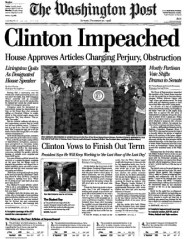
He was impeached in December 1998 on two counts — lying under oath and obstructing justice to cover up the affair — but acquitted by the U.S. Senate in February 1999 and served out the 23 months remaining in his term.

Separately, a federal judge found Clinton in contempt of court for having lied under oath about the Lewinsky affair. Clinton was barred from practicing law for five years and ordered to pay nearly $90,000 to the lawyers of Paula Jones, who had accused him of sexual harassment while he was governor of Arkansas.

Clinton was the second U.S. president impeached in office. The other was Andrew Johnson, in 1868.

ABC’s including Jefferson in its “double lives” roster was little short of baffling: Indeed, its writeup about Jefferson’s purported sexual liaison with a slave-mistress named Sally Hemings offered no small amount of exculpatory evidence.

In fact, the writeup referred to “the myth of Jefferson’s double life” and noted:

“To this day, Jefferson’s paternity of any of her children has not been established with any absolute certainty.”

ABC also pointed out that a recent and detailed study about the purported Jefferson-Hemings affair which “did not show much support for the accusations” of a sexual liaison.

That study, a 400-page work titled The Jefferson-Hemings Controversy: Report of the Scholars Commission, was compiled by a commission of Jefferson scholars charged with puncturing the myriad misunderstandings about the third president and a slave whom he rarely mentioned in his letters.

Among the misunderstandings was the DNA testing released in 1998 — about the time Clinton was facing impeachment charges — confirmed that Jefferson fathered children by Hemings.

“While the tests were professionally done by distinguished experts,” the scholars commission pointed out, “they were never designed to prove, and in fact could not have proven, that Thomas Jefferson was the father of any of Sally Hemings’ children.

“The tests merely establish a strong probability that Sally Hemings’ youngest son, Eston, was fathered by one of the more than two dozen Jefferson men in Virginia at the time ….”

One of the more than two dozen Jefferson men.

Yet, news media reports at the time characterized the DNA tests as offering “compelling evidence” of a sexual relationship between Jefferson and Hemings.

The scholars commission — a panel of 13 experts organized by the Thomas Jefferson Heritage Society — said that circumstantial evidence points more powerfully to Jefferson’s younger brother, Randolph (or his sons), in the paternity question.

Randolph Jefferson, the book says, was known to have socialized with the slaves at Monticello, Thomas Jefferson’s home near Charlottesville, VA.

Randolph Jefferson was a dozen years younger than the president, and the available record offers no evidence that Thomas Jefferson “enjoyed socializing at night with Monticello slaves,” the book points out.

Eston Hemings’ was conceived around August 1807, when Thomas Jefferson was 64 and in declining health — factors that further diminish the likelihood of his paternity.

Also making ABC’s roster of politicians who led “double lives” were Mark Sanford, a former governor of South Carolina; John Edwards, a former U.S. senator from North Carolina; Arnold Schwarzenegger, a former governor of California, and Anthony Wiener, a former congressman from New York City.

WJC

Many thanks to Instapundit
Glenn Reynolds for linking to this post.

Recent and related: