W. Joseph Campbell

Archive for the ‘Television’ Category

Some dubious election history from Al Jazeera English

In Anniversaries, Debunking, Error, Media myths, Television on September 20, 2012 at 12:12 pm

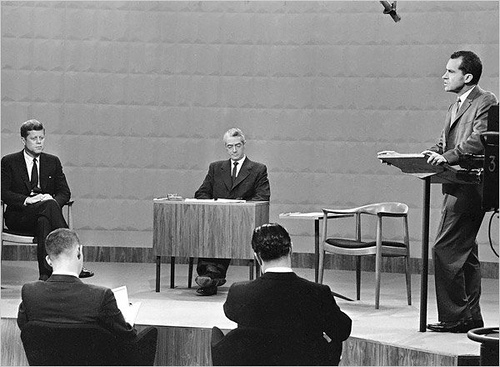
First televised presidential debate

The first televised presidential debate in 1960 gave rise to an enduring media myth — the notion that television viewers and radio listeners interpreted the encounter quite differently.

The myth of viewer-listener disagreement lives on despite its thorough dismantling 25 years ago, in an article in Central States Speech Journal by scholars David L. Vancil and Sue D. Pendell.

Vancil and Pendell noted that reports of viewer-listener disagreement in the first of four debates between John F. Kennedy and Richard M. Nixon in 1960 typically were impressionistic and anecdotal.

Moreover, they wrote, the few surveys that hinted at a viewer-listener disconnect were too small and unrepresentative to allow confident or sweeping judgments.

Vancil and Pendell also challenged the notion that Nixon’s haggard appearance and sweaty brow contributed powerfully to television viewers’ perceptions about the debate, which took place September 26, 1960.

“Appearance problems, such as Nixon’s perspiring brow, could have had a negative impact on viewer perceptions,” Vancil and Pendell wrote, “but it is also possible for viewers to be sympathetic to such problems, or to interpret them as evidence of attractive or desirable qualities.”

They also wrote that “the inference that appearance problems caused Nixon’s loss, or Kennedy’s victory [in the debate] is classic post hoc fallacy.”

Their debunking notwithstanding, the myth of viewer-listener disagreement tends to resurface at or near the anniversaries of the first Kennedy-Nixon debate.

Take, for example, a commentary posted today at the English-language online site of Al Jazeera, the Qatar-based Arabic television network.

The commentary describes the first Kennedy-Nixon debate as “a bellwether” and asserts that “listeners tuning in via radio considered the debate a draw or even a slight win for Nixon. But the 65 million who tuned in by TV saw something very different. Kennedy appeared vigorous yet relaxed, while Nixon looked pale and nervous. … Those viewing the debate on television judged Kennedy as the clear winner.”

But as Vancil and Pendell reported years ago, there is no persuasive, compelling evidence to support such claims.

Not only that, but contemporaneous evidence, including public opinion polls, offer scant support for the notion that television audiences “judged Kennedy as the clear winner.”

To be sure, not all observers saw it that way in late September 1960. In its post-debate editorial, the Washington Post declared, for example:

“Of the two performances Mr. Nixon’s probably was the smoother.

“He is an accomplished debater with a professional polish, and he managed to convey a slightly patronizing air of a master instructing a pupil.”

And the Los Angeles Times said in an editorial (beneath the headline “A slow fight to a draw”) that most television viewers of the debate probably “felt as we did: they were disappointed because (a) they could not pick a winner and (b) they could not find that any single issue had been sharpened up by the abrasives of debate.”

The nationally prominent columnist, James Reston, wrote in the New York Times after the debate:

“This TV program did not do any of the dramatic things predicted for it. It did not make or break either candidate. … Who took the first round is a matter of individual opinion. My own view is that Kennedy gained more than Nixon, but it was a fielder’s choice, settling nothing.”

A Gallup poll released in October 1960 reported that 43 percent of the debate’s viewers and listeners thought Kennedy “did the better job.” Twenty-three percent thought Nixon’s performance was better, and 29 percent said the candidates were about the same. Five percent offered no opinion.

But opinions about the debate did not translate into a decisive advantage for Kennedy. The same survey reported Kennedy was narrowly ahead in the race, by 49 percent to 46 percent, with 5 percent undecided.

That result represented a modest change from Gallup’s poll taken just before the debate, which reported Nixon leading narrowly, by 47 percent to 46 percent.

But Gallup described the post-debate shift as too slight to be meaningful.

“The prudent reader can see,” George Gallup, head of the polling organization, wrote in describing the results, “that polling accuracy has not reached the degree of accuracy required to say with certainty which candidate is ahead in a close race such as the present one.”

WJC

Recent or related:

‘Cronkite Moment’ morphing ‘into a general civic belief’? Why should it?

In Cronkite Moment, Debunking, Media myths, Reviews, Television on September 9, 2012 at 4:06 pm

Robert MacNeil writes in today’s Washington Post that the presumptive power and influence of  Walter Cronkite, the former CBS News anchorman, “has morphed into a general civic belief.”

Let’s hope not.

Let’s hope the opposite effect is becoming more pronounced — that Cronkite’s presumed influence is slowly being recognized for the myth that it is.

MacNeil, the former co-anchor of the PBS News Hour program, takes up the notion of Cronkite’s power to move national events in a review of the Cronkite biography that came out at the end of May.

The biography, written by Douglas Brinkley and titled Cronkite, appeared for a short time on the New York Times list of non-fiction best-sellers.  I found the book hagiographic, especially its treatment of the so-called “Cronkite Moment” of late February 1968.

That was when Cronkite declared on the air that the U.S. military was “mired in stalemate” in Vietnam and suggested that negotiations might lead to a way out.

But as I pointed out in my 2010 book, Getting It Wrong, Cronkite’s “stalemate” characterization was hardly novel and exerted little demonstrable effect on the policy or decisions of the administration of President Lyndon B. Johnson. The myth also has it that Cronkite’s “mired in stalemate” commentary prompted Johnson not to seek reelection in 1968.

MacNeil in his review notes the doubts about whether Cronkite’s assessment exerted much influence on Johnson but asserts nonetheless the “idea [that it did] has morphed into a general civic belief.”

It’s regrettable that MacNeil didn’t pause to consider the implications of the morphing, or reflect on why the myth of the “Cronkite Moment” is so appealing and so eagerly retold, despite the considerable evidence that can be arrayed in debunking it.

Cronkite himself (until late in his life) rejected the notion that his “mired in stalemate” assessment was all that influential, likening the effect to that merely of a “straw on the back of a crippled camel.”

Indeed, other news organizations in February 1968 were offering assessments far more pointed that Cronkite’s. For example, the Wall Street Journal said a few days before Cronkite’s “mired in stalemate” commentary that the U.S. war effort in Vietnam “may be doomed.”

National political figures likewise were expressing downbeat opinions about the war that month. George Romney, then a long-shot Republican candidate for president, declared in mid-February 1968:

“We haven’t been told the truth about Vietnam. They’re winning; we’re not winning: we’re losing, thus far.”

Such observations obviously were more emphatic than Cronkite’s tentative “mired in stalemate” assessment.

And yet, MacNeil in his review favorably notes a passage from Cronkite, that “America asked for truth about Vietnam, and Cronkite dutifully delivered.”

Americans in February 1968 had many sources other than Cronkite for analysis about Vietnam — analysis that was far sharper and far less equivocal.

WJC

Recent or related:

ABC needs to explain how, why Brian Ross so badly erred

In Debunking, Media myths, Television on July 24, 2012 at 11:59 am

Brian Ross’ stunning error last week linking the suspected Batman-movie shooter to the conservative Tea Party movement has been roundly and appropriately condemned — from Mother Jones to Rush Limbaugh, from the comedian Jon Stewart to the NewsBusters blog.

What’s missing, though, is a thorough, candid, and transparent accounting of what led Ross to proclaim on air that someone sharing the suspected shooter’s name, James Holmes, belonged to the Colorado Tea Party.

Ross, the chief investigative correspondent for ABC News, declared in a brief segment Friday morning, hours after the movie theater shootings in Aurora, Colorado:

“There is a Jim Holmes of Aurora, Colorado, page on the Tea Party site as well, talking about him joining the Tea Party last year.

“Now, we don’t know if this is the same Jim Holmes,” Ross said, “but it is a Jim Holmes of Aurora, Colorado.”

Ross and the network apologized later Friday morning for the error. In a statement posted online, ABC said:

“An earlier ABC News broadcast report suggested that a Jim Holmes of a Colorado Tea Party organization might be the suspect, but that report was incorrect. ABC News and Brian Ross apologize for the mistake, and for disseminating that information before it was properly vetted.”

It was a vague and empty apology that said nothing specifically to the misidentified Jim Holmes — and offered little insight into circumstances that gave rise to a towering error.

Still unexplained is what prompted Ross — whose online biography says he’s one of America’s “most honored and respected journalists” — to disseminate “information before it was properly vetted.”

So there ought to be a very public explanation for breaching such a fundamental protocol of professional journalism. Ross, and ABC News, ought to clarify, in detail, the circumstances that produced such a staggering lapse.

In a telephone conversation with me this morning, a spokesman for ABC News, Jeffrey W. Schneider, resisted engaging in a detailed discussion about Ross’ error.

“It was a mistake,” Schneider said. “We made it plainly clear it was a mistake. I think there’s been all kinds of speculation about how and why. It was simply an error. We made a human error.”

But why is such a broad acknowledgement of error not enough?

A number of reasons offer themselves.

By not explaining the back story to the error, Ross and ABC News have left themselves open to suspicions that political bias immediately and instinctively drove them to suspect a Tea Party connection to the shootings that left 12 people dead.

Rightly or wrongly, that conclusion has been reached often in the days since the shooting.

For example, John Kass of the Chicago Tribune  wrote in a column Sunday: “How long does it take for a major American television news network to politicize mass murder and blame conservatives for the blood of innocents?

“Not long.”

What’s more, by not specifying the circumstances that led to the stunning lapse, Ross and ABC News have effectively deprived serious-minded journalists and media audiences of an opportunity to understand the derivation of error and misjudgment of the kind that can blight the coverage of major breaking stories.

There is more than thumbsucking interest in understanding, at a granular level, why and how the news media get it so badly wrong.

Error-plagued coverage happens often enough: Consider, as another recent example, the wrongheaded early reports by CNN and FoxNews about the Supreme Court’s frankly baffling ruling on the constitutionality of ObamaCare.

As I point out in my latest book, Getting It Wrong, news reporting in the first hours of a dramatic event often is in error, owing in part to the swirl of rumor and confusion that typically accompanies a major breaking story.

And as Kass wrote, “when you add political bias to the rush of breaking news, as seems to have happened here, things get stinky.”

And worse.

WJC

Many thanks to Instapundit
Glenn Reynolds for linking to this post

Recent or related:

Slow to learn: Lesson for journos in Brian Ross’ egregious error on ABC

In Debunking, Media myths, Television on July 20, 2012 at 5:17 pm

Brian Ross’ appalling error linking the Tea Party movement to the suspected Batman-movie shooter in Colorado demonstrates anew how slow journalists can be in grasping an elementary lesson of disaster coverage: Resist temptation to report more than you can immediately verify.

In the hours just after a disaster, journalists tend to be especially prone to error and imprecision, as Ross, the chief investigative correspondent for ABC News, amply demonstrated in declaring today on Good Morning America:

“There is a Jim Holmes of Aurora, Colorado, page on the Tea Party site as well, talking about him joining the Tea Party last year.

“Now, we don’t know if this is the same Jim Holmes,” Ross added, “but it is a Jim Holmes of Aurora, Colo.”

The suspect arrested in the shootings early today at a movie theater in Aurora, Colorado, is named James Holmes. But he is not the “Jim Holmes” to whom Ross referred, and the suspected killer has no known connections to the grassroots Tea Party movement, which advocates restraints in government spending.

It soon was clear that Ross’ speculative remarks associating the killer with the Tea Party were in error. ABC News offered an apology — an apology that raised important unanswered questions:

“An earlier ABC News broadcast report suggested that a Jim Holmes of a Colorado Tea Party organization might be the suspect, but that report was incorrect. ABC News and Brian Ross apologize for the mistake, and for disseminating that information before it was properly vetted.”

But how did that happen? How did Ross — a veteran television reporter whose ABC biography unabashedly declares him “one of the most honored and respected journalists in the country” — come to disseminate “information before it was properly vetted”?

ABC’s apology didn’t say.

It may have been that Ross was excessively eager to be first in reporting a linkage to a conservative political movement. He may have been unable to restrain his ideological inclinations. He may have been misled by a producer.

Whatever the reason, his error on a television program that attracts 4.5 million viewers was inexcusable — and eminently preventable.

In the swirling uncertainty that invariably marks the hours after a disaster, journalists are well-served to show deliberation and restraint, to be mindful that error and distortion often blight the first reports of dramatic events.

I discuss this phenomenon in my latest book, Getting It Wrong, noting that “it is a near-certainty that erroneous reports will circulate in a disaster’s immediate aftermath.”

I also point out in Getting It Wrong:

“By recognizing that implausible rumors and exaggerated casualty tolls almost always are among the first effects of major disasters, journalists may spare themselves considerable embarrassment and their audiences great confusion.”

Getting It Wrong revisits the badly flawed news reporting of Hurricane Katrina’s assault on New Orleans in 2005 — which offers enduring if unlearned lessons for journalists about the near-certainty of error in disaster coverage.

The reporting about Katrina’s destructive assault, I write, “was in important respects flawed and exaggerated. On crucial details, journalists erred badly, and got it wrong.”

I note:

“They reported snipers firing at medical personnel. They reported that shots were fired at helicopters, halting evacuations from the Convention Center [in New Orleans].

“They told of bodies being stacked there like cordwood. They reported roving gangs were preying on tourists and terrorizing the occupants of the Superdome, raping and killing. They said children were victims of sexual assault, that one seven-year-old was raped and her throat was slit. They reported that sharks were plying the flooded streets of New Orleans.”

In the end, none of those reports was verified or substantiated.

Other examples of erroneous news reports about unfolding disasters are not difficult to find.

As I point out in Getting It Wrong, “initial and worst-case estimates of disaster casualties almost always are exaggerated. This happened in the aftermath of the September 11 terrorist attacks on New York City, offering a ready point of reference for reporters covering Katrina’s aftermath. The initial estimates of 10,000 deaths in New York were considerably overstated.”

Early reports about the attacks of September 11, 2001, also were distorted by error — by accounts, for example, of a car bombing at State Department, of military aircraft downing a hijacked plane near Camp David.

All too often, the news media are disinclined to revisit their disaster-coverage lapses and account for the errors. Such was the case in Katrina’s aftermath, when news organizations offered at best feeble and one-off explanations for their flawed and exaggerated reporting.

Ross and ABC News owe their viewers nothing less than a thorough and candid accounting for their error today.

WJC

Many thanks to Instapundit
Glenn Reynolds for linking to this post

Recent or related: