W. Joseph Campbell

Archive for the ‘Washington Post’ Category

ABC News invokes false narrative of Jessica Lynch case

In Debunking, Jessica Lynch, Media myths, Washington Post on December 17, 2011 at 10:22 am

ABC News yesterday invoked the false derivation of the hero-warrior myth about Jessica Lynch, declaring that “the U.S. government portrayed her as a fearless heroine who had gone down fighting” early in the Iraq War.
Not so. The Washington Post did that.

The Post — alone — placed the bogus tale about Lynch and her battlefield derring-do into the public domain in April 2003, in an electrifying, front-page article that was picked up by news organizations around the world.

The “U.S. government” — specifically, the Pentagon — was loath to embrace the tale about Lynch and her heroics.

Indeed, as one of the Post reporters on the botched report about Lynch later said:

“Our sources for that story were not Pentagon sources.”

The reporter, Vernon Loeb, also said in an interview on NPR: “They wouldn’t say anything about Jessica Lynch.”

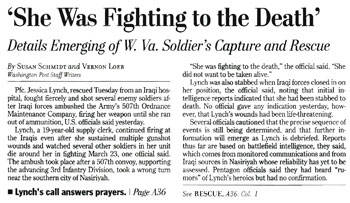
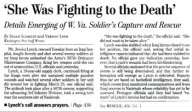
Loeb and another Post reporter, Susan Schmidt, had reported on April 3, 2003, that Lynch fought fiercely in the ambush of her unit, the 507th Maintenance Company, on March 23, 2003. Neither Loeb nor Schmidt was with Lynch’s unit; no journalist was.

Loeb and Schmidt wrote that Lynch “shot several enemy soldiers” and  “continued firing at the Iraqis even after she sustained multiple gunshot wounds and watched several other soldiers in her unit die around her in fighting” at Nasiriyah, in southern Iraq.

Loeb and Schmidt quoted a source, to whom they referred as a “U.S. official,” as saying:

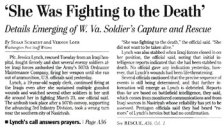
“She was fighting to the death. She did not want to be taken alive.”

Though dramatic, and even cinematic, the Post report was utterly wrong.

Lynch had not fired a shot in the ambush; her weapon jammed. Lynch was neither shot nor stabbed; she suffered shattering injuries in the crash of a Humvee as it tried to escape the ambush.

The Post has never fully explained how it botched the hero-warrior story about Lynch. It has never disclosed the identities of the anonymous sources that led it so badly awry on the Lynch story.

The murkiness of the newspaper’s sourcing has not only encouraged the rise of the false narrative, which ABC News cited in asserting, without attribution, that the “U.S. government portrayed” Lynch as a hero.

The Post’s obscure sourcing also has given rise to false allegations. The author Jon Krakauer, for example, wrongly accused Jim Wilkinson, a communications official in the administration of President George Bush, of having “arranged to give the Washington Post exclusive access” to the Lynch hero-warrior tale.

Krakauer called Wilkinson a “master propagandist” who “deserves top billing for creating the myth of Jessica Lynch.”

Krakauer has since quietly rescinded those allegations, which he had included in his 2009 book, Where Men Win Glory: The Odyssey of Pat Tillman.

Another upshot of the false narrative is that it has obscured wide recognition of a real hero at Nasiriyah, a sergeant in Lynch’s unit named Donald Walters.

Sgt. Walters

As I write in my latest book, Getting It Wrong, Walters’ battlefield heroics were likely misattributed to Lynch, owing to mistranslation of Iraqi radio transmissions from the battlefield.

“During the ambush in Nasiriyah,” I write, “… Walters either stayed behind, or was left behind, to lay down covering fire as his fellow soldiers tried to make their escape. Walters fought his attackers in a fashion that the Post attributed to Lynch.”

I point out that the most detailed account of Walters’ bravery appears in Richard Lowry’s fine study of the fighting at Nasiriyah, Marines in the Garden of Eden.

Lowry wrote that Walters killed “several Iraqis before he was surrounded and captured” by Iraqi irregulars, the Fedayeen, and executed.

“We will never really know the details of Walters’ horrible ordeal,” Lowry wrote. “We do know that he risked his life to save his comrades and was separated from the rest of the convoy, deep in enemy territory.

“We know that he fought until he could no longer resist.”

The Post, though, has shown scant interest in Walters’ heroism.

A database search of Post articles published since April 2003 revealed just four stories in which Walters was mentioned. None of those articles discussed in any detail his bravery at Nasiriyah.

WJC

Recent and related:

WaPo still dodging responsibility in Jessica Lynch case

In Debunking, Jessica Lynch, Washington Post on December 14, 2011 at 2:01 pm

Lynch in 2003

The Washington Post — the newspaper that brought the world the bogus hero-warrior tale about Jessica Lynch early in the Iraq War — placed at its Web site today a wire service report about Lynch’s completing an education degree at the University of West Virginia at Parkersburg.

The 900-word report made no mention about the Post’s singular role in pressing the hero-warrior tale into the public domain but instead invoked the false narrative that the U.S. military made up the account about Lynch’s battlefield heroics to bolster support at home for the war.

“To make her seem more heroic and rally public support for the war,” said the report by the Associated Press, which the Post placed online, “the military claimed she’d gone down firing — when, in fact, her rifle had jammed.”

How arrogant: It was the Post that reported Lynch had “gone down firing,” that she had fought ferociously in the ambush of her unit, the 507th Maintenance Company, at Nasariyah in March 2003.

It was the Post — citing otherwise unnamed “U.S. officials” — that presented the electrifying tale that Lynch had “shot several enemy soldiers” in the ambush.

It was the Post that reported Lynch “continued firing at the Iraqis even after she sustained multiple gunshot wounds and watched several other soldiers in her unit die around her” in the fighting.

It was the Post that said Lynch also suffered stab wounds in the ambush.

But none of it was true.

Lynch never fired a shot in Iraq. Her weapon jammed during the ambush.

She suffered shattering injuries not in battling Iraqi soldiers but in the crash of a Humvee as it fled the ambush.

As I discuss in a chapter in my latest book, Getting It Wrong, the Post has never fully explained how it got the Lynch story so badly wrong.

It has never disclosed the anonymous sources it cited in presenting the bogus hero-warrior tale.

Indeed, the Post has largely sidestepped accountability for the bogus hero-warrior narrative, which has allowed the false narrative about the military’s concocting the Lynch story to take hold and proliferate.

We know it’s a false narrative from one of the Post reporters whose byline appeared on the botched Lynch story, which was published April 3, 2003, beneath the headline:

“‘She was fighting to the death.'”

Vernon Loeb, a veteran journalist whose byline appeared on that report, said in an interview on NPR’s Fresh Air program in December 2003:

“Our sources for that story were not Pentagon sources.”

He also said in the interview:

“They wouldn’t say anything about Jessica Lynch.”

Loeb added: “I just didn’t see the Pentagon trying to create a hero where there was none. I mean …they never showed any interest in doing that, to me.”

Loeb said the Post based its story on the accounts of “some really good intelligence sources” in Washington, D.C., adding:

“We wrote a story that turned out to be wrong because intelligence information we were given was wrong. That happens quite often.”

As I note in Getting It Wrong, Loeb on another occasion was quoted in a commentary in the New York Times as saying:

“Far from promoting stories about Lynch, the military didn’t like the story.”

Loeb also was quoted in the commentary as saying that “the sources for this information [about Lynch’s derring-do] were apparently Iraqis, both Iraqi informants and intercepts.”

Loeb’s disclaimers notwithstanding, the notion that the Pentagon’s made up the story to bolster domestic U.S. support for the war makes little sense. The American public, after all, supported the Iraq War in overwhelming numbers in its early days and weeks, as I point out in Getting It Wrong.

But it’s clear that if not for the Post’s erroneous reporting, the bogus tale of Lynch’s battlefield heroism never would have circulated as widely and as profoundly as it did.

WJC

Recent and related:

So it begins: Woodward, Bernstein, and excess in run-up to Watergate’s 40th

In Anniversaries, Debunking, Washington Post, Watergate myth on December 4, 2011 at 12:48 am

American journalists love anniversaries, so expect excess next year at the 40th anniversary of the Watergate break-in, which gave rise to the greatest scandal in U.S. politics — and to the media-driven myth that Washington Post journalists toppled a president.

Woodward: 40th anniversary honor

In fact, Watergate commemorative excess is already scheduled.

The Los Angeles Press Club announced the other day that it plans to recognize the Watergate reporting of Bob Woodward and Carl Bernstein at next year’s Southern California Journalism Awards program.

“Woodward and Bernstein’s series of articles for The Washington Post unraveled the biggest American political scandal to date, culminating in President Richard Nixon’s resignation in 1974. Four decades later, the stories still stand as a bellwether of investigative journalism,” the press club said in a news release.  “To mark the occasion, the Los Angeles Press Club will honor Woodward and Bernstein with the 2012 President’s Award.”

Woodward and Bernstein’s Watergate reporting won a Pulitzer Prize for the Post in 1973. But to say they “unraveled” Watergate is an exaggeration, a misreading of history.

As I discuss in my latest book, Getting It Wrong, the reporting of Woodward and Bernstein was at best a minor factor in bringing down Richard Nixon.

What ended Nixon’s presidency was the incontrovertible evidence of the president’s culpability in the crimes of Watergate — evidence captured on audiotapes that he secretly made of his conversations at the White House.

The decisive evidence — known as the “Smoking Gun” tape — revealed that Nixon at a meeting with his top aide, H.R. Haldemann, on June 23, 1972, sought to deflect or derail the FBI investigation into the break-in several days before at Democratic National headquarters  at the Watergate complex in Washington, DC.

The reporting of Woodward and Bernstein didn’t reveal the contents of that tape, which Watergate prosecutors had subpoenaed and which Nixon had refused to surrender until 1974, after the U.S. Supreme Court ordered him to do so.

Their reporting didn’t disclose the existence of Nixon’s taping system, either. It was revealed in July 1973, during hearings of the U.S. Senate Select Committee on Watergate.

In All the President’s Men, their book about their Watergate reporting, Woodward and Bernstein said they had received a tip about the taping system a few days before its existence was made public.

According to All the President’s Men, Ben Bradlee, then the Post‘s executive editor, suggested not expending much energy pursuing the tip. And Woodward and Bernstein didn’t.

What really “unraveled” Watergate, I write in Getting It Wrong, “was the collective if not always the coordinated forces of special prosecutors, federal judges, both houses of Congress, the Supreme Court, as well as the Justice Department and the FBI.

Even then, despite all that scrutiny and pressure, Nixon, I argue, “likely would have served out his term if not for the audiotape recordings he secretly made of most conversations in the Oval Office of the White House.”

Far more important the reporting of Woodward and Bernstein to the outcome of Watergate was the federal judge who presided at Watergate-related trials, John J. Sirica.

The Post acknowledged Sirica’s decisive role in unraveling Watergate in its obituary of the judge, published in 1992, shortly after his death.

The newspaper said Sirica’s “persistence in searching for the facts while presiding over the Watergate cases led to President Nixon’s resignation,” adding:

“Sirica’s order that tape recordings of White House conversations about the Watergate break-in be made available to prosecutors precipitated Nixon’s resignation in 1974. The tapes revealed that Nixon had approved plans for the Watergate coverup six days after the break-in at the Democratic National Committee’s headquarters in the Watergate complex by men who were working for the Committee to Reelect the President.

“In directing the White House to produce the tapes, Sirica set himself on a constitutional collision course with Nixon, who tried to invoke executive privilege and argue that the tapes were not subject to judicial scrutiny. But in a historic ruling, the U.S. Supreme Court upheld Sirica, ruling unanimously that the judiciary must have the last word in an orderly constitutional system.”

WJC

Recent and related:

Jon Krakauer rolls back claims about WaPo ‘source’ in Jessica Lynch case

In Debunking, Jessica Lynch, Media myths, Washington Post on November 11, 2011 at 12:05 am

Author Jon Krakauer has quietly retreated from claims in a 2009 book that a former White House official, Jim Wilkinson, was the source for the Washington Post’s botched report about Jessica Lynch and her supposed battlefield heroics early in the Iraq War.

The unattributed assertions about Wilkinson — who was said to have “duped reporters and editors at the Washington Post” — were included in Krakauer’s Where Men Win Glory: The Odyssey of Pat Tillman.

The claims were removed in a recent printing of the book’s paperback edition, which now contains a footnote, saying:

“Earlier editions of this book stated that it was Jim Wilkinson ‘who arranged to give the Washington Post exclusive access’ to this leaked intelligence [about Jessica Lynch]. This is incorrect. Wilkinson had nothing to do with the leak.”

The Post has never identified the sources for its report, published on its front page April 3, 2003, that said Lynch had fought fiercely in the ambush of the 507th Maintenance Company at Nasiriyah in southern Iraq on March 23, 2003.

The Post’s account cited “U.S. officials” in saying that Lynch, a 19-year-old supply clerk, had kept “firing at the Iraqis even after she sustained multiple gunshot wounds and watched several other soldiers in her unit die around her in fighting” at Nasiriyah.

The Post’s electrifying report about the waif-like Army private was picked up by news organizations around the world.

But none of it was true.

As I discuss in my latest book, Getting It Wrong, Lynch never fired a shot at Nasiriyah; her rifle jammed during the attack. She suffered shattering injuries when a rocket-propelled grenade struck her Humvee, causing the vehicle to crash. But Lynch was not shot.

She was taken prisoner and treated at an Iraqi hospital, from where she was rescued April 1, 2003, by a U.S. special operations team.

In the years since, the Post has never adequately explained how it so thoroughly erred on the hero-warrior story about Lynch; nor has it disclosed the identities of the “U.S. officials” who led the newspaper awry.

The Post’s silence about its sources has contributed to the rise to a false narrative that the Pentagon concocted the hero-warrior tale in a cynical effort to bolster public support for the war.

Vernon Loeb, one of the reporters who shared the byline on the botched Lynch story, has said that the Pentagon was not the source for the report.

“I could never get anybody from the Pentagon to talk about those reports at all,” Loeb said on an NPR program in mid-December 2003, adding:

“They wouldn’t say anything about Jessica Lynch.”

Even so, the false narrative about Lynch and the Pentagon persists and has deflected attention from the Army sergeant who apparently did fight to the death at Nasiriyah. He was Donald Walters, who laid down covering fire as elements of the 507th tried to flee the ambush.

Walters was captured when his ammunition ran out and was executed by his captors soon afterward.

At the time of the battle at Nasiriyah, Wilkinson was director of strategic communications for General Tommy Franks, the commander of U.S. forces in Iraq. Among his prior positions, Wilkinson was deputy director of communications at the White House.

Wilkinson, who had vigorously denied the claims about him in Where Men Win Glory, said he met with Krakauer nearly a year ago in Colorado to discuss corrections.

At that meeting, Wilkinson said, the author told him that his source recanted claims about Wilkinson.

Wilkinson told Media Myth Alert that he was grateful to Krakauer for correcting the record, adding that he feels “100 times better” that the book’s extensive and unflattering assertions about him have been removed. “I greatly appreciate his willingness to meet with me and then issue a corrected version of the book that clears my name,” Wilkinson said.

The unflattering assertions were dropped in June, in what was the 17th printing of the Anchor Books soft-cover edition of Where Men Win Glory. Anchor, an imprint of Random House, issued no announcement about the revisions.

In earlier editions of Where Men Win Glory, Krakauer called Wilkinson a “master propagandist” and identified him as “the guy who deserved top billing for creating the myth of Jessica Lynch.”

Wilkinson, Krakauer also wrote, “duped reporters and editors at the Washington Post … and other media outlets into running wildly hyperbolic stories about Lynch.”

It remains unclear how Krakauer erred so badly in accusing Wilkinson. The author did not reply to an email sent to him yesterday and attempts this week to reach him through his publisher were unavailing.

“Unfortunately, he’s not talking questions at this time,” Russell Perreault, a spokesman for Random House, said by email. “He’s working on a new project.”

Krakauer’s most recent work, Three Cups of Deceit, seeks to puncture the humanitarian reputation of Greg Mortensen, whose charitable organization builds schools in Afghanistan and Pakistan.

“The image of Mortensen that has been created for public consumption,” Krakauer wrote in Three Cups of Deceit, “is an artifact born of fantasy, audacity, and an apparently insatiable hunger for esteem. Mortensen has lied about the noble deeds he has done, the risks he has taken, the people he has met, the number of schools he has built.”

WJC

Many thanks to Instapundit
Glenn Reynolds for linking to this post.

Recent and related:

Historian dismisses as ‘self-promotion’ the heroic-journalist interpretation of Watergate

In Debunking, Media myths, Washington Post, Watergate myth on October 25, 2011 at 5:44 am

Kutler

Stanley I. Kutler, the preeminent historian of the Watergate scandal, was on campus yesterday to speak to a government class, and he told me after his talk that the heroic-journalist interpretation of Watergate is grounded in reportorial “self-promotion.”

The heroic-journalist narrative has it that Richard Nixon’s corrupt presidency was brought down through the reporting of Bob Woodward and Carl Bernstein for the Washington Post.

It’s a myth, as I discuss in my latest book, Getting It Wrong. But it long ago became the dominant narrative of how Watergate was rolled up — a simplistic narrative that Kutler effectively dismantled during his appearance at American University.

In response to a question I posed afterward, Kutler said “self-promotion” by Woodward and Bernstein — notably their book about their Watergate reporting — explains the tenacity of what I call the heroic-journalist narrative.

Kutler, an emeritus professor at the University of Wisconsin, is the author, among other works, of The Wars of Watergate, a thorough and definitive treatment of the scandal that unfolded from 1972-74.

His talk at American was organized around the question, “Who really unraveled Watergate?”

In the final analysis, Kutler said, Nixon “was primarily responsible” for bringing down Nixon.

If not for the evidence of Nixon’s complicity — captured on audiotapes that he secretly recorded of conversations at the Oval Office of the White House — Nixon would have survived the scandal, Kutler said.

“Absent the tapes, Nixon walks,” he said. “You had to have that kind of corroborative evidence to nail the president of the United States.”

The tapes, which Nixon surrendered when compelled by the U.S. Supreme Court, captured the president participating in June 1972 in a clumsy attempt to cover up the signal crime of Watergate, the break-in a few days before at the headquarters of the Democratic National Committee.

Kutler devoted little time in his talk to the contributions of Woodward and Bernstein, whose book about their reporting, All the President’s Men, was an immediate best-seller when it came out in June 1974, less than two months before Nixon resigned.

Kutler said the book “is a potboiler in many, many ways” and offered “a layman’s brief for understanding Watergate.”

The book, he added, is “important in that way.”

Kutler praised the work of Earl Silbert, the U.S. attorney in Washington whose office investigated the unfolding scandal in 1972-73, until a special Watergate prosecutor was named. The criminal cases against Nixon’s closest aides were “made by these guys,” Kutler said of Silbert and his investigators.

The Senate select committee on Watergate, he added, “did incredible work” in investigating the scandal — notably in extracting testimony that revealed Nixon’s secret tape-recordings. “The whole story changes,” Kutler said, with the disclosure in July 1973 of the tapes’ existence.

Kutler also lauded the contributions of federal Judge John J. Sirica, of the Watergate special prosecutors, and of the House Judiciary Committee, which approved four articles of impeachment against Nixon before his resignation in August 1974.

“Everybody has a role to play” in unraveling Watergate, Kutler said. “But let’s face it: Richard Nixon was primarily responsible” for bringing down Nixon. “The tapes damn him.”

Kutler has been at the forefront of efforts to win release of transcripts of grand jury testimony that Nixon gave in June 1975.

He won a judge’s order to unseal the testimony, which is to be made available November 10 at the online site of the Nixon Presidential Library and Museum.

“We just don’t know what’s in there,” Kutler said of the grand jury testimony, adding, however, that he expects it to contain “no spectacular fireworks.”

Kutler said that Nixon in going before the grand jury was “not going to lie. … He knew how to give non-answers.”

WJC

Recent and related:

‘Deep Throat’ didn’t say ‘follow the money’; nor was he vital in Watergate

In Debunking, Media myths, Washington Post, Watergate myth on October 13, 2011 at 12:55 am

It is quite impressive how Watergate’s most famous made-up line — “follow the money” — is so often cited by so many news outlets.

Felt: Not so vital

Canada’s Calgary Herald was the latest to indulge in the myth that “follow the money” was guidance offered by the high-level anonymous source code-named “Deep Throat.” The advice supposedly was offered to Bob Woodward, a Washington Post reporter covering Watergate.

The Herald invoked the made-up line in an article the other day about U.S. charitable organizations making donations to Canadian environmental groups.

“Most of us don’t think much about where organizational funding comes from when we witness well-orchestrated protests against, say, fish farming,” the Herald article said, adding:

“But, as the Watergate-era Deep Throat source once counselled, follow the money.”

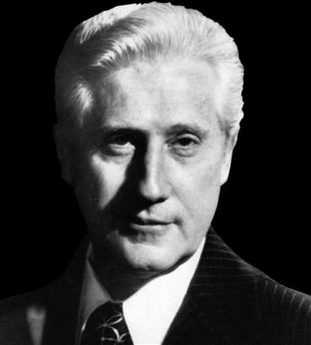
“Deep Throat” — who was self-revealed in 2005 to have been W. Mark Felt Jr., formerly the second-ranking official at the FBI — never spoke the line.

It was written into the screenplay of All the President’s Men, the cinematic version of the book by the same title that Woodward and Post colleague Carl Bernstein wrote about their Watergate reporting.

Follow the money” was uttered by Hal Holbrook, the actor who turned in an outstanding performance playing “Deep Throat” in the movie. He delivered the line with such assurance that it really did seem to offer a way through the labyrinth of the Watergate scandal.

Woodward

But even if Woodward had been advised to “follow the money,” the guidance neither would have unraveled Watergate nor led him to Nixon.

What forced Nixon’s resignation in August 1974 was not the misuse of campaign funds but, rather, his attempt to obstruct justice by covering up the signal crime of the Watergate scandal, the break-in at the headquarters of the Democratic National Committee in June 1972.

Although the movie version of All the President’s Men portrays “Deep Throat” as crucial to Watergate’s outcome, his contributions weren’t so vital in real life, as the scandal slowly unfolded.

That assessment was offered the other day by Barry Sussman, who was the Watergate editor for the Washington Post. In an online essay at Huffington Post, Sussman wrote that “Deep Throat/Mark Felt was more myth than reality as a useful Watergate source.”

Sussman’s essay linked to a commentary he wrote in 2005, after the identity of “Deep Throat” was revealed — more than 30 years after Woodward and Bernstein had written about him in All the President’s Men, an immediate best-seller when it appeared in 1974.

“Deep Throat was nice to have around, but that’s about it,” Sussman wrote. “His role as a key Watergate source for the Post is a myth, created by a movie and sustained by hype for almost 30 years.”

That’s very intriguing, especially from someone as close to the Post’s Watergate reporting as Sussman was.

He’s now editor of the Nieman Watchdog Project of the Nieman Foundation for Journalism at Harvard University.

He closed his 2005 commentary by asserting:

“Watergate for many years has been hailed as a victory for the American system, and for the press. It wasn’t. It was a very narrow miss. Woodward and Bernstein did fine work in helping lay out the scandal as it took place. But they have been riding the myth and hype of Deep Throat/Mark Felt for a very long time.”

It deserves emphasizing that Watergate’s dominant narrative notwithstanding, the reporting by Woodward and Bernstein did not, as I discuss in my latest book, Getting It Wrong, take down Nixon’s corrupt presidency.

Unraveling Watergate, as I point out in Getting It Wrong, required “the collective if not always the coordinated forces of special prosecutors, federal judges, both houses of Congress, the Supreme Court, as well as the Justice Department and the FBI.

“Even then,” I add, “Nixon likely would have served out his term if not for the audiotape recordings he secretly made of most conversations in the Oval Office of the White House.

“Only when compelled by the Supreme Court did Nixon surrender those recordings,” which captured him obstructing justice.

Sussman’s right: Watergate was a very narrow miss.

WJC

Recent and related:

Joe McGinniss, ‘Deep Throat,’ and anonymous sources

In Debunking, Washington Post, Watergate myth on October 11, 2011 at 1:02 am

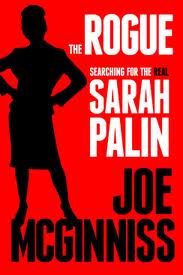
Joe McGinniss, author of a scathing biography about Sarah Palin, yesterday defended using anonymous sources in the book, asserting in a commentary in USA Today that “without Deep Throat, there wouldn’t have been any Watergate hearings, and Richard Nixon would never have resigned.”

'The Rogue,' by McGinniss

Deep Throat” was the anonymous, high-level source who conferred periodically in 1972 and 1973 with Bob Woodward of the Washington Post as the Watergate scandal unfolded.

As memorable as “Deep Throat” may be, his contributions to Watergate’s outcome were hardly as sweeping or decisive as McGinniss claimed.

As Woodward and his reporting colleague Carl Bernstein wrote in the book about their Watergate reporting, All the President’s Men, the principal role of “Deep Throat” was to “confirm information that had been obtained elsewhere and to add some perspective.”

Not only that, but “Deep Throat” and his conversations with Woodward were scarcely pivotal in the U.S. Senate’s decision to empanel a select committee and convene hearings in 1973 about the Watergate scandal.

In The Whole Truth, his memoir about the hearings, Sam Ervin Jr., the Democratic senator who chaired the select committee, saluted a lengthy roster of people who contributed to unwinding Watergate.

The roster included several journalists and news publications. But Ervin made no mention of Woodward’s shadowy “Deep Throat” source, who had been introduced in some detail in 1974, with publication of All the President’s Men.

“One shudders to think,” Ervin wrote in his memoir, “that the Watergate conspirators might have been effectively concealed … had it not been for the courage and penetrating understanding of [U.S. District] Judge [John] Sirica, the thoroughness of the investigative reporting of Carl Bernstein, Bob Woodward, Seymour Hersh, Clark Mollenhoff, and other representatives of a free press, the devotion to their First Amendment responsibilities of the Washington Post, The New York Times, Time magazine, Newsweek, and other publications, the labors of the Senate Select Committee, and the dedication and diligence of Special Prosecutors Archibald Cox and Leon Jaworski and their associates.”

No mention of “Deep Throat,” though.

The shadowy source was self-revealed in 2005 to have been W. Mark Felt Jr., formerly second in command at the FBI. Felt left the agency in 1973 — many months before Watergate reached its denouement in August 1974 with the resignation of Nixon.

All the President’s Men, and the like-titled 1976 movie version, touched off a years-long guessing about the identity of “Deep Throat” — speculation that surely inflated his importance in popular understanding about how Watergate was rolled up.

As I write in my latest book, Getting It Wrong, the speculation about “Deep Throat” brought “periodic and powerful reminders about the Post and its Watergate coverage, serving to keep Woodward and Bernstein in the public eye far longer than they otherwise would have been.

“They and the mysterious ‘Deep Throat’ source became central figures” in what the Philadelphia Inquirer once called “the parlor game that would not die.”

It’s important to keep in mind, too, that Felt hardly was a heroic figure, even though “Deep Throat” is portrayed that way in the cinematic version of All the President’s Men.

Felt in his senior position at the FBI authorized illegal burglaries in the early 1970s as part of the agency’s investigations into leftists linked to the radical Weather Underground.

Felt was convicted in 1980 on felony charges related to the break-ins, but was pardoned by President Ronald Reagan.

WJC

Many thanks to Instapundit
Glenn Reynolds for linking to this post

Recent and related:

NYTimes errs, claims Woodward, Bernstein ‘unraveled’ Watergate

In Debunking, Media myths, Washington Post, Watergate myth on October 10, 2011 at 1:55 am

The New York Times inaccurately declared over the weekend that Bob Woodward and Carl Bernstein, in their reporting for the Washington Post, “unraveled the Watergate affair.”

The Times’ erroneous assertion was made in an obituary published Saturday about a minor figure in the Watergate scandal, Kenneth H. Dahlberg, who died last week. Watergate led to the resignation in 1974 of President Richard M. Nixon.

The obituary noted that Dahlberg was an “unwitting link between the Nixon re-election campaign and the five men … charged with breaking into the Democratic National Committee headquarters at the Watergate complex in Washington,” the scandal’s signal crime.

Dahlberg, the Times added, “had been a fund-raiser for Nixon’s re-election campaign, and his name was on a $25,000 cashier’s check that had been deposited in the bank account of one of the burglars, Bernard L. Barker. The money was to help cover the burglars’ expenses, and Mr. Barker had withdrawn that amount in $100 bills. He was carrying more than $5,000” when arrested at the DNC headquarters June 17, 1972.

The Times then asserted:

“Bob Woodward, a young reporter for The Washington Post who with Carl Bernstein unraveled the Watergate affair, has called the Dahlberg check the ‘connective tissue’ that turned what they thought was a story about a common crime into one of historic dimensions.”

That may be, but the Dahlberg connection was only a small, early step in unwinding the scandal. Interestingly, Dahlberg receives one, passing mention in Stanley I. Kutler’s exhaustive, single-volume work, The Wars of Watergate.

What’s more, Woodward and Bernstein scarcely can be credited with having “unraveled” Watergate — and the Times offered no evidence to support its exaggerated claim.

Rather, the Times effectively sidled up to the beguiling “heroic-journalist myth,”  which, as I write in my latest book,  Getting It Wrong, has become “the most familiar storyline of Watergate.”

What unraveled Nixon’s presidency wasn’t the reporting of Woodward and Bernstein for the Post but the incontrovertible evidence of his culpability in the crimes of Watergate — evidence captured on audiotapes that he secretly made of his conversations at the White House.

The decisive evidence — known as the “Smoking Gun” tape — revealed that Nixon at a meeting with his top aide, H.R. Haldemann, on June 23, 1972, sought to deflect or derail the FBI investigation into the Watergate burglary.

Woodward and Bernstein didn’t reveal the contents of that tape, which Watergate prosecutors had subpoenaed and which Nixon had refused to surrender until 1974, after the U.S. Supreme Court ordered him to do so.

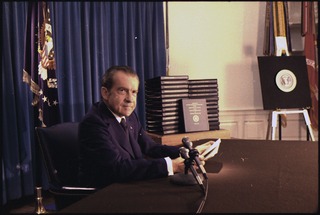
Nixon with tape transcripts, 1974

Nor did Woodward and Bernstein disclose the existence of Nixon’s secret audiotaping system, which proved so crucial to Watergate’s outcome.

The taping system was revealed in July 1973, during hearings of the U.S. Senate Select Committee on Watergate.

In All the President’s Men, their book about their Watergate reporting, Woodward and Bernstein said they had received a tip about the taping system a few days before its existence was made public.

According to All the President’s Men, Ben Bradlee, then the Post‘s executive editor, suggested not expending much energy pursuing the tip. And Woodward and Bernstein didn’t.

What really “unraveled” Watergate, I write in Getting It Wrong, “was the collective if not always the coordinated forces of special prosecutors, federal judges, both houses of Congress, the Supreme Court, as well as the Justice Department and the FBI.

Even then, despite all that scrutiny and pressure, Nixon, I argue, “likely would have served out his term if not for the audiotape recordings he secretly made of most conversations in the Oval Office of the White House.”

WJC

Many thanks to Jack Shafer for linking
to this post

Recent and related:

Made-up Watergate line, ‘follow the money,’ crosses into the news

In Cinematic treatments, Debunking, Washington Post, Watergate myth on October 6, 2011 at 4:38 am

Kenneth H. Dahlberg, a minor Watergate figure, died the other day and Minnesota Public Radio recalled his role in the scandal by turning to the famous made-up line, “follow the money” — advice supposedly given to Washington Post reporters working the story.

The public radio station’s “News Cut” feature noted yesterday that “Dahlberg was the Midwest finance chairman for the Committee to Re-elect the President during President Richard M. Nixon’s 1972 campaign.

“A mysterious check, which later would be determined to be from the CEO of Archer Daniels Midland, was given to Dahlberg, who converted it to a cashier’s check. It was money from the campaign, destined for the Watergate burglars.”

The Minnesota Public Radio report added that when the stealthy, high-level “Deep Throat” source told Post reporters Bob Woodward and Carl Bernstein “to ‘follow the money,’ that was the money. And when Woodward called Dahlberg to confirm he handled the check, Dahlberg didn’t lie. … It ended up a critical part of the movie All The President’s Men.”

That last bit is true. Woodward’s telephone interview with Dahlberg became a memorable scene in the 1976 movie.

Otherwise, though, there’s a fair amount of wayward information in the “News Cut” report.

For starters, “Deep Throat” never met with Bernstein during Watergate.

More important, “Deep Throat” (self-revealed in 2005 to have been former FBI official W. Mark Felt) never advised Woodward to “follow the money.”

Felt: Never said it

That line appears nowhere in All the President’s Men, Woodward and Bernstein’s 1974 book about their Watergate reporting — reporting that did not, as I discuss in my latest work, Getting It Wrong, take down Nixon’s corrupt presidency.

Moreover, “follow the money” appeared in no Watergate-related article or editorial in the Washington Post  before 1981 — or long after Nixon resigned the presidency in disgrace.

Rather, “follow the money” was written into the screenplay of the cinematic version of All the President’s Men; the line was memorably uttered not by Felt, the real-life “Deep Throat,” but by Hal Holbrook, the actor who played him in the movie.

As I’ve noted at Media Myth Alert, Holbrook turned in an outstanding performance as a tormented and conflicted “Deep Throat.”

And he delivered his “follow the money” line with such steely assurance that it did seem to offer a way through the labyrinth that was the Watergate scandal.

But even if Woodward had been counseled to “follow the money,” such advice certainly would neither have unraveled Watergate nor led him to Nixon.

What forced Nixon from office in 1974 was not the grubby misuse of campaign funds but, rather, his active role in seeking to obstruct justice by covering up the signal crime of the Watergate scandal, the break-in at the headquarters of the Democratic National Committee in June 1972.

Rolling up the scandal of Watergate’s complexity and dimension was scarcely as straightforward as pursuing misused campaign contributions.

As I write in Getting It Wrong, unraveling Watergate required “the collective if not always the coordinated forces of special prosecutors, federal judges, both houses of Congress, the Supreme Court, as well as the Justice Department and the FBI.

“Even then,” I note “Nixon likely would have served out his term if not for the audiotape recordings he secretly made of most conversations in the Oval Office of the White House.

“Only when compelled by the Supreme Court did Nixon surrender those recordings, which captured him plotting the cover-up” and cost him the presidency.

WJC

Recent and related:

Carl Bernstein, at it again

In Debunking, Washington Post, Watergate myth on October 1, 2011 at 11:25 am

Carl Bernstein, he of Watergate fame, was in London the other day, waxing indignant about the phone-hacking scandal that shook Rupert Murdoch’s media operations in Britain over the summer and forced the closure of the raunchy News of the World tabloid.

Mentions reporters' ethical lapses

As he has in the past, Bernstein conveniently avoided reference to his own suspect conduct as a Washington Post reporter covering Watergate, the scandal that brought down Richard Nixon’s corrupt presidency in 1974.

Bernstein, who comes across as something of a sanctimonious windbag, sounded aghast in London, telling a panel convened by the Guardian newspaper that he was stunned by the notion of “criminals working for a newspaper, being a substitute for reporters” at the News of the World.

“Gathering news through criminal acts — it’s absolutely stunning,” Bernstein declared.

Bernstein, though, is an odd, curious choice to criticize such conduct, given his own ethical lapses in reporting Watergate.

It’s not often recalled these days, but Bernstein and his Washington Post colleague, Bob Woodward, sought out federal grand jurors in December 1972, inviting them to break their oaths of secrecy and discuss Watergate-related testimony that they had heard.

The reporters were that desperate for leads in what was a slowly unfolding scandal.

The private entreaties to grand jurors nearly landed Bernstein and Woodward in jail for contempt.

As recounted in All the President’s Men, Bernstein and Woodward’s book about their Watergate reporting, none of the grand jurors was cooperative and the overtures soon were made known to John J. Sirica, chief judge of U.S. District Court in the District of Columbia.

The judge was livid.

According to All the President’s Men, Edward Bennett Williams, the Post’s  lawyer and well-known Washington insider, went to lengths to persuade Sirica — known as “Maximum John” for the severe sentences he often imposed — not to punish Bernstein and Woodward.

“John Sirica is some kind of pissed at you fellas,” Williams was quoted as saying in the book. “We had to do a lot of convincing to keep your asses out of jail.”

The reporters wrote in All the President’s Men, which came out in 1974 just as Watergate was nearing its climax, that in seeking out grand jurors, they “had chosen expediency over principle and, caught in the act, their role had been covered up.” That is, they managed to dodge media scrutiny of their misconduct.

All the President’s Men also described how Bernstein sought, and obtained, information from private telephone records of Bernard Barker, one of the men who in June 1972 broke into headquarters of the Democratic National Committee, the signal crime of Watergate.

Seeking Barker’s records was another case of choosing “expediency over principle” — not to mention a bit of phone-hacking, 1970s style.

WJC

Recent and related: