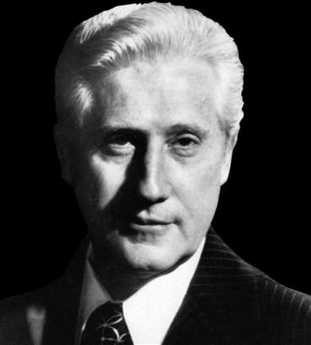
W. Joseph Campbell

NYTimes errs, claims Woodward, Bernstein ‘unraveled’ Watergate

In Debunking, Media myths, Washington Post, Watergate myth on October 10, 2011 at 1:55 am

The New York Times inaccurately declared over the weekend that Bob Woodward and Carl Bernstein, in their reporting for the Washington Post, “unraveled the Watergate affair.”

The Times’ erroneous assertion was made in an obituary published Saturday about a minor figure in the Watergate scandal, Kenneth H. Dahlberg, who died last week. Watergate led to the resignation in 1974 of President Richard M. Nixon.

The obituary noted that Dahlberg was an “unwitting link between the Nixon re-election campaign and the five men … charged with breaking into the Democratic National Committee headquarters at the Watergate complex in Washington,” the scandal’s signal crime.

Dahlberg, the Times added, “had been a fund-raiser for Nixon’s re-election campaign, and his name was on a $25,000 cashier’s check that had been deposited in the bank account of one of the burglars, Bernard L. Barker. The money was to help cover the burglars’ expenses, and Mr. Barker had withdrawn that amount in $100 bills. He was carrying more than $5,000” when arrested at the DNC headquarters June 17, 1972.

The Times then asserted:

“Bob Woodward, a young reporter for The Washington Post who with Carl Bernstein unraveled the Watergate affair, has called the Dahlberg check the ‘connective tissue’ that turned what they thought was a story about a common crime into one of historic dimensions.”

That may be, but the Dahlberg connection was only a small, early step in unwinding the scandal. Interestingly, Dahlberg receives one, passing mention in Stanley I. Kutler’s exhaustive, single-volume work, The Wars of Watergate.

What’s more, Woodward and Bernstein scarcely can be credited with having “unraveled” Watergate — and the Times offered no evidence to support its exaggerated claim.

Rather, the Times effectively sidled up to the beguiling “heroic-journalist myth,”  which, as I write in my latest book,  Getting It Wrong, has become “the most familiar storyline of Watergate.”

What unraveled Nixon’s presidency wasn’t the reporting of Woodward and Bernstein for the Post but the incontrovertible evidence of his culpability in the crimes of Watergate — evidence captured on audiotapes that he secretly made of his conversations at the White House.

The decisive evidence — known as the “Smoking Gun” tape — revealed that Nixon at a meeting with his top aide, H.R. Haldemann, on June 23, 1972, sought to deflect or derail the FBI investigation into the Watergate burglary.

Woodward and Bernstein didn’t reveal the contents of that tape, which Watergate prosecutors had subpoenaed and which Nixon had refused to surrender until 1974, after the U.S. Supreme Court ordered him to do so.
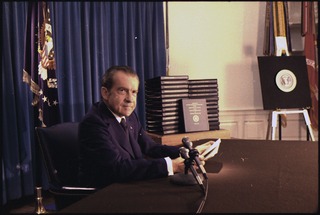
Nixon with tape transcripts, 1974

Nor did Woodward and Bernstein disclose the existence of Nixon’s secret audiotaping system, which proved so crucial to Watergate’s outcome.

The taping system was revealed in July 1973, during hearings of the U.S. Senate Select Committee on Watergate.

In All the President’s Men, their book about their Watergate reporting, Woodward and Bernstein said they had received a tip about the taping system a few days before its existence was made public.

According to All the President’s Men, Ben Bradlee, then the Post‘s executive editor, suggested not expending much energy pursuing the tip. And Woodward and Bernstein didn’t.

What really “unraveled” Watergate, I write in Getting It Wrong, “was the collective if not always the coordinated forces of special prosecutors, federal judges, both houses of Congress, the Supreme Court, as well as the Justice Department and the FBI.

Even then, despite all that scrutiny and pressure, Nixon, I argue, “likely would have served out his term if not for the audiotape recordings he secretly made of most conversations in the Oval Office of the White House.”

WJC

Many thanks to Jack Shafer for linking
to this post

Recent and related:

Gorging on the mythical ‘Cronkite Moment’

In Cronkite Moment, Debunking, Media myths on October 7, 2011 at 1:55 am

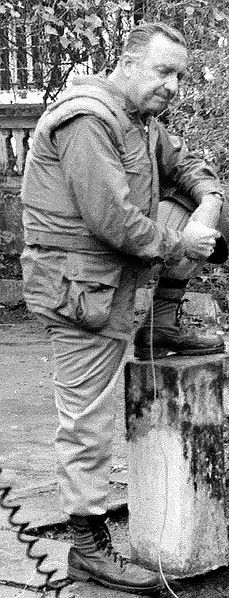
Cronkite in Vietnam

The phenomenon of version variability runs rampant across the presumptive “Cronkite Moment,” the mythical broadcast in 1968 when Walter Cronkite’s editorial comment supposedly altered U.S. war policy in Vietnam.

Version variability is the imprecision that alters or distorts an anecdote in its retelling, and it’s a marker of a media-driven myth.

The “Cronkite Moment” supposedly was an epiphany for President Lyndon Johnson, prompting him to declare:

“If I’ve lost Cronkite, I’ve lost Middle America.”

Or: “If I’ve lost Cronkite, I’ve lost the war.”

Or: “If I’ve lost Cronkite, I’ve lost the American people.”

Or: “If I’ve lost Cronkite, I’ve lost the country.”

Or: “If I’ve lost Cronkite, I’ve lost America.”

To that dubious roster, the Irish Independent the other day offered this version:

“It’s said that Lyndon Johnson knew his presidency had imploded when he sat down one evening after a gargantuan Texan dinner to watch Walter Cronkite denounce his Vietnam policy straight to camera.

“Johnson knew that … it was time to start planning the presidential library.”

As I discuss in my latest book, Getting It Wrong, Johnson wasn’t in front of a television set the night Cronkite offered what really was an unremarkable assessment of the Vietnam War.

The CBS News anchorman said at the close of an hour-long special report about Vietnam that the war effort there had become “mired in stalemate” and that negotiations might eventually be the way out for the United States.

Other commentators and news outlets had been turning for months to stalemate” to describe the U.S. war effort. So Cronkite’s assessment was hardly striking, hardly very original. Indeed, it was quite tame compared to other commentaries at the time.

But Johnson didn’t see the Cronkite report when it aired February 27, 1968 (and there’s no evidence he saw it later, on videotape). The president most certainly didn’t gorge on “a gargantuan Texan dinner” before sitting down to watch Cronkite’s program.

As the show aired, Johnson was en route to the University of Texas at Austin, to attend the 51st birthday party of a longtime political ally, Governor John Connally.

Johnson spoke for a few minutes at the party. He didn’t bemoan the loss of Cronkite’s support. Rather, he offered light-hearted comments about Connally’s age.

About the time Cronkite was offering his “mired in stalemate” closing assessment, Johnson was saying:

“Today you are 51, John. That is the magic number that every man of politics prays for — a simple majority.”

I further note in Getting It Wrong that even if Johnson saw the Cronkite’s program on videotape, the president “gave no indication of having taken the anchorman’s message to heart.

“Just three days after the program aired, Johnson vowed in remarks at a testimonial dinner in Texas that the United States would ‘not cut and run’ from Vietnam. ‘We’re not going to be Quislings,’ the president said, invoking the surname of a Norwegian politician who helped the Nazis take over his country. ‘And we’re not going to be appeasers….'”

So under scrutiny, the presumptive “Cronkite Moment” dissolves as illusory— a media-driven myth.

“That it does is not so surprising,” I write in Getting It Wrong, adding:

“Seldom, if ever, do the news media exert truly decisive influences in decisions to go to war or to seek negotiated peace. Such decisions typically are driven by forces and factors well beyond the news media’s ability to shape, alter, or significantly influence. So it was in Vietnam, where the war ground on for years after the ‘Cronkite moment.'”

WJC

Recent and related:

Made-up Watergate line, ‘follow the money,’ crosses into the news

In Cinematic treatments, Debunking, Washington Post, Watergate myth on October 6, 2011 at 4:38 am

Kenneth H. Dahlberg, a minor Watergate figure, died the other day and Minnesota Public Radio recalled his role in the scandal by turning to the famous made-up line, “follow the money” — advice supposedly given to Washington Post reporters working the story.

The public radio station’s “News Cut” feature noted yesterday that “Dahlberg was the Midwest finance chairman for the Committee to Re-elect the President during President Richard M. Nixon’s 1972 campaign.

“A mysterious check, which later would be determined to be from the CEO of Archer Daniels Midland, was given to Dahlberg, who converted it to a cashier’s check. It was money from the campaign, destined for the Watergate burglars.”

The Minnesota Public Radio report added that when the stealthy, high-level “Deep Throat” source told Post reporters Bob Woodward and Carl Bernstein “to ‘follow the money,’ that was the money. And when Woodward called Dahlberg to confirm he handled the check, Dahlberg didn’t lie. … It ended up a critical part of the movie All The President’s Men.”

That last bit is true. Woodward’s telephone interview with Dahlberg became a memorable scene in the 1976 movie.

Otherwise, though, there’s a fair amount of wayward information in the “News Cut” report.

For starters, “Deep Throat” never met with Bernstein during Watergate.

More important, “Deep Throat” (self-revealed in 2005 to have been former FBI official W. Mark Felt) never advised Woodward to “follow the money.”

Felt: Never said it

That line appears nowhere in All the President’s Men, Woodward and Bernstein’s 1974 book about their Watergate reporting — reporting that did not, as I discuss in my latest work, Getting It Wrong, take down Nixon’s corrupt presidency.

Moreover, “follow the money” appeared in no Watergate-related article or editorial in the Washington Post  before 1981 — or long after Nixon resigned the presidency in disgrace.

Rather, “follow the money” was written into the screenplay of the cinematic version of All the President’s Men; the line was memorably uttered not by Felt, the real-life “Deep Throat,” but by Hal Holbrook, the actor who played him in the movie.

As I’ve noted at Media Myth Alert, Holbrook turned in an outstanding performance as a tormented and conflicted “Deep Throat.”

And he delivered his “follow the money” line with such steely assurance that it did seem to offer a way through the labyrinth that was the Watergate scandal.

But even if Woodward had been counseled to “follow the money,” such advice certainly would neither have unraveled Watergate nor led him to Nixon.

What forced Nixon from office in 1974 was not the grubby misuse of campaign funds but, rather, his active role in seeking to obstruct justice by covering up the signal crime of the Watergate scandal, the break-in at the headquarters of the Democratic National Committee in June 1972.

Rolling up the scandal of Watergate’s complexity and dimension was scarcely as straightforward as pursuing misused campaign contributions.

As I write in Getting It Wrong, unraveling Watergate required “the collective if not always the coordinated forces of special prosecutors, federal judges, both houses of Congress, the Supreme Court, as well as the Justice Department and the FBI.

“Even then,” I note “Nixon likely would have served out his term if not for the audiotape recordings he secretly made of most conversations in the Oval Office of the White House.

“Only when compelled by the Supreme Court did Nixon surrender those recordings, which captured him plotting the cover-up” and cost him the presidency.

WJC

Recent and related: