W. Joseph Campbell

Challenging the media-driven mantra that 9/11 ‘changed everything’

In Anniversaries, Debunking, Error, Media myths, Newspapers, Washington Post on September 10, 2021 at 3:02 pm

From the hours immediately after the deadly terrorist attacks of September 11, 2001, news outlets have promoted a mantra that the assault on commercial and military landmarks in New York and suburban Washington “changed everything” in America.

USA Today stated as much on the day after the attacks:

“Days that live in infamy are supposed to be found in dusty history books. Tuesday changed all that. It changed everything. Our world will never be the same.”

The Independent in London declared on the day after:

“Tuesday, 11 September 2001, will go down in America’s annals as the day that changed everything. It was the day that a nation’s confidence was shattered during morning rush-hour in New York City, and its defensive might was mocked at coffee-time in Washington.”

Similar accounts invoking a similar catchcry have appeared in innumerable news reports and commentaries in the 20 years since al-Qaeda terrorists commandeered commercial jets and flew two of them into the twin towers of New York’s World Trade Center. They crashed a third into the west facade of the Pentagon. A fourth hijacked jet plunged into a field in Somerset County, Pennsylvania, after passengers attempted to wrest control of the aircraft.

Nearly 3,000 people were killed in the attacks, and the lives of thousands of others were shattered or forever altered.

To posit that 9/11 “changed everything” understandably has been a way to make fathomable the shock, horror, and malignant theatricality of that infamous day, a way to invest September 11, 2001, with exceptional and enduring significance.

But exactly what “changed everything” meant remained definitionally elusive — and subject to not infrequent dispute. “Nothing changes everything,” columnist George Will wrote at the fifth anniversary of 9/11. (The activist Jesse Jackson said at the first anniversary that “9/11 did not change everything. It did change the subject.”)

The Washington Post made a determined effort recently to pin down and elaborate on the “changed everything” mantra. It did so by devoting much of its Sunday magazine (see cover image nearby) to a collection of brief, solicited opinions purporting to describe how 9/11 wrought change in journalism, television, movies, art, fashion, theater, policing, architecture, editorial cartooning, and other fields and pursuits.

The collection was introduced with a sweeping claim that “9/11 changed the world in demonstrable, massive and heartbreaking ways.”

It was a far-reaching yet ultimately unpersuasive attempt to clarify and bring dimension to the “changed everything” catchcry. Indeed, it was striking that the Post’s collection presented only mixed evidence of significant change incontrovertibly linked to the attacks. Many entries were impressionistic; vagueness stalked more than a few contributions.

For example, one contributor wrote, “Museums have yet to return to the levels of ambition we saw before the attacks.”

Declared another contributor: “The post-9/11 fashion industry puts a premium on fresh faces and wily entrepreneurs. And while those celebrated young talents often move with reckless speed, the desire to create and a belief in the impossible were salvaged from the wreckage.”
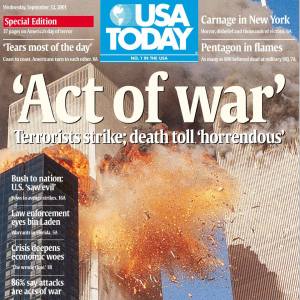
USA Today front page, day after 9/11

Another contributor alluded to recordings of telephone calls placed by victims aboard the hijacked aircraft or trapped in the stricken Twin Towers and wrote:

“There’s no way to prove, of course, that 9/11 led more people to use the phrase ‘I love you.’ And we might not be thinking of disaster while on a routine call with Mom, Dad, a sibling, a best friend or a spouse. But it was one of the first times Americans got such a visceral window into other people’s intimate conversations — and I believe that, for many of us, it left a mark.”

The attacks of 9/11 certainly led to change — and fresh intrusions — in airport security and personal privacy. The federal government was expanded. The country fought a prolonged conflict in Afghanistan, where al-Qaeda planned the attacks.

But when considered closely, it becomes clear the 9/11 attacks did not “change everything.”

The attacks were not fatal to American political or economic power. Public opinion polls reported that after 9/11 many Americans felt a surge of patriotic fervor, a deeper commitment to the religious and spiritual side of life, and a newfound sense of political unity.

Such responses proved fleeting, however. They faded in time.

Even the Post’s collection acknowledged, perhaps unintentionally,  that change after 9/11 wasn’t always so enduring. The syndicated cartoonist Steve Breen wrote, for example, that after the attacks “there seemed to be an unspoken rule that our favorite target, President George W. Bush, was off-limits. Luckily, that didn’t last long, and we were free to go after Bush (as well as Dick Cheney, John Ashcroft, Tom Ridge, etc.) unfettered.”

Gene Weingarten, the newspaper’s humor columnist, observed: “Pretty quickly [after 9/11], humor returned. It was, I think, the first return to normalcy after that ghastly day, the first good thing to happen.”

(Just a week after the 9/11 attacks, Weingarten had lamented the diminished state of humor in America. “The problem,” he wrote then, “is we are finding no humor, anywhere. When will we be able to laugh again?”)

An assessment far more tempered and thoughtful about the effects of 9/11 was offered not long ago by Anatol Lieven, a Georgetown University professor who pointed out:

“In the United States, the long-term impact of 9/11 does not compare to the great underlying tensions that have shaped American life over generations and centuries: racial tensions and oppression, fears created by immigration, concern about cultural change and the threat to religion and morality, fears about the impact of alcohol and drugs, and the Cold War.

“The impact of 9/11 rather resembles one of the ‘moral panics’ analyzed by James A. Morone in Hellfire Nation; a wave of public hysteria that, like Prohibition and McCarthyism, has receded again, leaving behind a new layer of US security institutions and practices.”

Akin to a “wave of public hysteria that, like Prohibition and McCarthyism, has receded again”: that’s a fair point — a tenable interpretation given the analytical distance allowed by the passage of 20 years.

“The events of 9/11,” Lieven observed in closing, “have not … defined the world in general, and certainly not ‘our’ world in the West.

“The truly defining factors are quite different,” he wrote, citing the “geopolitical struggle with China” and the domestic troubles of Western democracies.

What’s notable and refreshing about Lieven’s commentary is that it did not proceed from an assumption that 9/11 “changed everything.” It is instead a detached and critical assessment, of which we could use more.

WJC

More from Media Myth Alert:

Afghanistan is ‘Biden’s Katrina’? Afghanistan is dramatically worse

In Error, Hurricane Katrina, Media myths, Scandal on August 27, 2021 at 10:12 am

USA Today suggested in an editorial the other day that the chaos accompanying Joe Biden’s botched and precipitous withdrawal of U.S. military personnel could turn into a kind of Hurricane Katrina for the president.

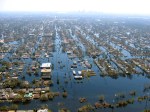
New Orleans, post-Katrina

The reference was to the damage done to President George W. Bush’s administration by the fitful federal response to the storm that tore into the U.S. Gulf Coast 16 years ago, leaving much of New Orleans under water.

The newspaper’s analogy, while interesting, was cliched and badly misplaced: the hasty and unprovoked U.S. flight Biden ordered from Afghanistan after a 20 year commitment there, and the country’s rapid takeover by Taliban extremists, represent a foreign policy debacle of towering and unprecedented dimensions — a humiliation likely to reverberate for years.

So, no, Afghanistan is hardly “Biden’s Katrina.”

It is scandalously worse, as was confirmed yesterday by the deadly terrorist bombings near Kabul’s international airport, the lone exit from Afghanistan for untold thousands of Americans, other Westerners, and Afghans who allied with them since the U.S.-led invasion in the aftermath of the terrorist attacks on America on September 11, 2001.

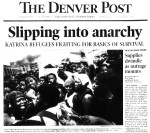
It is true that New Orleans in Katrina’s wake conjured comparisons to a war zone. The dominant media narrative in late summer 2005 told of mayhem and unimaginable horror that supposedly had been unleashed across the flooded city.

The Miami Herald, to take just one example, said on September 1, 2005, that a “major American city [had] all but disintegrated … and the expected death toll from Hurricane Katrina mushroomed into the thousands. Bodies floated down streets. Defeated survivors waded waist-deep and ghost-like through floods. Packs of looters rampaged through the ruins and armed themselves with stolen weapons, and gunfire echoed through the city.”

Paula Zahn, for another example, said on her CNN program that day, “We are getting reports that describe [New Orleans] as a nightmare of crime, human waste, rotten food, dead bodies everywhere. Other reports say sniper fire is hampering efforts to get people out.” She referred to “very discouraging reports out of New Orleans tonight about bands of rapists going from block to block, people walking around in feces, dead bodies floating everywhere.”

In her column published September 3, 2005, in the New York Times, Maureen Dowd referred to New Orleans as “a snake pit of anarchy, death, looting, raping, marauding thugs, suffering innocents, a shattered infrastructure, a gutted police force, insufficient troop levels and criminally negligent government planning.”

But much of the reporting about Katrina’s aftermath — the horror, the anarchy, the city’s disintegration — was highly exaggerated and erroneous. Few if any of the nightmarish accounts that pulsated through the news media proved true.

As I wrote in my media-mythbusting book, Getting It Wrong, “On crucial details, journalists erred badly” in describing post-Katrina horrors in New Orleans. What’s more, I wrote, “the erroneous and exaggerated reporting had the cumulative the effect of painting for America and the rest of the world a scene of surreal violence and terror, something straight out of Mad Max or Lord of the Flies.”

The coverage of Katrina’s aftermath was no “quintessentialgreat moment in journalism, as some credulous commentators (including former CBS News anchor Dan Rather) declared.

Instead, the exaggerated coverage had the effect of tainting a proud city and its residents at a time of their great vulnerability. It also had the effect of delaying the arrival of aid to New Orleans.

If anyone rioted, it was the media,” a bipartisan congressional report on Katrina stated, adding, pointedly:

“Many stories of rape, murder, and general lawlessness were at best unsubstantiated, at worst simply false.”

Some of the most troubling conduct by public figures was not that of the Bush administration but of local government, notably the New Orleans mayor, Ray Nagin, and the city’s police commissioner, Eddie Compass. They were sources for some of the most gruesome and exaggerated reporting about lawlessness in Katrina’s aftermath.

At one point, Nagin asserted that “hundreds of armed gang members” were terrorizing evacuees inside the New Orleans Superdome. He claimed that conditions there had deteriorated to “an almost animalistic state” and evacuees had been “in that frickin’ Superdome for five days, watching dead bodies, watching hooligans killing people, raping people.”

Compass told of other horrors. “We had little babies in there, little babies getting raped,” Compass said about the Superdome where, he claimed, police officers had been shot and wounded.

Their accounts of violence in New Orleans were taken at face value and widely reported — but proved almost completely without foundation. Months later, Compass said he passed along the rumors of violence because he “didn’t want people to think we were trying to cover anything up. So I repeated things without being substantiated, and it caused a lot of problems.”

Compass quit his job in late September 2005. Nagin, who won reelection less than two years after Katrina struck, was convicted in 2014 and sent to prison on 20 counts of corruption, bribery and fraud — charges unrelated to the hurricane and its aftermath. He was released early last year.

Katrina was a powerful, destructive natural disaster, the coverage of which the news media botched.

The U.S. exit from Afghanistan is a bloody, self-inflicted disaster, borne of Biden’s blundering, impatience, and ineptitude.

WJC

More from Media Myth Alert:

Insidious: Off-hand references signal deep embedding of prominent media myths

In Cronkite Moment, Debunking, Error, Media myths, New York Times, Newspapers, Quotes, Washington Post, Watergate myth on July 6, 2021 at 11:15 am

The insidious nature of prominent media myths is evident in how casually they are invoked, as if their veracity is beyond question.

These blithe, passing references in news articles and commentary seldom are accompanied by much context or explanation. And their appearance signals how deeply embedded some media myths have become.

Two recent cases serve to illustrate this tendency.

Musings in the New York Times

One example appeared last week in an entertaining if overlong New York Times article that mused about the identity of an elusive and anonymous Instagram user whose handle is rg_bunny1. Over the recent months, user rg_bunny1 has unleashed what the Times called “a daily torrent of quirky, particular images that, taken together, speak to an aesthetic that delights, confounds, fixates and infuriates in equal measures.”

What most interests Media Myth Alert was the article’s passing reference to Carl Bernstein, one of the Washington Post’s lead reporters on the Watergate scandal of 1972-74. Bernstein, we are told, was “one-half of the duo that famously uncovered the source that brought down the Nixon presidency.”

The “duo” was Bernstein and Bob Woodward and “the source” no doubt refers to “Deep Throat,” the anonymous informant with whom Woodward — but not Bernstein — consulted from time to time as the Watergate scandal unfolded in 1972 and 1973.

But he was “the source that brought down the Nixon presidency”?

Nope. Not “Deep Throat.” Not Bernstein and Woodward. Not their reporting for the Washington Post.

Those all are components of a tenacious media myth — what I call the heroic-journalist interpretation of Watergate — a trope that’s erroneous but ever-appealing, easy to retell and easy to grasp.

What really brought down Nixon is far more complicated than a duo of journalists and a well-placed anonymous source.

As I wrote in my media-mythbusting book, Getting It Wrong, rolling up a scandal of the dimensions and intricacy of Watergate “required the collective if not always the coordinated forces of special prosecutors, federal judges, both houses of Congress, the Supreme Court, as well as the Justice Department and the FBI.”

But even then, I noted, “Nixon likely would have served out his term if not for the audiotape recordings he secretly made of most conversations in the Oval Office of the White House. Only when compelled by the Supreme Court did Nixon surrender those recordings,” making inevitable the early end to his presidency in August 1974.

The disclosure about the existence of Nixon’s tapes was pivotal in the Watergate saga — and it was a disclosure not by Bernstein and Woodward or by “Deep Throat,” but by a former Nixon aide in testimony before  a U.S. Senate select committee. (In a book about their Watergate reporting, Bernstein and Woodward claimed to have had a lead about the existence of the tapes, but did not pursue it because the Post’s executive editor, Ben Bradlee, didn’t think it would lead to a high-quality story.)

The “Deep Throat” source was W. Mark Felt, a senior FBI official who fed Watergate-related information, and sometimes misinformation, to Woodward (as well as a reporter for Time magazine named Sandy Smith). Felt was motivated not so much by altruism or distate for Nixon’s White House as by ambition to become director of the FBI, a position that opened up in May 1972 with the death of J. Edgar Hoover.

By leaking to reporters, Felt believed he could undercut his rivals for the FBI directorship. Those motives were persuasively described in Max Holland’s 2016 book Leak: Why Mark Felt Became Deep Throat.

It’s useful and revealing in this context to recall what Woodward once said about the notion that he and Bernstein toppled Nixon. Woodward told an interviewer in 2004:

To say that the press brought down Nixon, that’s horseshit.”

Another example of a media myth breezily cited appeared the other day in essay posted at the online site of Newsmax, the cable news outlet that has become a favorite of former President Donald Trump.

The essay took up President Joe Biden’s recent gun-control proposal, asserting that it would “strangle the rights of law-abiding gun-owners.” In search of an analogy, the essay landed on the mythical “Cronkite Moment” of 1968. That was when CBS News anchorman Walter Cronkite delivered a pessimistic, on-air assessment about the U.S. war effort in Vietnam.

The Newsmax essay invoked President Lyndon Johnson’s supposed reaction — “If I’ve lost Cronkite, I’ve lost Middle America,” or something to that effect — and declared:

“At that moment, and on that basis, [Johnson] decided that he wouldn’t seek another term as president.”

Again, nope.

Johnson did not watch Cronkite’s report about Vietnam when it aired on February 27, 1968, and it is not clear whether the president ever saw the show program on videotape at some undefined later date.

But it is clear that in the days and weeks immediately after the Cronkite report, Johnson remained publicly and adamantly hawkish about the war. In orher words, when the effects of Cronkite’s pessimistic assessment should have been most potent, Johnson was as insistent as ever about prosecuting the conflict. After the presumptive “Cronkite Moment,” Johnson doubled down on his Vietnam policy.

Just three days after Cronkite’s report, for example, Johnson vowed in remarks at a testimonial dinner that the United States would “not cut and run” from Vietnam. “We’re not going to be Quislings,” he said, invoking the surname of a Norwegian politician who had helped the Nazis take over his country. “And we’re not going to be appeasers.”

At a ceremony at the White House on March 12, 1968, at which he awarded Medals of Honor to two Marines, the president declared:

“I think if we are steady, if we are patient, if we do not become the willing victims of our own despair [about Vietnam], if we do not abandon what we know is right when it comes under mounting challenge — we shall never fail.”

The president spoke about Vietnam with even greater vigor in mid-March 1968, telling a meeting of business leaders in Washington:

“We must meet our commitments in the world and in Vietnam. We shall and we are going to win. … I don’t want a man in here to go back home thinking otherwise — we are going to win.”

Johnson’s views on Vietnam did change, and he did decide against seeking reelection to the presidency.

But not because of what Cronkite had said.

The reasons for the president’s change of heart were political, at least in part.

By mid-March 1968, Johnson was facing insurgent challenges for the Democratic nomination from two anti-war U.S. senators, Eugene McCarthy and Robert Kennedy. Johnson had nearly lost the New Hampshire primary election on March 12, 1968, to McCarthy and he seemed unlikely to prevail in the upcoming primary in Wisconsin.

Also was influential in swinging Johnson’s views about the war was a coterie of informal advisers who met at the White House in late March 1968.

The advisers, who came to be called the “Wise Men,” included such foreign policy notables as Dean Acheson, a former secretary of state; McGeorge Bundy, a former national security adviser, and George Ball, a former under-secretary of state.

“The theme that ran around the table was, ‘You’ve got to lower your sights'” in Vietnam, Ball later recalled.

Johnson, he said, “was shaken by this kind of advice from people in whose judgment he necessarily had some confidence, because they’d had a lot of experience.”

The counsel of the Wise Men was a tipping point in Johnson’s deciding to seek “peace through negotiations.” In a speech on March 31, 1968, Johnson announced limits to U.S. aerial bombing of North Vietnam, as an inducement to the communist regime in Hanoi to enter talks to end the war.

Johnson closed the speech by declaring he would not seek reelection — a bombshell announcement that contained no reference, passing or otherwise, to Cronkite’s on-air assessment of a month before.

WJC

More from Media Myth Alert: