W. Joseph Campbell

‘Strategy for peace’ and blocking the schoolhouse door: Recalling a crowded week in June 1963

In Anniversaries, Newspapers, Photographs, Quotes, Television, Year studies on June 6, 2013 at 5:56 am

Monday marks the 50th anniversary of President John F. Kennedy’s “strategy for peace” commencement address at American University, a speech delivered at the height of the Cold War in which he called for a rapprochement with the Soviet Union.
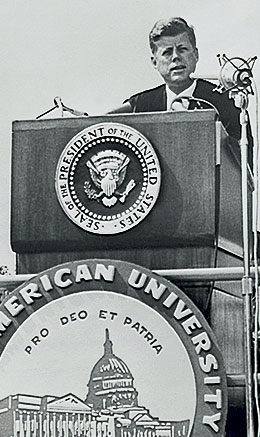
JFK_AU_speech

Kennedy, June 10, 1963

The speech often is ranked among the finest of its kind.

Speaking to about 10,000 people out-of-doors on a 90-degree day in Washington, D.C., Kennedy announced that talks would soon begin in Moscow on a comprehensive nuclear test ban treaty. He also said the United States would suspend atmospheric testing as long as other nuclear powers did the same.

Fifty years on, the speech is still recalled for such passages as: “[W]e must labor on— not towards a strategy of annihilation but towards a strategy of peace.”

And:

“Let us examine our attitude toward peace itself. Too many of us think it is impossible. Too many think it unreal. But that is a dangerous, defeatist belief. It leads to the conclusion that war is inevitable, that mankind is doomed, that we are gripped by forces we cannot control.”

Those sentiments represented something of a modest departure from the rhetoric common at the time. Kennedy spoke at American University less than eight months after the Cuban Missile Crisis, which brought the United States and Soviet Union to the brink of a nuclear exchange.

The speech was not without significance: The talks Kennedy announced on June 10, 1963, led fairly quickly to a limited test-ban treaty with the Soviets and British.

Interestingly, Kennedy’s address was in short order crowded off the front pages. His “strategy for peace” remarks hardly dominated the news that week.

Indeed, few weeks arguably have been as packed with such a variety of major and memorable news events as June 9-15, 1963.

Kennedy’s commencement speech received prominent treatment for a day or two in U.S. newspapers. Then it was overtaken by some of the most dramatic moments of the Civil Rights era — among them, Governor George Wallace’s stand at the schoolhouse door, symbolically blocking the desegregation of the University of Alabama.

It has been said that the “drama of the nation’s division over desegregation came sharply into focus” that day, June 11, 1963.

In the face of the governor’s defiance, Kennedy federalized the Alabama National Guard. After reading a bitter statement denouncing the “unwelcomed, unwanted, unwarranted and force-induced intrusion upon the campus of the University of Alabama,” Wallace stepped aside. Two black students were allowed to register for classes.
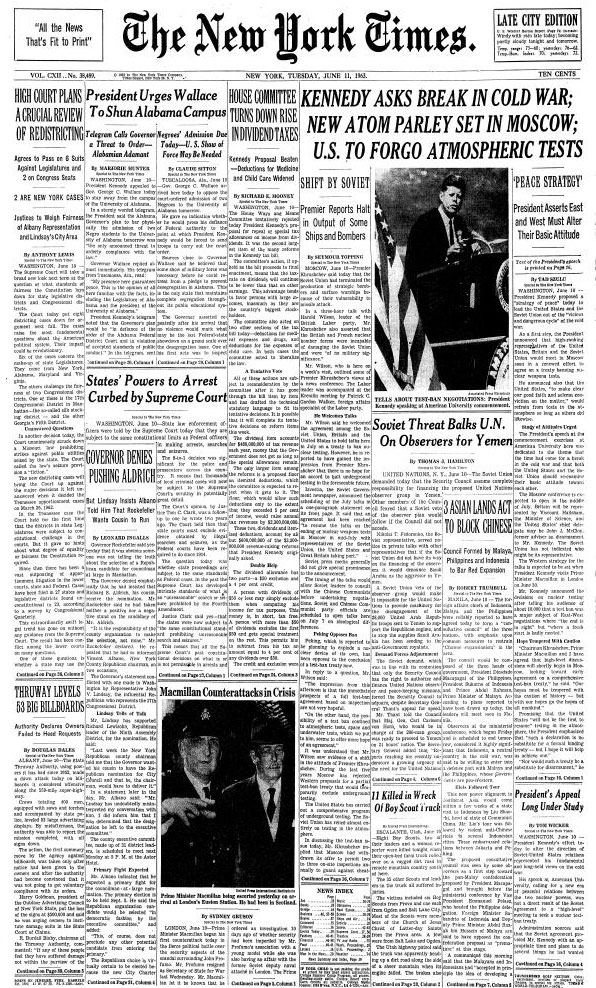
NYT-front_11June1963_full

New York Times front, June 11, 1963

Kennedy referred to the confrontation in Alabama in a radio and television speech that night in which he proposed that Congress pass civil rights legislation to end discrimination in voting, enhance educational opportunities, and ensure access to restaurants, hotels, and other public places.

The resulting legislation became the Civil Rights Act of 1964.

Also on June 11, 1963,  an Associated Press correspondent in South Vietnam, Malcolm Browne, took one of the iconic images of the long war in Southeast Asia — that of a Buddhist monk who had set himself afire in downtown Saigon, to protest the government’s religious oppression.

“It was clearly theater staged by the Buddhists to achieve a certain political end,” Browne later said. “At the same time, there was a human element to it that was just horrifying, because the sequence of pictures showed the initial shock of the flames touching his face, and so forth. He never cried out or screamed ….”

The following day, Civil Rights leader Medgar Evers was shot to death outside his home in Mississippi. Byron De La Beckwith was tried three times for Evers’ killing, most recently in 1994 when he was convicted and sentenced to life in prison. The other two trials ended in hung juries.

Evers, an Army veteran who had fought in World War II, was buried at Arlington National Cemetery.

The space race, as it was known, seldom was far from the news in 1963. At the close of the crowded week, the Soviets were preparing to launch Vostok 6. On board was Valentina Tereshkova, destined to become the first woman in space.

The flight lifted off on June 16, 1963, and lasted nearly 71 hours. Tereshkova’s 49 Earth orbits more than doubled the most compiled to that point by any American astronaut.

And 20 years would pass before the first American woman flew in space. She was Sally Ride, a mission specialist aboard the space shuttle Challenger in 1983.

The crowded week 50 years ago was a microcosm of the Cold War era, what with nuclear arms, civil rights, Southeast Asia, and the U.S.-Soviet space race all prominently in the news.

Even so, why does it much matter to look back on that week in June?

Doing so offer some useful and interesting perspective, given that we tend to think we live in such busy and momentous times.

Taking a look back also reveals how unsettled the country seemed to be in 1963, given the violence and the confrontations in the South, the Cold War rivalry with the Soviets, the strife in Vietnam.

So looking back to the crowded week in June tells us the 1960s were churning well before the climatic and tumultuous year of 1968.

One wouldn’t immediately have recognized this in mid-June 1963, but dominance was shifting in the news media, flowing from newspapers  to television.

Confirmation of this transition came in late November 1963 with wall-to-wall television coverage of the Kennedy assassination and its aftermath. “Even television’s critics had to admit that the medium had been transformed into an even more powerful force,” media historian David Davies wrote in a book of the postwar decline of American newspapers.

Nineteen sixty-three was pivotal for the news media.

WJC

More from Media Myth Alert:

Ignoring nuance in the bra-burning myth

In Bra-burning, Debunking, Error, Media myths on May 30, 2013 at 9:01 am

“Myths die hard.”

So says the latest issue of the Economist magazine, in an article that addresses the nuanced myth of bra-burning.

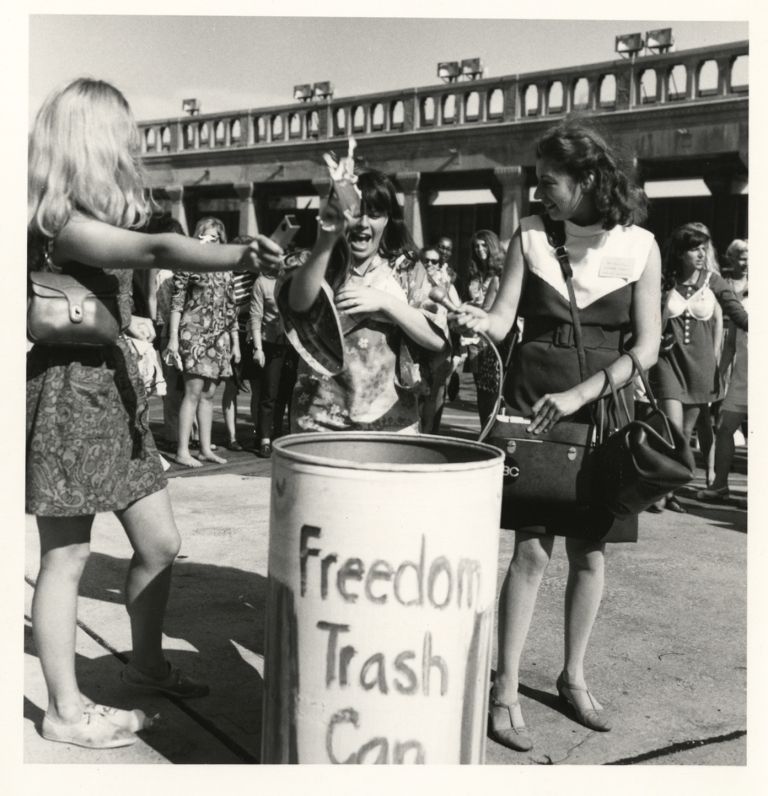
bra-burning_freedomtrashcan

At the ‘Freedom Trash Can,’ 1968

Only there’s not much nuance in the Economist’s description.

“When a handful of feminists protested at the 1968 Miss America pageant in Atlantic City,” the Economist says, “they burned no brassières. They did, however, dump a few (and make-up and high-heeled shoes) into a ‘freedom trash can,’ while also crowning a sheep.”

The syntax of that paragraph is certainly awkward. But what most interests Media Myth Alert is the assertion “they burned no brassières.”

And that’s not quite right.

As I discuss in my myth-busting book, Getting It Wrong, there is compelling evidence that bras were indeed set afire, briefly, during a women’s liberation protest on the boardwalk at Atlantic City.

That protest took place September 7, 1968, and denounced the Miss America pageant as a degrading spectacle. Demonstrators carried placards that expressed such unsubtle sentiments as: “Up Against the Wall, Miss America,” “Miss America Sells It,” “Miss America Is a Big Falsie,” and “Miss America Goes Down.”

A centerpiece of the demonstration was what the organizers called the “Freedom Trash Can.” The Economist is correct in noting that high-heel shoes and other items were tossed into that converted burn barrel.

Bras went into the Freedom Trash Can, too. And according to a first-hand account published the following day in the Atlantic City newspaper, the Press, “bras, girdles, falsies, curlers, and copies of popular women’s magazines [were] burned in the ‘Freedom Trash Can.'”

The Press account appeared beneath this headline:

“Bra-burners blitz boardwalk.”

That account was endorsed by Jon Katz, who in 1968 was a young reporter for the Press and who wrote a sidebar article about the women’s liberation demonstration.

“I quite clearly remember the ‘Freedom Trash Can,’ and also remember some protestors putting their bras into it along with other articles of clothing, and some Pageant brochures, and setting the can on fire,” Katz told me in my research for Getting It Wrong.

“I am,” he added, “quite certain of this.”

Katz also said:

“I recall and remember noting at the time that the fire was small, and quickly was extinguished, and didn’t pose a credible threat to the Boardwalk. I noted this as a reporter in case a fire did erupt.”

When the fire flickered out, Katz said, the police dragged the trash bin to the sand.

The reference to bra-burning in the Press article the day afterward as well as Katz’s recollections “offer fresh dimension to the bra-burning legend,” I write in Getting It Wrong, noting:

“They represent two witness accounts that bras and other items were burned, or at least smoldered, in the Freedom Trash Can. There is now evidence that bras and other items were set afire, if briefly, at the 1968 Miss America protest in Atlantic City.

“This evidence cannot be taken lightly, dismissed or ignored.”

However, these accounts do not support the much more vivid and popular notion that bras went up in flames that day, in a flamboyant protest on the boardwalk.

The witness accounts, I write, do not corroborate the “widely held image of angry feminists demonstratively setting fire to their bras and tossing the flaming undergarments into a spectacular bonfire.”

And yet, as the evidence presented in Getting It Wrong makes clear, “bra-burning” is an epithet not entirely misapplied to the women’s liberation demonstration at Atlantic City.

WJC

More from Media Myth Alert:

Still hardy after 40 years: The myth that Woodward, Bernstein ‘brought down’ Nixon

In Anniversaries, Debunking, Error, Media myths, Scandal, Washington Post, Watergate myth on May 17, 2013 at 10:30 am

Forty years ago today, a Senate select committee convened public hearings into the then-emergent Watergate scandal. The hearings stretched into the summer of 1973 and helped make “Watergate” a household term.

More important, the panel’s inquiry produced the disclosure that President Richard Nixon had secretly taped many of his private conversations at the White House — a revelation that was to prove decisive to the scandal’s outcome.

The most incriminating tape, released under Supreme Court directive in July 1974, captured Nixon plotting a coverup of the FBI’s investigation into the break-in at the headquarters of the Democratic National Committee in Washington in June 1972.

If not for the tapes, Nixon likely would have remained in office — a wounded and hobbled president, but one who would have completed his term.

So the Senate select committee was vital in the array of subpoena-wielding forces that produced evidence that eventually compelled Nixon’s resignation.

And yet, on this anniversary, the simplistic, media myth circulates anew — that two dogged reporters for the Washington Post, Bob Woodward and Carl Bernstein, exposed the crimes of Watergate and brought down Nixon’s corrupt presidency.

The latest to invoke what I call the heroic-journalist myth of Watergate was the executive director of the ACLU of Massachusetts, Carol Rose, who declared in a commentary for Boston’s NPR station, WBUR:

“Nixon himself was brought down by two enterprising young reporters at the Washington Post and a whistleblower by the name of ‘Deep Throat.'”

Rose’s commentary, posted yesterday at the “Cognoscenti” page of WBUR’s Web site, focused on and rightly took issue with the Justice Department’s snooping into phone records of Associated Press reporters and editors in Washington, New York, and Hartford, Connecticut.

“Lest there be any confusion: This is a big deal,” Rose says of the Justice Department’s activity. (She also writes, “Dismantle the free press, and you pretty much dismantle democracy,” which probably is to put it backwards: A free press is a marker and byproduct of democratic government, not an essential precondition.)

But what most concerns Media Myth Alert is the blithely offered claim about the work of Woodward and Bernstein — those “enterprising young reporters” to whom Rose refers.

Simply put, Woodward and Bernstein did not bring down Nixon’s corrupt presidency.

Their Watergate reporting for the Post as the scandal slowly unfolded in the summer and fall of 1972 did win a Pulitzer Prize in 1973. But Woodward and Bernstein were not central to the major disclosures of Watergate.

Notably, they did not reveal the existence of the Nixon’s tapes.

Nor did they describe the extent of the Nixon administration’s coverup of the crimes of Watergate.

Interestingly, authorities at the Post over the years have scoffed at claims that Woodward and Bernstein’s reporting took down Nixon.

Katharine Graham, the Post’s publisher during Watergate, said in 1997:

“Sometimes people accuse us of bringing down a president, which of course we didn’t do. The processes that caused [Nixon’s] resignation were constitutional.”

Woodward, himself, has pooh-poohed the notion, too. He once told an interviewer:

To say the press brought down Nixon, that’s horse shit.”

More delicately, Woodward said in an interview with the PBS “Frontline” program that “the mythologizing of our role in Watergate has gone to the point of absurdity, where journalists write … that I, single-handedly, brought down Richard Nixon. Totally absurd.”

As for the “whistleblower” Rose mentions, the shadowy “Deep Throat” source?

He turned out to be W. Mark Felt, a senior FBI official motivated not so much by whistleblowing as by high-stakes, inter-office politics.

Felt wanted the FBI top job after the death in May 1972 of the agency’s director, J. Edgar Hoover. Leaking to Woodward (Felt never met Bernstein during Watergate) was a way to pursue those ambitions — and to undercut the official who was appointed acting FBI director, L. Patrick Gray.

Felt was no noble figure. As I note in my media-mythbusting book, Getting It Wrong, he authorized burglaries as part of the FBI’s investigations into leftists associated with the radical Weather Underground.

Felt was convicted in 1980 on felony charges related to the break-ins, but was pardoned the following year by President Ronald Reagan.

WJC

More from Media Myth Alert: