W. Joseph Campbell

Posts Tagged ‘Bra-burning’

Bra-burning and home luxuries lost: Whoa

In Bra-burning, Debunking, Media myths, New York Times on May 23, 2010 at 11:40 am

If I read this article correctly, bra-burning contributed to a decline in the late 20th century of a taste for small luxuries around the home.

Media-driven myths have been mistakenly credited with bringing on wars and bringing down presidents. But bringing about a decline in household luxuries?

This is a first.

The article recalls with praise Mrs. Beeton’s Book of Household Management, which came out in 1861 and offered hundreds of pointers on cooking, supervising servants, and choosing decor.

Says the article, which appeared the other day in the Seattle Times and elsewhere:

“The dang thing had 2,751 entries—from how to cut a side of lamb, to just when to put away the white summer curtains—spelled out across more than 1,680 pages. And back in 1861, millions of copies were sold. Millions.

“Then,” the article says, “came the bra-burning latter half of the 20th century, and along with it permanent-press sheets, the paper napkin, and Hamburger Helper served up on melamine plates.

“We say, Whoa. We might have ditched too much. Lost all hints of luxury in the household department.”

I say, Whoa.

What did bra-burning supposedly have to do with lost “hints of luxury” at home? The article doesn’t say. Nor does it say explain how bra-burning helped to define the “latter half of the 20th century.”

Bra-burning in fact was a dramatically overstated phenomenon, as I discuss in a chapter in Getting It Wrong, my forthcoming book about media-driven myths–well-known and often-told stories about the news media that are dubious, apocryphal, or wildly exaggerated.

As I write in Getting It Wrong, the notion of bra-burning took hold in the days after the Miss America pageant at Atlantic City, N.J., on September 7, 1968, and was promoted, probably unwittingly, by two syndicated columnists.

On that September afternoon, “about 100 women from New York City, New Jersey, Boston, Washington, D.C., and elsewhere arrived by bus at the Atlantic City boardwalk,” I write, adding:

“They were, according to the New York Times, ‘mostly middle-aged careerists and housewives’ and they set up a picket line … across from the Convention Center. They were there, as one participant declared, ‘to protest the degrading image of women perpetuated by the Miss America pageant,’ which took place that night inside the Convention Center.”

A highlight of their protest came when the demonstrators tossed into a barrel what they termed “instruments of torture,” including brassieres, girdles, high-heeled shoes, and magazines such as Playboy and Cosmopolitan.

The protesters dubbed the barrel the Freedom Trash Can.

The organizers of the daylong protest, who included the activist and former child actor Robin Morgan, have long insisted that bras and other contents of the Freedom Trash Can were not set afire during the protest.

But the notion that bra-burning was a dramatic element of the demonstration at Atlantic City was encouraged by syndicated columnists, including Harriett Van Horne.

Soon after the protest, Van Horne wrote that the demonstrators surely were frustrated– “scarred by consorting with the wrong men. Men who do not understand the way to a woman’s heart, i.e., to make her feel utterly feminine, desirable and almost too delicate for this hard world. … No wonder she goes to Atlantic City and burns her bra.”

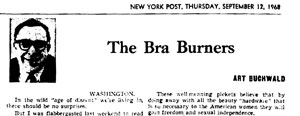
Van Horne was not at the protest, however. Nor was Art Buchwald, then American journalism’s leading humorist, who nonetheless played on the bra-burning trope in a column published in the Washington Post and other newspapers.

With tongue firmly in cheek, Buchwald wrote that he had been “flabbergasted to read that about 100 women had picketed the Miss America pageant in Atlantic City against ‘ludicrous beauty standards that had enslaved the American woman.’”

He added: “The final and most tragic part of the protest took place when several of the women publicly burned their brassieres.”

As I note in Getting It Wrong, Buchwald’s slyly humorous “characterization of the protest at Atlantic City introduced the notion of flamboyant bra-burning to a national audience, conjuring as it did a powerful mental image of angry women setting fire to bras and twirling them, defiantly, for all … to see.”

But the dramatic burning of bras as a form of feminist protest wasn’t a defining feature of the second half of the 20th century. More than anything, it was an effect of a humor columnist’s satiric riff.
WJC

‘A debunker’s work is never done’

In Bay of Pigs, Bra-burning, Cronkite Moment, Debunking, Furnish the war, Media myths, Murrow-McCarthy myth, New York Times, Reviews, War of the Worlds, Washington Post, Watergate myth, Yellow Journalism on May 21, 2010 at 6:14 pm

So notes the inestimable media critic Jack Shafer in his review of my forthcoming book, Getting It Wrong, posted today at slate.com.

And what a generous, engaging, and insightful review it is.

Under the headline “The Master of Debunk,” Shafer notes that “the only way to debunk an enshrined falsehood is with maximum reportorial firepower.

“Toting big guns and an itchy trigger-finger is American University professor W. Joseph Campbell, whose new book Getting It Wrong: Ten of the Greatest Misreported Stories in American Journalism flattens established myths that you were brought up to believe were true.”

Shafer’s review specifically discusses a variety of media-driven myths, including William Randolph Hearst’s purported vow to “furnish the war” with Spain; the so-called “Cronkite moment” that supposedly altered President Lyndon Johnson’s Vietnam policy; the Bay of Pigs suppression myth that erroneously says President John F. Kennedy persuaded the New York Times to spike a story about the pending U.S.-backed invasion of Cuba, and the heroic-journalist myth of Watergate.

Shafer rightly points out that “a debunker’s work is never done” and to that end notes my recent post at Media Myth Alert about Evan Thomas’ new book, The War Lovers. The book embraces myths of the yellow press period in American journalism, including the Hearst vow.

Shafer thoughtfully considers the tenacity of media-driven myths, writing:

“Some myths endure because the stories are so compelling, like the Hearst tale and the alleged mayhem caused by Orson Welles’ [War of the Worlds] broadcast. Others survive because our prejudices nourish them (“crack babies,” bra burners) or because pure repetition has drummed them into our heads, smothering the truth in the process.

“The best tonic for the brain fever caused by media myths is an open mind and a free inquiry,” he writes.

Shafer wraps up the review by invoking this observation, by Jonathan Rauch:

“It is the error we punish, not the errant.”

Shafers adds:

“Of course when you do such a good job punishing the error, as Campbell does, you don’t need to bother with the errant.”

WJC

Related:

‘Bra-burning feminists’: Who were they?

In Bra-burning, Debunking, Media myths on May 3, 2010 at 1:58 pm

A commentary today at the Huffington Post blog salutes trailblazing, rule-breaking American women–including the elusive “bra-burners” of the 1960s.

The commentary reads in part:

“From Revolutionary War icon Betsy Ross to World War II’s Rosie the Riveter, from sexually liberated 1920s femme fatale Louise Brooks to bra-burning feminists in the 1960s, from anti-slavery orator Sojourner Truth to controversial civil rights activist Angela Davis, American history is filled with female archetypes who pushed against the barriers of repression and social convention.”

True enough: History indeed counts many “female archetypes who pushed against the barriers of repression and social convention.”

But as for those “bra-burning feminists in the 1960s”–just who were they?

The commentary doesn’t say, leaving an implication that bra-burning was widespread, and even commonplace, during the 1960s.

Which just isn’t so.

I devote a chapter to bra-burning in Getting It Wrong, my forthcoming book about media-driven myths.

In that chapter, I trace the diffusion of the “bra-burning” epithet to the aftermath of the Miss America pageant at Atlantic City, N.J., on September 7, 1968.

That afternoon, about 100 women gathered on the Atlantic City boardwalk to protest the pageant as degrading to women.

A highlight of the afternoon came when demonstrators tossed into a barrel what they called “instruments of torture,” including brassieres, girdles, high-heeled shoes, and such magazines as Playboy and Cosmopolitan. The protesters dubbed the barrel the Freedom Trash Can.

The protest organizers, who included the feminist and former child actor Robin Morgan, have long insisted that the bras and other contents of the Freedom Trash Can were not set afire during the protest.

But the notion that bras had been set ablaze in flamboyant protest became a misleading legacy of that long-ago afternoon–an image promoted and spread by columnists Harriett Van Horne and Art Buchwald.

Neither of them was at the protest.

Two days afterward, Van Horne wrote in her column that there had been a bonfire in a Freedom Trash Can.

“With screams of delight,” she said of the protesters, “they consigned to the flames such shackling, demeaning items as girdles, bras, high-heeled slippers, hair curlers and false eyelashes.”

As I write in Getting It Wrong, this highly imaginative characterization was taken up a few days later by Art Buchwald in his nationally syndicated column.

Buchwald, who by then was American journalism’s leading humor columnist, wrote with tongue in cheek that he had been “flabbergasted to read that about 100 women had picketed the Miss America pageant in Atlantic City against ‘ludicrous beauty standards that had enslaved the American woman.’”

He also wrote:

“The final and most tragic part of the protest took place when several of the women publicly burned their brassieres.”

And he closed the column by writing:

“If the women in Atlantic City wanted to picket the Miss America beauty pageant because it is lily-white, that is one thing, and if they wanted to picket because it is a bore, that is also a legitimate excuse. But when they start asking young American women to burn their brassieres and throw away their false eyelashes, then we say dissent in this country has gone too far.”

And an embryonic media-driven myth had begun to emerge.

WJC

Recent and related:


On columnists and burning bras

In Bra-burning, Debunking, Media myths on May 1, 2010 at 9:16 am

Two dozen men and women bared torsos and marched in Farmington, Maine, yesterday, prompting a snarky commentary in the Bangor Daily News about social protests–and bra-burning.

“In the 1960s and 1970s there was that whole Vietnam War issue and the sexual revolution to boot. There were lots of things to protest and stand for,” the commentary declared, adding:

“During that time I believe there were more than a few college-age women who burned their bras. Some believe young women tossed their bras into burning trash cans as a protest of the Vietnam War, but others stand firm that the first ‘bra burning’ incident actually occurred in 1968 at a demonstration against the Miss America contest.”

Like many discussions about bra-burning–a topic addressed in Getting It Wrong, my forthcoming book about media-driven myths–the commentary is more than a bit tangled and confused.

As I write in Getting It Wrong, the notion of bra-burning took hold in the days after the Miss America pageant at Atlantic City, N.J., on September 7, 1968.

“Early that afternoon,” I write, “about 100 women from New York City, New Jersey, Boston, Washington, D.C., and elsewhere arrived by bus at the Atlantic City boardwalk.

“They were, according to the New York Times, ‘mostly middle-aged careerists and housewives’ and they set up a picket line at Kennedy Plaza, across from the Convention Center. They were there, as one participant declared, ‘to protest the degrading image of women perpetuated by the Miss America pageant,’ which took place that night inside the Convention Center.”

A highlight of their protest came when the demonstrators tossed into a barrel what they called “instruments of torture,” including brassieres, girdles, high-heeled shoes, and magazines such as Playboy and Cosmopolitan. The protesters dubbed the barrel the Freedom Trash Can.

The protest organizers, who included the activist and former child actor Robin Morgan, have long insisted that bras and other contents of the Freedom Trash Can were not set afire during the protest.

But the notion that bra-burning was a dramatic element of the demonstration at Atlantic City was driven by syndicated columnists, including Harriett Van Horne.

Soon after the protest, Van Horne wrote that the protesters had been “scarred by consorting with the wrong men. Men who do not understand the way to a woman’s heart, i.e., to make her feel utterly feminine, desirable and almost too delicate for this hard world. … No wonder she goes to Atlantic City and burns her bra.”

Van Horne was not at the protest, however. Nor was Art Buchwald, then American journalism’s preeminent humorist, who played on the bra-burning trope in a column published in the Washington Post and other newspapers.

With tongue in cheek, Buchwald wrote that he had been “flabbergasted to read that about 100 women had picketed the Miss America pageant in Atlantic City against ‘ludicrous beauty standards that had enslaved the American woman.’”

He added: “The final and most tragic part of the protest took place when several of the women publicly burned their brassieres.”

As I note in Getting It Wrong, Buchwald’s “characterization of the protest at Atlantic City introduced the notion of flamboyant bra-burning to a national audience, conjuring as it did a powerful mental image of angry women setting fire to bras and twirling them, defiantly, for all … to see.”

But as for the claim in the Bangor Daily News commentary that “more than a few college-age women … burned their bras” in the 1960s and 1970s, well, the supporting evidence just isn’t there.

WJC

Bra-burning revisited, in error

In Bra-burning, Debunking, Media myths on December 22, 2009 at 2:37 pm

The enduring myths of bra-burning — a topic explored in my forthcoming book, Getting It Wrong — were invoked not only ago in a column posted at the Syndey Morning Herald‘s online site.

The passage was brief, but stunning in the ways in which it was in error.

The Morning Herald column was about the National Organization of Women and its opposition to a proposed tax on Botox. But here’s the passage about bra-burning, which refers to a demonstration in Atlantic City in September 1968 that targeted the Miss America Pageant:

“The most famous NOW action — burning a trash can full of bras and girdles outside a Miss America beauty pageant – became the stuff of folklore, and made ‘bra-burning’ a universal symbol of women’s liberation. As a symbol it’s perhaps been over-hyped, but at least it grabbed attention and made a point.”

Where to begin?

The protest on the boardwalk at Atlantic City had little to do with NOW. It was organized by a small group called New York Radical Women, a leader of which was the writer and former child actor, Robin Morgan.

At the Freedom Trash Can, 1968 (Duke University, special collections)

A highlight of the protest came when Morgan and other demonstrators (described by the New York Times as “mostly middle-aged careerists and housewives”) tossed into a barrel what they called “instruments of torture,” which included brassieres, girdles, high-heeled shoes, and magazines such as Playboy and Cosmopolitan. The protesters dubbed the barrel the Freedom Trash Can.

Morgan and others have long insisted that the bras and other contents of the Freedom Trash Can were not set afire during the protest that day.

Moreover, “bra-burning” scarcely was “a universal symbol of women’s liberation.” Far from it: Feminists like Morgan abhorred the term. They never embraced “bra-burning” as anything remotely approaching a symbol or metaphor.

But “bra-burning” did become a media-driven myth.

As I write in Getting It Wrong, the term was often invoked “to denigrate women’s liberation and feminist advocacy as trivial and even a bit primitive.”

The notion that bras were demonstratively and flamboyantly set afire at the Atlantic City protest was driven by syndicated newspaper columnists such as Harriett Van Horne.

“My feeling about the liberation ladies,” Van Horne wrote soon after the protest at Atlantic City, “is that they’ve been scarred by consorting with the wrong men. Men who do not understand the way to a woman’s heart, i.e., to make her feel utterly feminine, desirable and almost too delicate for this hard world. … No wonder she goes to Atlantic City and burns her bra.”

The author of the Sydney Morning Herald column, by the way, was Virginia Haussegger, whose Web site identifies her as “a journalist, author and commentator whose extensive media career spans more than 20 years.” She is further identified as “the face” of Australian Broadcasting Corp. TV News in Canberra.

Haussegger is the author of Wonder Woman: The Myth of Having It All, a 2005 memoir that takes feminism to task. Read the first chapter here.

WJC

Related: