What I call the “nuanced myth” of bra-burning can be traced to September 7, 1968, and the women’s liberation protest on the boardwalk of Atlantic City, N.J., against the Miss America pageant.
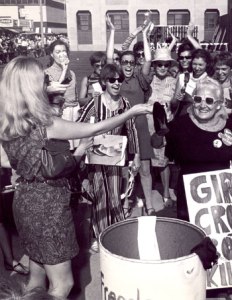
Protesting Miss America, 1968
A centerpiece of the demonstration was the so-called Freedom Trash Can (see photo, right) into which the protesters consigned “instruments of torture,” such as brassieres, girdles, high-heeled shoes, false eyelashes, and copies of magazines such as Playboy and Cosmopolitan.
But the protest’s organizers have long insisted that nothing had been set ablaze at Atlantic City. The lead organizer, Robin Morgan, has asserted, for example:
“There were no bras burned. That’s a media myth.”
And yet the epithet “bra-burning” took hold, serving to denigrate and trivialize the objectives of the women’s liberation movement.
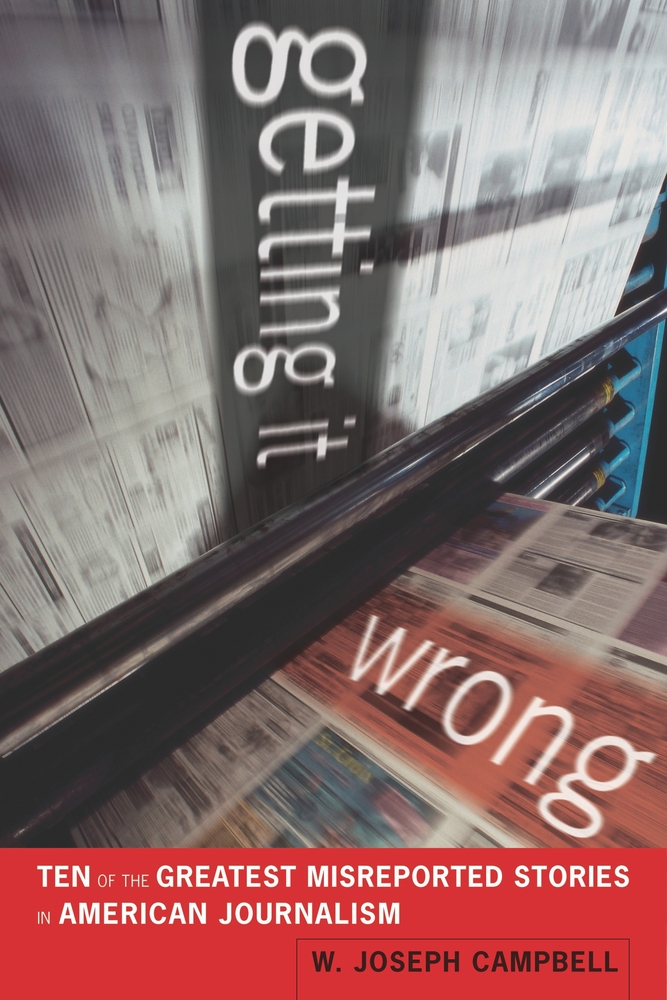
In researching bra-burning for Getting It Wrong, my new book about prominent media myths, I was inclined to accept the denials. They seemed insistent and solid—and no one had produced evidence to the contrary. Bra-burning certainly seemed to be a media-driven myth.
Still, I was curious about what the local newspaper, the Atlantic City Press, had written about the 1968 demonstration. I had never seen references to its reporting.
Microfilm of the Press for September 1968 proved impossible to obtain through inter-library loan, so I paid a visit to the public library in Atlantic City, to crank microfilm there.
I found that the Press published two articles about the protest, both on page 4. The lead article appeared beneath the intriguing headline:
“Bra-burners blitz boardwalk.”
The article conveyed a sense of astonishment that such a protest would take place at the venue of the Miss America pageant, then a revered tradition in Atlantic City.
The article’s ninth paragraph offered stunning detail, in a matter-of-fact sort of way.
“As the bras, girdles, falsies, curlers, and copies of popular women’s magazines burned in the ‘Freedom Trash Can,’” it said, “the demonstration reached the pinnacle of ridicule when the participants paraded a small lamb wearing a gold banner worded ‘Miss America.’”
“Whoa,” I said to myself in reading that paragraph. “Whoa.”
Here, after all, was a contemporaneous, eyewitness account—the first such account I had ever seen—that said that bras had indeed been burned during the protest.
The single mention of bra-burning was significant and striking. But it was a single mention, and I needed detail and corroboration.
The other article in the Press described the bewildered reactions of boardwalk-strollers who watched the protest; it made no mention of burning bras.
The author of the lead article, John L. Boucher, died in 1973.
Boucher, I learned, could be gruff and tough, in a old-school way. He was also an informal adviser to young reporters at the Atlantic City newspaper.
Among them was Jon Katz, who in 1968 was at the outset of a career that took him to the Philadelphia Inquirer and Boston Globe, and to the CBS Morning News as executive producer. After leaving daily journalism, Katz became a writer of mysteries and nonfiction.
Katz had been on the boardwalk that long-ago September day: He had written the other article about the protest for the Press.
I traced Katz to upstate New York. In interviews by email and phone, Katz said without hesitation that he recalled that bras and other items had been set afire during the demonstration against Miss America.
“I quite clearly remember the ‘Freedom Trash Can,’ and also remember some protestors putting their bras into it along with other articles of clothing, and some Pageant brochures, and setting the can on fire,” Katz said. “I am quite certain of this.”
He added:
“I recall and remember noting at the time that the fire was small, and quickly was extinguished, and didn’t pose a credible threat to the boardwalk. I noted this as a reporter in case a fire did erupt.”
Katz thus offered confirmation that bras and other items had been burned in the Freedom Trash Can.
I sought to interview with Robin Morgan about these new details. She replied to my inquiries through a spokeswoman, declaring:
“There were NO bras EVER burned at the 1968 protest.”
So how is all this treated in Getting It Wrong, which will be launched Saturday, June 19, at an “Inside Media” program at the Newseum in Washington, D.C.?
The account by Boucher and the recollections of Katz offer “fresh dimension to the bra-burning legend,” I write in the book. “They represent two witness accounts that bras and other items were burned, or at least smoldered, in the Freedom Trash Can. There is now evidence that bras and other items were set afire, if briefly, at the 1968 Miss America protest in Atlantic City. This evidence cannot be taken lightly, dismissed or ignored.”
But at the same time, their accounts lend no support to the more vivid popular imagery that many bras went up in flames in flamboyant protest on the boardwalk.
Boucher and Katz offered no endorsement for the central feature of the media-driven myth that angry women burned their bras in a fiery public spectacle.
At most, fire was a subtle, modest, and fleeting element of the protest that day.
And yet, “bra-burning” is an epithet not entirely misapplied to the demonstration at Atlantic City.
WJC
A version of this post first appeared at the University of California Press blog.
Many thanks to Jim Romenesko for linking to this post.






 Media Myth Alert