W. Joseph Campbell

Posts Tagged ‘Debunking’

Slaying the McCarthy dragon? It wasn’t Murrow

In Debunking, Media myths, Murrow-McCarthy myth on January 10, 2010 at 2:46 pm

Few lessons in American journalism are as inspiring — but, in the end, as misplaced — as the notion of Edward R. Murrow’s slaying the dragon of McCarthyism in a single television program in 1954.

It’s a great story, how Murrow, the legendary figure of American broadcasting, stood up to Senator Joseph R. McCarthy, when no one else would, or dared, and in so doing, brought an abrupt end to senator’s witchhunt for communists in the U.S. government.

Murrow in 1954 (Library of Congress)

It’s a tale that dates to the evening of March 9, 1954, and Murrow’s “Special Report on Joseph R. McCarthy,” which aired on the CBS television show, See It Now.

The epic confrontation of Murrow and McCarthy was recalled the other day in a commentary posted at the online edition of a Philipine newspaper, the News Today.

The commentary invoked the dragon metaphor, stating in part:

“Edward Murrow slew the dragon that was McCarthyism, ushering in the pure air of freedom enjoyed by his fellow Americans be they from the left, right, or center. Witch-hunting was thrashed to damnation, and Joseph McCarthy exited in ignominy.”

It is a great story; indeed, it’s one of the most treasured in American journalism.

But as I write in my forthcoming book, Getting It Wrong, the notion that Murrow took down McCarthy and ended the senator’s witchhunting ways is a tenacious media-driven myth, one that obscures the more important contributions of journalists other than Murrow in McCarthy’s demise.

As I also write in Getting It Wrong:

“Long before the See It Now program” in March 1954, “several prominent journalists—including the Washington-based syndicated columnist Drew Pearson—had become persistent and searching critics of McCarthy, his record, and his tactics.”

Pearson’s contributions to unraveling the scourge of McCarthyism are, however, little recalled these days.

Interestingly, the media myth of Murrow v. McCarthy took hold despite the protestations of its central figures.

In the days and weeks following the See It Now program on McCarthy, Murrow said he recognized his accomplishments were modest, that at best he had reinforced what others had long said about McCarthy.

Jay Nelson Tuck, the television critic for the New York Post, wrote that Murrow felt “almost a little shame faced at being saluted for his courage in the McCarthy matter. He said he had said nothing that … anyone might not have said without a raised eyebrow only a few years ago.”

Murrow told Newsweek magazine: “It’s a sad state of affairs when people think I was courageous.”

Murrow’s collaborator and co-producer, Fred W. Friendly, also rejected claims the program was pivotal or decisive, writing in his 1967 memoir:

“To say that the Murrow broadcast of March 9, 1954, was the decisive blow against Senator McCarthy’s power is as inaccurate as it is to say that Joseph R. McCarthy … single-handedly gave birth to McCarthyism.”

So why has the Murrow-McCarthy myth become so tenacious?

There are several reasons. A particularly persuasive explanation, in my view, is that mythologizing Murrow’s See It Now program on McCarthy serves, as I write in Getting It Wrong, “to affirm television’s sometimes-tenuous claim to seriousness of purpose.

“Enveloping the program in heroic terms is a way to identify and celebrate the potential of broadcast journalism, which often has been criticized for superficiality and a taste for the trivial. As it became an inescapable presence in American living rooms in the 1950s, television needed a hero and a heroic moment. Murrow and his ‘Report on Joseph R. McCarthy’ were both ….”

This is a point that communications scholar Gary Edgerton has addressed notably well, having written in 1992:

“In a deep and heartfelt sense, Murrow is the electronic media’s hero for self-justification. Commemorating a ‘patron saint of American broadcasting’ is also an act of testimony to the tenets of fairness, commitment, conscience courage, and social responsibility which compose the Murrow tradition for broadcast journalism.”

Besides, it wasn’t as if Americans in early 1954 were hoping for someone to step up and expose McCarthy, or waiting for a white knight like Murrow to tell them about the toxic threat the senator posed. It was quite well-known by then.

WJC

The ‘Cronkite Moment’: That famous, dubious turn of phrase

In Cronkite Moment, Debunking, Media myths on January 8, 2010 at 6:57 pm

I blogged not long ago about what may be the most famous words in American journalism, offering a couple of media myths as examples.

One was the enduring anecdote about William Randolph Hearst’s supposed vow to “furnish the war” with Spain. That one’s been retold many, many since it first appeared in print in 1901.

It is arguably American journalism’s most tenacious myth. Those words attributed to Hearst surely are some of the most famous in journalism. Even though it’s quite unlikely he ever made such a vow.

Another example I cited was the so-called “Cronkite Moment,” the occasion in 1968 when the views of CBS News anchorman Walter Cronkite were supposedly so powerful and persuasive they swiftly altered U.S. policy in Vietnam.

That anecdote centers around Cronkite’s special program on the Vietnam War, a show that aired February 27, 1968. Near the end of the program, Cronkite declared the U.S. war effort was “mired in stalemate” and suggested negotiations with the communist North Vietnamese to end the conflict.

At the White House, President Lyndon Johnson supposedly watched the Cronkite program and snapped off the television set when he heard the anchorman’s dire assessment, telling an aide, “If I’ve lost Cronkite, I’ve lost Middle America.” Or something to that effect.

The point is that Cronkite was such a trusted figure that his views could sway the opinions of countless thousands of Americans. With Cronkite gone wobbly on Vietnam, the Johnson White House supposedly reeled. At the end of March 1968, Johnson announced he would not seek reelection.

The “Cronkite Moment” made yet another appearance the other day in a blog of the San Diego Union-Tribune.

The blog comment, posted by an editorial writer for the newspaper, stated:

“One of the standard views of why America turned on the Vietnam War focuses on CBS anchorman Walter Cronkite’s increasingly obvious pessimism about President Lyndon Johnson’s statements about and management of the war. LBJ reportedly told an aide, ‘That’s it. If I’ve lost Cronkite, I’ve lost middle America.'”

As I’ve noted several time at Media Myth Alert, and as I write in my forthcoming book, Getting It Wrong, Johnson did not see the Cronkite program on Vietnam when it aired. The president that night was in Austin, Texas, at the 51st birthday of a political ally, Governor John Connally.

When Cronkite was intoning his downbeat assessment of the war, Johnson was offering light-hearted banter about Connally’s age, saying:

“Today you are 51, John. That is the magic number that every man of politics prays for—a simple majority. Throughout the years we have worked long and hard—and I might say late—trying to maintain it, too.”

Earlier that day, Johnson delivered a rousing speech in Dallas, invoking Churchillian language at one point.

“There will be blood, sweat and tears shed,” he said, adding:  “I do not believe that America will ever buckle” in pursuit of its objectives in Vietnam.

Even if the president had seen the Cronkite program, it is exceedingly difficult to imagine how his mood could swing so abruptly, from vigorously defending the war effort to throwing up his hands in despair.

But if the “Cronkite Moment” is to be believed, that’s what happened: A swift, dramatic and decisive change of heart that occurred within hours of the hawkish speech in Dallas.

Not likely.

Even so, the frequency with which the quote attributed to Johnson is invoked certainly has made it among the most famous, if most dubious, turns of phrase in American journalism.

As I also write in Getting It Wrong, “Seldom, if ever, do the news media exert truly decisive influences in decisions to go to war or to seek negotiated peace. Such decisions typically are driven by forces and factors well beyond the news media’s ability to shape, alter, or significantly influence.

“So it was in Vietnam, where the war ground on for years after the ‘Cronkite moment.’”

WJC

A media myth tamed — or at least controlled

In Cronkite Moment, Debunking, Furnish the war, Media myths on January 3, 2010 at 4:58 pm

Many media-driven myths seem to defy debunking.

The tale of William Randolph Hearst’s supposed vow to “furnish the war” with Spain is a telling example. So is the notion that Walter Cronkite’s downbeat report in 1968 about the U.S. military effort in Vietnam forced President Lyndon Johnson to rethink American war policy.

Both media myths live on and on.

As I write in my forthcoming book Getting It Wrong, these “and other media myths endure, because in part they are reductive: They offer unambiguous, easily remembered explanations about complex historic events. Similarly, media myths invite indulgence in the ‘golden age fallacy,’ the flawed but enticing belief that there really was a time when journalism and its practitioners were respected and inspiring.”

While many media myths are indeed tenacious, the efforts of the Annenberg Public Policy Center over the past 10 years suggest that some myths can be curbed or contained, if not defeated entirely.

The Phildelphia-based Annenberg Center has worked to debunk the notion that suicides rise during the year-end holidays.

Such a connection may seem logical, given the stresses of the holiday season. But the data point otherwise: Suicides most often peak in the United States during the spring and fall, according to the Centers for Disease Control and Prevention.

(See the CDCP’sl 2009 data sheet on suicides here.)

The Annenberg Center tracks newspaper reports for mentions of a holiday season-suicide link. Its analysis of reporting during the 2008–09 holiday season found that 37.5 percent of 64 newspaper articles asserted such a linkage. A majority, 62.5 percent, disputed or challenged the presumed holiday season-suicide connection.

The difference over 10 years is quite dramatic. In 1999–2000, the first year of the Annenberg Center’s study on the topic, 77 percent of 101 newspapers articles asserted a holiday season-suicide link.

The pattern has been a bit erratic in the intervening years, Annenberg Center data show.

In 2006–07, for example, just 9 percent of 32 articles asserted a holiday season-suicide link. The following season, however, 51 percent of 43 articles claimed there was such a connection.

Data for the 2009–2010 season are still being compiled. But a quick check of the LexisNexis database suggests that newspaper articles published in late 2009 more often challenged than claimed a holiday season-suicide link.

A notable example was an article in USA Today in late November which noted:

“You could blame George Bailey” for the myth. “In the 1946 holiday film It’s a Wonderful Life, that fictional character contemplated suicide on Christmas Eve, possibly giving birth to the idea that suicides climb during the winter holidays.”

The Washington Times suggested a similar explanation in an article published two days before Christmas.

Like many media-driven myths, the dubious holiday season-suicide link is neither harmless nor trivial.

The Annenberg Center says:

“Perpetuating the myth not only misinforms readers but it also misses an opportunity to educate the public about the most likely sources of suicide risk, including major depression and substance abuse.”

Still, the Center’s data offer a measure of encouragement that media-driven myths are not entirely beyond taming.

WJC

The debunking of the year, 2009

In Debunking, Photographs on January 2, 2010 at 1:22 pm

The nod for the most impressive debunking of 2009 has to go to the Spanish researchers who’ve seriously challenged the authenticity of Robert Capa’s famed “Falling Soldier” image, taken during the Spanish Civil War in September 1936.

It purports to show a charging loyalist militiaman at the very moment he is shot to death.

Capa's iconic and dubious image (Robert Capa/Copyright 2001 by Cornell Capa)

The earnest research of a university lecturer in northern Spain, José Manuel Susperregui, as well as that of historian Francisco Moreno, show fairly persuasively that Capa’s photo was shot about 35 miles from Cerro Muriano, where Capa claimed it was taken.

Susperregui, who last year published Sombras de la fotografía (Shadows of Photography), a book in Spanish about his research, maintains that “The Falling Soldier” was taken in Llano de Banda, near the village of Espejo.

The most compelling evidence is the horizon, which shows a ridgeline that nearly matches that in Capa’s photos, which were first published in Vu, a French magazine.  (See the Vu spread here.)

“The landscape around Cerro Muriano looks nothing like that in the photographs,” the London newspaper Guardian quoted Susperregui as saying in  July 2009. “I have no doubt that this was taken in Llano de Banda.”

Susperregui was further quoted as saying:

“My theory is that Capa went to Espejo because he knew it had been an active front. He found nothing going on there, so did the posed photographs. Then he went on to Cerro Muriano, which was active, and took a different set of photographs there of people fleeing the fighting.”

The Guardian has posted an audio slideshow that vividly describes the landscape around Llano de Banda and dramatically underscores the arguments of the Spanish researchers. (It should be noted that doubts about the authenticity of Capa’s “Falling Solider” were raised as long ago as 1975, in Phillip Knightley’s The First Casualty. Knightley’s account quoted an associate of Capa’s as saying the photographer told him the “Falling Soldier” photos were staged.)

As I wrote in a Media Myth Alert posting November 22, “the apparent debunking is a delicious one, given the status and standing that Capa’s photograph has gained over decades. It is considered among the most dramatic wartime photos ever made.”

Not only that, but “Falling Soldier” helped launched Capa’s fabled career in photojournalism. Capa was killed in Indochina in 1954.

The efforts of Susperregui and colleagues may not have received in the United States as much attention as they deserved. But they’re imaginative and intriguing — and they represent the debunking of the year 2009.

WJC

‘Furnish the war,’ en espagnol

In 1897, Debunking, Furnish the war, Spanish-American War on December 30, 2009 at 11:54 am

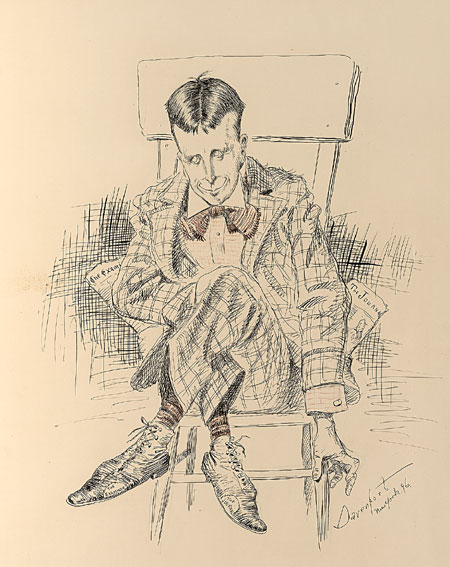
Hearst, under the pen of Homer Davenport, 1896

William Randolph Hearst’s purported vow to “furnish the war” with Spain is such a delicious and tenacious media-driven myth that it’s hardly surprising it has crossed over to other languages.

Spanish among them.

Just the other day, the online publication elmercuriodigital.es posted a commentary that invoked the Hearst quote. It read in part:

“El dibujante, Frederic Remington, telegrafió a su jefe pidiéndole autorización para regresar, pues no había ninguna guerra, y por lo tanto no había nada para cubrir. ‘Todo en calma. No habrá guerra’, dijo Remington. La respuesta del empresario periodístico fue célebre: ‘Le ruego que se quede. Proporcione ilustraciones, yo proporcionaré la guerra’.”

The passage recounts the essential portion of the anecdote, that the artist Frederic Remington, on assignment to Cuba for Hearst’s New York Journal, supposedly found “everything … quiet” and, in a cable to Hearst, asked permission to return.

In reply, as the myth has it, Hearst told Remington: “Please remain. You furnish the pictures, and I’ll furnish the war.”

As I write in my forthcoming book, Getting It Wrong:

“Hearst’s famous vow to ‘furnish the war’ has achieved unique status as an adaptable, hardy, all-purpose anecdote, useful in illustrating any number of media sins and shortcomings. It has been invoked to illustrate the media’s willingness to compromise impartiality, promote political agendas, and indulge in sensationalism. It has been used, more broadly, to suggest the media’s capacity to inject malign influence into international affairs.”

It lives on, I further write, “despite a nearly complete absence of supporting documentation.

“It lives on even though telegrams supposedly exchanged by Remington and Hearst have never turned up. It lives on even though Hearst denied ever sending such a message.”

And it lives on despite an irreconcilable internal inconsistency. Hearst had assigned Remington and the correspondent Richard Harding Davis to Cuba at the end of 1896. After several delays, they arrived in January 1897 — 15 months before the start of the Spanish-American War.

Anyone reading U.S. newspapers in early 1897 would have been well aware that Cuba was the theater of a nasty war, a rebellion against Spain’s armed forces which, by the time Remington and Davis arrived, had reached island-wide proportion.

So it would have been incongruous and inconceivable for Hearst to have vowed to “furnish the war” when war was the very reason he sent Remington and Davis to Cuba in the first place.

WJC

<!–[if !mso]> <! st1\:*{behavior:url(#ieooui) } –>

“Please remain. You furnish the pictures, and I’ll furnish the war.”[i]


[i] See Creelman, On the Great Highway, 177–178.

Bra-burning revisited, in error

In Bra-burning, Debunking, Media myths on December 22, 2009 at 2:37 pm

The enduring myths of bra-burning — a topic explored in my forthcoming book, Getting It Wrong — were invoked not only ago in a column posted at the Syndey Morning Herald‘s online site.

The passage was brief, but stunning in the ways in which it was in error.

The Morning Herald column was about the National Organization of Women and its opposition to a proposed tax on Botox. But here’s the passage about bra-burning, which refers to a demonstration in Atlantic City in September 1968 that targeted the Miss America Pageant:

“The most famous NOW action — burning a trash can full of bras and girdles outside a Miss America beauty pageant – became the stuff of folklore, and made ‘bra-burning’ a universal symbol of women’s liberation. As a symbol it’s perhaps been over-hyped, but at least it grabbed attention and made a point.”

Where to begin?

The protest on the boardwalk at Atlantic City had little to do with NOW. It was organized by a small group called New York Radical Women, a leader of which was the writer and former child actor, Robin Morgan.

At the Freedom Trash Can, 1968 (Duke University, special collections)

A highlight of the protest came when Morgan and other demonstrators (described by the New York Times as “mostly middle-aged careerists and housewives”) tossed into a barrel what they called “instruments of torture,” which included brassieres, girdles, high-heeled shoes, and magazines such as Playboy and Cosmopolitan. The protesters dubbed the barrel the Freedom Trash Can.

Morgan and others have long insisted that the bras and other contents of the Freedom Trash Can were not set afire during the protest that day.

Moreover, “bra-burning” scarcely was “a universal symbol of women’s liberation.” Far from it: Feminists like Morgan abhorred the term. They never embraced “bra-burning” as anything remotely approaching a symbol or metaphor.

But “bra-burning” did become a media-driven myth.

As I write in Getting It Wrong, the term was often invoked “to denigrate women’s liberation and feminist advocacy as trivial and even a bit primitive.”

The notion that bras were demonstratively and flamboyantly set afire at the Atlantic City protest was driven by syndicated newspaper columnists such as Harriett Van Horne.

“My feeling about the liberation ladies,” Van Horne wrote soon after the protest at Atlantic City, “is that they’ve been scarred by consorting with the wrong men. Men who do not understand the way to a woman’s heart, i.e., to make her feel utterly feminine, desirable and almost too delicate for this hard world. … No wonder she goes to Atlantic City and burns her bra.”

The author of the Sydney Morning Herald column, by the way, was Virginia Haussegger, whose Web site identifies her as “a journalist, author and commentator whose extensive media career spans more than 20 years.” She is further identified as “the face” of Australian Broadcasting Corp. TV News in Canberra.

Haussegger is the author of Wonder Woman: The Myth of Having It All, a 2005 memoir that takes feminism to task. Read the first chapter here.

WJC

Related:

More myths of ‘Yes, Virginia’

In 1897, Debunking, Media myths, New York Sun on December 20, 2009 at 2:13 pm

A couple of tenacious myths associated with American journalism’s most famous editorial, “Is There A Santa Claus?,” made another appearance today.

The West Milford Messenger in New Jersey reprinted the editorial in its entirety and then added a few observations, which are in error.

The newspaper said the editorial, which first appeared in the the New York Sun of September 21, 1897, “was an immediate sensation” and “was reprinted annually until 1949 when the paper went out of business.”

The New York Sun

Well, no, not really.

The editorial wasn’t “an immediate sensation.” Nor was it reprinted annually by the Sun, which ceased publication in 1950. Those mistakes are often enough associated with “Is There A Santa Claus?,” though.

As described in my 2006 book, The Year That Defined American Journalism: 1897 and the Clash of Paradigms, the editorial stirred no comment by other newspapers at the time. And in 1897, the New York City press routinely commented on—and often disparaged—the work and content of their rivals.

But the oddly timed editorial that contained the passage, “Yes, Virginia, there is a Santa Claus,” prompted no comment from the Sun’s rivals in New York.

Moreover, “Is There A Santa Claus?” was diffidently embraced by the Sun.

In the ten years from 1898–1907, “Is There A Santa Claus?” was reprinted in the Sun at Christmastime only twice.

The first time was in 1902. On that occasion, the Sun reprinted the editorial with more than a hint of annoyance, stating:

“Since its original publication, the Sun has refrained from reprinting the article on Santa Claus which appeared several years ago, but this year requests for its reproduction have been so numerous that we yield.” The newspaper added this gratuitous swipe:

“Scrap books seem to be wearing out.”

Francis P. Church of the Sun

The Sun next reprinted the editorial in December 1906, as a tribute to its author, Francis P. Church, who died eight months before.

The Sun then said it was reprinting the editorial “at the request of many friends of the Sun, of Santa Claus, of the little Virginias of yesterday and to-day, and of the author of the essay, the late F.P. Church.”

But it wasn’t until the early 1920s when the editorial begin appearing prominently, and without fail, at Christmastime in the Sun.

In the years that followed, readers implored the Sun not to fail to reprint the editorial.

“It will neither be Christmas nor the Sun without it,” declared one reader in 1927.

A letter-writer told the Sun in 1926 that “Is There A Santa Claus?” offered “a fine relief from the commercialism and unsentimental greed” of the Christmas season.

“Every year, as I grow a little older,” another reader wrote in 1940, “I find added significance in its profound thoughts.”

WJC

The ‘Johnson White House reeled’? Not because of Cronkite

In Cronkite Moment, Debunking, Media myths on December 19, 2009 at 12:56 pm

The AOL Television online site today recalls as a “TV moment of 2009” the death five months ago of Walter Cronkite, the famous CBS News anchorman.

The AOL Television post recalls the so-called “Cronkite Moment” of 1968, when the anchorman’s downbeat assessment about the U.S. military effort in Vietnam was said to have had immediate and stunning effects on President Lyndon Johnson and his war policy.

The AOL post says of Cronkite: “In 1968, after extensive on-the-ground reporting, he advocated the withdrawal of American troops from Vietnam. The Johnson White House reeled.”

Reeled?

Hardly.

As I write in my forthcoming book, Getting It Wrong:

“Scrutiny of the evidence associated with the program reveals that Johnson did not have—could not have had—the abrupt yet resigned reaction that so often has been attributed to him. That’s because Johnson did not see the program when it was aired” on February 27, 1968.

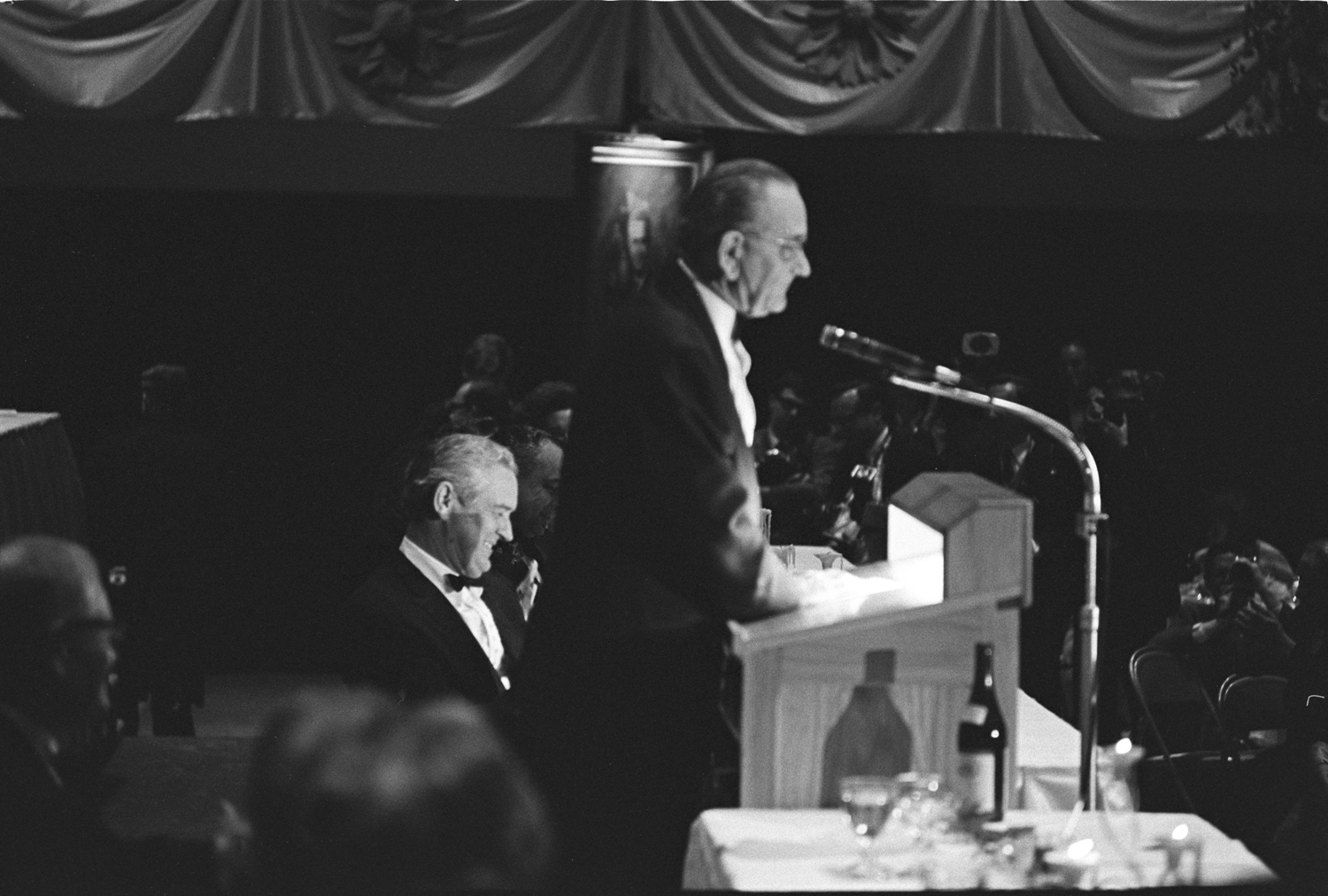
Lyndon Johnson at Connally's birthday party

Johnson then was in Austin, Texas, engaging in light-hearted banter at a black-tie party for Governor John Connally. “Today you are 51, John,” the president said in Austin, at about the time the Cronkite program was ending.

“That is the magic number that every man of politics prays for—a simple majority. Throughout the years we have worked long and hard—and I might say late—trying to maintain it, too.”

Even if he later heard—or heard about— Cronkite’s assessment, it represented no epiphany for Johnson. Indeed, soon after the Cronkite program, the president gave a rousing, lectern-pounding speech in which he urged a “total national effort” to win the war in Vietnam.

So Cronkite’s program scarcely was decisive to American war policy. It certainly did not send the Johnson White House reeling.

It is noteworthy to recall that Cronkite in his program on Vietnam did not urge the immediate withdrawal of U.S. forces.

He hedged, holding open the possibility that the U.S. military efforts might still force the North Vietnamese to the bargaining table. Cronkite suggested the U.S. forces be given a few months more to press the fight in Vietnam, in the wake of the communists’ surprise Tet offensive, stating:

“On the off chance that military and political analysts are right, in the next few months we must test the enemy’s intentions, in case this [Tet offensive] is indeed his last big gasp before negotiations. But it is increasingly clear to this reporter that the only rational way out then will be to negotiate, not as victors, but as an honorable people who lived up to their pledge to defend democracy, and did the best they could.”

What’s more, Cronkite’s assessment was scarcely exceptional or extraordinary.

In his year-study about 1968, Mark Kurlansky wrote that Cronkite’s view was “hardly a radical position” for the time.

Four days before the Cronkite program, the Wall Street Journal said in an editorial that the U.S. war effort in Vietnam “may be doomed” and that “everyone had better be prepared for the bitter taste of defeat beyond America’s power to prevent.” And nearly seven months before the Cronkite program, New York Times correspondent R.W. Apple Jr. cited “disinterested observers” in reporting that the war in Vietnam “is not going well.”

Victory, Apple wrote, “is not close at hand. It may be beyond reach.”

WJC

Too bad it’s only in French: A neat little book of impressive debunking

In Debunking, Media myths on December 17, 2009 at 3:21 pm

Talk about heavy-duty debunking.

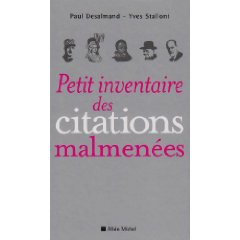
The Times of London not long ago posted an item at one of its blogs about a book published last month that challenges the veracity of well-known quotes attributed to French rulers and intellectuals.

The book, Le Petit inventaire des citations malmenées (or, roughly, the Small  inventory of abused quotations), calls into question such famous lines as Louis XIV’s  “L’état c’est moi,”  Louis XV’s “Après moi le déluge,” and Queen Marie Antoinette’s “Qu’ils mangent de la brioche” (let them eat cake).

As described by Charles Bremner, the Times‘ correspondent in Paris in a blog posting late last month, “Those famous royal remarks are among dozens of misattributed, misunderstood and outright false quotations in a fun little book just published by two academics,” Paul Desalmand and Yves Stallini.

Bremner writes that the authors “delight in knocking down famous lines that were outright invented or wrongly attributed to great figures of the past. They blame lazy journalists and historians for populari[z]ing dodgy quotes and making them up because they sound right.”

Lazy journalists: Seems right.

Journalists can be quite eager to invoke famous quotes that “sound right” or are simply too good to check out. Too delicious not to be true.

The long-lived but almost certainly apocryphal remark attributed to William Randolph Hearst, “You furnish the pictures, I’ll furnish the war,” comes readily to mind.

So does the comment attributed to President Lyndon Johnson, “If I’ve lost Cronkite, I’ve lost Middle America.” Johnson supposedly made the remark after watching Walter Cronkite’s special report on Vietnam in February 1968. As is discussed in my forthcoming book, Getting It Wrong, Johnson did not see the program when it aired.

And Hearst denied ever having vowed to “furnish the war” between the United States and Spain.

In its review, the Parisian daily Le Monde calls Le Petit inventaire des citations malmenées “clever” as well as “instructive and amusing. Also sad, sometimes.”

The book, Bremner further notes, challenges the quote attributed to King Henri IV, “Paris vaut bien une messe” [Paris is well worth a mass]. “No trace of this legendary quip by the ex-protestant king can be found in historical records,” Bremner writes, adding that authors Desalmand and Stallini “suggest that it may have been invented by enemies of the popular 16th century ruler who switched to Catholicism in order to have the crown.”

Le Petit inventaire des citations malmenées sounds like a neat little book of impressive debunking. It runs 188 pages, but hélas, is available only in French.

WJC