W. Joseph Campbell

Posts Tagged ‘Hearst’

The seven most famous words in American journalism

In 1897, New York Times on February 9, 2010 at 8:10 am

I’ve written that 1897 was a decisive year in American journalism.

The evocative sneer “yellow journalism” first appeared in print in 1897.

What became the best-known, most-reprinted editorial in American journalism, the New York Sun‘s “Is There A Santa Claus?,” was published in 1897.

William Randolph Hearst’s New York Journal developed its bold and interventionist model of “journalism of action” in 1897.

And the seven most famous words in American journalism, “All the News That’s Fit to Print,” took a permanent place on the front page of the New York Times in 1897.
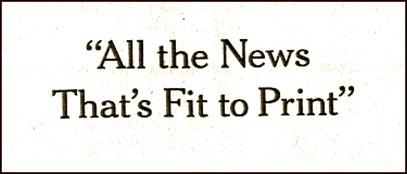
The motto appeared without comment, notice, or fanfare in the upper-left corner, the left “ear,” of the Times front page 113 years ago tomorrow — February 10, 1897.

The smug and tidy slogan has occupied the spot ever since. As  I noted in my 2006 book, The Year That Defined American Journalism: 1897 and the Clash of Paradigms, the motto represents “an enduring statement of guiding principle of what has long been recognized as the best newspaper in America.”

I also noted that the Times motto has been endlessly parodied and analyzed. Even admirers of the newspaper have acknowledged it’s a bit “overweening” and “elliptical.”

The motto has evoked lofty claims over the years. The Times in 1901, at the fiftieth anniversary of its founding, referred to “All the News That’s Fit to Print” as its “covenant.”

An historian of the Times, Elmer Davis, said the motto had served as “a war cry.”

In 2001, a columnist for the Wall Street Journal described the motto as the “leitmotif not merely for the Times, but also, by a process of osmosis and emulation, for most other general-interest papers in the country, as well as for much of the broadcast media.”

It was also, I wrote in The Year That Defined American Journalism, “a pithy summation of the Times’ … vision for American journalism,” a model of detachment in newsgathering “that stood in apposition to the extravagance and self-promotion” of Hearst’s “journalism of action.”

Indeed, “All the News That’s Fit to Print” is a timeless rebuke to the practices of Hearst and, to an extent, of Joseph Pulitzer — aggressive and flamboyant techniques that critics scorned as “yellow journalism.”

Interestingly, “All the News That’s Fit to Print” was at first a feature of a marketing campaign by the Times which, in August 1896, had been acquired in bankruptcy court by Adolph S. Ochs, a newspaperman from Tennessee. “All The News That’s Fit to Print” appeared in advertisements in the trade journal Fourth Estate in mid-October 1896. By month’s end, the phrase had taken a modest place in a corner of the Times’ editorial page.

The seven most famous words in American journalism made their debut in early October 1896, in a row of red lights arrayed across a huge advertising sign above Manhattan’s Madison Square. The illuminated sign was on the north wall of the old Cumberland Hotel building at Broadway and 22d Street.

Ochs, who turned 39 in 1897, had a bit of a flair for self-promotion, as the illuminated sign at Madison Square suggested. Securing the space “was nothing less than a coup” for the newcomer to New York journalism, I wrote in The Year That Defined American Journalism.

“The sign’s bright, multi-colored lights could be seen for many blocks away. Nowhere in the country, or in Europe, the Times immodestly crowed, was there ‘so large and perfect a display.'”

It was illuminated by four rows of lights. White lights of the top and bottom rows spelled, “New-York Times” and “Have You Seen It?” A row of blue, white, and green lights spelled out “Sunday Magazine Supplement.” The red lights, which formed the second row of illumination, announced:

“All the News That’s Fit to Print.”

WJC

in mid-October 1896 and by month’s end had taken a place in the upper-left corner of the newspaper’s editorial page.
More than merely sensational

In 1897, Media myths, Yellow Journalism on February 1, 2010 at 8:36 am

Yellow journalism” lives on in as ready shorthand for sensationalism, for reckless and lurid treatment of the news.

“Yellow journalism” is a delicious and versatile sneer, a term that first appeared in print in late January 1897 and routinely invoked in the decades since to describe egregious journalistic misconduct of almost any kind.

But such casual, shorthand characterizations are not very accurate.

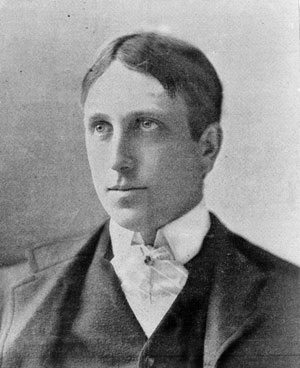
Young W.R. Hearst

They fail to capture or reflect the complexity and vigor of yellow journalism, the leading practitioners of which were the newspapers of William Randolph Hearst and, to a lesser extent, those of Joseph Pulitzer.

Yellow journalism was flamboyant and aggressive, to be sure. Especially so was Hearst’s New York Journal. But to equate “yellow journalism” simply to sensationalism is to misunderstand what a dynamic phenomenon it was.

As I wrote my 2001 book, Yellow Journalism: Puncturing the Myths, Defining the Legacies, “in its most developed and intense form, yellow journalism was characterized by” these features:

  • the frequent use of multicolumn headlines that sometimes stretched across the front page.
  • a variety of topics reported on the front page, including news of politics, war, international diplomacy, sports, and society.
  • the generous and imaginative use of illustrations, including photographs and other graphic representations such as locator maps.
  • bold and experimental layouts, including those in which one report and illustration would dominate the front page. Such layouts sometimes were enhanced by the use of color.
  • a tendency to rely on anonymous sources, particularly in dispatches of leading reporters.
  • a penchant for self-promotion, to call attention eagerly to the paper’s accomplishments. This tendency was notably evident in crusades against monopolies and municipal corruption.

As defined above and as practiced more than a century ago, yellow journalism, I wrote in the book, “certainly could not be called predictable, boring, or uninspired”—complaints of the sort often raised about contemporary American newspapers.

Moreover, yellow journalism “was a product of a lusty, fiercely competitive, and intolerant time, when newspapers routinely traded brickbats and insults,” I wrote.

“The latter practice was remarkably well-developed at the end of the nineteenth century. The Journal and [Pulitzer’s] World, for example, were ever eager to impugn, denounce, and sneer at each other; so, too, were conservative newspapers.”

More generally, “yellow journalism reflected the brashness and the hurried pace of urban America at the turn of the twentieth century,” I wrote.

“It was a lively, provocative, swaggering style of journalism well suited to an innovative and expansive time—a period when the United States first projected its military power beyond the Western Hemisphere in a sustained manner. The recognition was widespread at the end of the nineteenth century that the country was on the cusp of rapid, perhaps even disruptive transformation.”

Yellow journalism, moreover, “was a genre keen to adapt and eager to experiment.” It took risks; it shook up and even shocked the field.

Were that mainstream news media of the 21st century so inclined.

WJC

Yellow journalism: A sneer is born

In 1897, Anniversaries, Spanish-American War, Yellow Journalism on January 31, 2010 at 9:30 am

Erwin Wardman, New York Press

It’s a little-recognized, never-celebrated anniversary in American journalism, granted.

But today marks the 113th year since the term “yellow journalism” first appeared in print, in the New York Press, edited by the austere Ervin Wardman.

The phrase “the Yellow Journalism” appeared in a small headline on the Press’ editorial page on January 31, 1897. The phrase also appeared that day in the Press’ editorial page gossip column, “On the Tip of the Tongue.”

“Yellow journalism” caught on quickly, as a way to denigrate what then was called the “new journalism” of William Randolph Hearst’s New York Journal and of Joseph Pulitzer‘s New York World.  By the end of March 1897, references to “yellow journalism” had appeared in newspapers in Providence, Richmond, and San Francisco.

In the decades since then, “yellow journalism” has become a widely popular sneer, a derisive shorthand for denouncing sensationalism and journalistic misconduct of all kinds, real and imagined. “It is,” as I noted in my 2001 book Yellow Journalism: Puncturing the Myths, Defining the Legacies, “an evocative term that has been diffused internationally, in contexts as diverse as Greece and Nigeria, as Israel and India.”

Precisely how Wardman and the Press landed on the phrase “yellow journalism” is not clear.

The newspaper’s own, brief discussion of the origins was vague and unrevealing: “We called them Yellow because they are Yellow,” it said in 1898 about the Journal and the World.

In the 1890s, the color yellow sometimes was associated with depraved literature, which may have been an inspiration to the Harvard-educated Wardman, a figure largely lost to New York newspaper history.

Wardman was tall and stern-looking. He once was described as showing his “Calvinistic ancestry in every line of his face.” He did little to conceal his disdain for Hearst and Hearst’s journalism.

His contempt was readily apparent in the columns of the Press, of which Wardman became editor in chief in 1896 at the age of 31. (The Press is long defunct; it is not to be confused with the contemporary alternative weekly by the same name.)

Wardman’s Press took to taunting Hearst, Hearst’s mother, and Hearst’s support for Democratic candidate William Jennings Bryan in the 1896 presidential election. Hearst’s Journal was virtually alone among New York newspapers in supporting Bryan’s “free silver” candidacy.

The Press disparaged Hearst, then 34, as a mama’s boy, as “Billy” and “little Willie.” It referred to the Journal as “our silverite, or silver-wrong, contemporary.”

The Press also experimented with pithy if stilted turns of phrase to denounce “new journalism.”

“The ‘new journalism,’” the Press said in early January 1897 “continues to think up a varied assortment of new lies.”

Later in the month, the Press asked in a single-line editorial comment:

“Why not call it nude journalism?”

It clearly was a play on “new journalism” and meant to suggest the absence of “even the veneer of decency.”

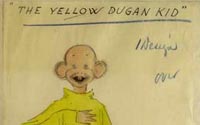
Before long, Wardman and the Press seized upon the phrase “yellow-kid journalism,” which evoked the Hearst-Pulitzer rivalry over a popular cartoon character known as the “Yellow Kid.” Both the Journal and the World at the time were publishing versions of the kid.

The Yellow Kid (Library of Congress)

At the end of January 1897, the phrase “yellow-kid journalism” was modified  to “the Yellow Journalism,” and the sneer was born.

After landing on that sneering pejorative, Wardman turned to it often, invoking the term in brief editorial comments and asides such as: “The Yellow Journalism is now so overripe that the little insects which light upon it quickly turn yellow, too.”

The diffusion of “yellow journalism” was sealed when Hearst’s Journal embraced the term in mid-May 1898, during the Spanish-American War. With typical immodesty, it declared:

“… the sun in heaven is yellow—the sun which is to this earth what the Journal is to American journalism.”

WJC

‘Pharm parties’ and the tenacity of media myths

In Debunking, Furnish the war, Media myths on January 26, 2010 at 6:25 am

Jack Shafer, editor-at-large at slate.com, recently revisited and re-debunked the media-driven myth of “pharm parties,” those purported gatherings at “which young people … dump the pills they’ve stolen from their parents’ medicine cabinets into a big bowl and then scoop out and swallow random handfuls.”

It’s a phenomenon, he says, that the news media “pretend [is] both real and ubiquitous.”

Shafer begins his take-down with a half-serious lament, writing:

“I regret to inform you that this column has failed to eradicate the ‘pharm party’ meme,” noting that he has written about this fanciful pastime on five other occasions.

Shafer appeals to common sense in deflating the myth, writing:

“There are at least two basic problems with the pharm-party scenario reported in the press. To begin with, if you were a young drug fiend and stole potent drugs, why would you deposit them in a communal bowl if there was a good chance that when your turn came to draw a drug at random, you might get an antihistamine? And second, I’ve yet to read a story in which a journalist actually attends such a gathering, interviews a participant, or cites a police report alleging such behavior.”

It’s an impressive debunking, but Shafer is under no illusions that his efforts will kill off the fantasy.

After all, he says, reports of “pharm parties” or their equivalent can be traced to the mid-1960s. “Any myth hearty enough to survive and thrive for 40-plus years in the media is probably unkillable,” Shafer writes.

And he’s probably right.

As I note in my forthcoming book, Getting It Wrong, some media-driven myths are so tenacious, so debunking-resistant, because they seem too good, too delicious, not to be true.

That’s certainly the case with the hoary tale of William Randolph Hearst’s purported vow to “furnish the war” with Spain at the end of the nineteenth century. What story better captures Hearst the warmonger than that? What tale better signals the potential malignant effects of the news media, writ large?

The anecdote of the Hearstian vow lives on, shrugging off repeated efforts to uproot it.

Likewise, the notion of “pharm parties,” is too enticing, too delicious in a perverse way, not to be true.

Another factor explaining tenacity of media-driven myths is that they readily feed stereotypes. “Pharm parties” certainly do so, offering supposed evidence of the mindless, reckless ways of a younger generation.

One of the cases of stereotyping explored in Getting It Wrong is that of “crack babies,” a frightening and overstated phenomenon of the late 1970s and 1980s. Women who smoked crack cocaine during pregnancy were, it was feared, giving birth to a neurologically damaged “bio-underclass” that would forever be dependent on the state.

The “crack baby” phenomenon turned out to be a widely misreported pandemic. Even so, it seemed to confirm the worst pathologies associated with inner-city poor people. That stereotype was one reason the “crack baby” meme lived on.

And lives on still.

WJC

New Pulitzer biography: An opportunity missed

In 1897, Media myths, Yellow Journalism on January 25, 2010 at 1:35 pm

I recently completed a review of Pulitzer: A Life in Politics, Print, & Power, a forthcoming biography of Joseph Pulitzer, who is routinely—but undeservedly—regarded as an iconic figure in American journalism.

Pulitzer (Library of Congress)

The new biography, by James McGrath Morris, indulges in the cliché of Pulitzer the great innovator. The author calls him the “midwife to the birth of the modern mass media.”

My review, written for the peer-reviewed quarterly journal American Journalism, notes that the book contains ample material for what could have been a long-overdue reinterpretation of Pulitzer, one that would take him down several pegs.

“All the elements are there,” I write, “to depict Pulitzer not as innovator but as a cruel, ruthless, self-absorbed newspaper owner who became a millionaire championing the cause of the dispossessed while eager to rub elbows with the moneyed classes.”

Pulitzer was a hypocrite and an absentee publisher. But the opportunity for a much-needed reinterpretation was missed.

Pulitzer’s correspondence, which Morris tapped extensively, certainly encourages revisionist treatment. As I noted in my 2006 book, The Year That Defined American Journalism:

“Pulitzer’s mean-spirited letters to senior managers do little to support the reputation historians have accorded him, that of a heroic and innovative journalistic icon.”

The new biography also indulges in a media myth in describing William Randolph Hearst, Pulitzer’s rival in New York City journalism in mid- and late 1890s, as an imitator of Pulitzer’s flagship newspaper, the New York World.

It’s quite conventional to make such a claim.

And misleading, too.

Hearst’s significant model was a British journalist named William T. Stead, who in the mid-1880s offered a vision of “government by journalism.” Stead argued that the journalist was “the ultimate depository of power in modern democracy.”

Hearst clearly borrowed from Stead in developing his model of the “journalism of action,” which sought to do much more than gathering, printing, and commenting on the news. As Hearst’s New York Journal put it in 1897, the “journalism of action” obliged a newspaper to inject itself conspicuously and often into public life, to “fitly render any public service within its power.”

It was a breathtaking model of activism that went well beyond the stunt journalism of Pulitzer’s World.

Oddly, the new biography fails to acknowledge Pulitzer’s nod to Hearst’s success with the Journal.

As infirm and disagreeable as Pulitzer had become by 1897, he was not without moments of keen insight. In a letter late that year to his business manager, Pulitzer invoked “Geranium,” his code name for Hearst’s Journal, and declared:

“I personally think Geranium a wonderfully able & attractive and popular paper, perhaps the ablest in the one vital sense, of managing to be talked about; of attracting attention; of constantly furnishing something which will compel people wherever they meet, whether in the drawing room, or in the poor house, elevated car or dinner table, to talk about something in that paper. That is the sort of brains the World needs. Pardon me for saying also, that with all its faults, which I should not like to copy—though they have been exaggerated—it is a newspaper.”

WJC

A media myth tamed — or at least controlled

In Cronkite Moment, Debunking, Furnish the war, Media myths on January 3, 2010 at 4:58 pm

Many media-driven myths seem to defy debunking.

The tale of William Randolph Hearst’s supposed vow to “furnish the war” with Spain is a telling example. So is the notion that Walter Cronkite’s downbeat report in 1968 about the U.S. military effort in Vietnam forced President Lyndon Johnson to rethink American war policy.

Both media myths live on and on.

As I write in my forthcoming book Getting It Wrong, these “and other media myths endure, because in part they are reductive: They offer unambiguous, easily remembered explanations about complex historic events. Similarly, media myths invite indulgence in the ‘golden age fallacy,’ the flawed but enticing belief that there really was a time when journalism and its practitioners were respected and inspiring.”

While many media myths are indeed tenacious, the efforts of the Annenberg Public Policy Center over the past 10 years suggest that some myths can be curbed or contained, if not defeated entirely.

The Phildelphia-based Annenberg Center has worked to debunk the notion that suicides rise during the year-end holidays.

Such a connection may seem logical, given the stresses of the holiday season. But the data point otherwise: Suicides most often peak in the United States during the spring and fall, according to the Centers for Disease Control and Prevention.

(See the CDCP’sl 2009 data sheet on suicides here.)

The Annenberg Center tracks newspaper reports for mentions of a holiday season-suicide link. Its analysis of reporting during the 2008–09 holiday season found that 37.5 percent of 64 newspaper articles asserted such a linkage. A majority, 62.5 percent, disputed or challenged the presumed holiday season-suicide connection.

The difference over 10 years is quite dramatic. In 1999–2000, the first year of the Annenberg Center’s study on the topic, 77 percent of 101 newspapers articles asserted a holiday season-suicide link.

The pattern has been a bit erratic in the intervening years, Annenberg Center data show.

In 2006–07, for example, just 9 percent of 32 articles asserted a holiday season-suicide link. The following season, however, 51 percent of 43 articles claimed there was such a connection.

Data for the 2009–2010 season are still being compiled. But a quick check of the LexisNexis database suggests that newspaper articles published in late 2009 more often challenged than claimed a holiday season-suicide link.

A notable example was an article in USA Today in late November which noted:

“You could blame George Bailey” for the myth. “In the 1946 holiday film It’s a Wonderful Life, that fictional character contemplated suicide on Christmas Eve, possibly giving birth to the idea that suicides climb during the winter holidays.”

The Washington Times suggested a similar explanation in an article published two days before Christmas.

Like many media-driven myths, the dubious holiday season-suicide link is neither harmless nor trivial.

The Annenberg Center says:

“Perpetuating the myth not only misinforms readers but it also misses an opportunity to educate the public about the most likely sources of suicide risk, including major depression and substance abuse.”

Still, the Center’s data offer a measure of encouragement that media-driven myths are not entirely beyond taming.

WJC

A nod to ‘Big Years’

In 1897, Year studies on December 13, 2009 at 8:21 pm

The “Outlook” section of today’s Washington Post carries an interesting look at recent books about important years.  “Year studies,” as they’re known in the academy.

The Post article, by the “Outlook” editor Carlos Lozada, noted that several studies were published in 2009 about years that changed the world or changed everything. “In an homage to anniversaries divisible by 10,” Lozada wrote, these books “focus on 1959, 1969, 1979 and, of course, 1989 (though ’99 is absent. Too soon?).”

As it turns out, he added, “there is plenty of competition in the Big Years department; identifying history’s most consequential calendar is a well-worn genre for journalists and historians, producing books such as David McCullough’s ‘1776,’ Margaret MacMillan’s ‘Paris 1919,’ Ray Huang’s brilliantly titled ‘1587: A Year of No Significance’ and countless more.”

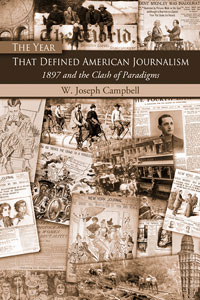
Lozada might well have mentioned the first year study about U.S. media — my 2006 book, The Year That Defined American Journalism: 1897 and the Clash of Paradigms.

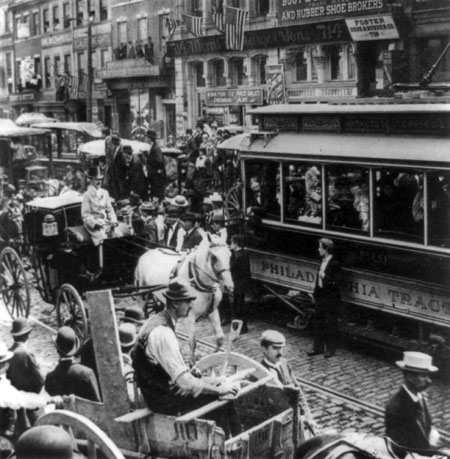
Philadelphia street scene in 1897

As I wrote in The Year That Defined American Journalism:

“Significantly, 1897 was the year when American journalism came face-to-face with a choice among three rival and incompatible visions, or paradigms, for the profession’s future. The emergence of these rival visions is central to the exceptionality of 1897. The choices that materialized then were to set a course for American journalism in the twentieth century and beyond.

“The most dramatic of the three paradigms was the self-activated, participatory model of [William Randolph] Hearst’s yellow journalism. Hearst called it the ‘journalism of action’ or the ‘journalism that acts.’ It was a paradigm of agency and engagement that went beyond gathering and publishing the news. Hearst’s New York Journal, the leading exemplar of the activist paradigm, argued that newspapers were obliged to inject themselves, conspicuously and vigorously, in righting the wrongs of public life, and in filling the void of government inaction and incompetence. …

“The antithesis of the ‘journalism of action’ was the conservative, counter-activist paradigm represented by the New York Times [of Adolph Ochs] and its lofty commitment to ‘All the News That’s Fit to Print.’ The Times model emphasized the detached, impartial, yet authoritative treatment of news. Unlike its conservative counterparts such as the New York Sun, the Times was not reluctant to adapt innovative technologies of the 1890s. The Times in 1897 made memorable use of halftone photographs in its upscale Sunday magazine supplement, presenting the images in a sober, restrained manner quite unlike the flashy treatment typical of Hearst’s yellow journalism.

The Year That Defined American Journalism: About the 'Big Year,' 1897

“The most eccentric of the three paradigms was non-journalistic, even anti-journalistic: It was a literary approach pursued by Lincoln Steffens upon his becoming city editor of the New York Commercial Advertiser in late 1897. Deliberately, and even demonstratively, Steffens shunned veteran newspapermen and instead recruited college-educated writers who had little or no experience in journalism. He then sent them out to write, to hone their talent by telling stories about the joys, hardships, and serendipity of life in New York City.”

Eighteen-ninety-seven also was the year of publication of what became American journalism’s best-known, most-reprinted editorial, the New York Sun‘s “Is There A Santa Claus?” It also was the year when the term “yellow journalism” first appeared in print, in the old New York Press. And the Times motto, “All the news that’s fit to print,” was given a permanent berth on the newspaper’s front page in 1897.

Moreover, the cinema in 1897 was in its “novelty year.” The presidential inauguration of William McKinley in March 1897 was the first to be captured on film.

But back to Lozada: He closed his article by ruminating about whether 2009 eventually will be recalled as a “Big Year.”

At this point, of course, who can tell? Lozada’s take: “it may not be a 1776 or a 1989, but 2009 seems destined to go down as a year of at least some significance. What for? Who knows. We just live here. Fortunately, it needn’t be for something that actually happened in these past 12 months, but perhaps for some future event that will be linked to our calendar.”

Not everyone finds the year study very appealing. A snarky review published during the summer in Canada’s National Post began by noting:

“Lately, it seems not a year goes by without a new book proclaiming a certain 12-month period the Most Important Year Ever.” That’s a fair point.

But in mild defense of the year-study approach, allow me to say that The Year That Defined American Journalism brought a measure of methodological freshness to journalism history. Before then, the single-year study had been neglected or overlooked in the field.

WJC

Debunking the debunking

In Media myths, Yellow Journalism on November 20, 2009 at 3:04 pm

There’s undenial appeal in busting myths.

As I write in Getting It Wrong, my forthcoming book on media-driven myths, “Debunking can be an entertaining and even faintly mischievous pursuit.”

A hint of that appeal can be detected in a commentary posted recently at fairfieldweekly.com, the online site of a free weekly newspaper in Connecticut.

The author writes: “In recent weeks, while researching a publishing project on the myths of American history, I have combed through an unending supply of stories that, upon closer scrutiny, simply do not hold, or even add, up.”

He says “the swiftness with which Americans are willing to accept, believe and disseminate myths would be touching if it wasn’t so dangerous.”

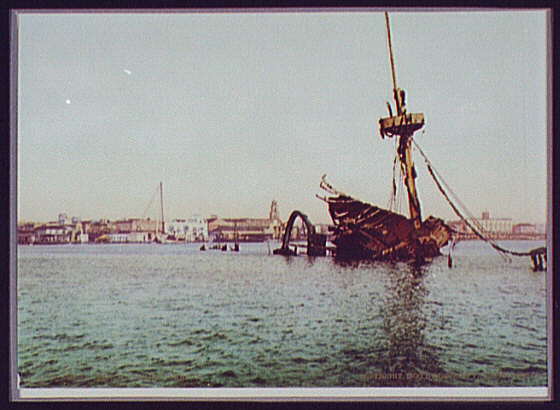
To illustrate that point, he cites “the sinking of the battleship Maine, the immediate cause of the Spanish-American War. The explosion was caused by a fire in the ammunition hold, not by Spanish sabotage. Doesn’t matter; we wanted the war, so [William Randolph] Hearst sold the sabotage myth to the American people, they quickly bought it hook, line and sinker, and we ended up an empire.”

Wreckage of the Maine, 1898 (Library of Congress)

In addressing a purported myth, the author indulges in and reiterates another, even more profound myth — that Hearst’s coverage of the Maine‘s destruction in Havana harbor in early 1898 was decisive to the U.S. declaration of war against Spain.

It’s a tempting and very tidy explanation about why the United States went to war. But it’s decidedly in error.

As I wrote in Yellow Journalism: Puncturing the Myths, Defining the Legacies (2001),  Hearst and his newspapers are “not to blame for the Spanish-American-War.” They did not force—they could not have forced—the United States into hostilities with Spain over Cuba in 1898.

The destruction of the Maine may have focused American public opinion on Cuba, but it was scarcely the principal reason in the decision to go to war.

Rather, the conflict was result of a convergence of forces that were far beyond the control or influence of Hearst and his papers.

The war with Spain was the consequence of a prolonged, three-sided impasse: Spain, for domestic political reasons, could not agree to grant independence for Cuba. The rebel movement in Cuba, which had been fighting Spanish forces for three years before the United States declared war, would accept nothing less than independence. And the United States, for political and economic reasons, could tolerate no longer the disruption and the human rights abuses caused by Spain’s harsh and ineffective efforts to put down the rebellion.

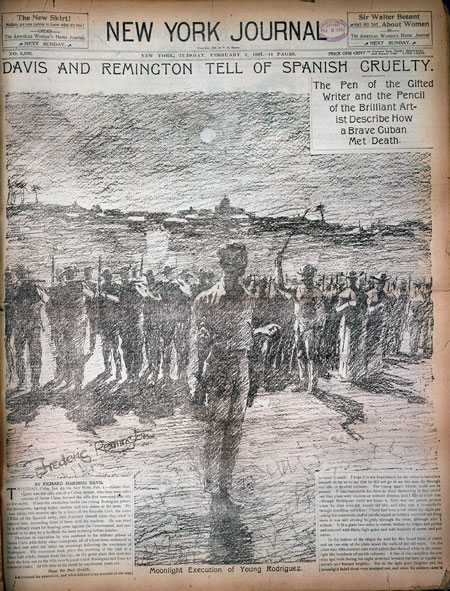
A Cuban rebel executed by Spanish firing squad, 1897

By early 1898, the Spanish had forced thousands and thousands of Cuban non-combatants — women, children, and old men — into garrison towns, in an attempt to deprive the rebels of support. Many thousands of these civilians died of disease and malnutrition, at what the Spanish called “reconcentration” centers.

This human rights disaster was well-known to, and often a topic of coverage by, U.S. newspapers, including Hearst’s. In many respects, the U.S. war with Spain was a humanitarian crusade, to end the abuses on Cuba.

In addition, there is no agreement among historians that the Maine blew up because of “a fire in the ammunition hold.” A study commissioned by the National Geographic Society and released in 1998 reports that chemical analysis pointed to an external source, such as an underwater mine, as the cause of the deadly explosion that destroyed the battleship.

WJC

‘Furnish the war’ lives on, and on

In Furnish the war, Media myths on November 9, 2009 at 10:22 am

The  media-driven myth of William Randolph Hearst’s purported vow to “furnish the war” with Spain is as delicious as it is tenacious.

The myth is cited in the “E-bits” column in the November 2009 issue of The Digital Journalist. The columnist writes: “The godfather of yellow journalism, Hearst purportedly said to an illustrator he sent to cover a revolution that wasn’t happening in 1898, ‘You furnish the pictures, I’ll furnish the war.'”

It’s a story almost too good not to be true, almost too delicious to be false.

But it’s almost certainly apocryphal. As I write in the forthcoming Getting It Wrong,  the story lives on despite a nearly complete absence of supporting documentation. It lives on even though the telegram that supposedly contained Hearst’s vow has never turned up. It lives on even though Hearst denied ever sending such a message.

It lives on despite an irreconcilable internal inconsistency: It would have been absurd for Hearst to vow to “furnish the war” because war—specifically, the Cuban rebellion against Spain’s colonial rule—was the very reason Hearst sent the illustrator, Frederic Remington, to Cuba in the first place. Remington was in Cuba in early 1897, at a time when anyone reading U.S. newspapers would have been well aware that Cuba was a theater of a nasty war. By then, Spain had sent nearly 200,000 soldiers in a failed attempt to put down the rebellion, which in 1898 gave rise to the Spanish-American War.

Hearst’s famous vow has achieved unique status as an all-purpose anecdote, useful in illustrating any number of media sins and shortcomings. It has been invoked to illustrate the media’s willingness to compromise impartiality, promote political agendas, and indulge in sensationalism. It has been used, more broadly, to suggest the media’s capacity to inject malign influence into international affairs.

And it’s as tenacious as any media-driven myth.

WJC