W. Joseph Campbell

Posts Tagged ‘Scandal’

The media myths of Watergate: Part Four

In Anniversaries, Cinematic treatments, Debunking, Media myths, Newspapers, Quotes, Reviews, Washington Post, Watergate myth on June 20, 2012 at 7:40 am

This is the fourth of five posts addressing prominent media-driven myths about the Watergate scandal, which began unfolding 40 years ago this week, with
the foiled burglary at the headquarters
in Washington of the Democratic National Committee.
This installment addresses the notion that the Watergate reporting of Bob Woodward and Carl Bernstein
placed the reporters in grave danger.

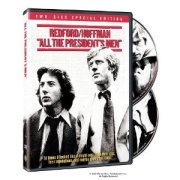
No film or documentary about Watergate has been seen more often by more people than All the President’s Men, the 1976 adaptation of the eponymous book by the Washington Post’s lead reporters on the scandal, Bob Woodward and Carl Bernstein.

The movie won rave reviews. The New York Times called it “a spellbinding detective story” and “an unequivocal smash-hit — the thinking man’s Jaws.”

The Post once immodestly described All the President’s Men as “journalism’s finest 2 hours and 16 minutes” and “the best film ever made about the craft of journalism.”

For all its glowing notices, All the President’s Men was often sluggish in pacing. More than a few scenes showed reporters at their desk, talking into telephones and banging away at typewriters.

Hardly gripping cinema.

But a measure of drama and menace was injected near the close of the movie (see video clip below).

That came when Woodward’s stealthy, high-level “Deep Throat” source, at a meeting in a darkened parking garage, grimly warns the wide-eyed reporter, played by Robert Redford:

“Your lives are in danger.”

But was it even true? Had Woodward and Bernstein, in their reporting about the misdeeds of men close to President Richard Nixon, unknowingly put their lives on the line? Were they targeted by Nixon’s henchmen? Or was this just dramatic license by Hollywood?

The movie leaves such questions hanging. The Woodward/Redford character informs the Bernstein character (played by Dustin Hoffman) about what “Deep Throat” said, and together they confer with the Post’s executive editor character (Jason Robards) — in the middle of the night, in the middle of the editor’s lawn.

But the movie closes before resolving the question of the hazards the reporters faced.

So were their lives really in danger?

Nope.

Not according to the book, All the President’s Men.

The book discusses a late-night meeting between Woodward and “Deep Throat” in mid-May 1973 when the source — W. Mark Felt, a senior official at the FBI, as it turned out — advised the reporter to “be cautious.”

Woodward returned to his apartment and invited Bernstein to stop by. When he did, Woodward typed out a message and handed it to his colleague:

Everyone’s life is in danger.”

Bernstein gave a curious look and Woodward typed another note:

Deep Throat says electronic surveillance is going on and we had better watch it.”

Who was doing the surveillance? Bernstein asked in long hand.

“C-I-A,” Woodward silently mouthed.

For a time afterward, the reporters and senior editors at the Post took precautions to avoid the suspected surveillance of their activities.

Woodward and Bernstein wrote in All the President’s Men that they “conferred on street corners, passed notes in the office, avoided telephone conversations.”

But soon, they said, “it all seemed rather foolish and melodramatic” and they went back to their routines.

No evidence, they wrote, was ever found “that their telephones had been tapped or that anyone’s life had been in danger.”

At a program last week at the Newseum, Woodward said he took Felt’s warning “too literally. I think he was speaking metaphorically” about the hazards.

“I think it was an overreaction,” Woodward said.

On another occasion — an online chat five years ago — Woodward said the “most sinister pressure” he and Bernstein felt during Watergate “was the repeated denial” by Nixon’s White House “of the information we were publishing” as the scandal deepened.

Also in that chat, Woodward said of the cinematic version of All the President’s Men:

“The movie is an incredibly accurate portrait of what happened.”

Oh, sure, it is.

Even that Post review, which called the movie journalism’s finest 2 hours and 16 minutes, noted that All the President’s Men “over-glamorizes reporting, oversimplifies editing and makes power appear the only proper subject for a newsman’s pen.”

WJC

Recent or related:

The media myths of Watergate: Part Three

In Anniversaries, Debunking, Media myths, Newspapers, Quotes, Washington Post, Watergate myth on June 19, 2012 at 5:25 am

This is the third of five posts addressing prominent media-driven myths about the Watergate scandal, which began
unfolding 40 years ago this week with the foiled burglary at the headquarters in Washington of the Democratic National Committee.
This installment discusses the most famous made-up line of Watergate.

“Follow the money.” It’s the best-known, most popular turn-of-phrase associated with the Watergate scandal of 1972-74.

Felt: Never said it

It’s often said that “follow the money” was sage counsel offered by the stealthy, high-level “Deep Throat” source with whom Bob Woodward of the Washington Post periodically met as the scandal unfolded.

The guidance to “follow the money” supposedly proved crucial in understanding and unraveling the labyrinthine scandal that was Watergate.

Except that it really wasn’t.

“Deep Throat” never advised Woodward to “follow the money.”

The passage appears in no Watergate-related article or editorial in the Post until June 1981, nearly seven years after Nixon’s resignation. It doesn’t appear, either, in All the President’s Men, the book Woodward and his Post colleague, Carl Bernstein, wrote about their Watergate reporting.

Follow the money” was written into the screenplay of All the President’s Men, the cinematic adaptation of Woodward and Bernstein’s book.

The line was spoken by Hal Holbrook, the actor who played “Deep Throat” in the movie. (The real “Deep Throat” was self-revealed in 2005 to have been W. Mark Felt, a senior FBI official.)

Holbrook in All the President’s Men turned in a marvelous performance as a twitchy, conflicted, chain-smoking “Deep Throat.”

‘All the President’s Men,’ the movie

He delivered the line, “follow the money,” with such raspy assurance and conviction that it seemed for all the world to be vital to understanding the scandal that began unfolding 40 years ago.

Follow the money” is certainly Watergate’s most memorable and mythical phrase; it is so pithy and emphatic that it seems almost too good not to be true.

Indeed, “follow the money” tends to be treated with reverence by news media. A “credo,” it’s been called.

Take, for example, a recent post at the “Daily Intel” blog of New York Magazine. The blog post began by invoking the famous phrase, with emphasis:

Follow the money. The pithy investigative advice Woodward and Bernstein attributed to Deep Throat is still brilliant and important, whatever else the Watergate reporters may have embellished.”

Brilliant and important?

Made up is more like it.

But even if Woodward had been counseled to “follow the money,” the advice neither would have unraveled the Watergate scandal nor led him to Nixon.

Besides, Woodward and Bernstein already were on the money trail.

One of their most important stories was in reporting that a $25,000 check to Nixon’s reelection campaign had been deposited in the bank account of one of the Watergate burglars.

The scandal, though, was much more than Nixon’s improper use of campaign funds. The president was forced to resign because he obstructed justice by approving a plan to cover up the burglary at the Democratic National Committee.

The simplified, follow-the-money construct not only is inaccurate and misleading: It serves to deflect attention from the array of forces that combined to expose Nixon’s crimes.

As I note in my 2010 book Getting It Wrong, rolling up a scandal of Watergate’s depth and dimension required “the collective if not always the coordinated forces of special prosecutors, federal judges, both houses of Congress, the Supreme Court, as well as the Justice Department and the FBI.

“Even then,” I write, “Nixon likely would have served out his term if not for the audiotape recordings he secretly made of most conversations in the Oval Office of the White House.

“Only when compelled by the Supreme Court did Nixon surrender those recordings, which captured him plotting the cover-up” that cost him the presidency.

WJC

Recent or related:

The media myths of Watergate: Part Two

In Anniversaries, Debunking, Media myths, Newspapers, Scandal, Washington Post, Watergate myth on June 18, 2012 at 5:42 am

This is the second of five posts addressing prominent media-driven myths about the Watergate scandal, which began unfolding 40 years ago this week with
the foiled burglary at the headquarters in Washington
of the Democratic National Committee.
This installment discusses the notion
that the 
Washington Post “uncovered” the Watergate story.

Post’s Watergate story, June 18, 1972 (Ransom Center, University of Texas)

Watergate was America’s gravest political scandal. It began as a police beat story.

News of the scandal’s seminal crime — the thwarted break-in of June 17, 1972, at the headquarters of the Democratic National Committee at the Watergate complex in Washington, D.C. — was circulating within hours.

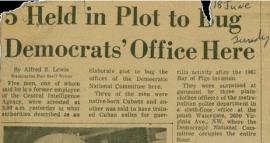
The opening paragraph of the Posts front-page report about the burglary, published 40 years ago today, made it clear that details had come from investigating authorities. The paragraph read:

“Five men, one of whom said he is a former employee of the Central Intelligence Agency, were arrested at 2:30 a.m. yesterday in what authorities described as an elaborate plot to bug the offices of the Democratic National Committee here.”

So it can’t be said the Post “uncovered” the Watergate story.

Nor can it be said that the newspaper “uncovered” crucial elements of the deepening scandal, which ultimately forced President Richard Nixon to resign the presidency in August 1974.

Take, for example, Nixon’s secret audiotaping system at the White House.

Existence of the tapes was disclosed in July 1973 to a bipartisan select committee of the U.S. Senate (see video clip below).

The tapes were decisive to Watergate’s outcome; Watergate’s leading historian, Stanley I. Kutler, has characterized them as “the gift of the gods.”

The so-called “smoking gun” tape revealed that Nixon had approved a plan to divert the FBI’s investigation of the break-in of DNC headquarters.

He did so in a conversation June 23, 1972, with his top aide, H.R. Haldeman. The contents of the “smoking gun” tape were made public in early August 1974, shortly after the U.S. Supreme Court ordered Nixon to turn it over to investigators.

The “smoking gun” tape sealed Nixon’s fate and led to his resigning the presidency.

(As Kutler has noted, Nixon-White House tapes “released in 1997 clearly reveal” that the president knew about “hush money” payments to the Watergate burglars.)

Interestingly, the Post’s Watergate reporters, Bob Woodward and Carl Bernstein, later claimed to have had a solid lead about Nixon’s taping system — a lead they did not pursue.

They mentioned in their book, All the President’s Men, that Woodward had spoken about the tip with Ben Bradlee, then the Post’s executive editor.

Bradlee advised: “See what more you can find out, but I wouldn’t bust one on it.”

And they didn’t.

Had they, Woodward and Bernstein may well have broken a pivotal story about the scandal.

Principals at the Post often have said that the newspaper’s reporting kept the Watergate story alive during the summer and fall of 1972, a time when few other news organizations seemed interested in pursuing the scandal.

Leonard Downie, who succeeded Bradlee as executive editor, renewed that claim in a recent commentary in the Post.

For “several months after the Watergate burglary in 1972,” Downie wrote, “Woodward, Bernstein and their colleagues on the local news staff of The Post were alone on the story.

“We were ignored and doubted by the rest of the news media and most of the country, and under heavy fire from the Nixon administration and its supporters.”

It’s a heroic interpretation.

But it’s not entirely accurate.

As I point out in my 2010 book, Getting It Wrong, “The Post may well have led other newspapers on the Watergate story — principally was because Watergate at first was a local story, based in Washington, D.C.

“But rival news organizations such as Los Angeles Times and New York Times did not ignore Watergate as the scandal slowly took dimension during the summer and fall of 1972.”

The Los Angeles Times, for example, published a first-person account in early October 1972 of Alfred C. Baldwin III, a former FBI agent who acted as a lookout man in the Watergate burglary.

Significantly, the New York Times was the first news organization to report the payment of hush money to the burglars, a pivotal disclosure in mid-January 1973. The Times report made clear that efforts were under way to cover up and conceal the roles of others in the scandal.

John Dean, Nixon’s former counsel, recalled in a memoir published years later that the Times report about hush-money payments “hit home!”

The disclosure, Dean wrote, “had everyone concerned and folks in the White House and at the reelection committee were on the wall.”

And as Edward Jay Epstein pointed out in a classic essay in 1974, the Post and other newspapers were joined during the summer of 1972 by the General Accounting Office, the investigative arm of Congress, and Common Cause, a foundation that seeks accountability in government office, in directing attention to the scandal.

Moreover, George McGovern, Nixon’s hapless Democratic challenger for the presidency in 1972, not infrequently invoked Watergate in his campaign appearances. At one point in the summer of 1972, McGovern charged that Nixon was “at least indirectly responsible” for the Watergate burglary.

So in the summer and fall of 1972, the Post was one of several institutions seeking to delineate the reach and contours of Watergate.

The Post, as I note in Getting It Wrong, “was very much not alone.”

WJC

Recent or related:

The media myths of Watergate: Part One

In Anniversaries, Cinematic treatments, Debunking, Media myths, Newspapers, Reviews, Scandal, Washington Post, Watergate myth on June 17, 2012 at 6:00 am

This is the first of five posts addressing prominent media-driven myths about the Watergate scandal, which began unfolding 40 years ago with the foiled burglary at the headquarters in Washington of the Democratic National Committee. This installment discusses the tenacious myth
that reporting by the 
Washington Post brought down
Richard Nixon’s corrupt presidency
.

Other posts in this series
may be accessed here, here, here, and here.

For years, the dominant narrative of Watergate has been that the dogged reporting of Bob Woodward and Carl Bernstein for the Washington Post revealed the crimes that forced Richard Nixon to resign the presidency in August 1974.

That’s also a media-driven myth — the heroic-journalist myth, as I called it in my 2010 book, Getting It Wrong.

I note in Getting It Wrong that the media-centric heroic-journalist construct “has become the most familiar storyline of Watergate,” serving as “ready short-hand for understanding Watergate and its denouement, a proxy for grasping the scandal’s essence while avoiding its forbidding complexity.”

The misdeeds of Watergate were many. Twenty men associated with Nixon’s presidency or his 1972 reelection campaign went to jail for crimes such as perjury, obstruction of justice, and conspiracy.

Three powerful and related factors have propelled and solidified the heroic-journalist trope in the popular consciousness.

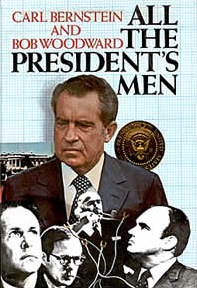
One factor was Woodward and Bernstein’s engaging book about their Watergate reporting, All the President’s Men, which came out in June 1974, just as the scandal was nearing culmination.

As Stanley I. Kutler, Watergate’s preeminent historian, has written, All the President’s Men “offered a journalistic brief to the nation as it prepared to understand and judge for itself” the growing evidence of Nixon’s guilt.

All the President’s Men was quite the success, holding the top spot on the New York Times’ non-fiction best-seller list for 15 weeks — through the climatic days of Watergate and beyond.

“The book’s impeccable timing,” I write in Getting It Wrong, served to “promote an impression that Woodward and Bernstein were central to Watergate’s ultimate outcome.”

The book that helped promote a myth

That impression was deepened in the cinematic version of All the President’s Men, which was released to great fanfare and rave reviews in April 1976.

The movie placed Woodward and Bernstein at the center of Watergate’s unraveling — and minimized or ignored the far more decisive contributions of subpoena-wielding investigators.

Indeed, rolling up a scandal of Watergate’s dimension and complexity required the collective efforts of special prosecutors, federal judges, both houses of Congress, the Supreme Court, as well as the Justice Department and the FBI.

And even then, as I write in Getting It Wrong, Nixon likely would have survived the scandal and served out his term if not for the audiotape recordings he secretly made of conversations in the Oval Office of the White House.

Only when compelled by the Supreme Court did Nixon surrender the recordings, which captured him approving a plan to divert the FBI’s investigation into Watergate’s seminal crime, the break-in June 17, 1972, at the headquarters of the Democratic National Committee.

The third factor in pressing the heroic-journalist myth firmly into the popular consciousness was the 30-year guessing game about the identity of Woodward’s stealthy, high-level source whom a Post editor code-named “Deep Throat.”

Speculation about the identity of “Deep Throat” came not infrequently and was often prominent. The guessing game offered periodic reminders about the Post and its Watergate coverage. The speculation effectively kept Woodward and Bernstein in the public eye far longer than they otherwise might have.

In 2005, W. Mark Felt, formerly second in command at the FBI, disclosed that he had been the “Deep Throat” source — giving rise to yet another round of reminiscing about the heroic journalists  of Watergate.

Such preening was misplaced, of course.

As Max Holland, author of Leak, a recent book about Watergate and “Deep Throat,” has aptly put it:

“Federal prosecutors and agents never truly learned anything germane from The Washington Posts [Watergate] stories — although they were certainly mortified to see the fruits of their investigation appear in print. … The government was always ahead of the press in its investigation of Watergate; it just wasn’t publishing its findings.”

Interestingly, principals at the Post have periodically scoffed at and rejected the heroic-journalist narrative.

For example, Katharine Graham, the Post’s publisher during and after Watergate, said at a program in 1997 marking the scandal’s 25th anniversary:

“Sometimes people accuse us of bringing down a president, which of course we didn’t do. The processes that caused [Nixon’s] resignation were constitutional.”

And Woodward  complained in 1996 that “the mythologizing of our role in Watergate has gone to the point of absurdity, where journalists write … that I, single-handedly, brought down Richard Nixon.

“Totally absurd.”

Indeed. To explain Watergate through the lens of the heroic-journalist is to simplify and misunderstand the scandal. It is to misread history and indulge in a beguiling media-driven myth.

WJC

Recent or related:

Did Watergate’s ‘Deep Throat’ know he was ‘Deep Throat’?

In Anniversaries, Debunking, Scandal, Washington Post, Watergate myth on April 15, 2012 at 11:48 am

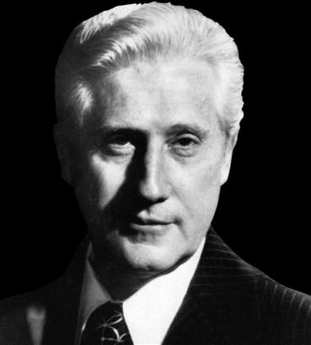
Felt: Did he know he was 'Deep Throat'?

Barry Sussman, the Washington Post’s Watergate editor in the early 1970s, raises a provocative question about the newspaper’s famous high-level source, W. Mark Felt, a senior FBI official when the Watergate scandal was unfolding.

Did Felt realize that the Post regarded him as “Deep Throat,” as a vital source in reporting the unfolding Watergate scandal? Sussman asks.

The question is pertinent and intriguing, Sussman writes in a recent commentary at the Nieman Watchdog blog, because Felt as a source offered “so little” to Bob Woodward, one of the Post’s lead reporters on Watergate.

And yet it is widely believed Felt offered vital information to Woodward about the emergent scandal.

Although Sussman doesn’t specifically address it, the implication of his observation is that “Deep Throat” may have been more composite than a single source — a literary device to infuse drama in All the President’s Men, the book Woodward wrote with Post colleague Carl Bernstein about their Watergate reporting.

It has long been suspected, though never confirmed, that “Deep Throat” was a composite.

Adrian Havill, the author of Deep Truth, a deliciously scathing biography of Woodward and Bernstein, speculated that “Deep Throat” was “a hybrid of three or four main sources.”

Edward Jay Epstein, in his fine 1976 essay about the Post and Watergate, stated he believed “Deep Throat” was “a composite character.”

More recently, James Rosen, chief Washington correspondent for Fox News, speculated in a book review that “‘Deep Throat’ was more than just Mark Felt.”

Prodded by his family, Felt came forward in 2005 and pronounced himself the source who had been “Deep Throat.” Woodward soon confirmed Felt’s self-disclosure.

But Felt was frail and suffering from dementia. He was forgetful and seldom able to carry on prolonged interviews. (Woodward quoted Felt’s daughter as saying in 2002 that Felt “goes in and out of lucidity.”)

Sussman, as he has on other occasions, asserts that “Deep Throat wasn’t an important source at all” to the Post.

“He was nice to have around, helpful on occasion,” Sussman writes, adding that Woodward and Bernstein “have blown up Felt’s importance for almost four decades or nodded in assent when others did….”

Sussman acknowledges he didn’t know that Felt was supposedly “Deep Throat” before 2005. He also notes that Felt, who died in 2008, often denied having been “Deep Throat.”

And that’s true. In a memoir published in 1979, Felt insisted: “I never leaked information to Woodward and Bernstein or to anyone else!”

Years later, Felt told a Connecticut newspaper that had he been “Deep Throat,” he “would have done it better.”

Felt may have been a liar. Or, as Sussman says, he may not have fully understood that he was considered the source whom the Post referred to as “Deep Throat.”

Sussman’s commentary was prompted by a recent book titled Leak, which claims that Felt was a crucial if sometimes duplicitous source for Woodward on Watergate. (Bernstein, by the way, met Felt only weeks Felt’s death.)

Sussman asserts that Leak “is way off base when it comes to the Post.”

The author of Leak, Max Holland, “accepts a key part of the Watergate myth that really is hokum – that Deep Throat was an important, sine qua non source for the Washington Post,” Sussman writes.

“He not only accepts it; it is his basic premise. This is where his book runs into trouble.”

So why does all this matter now, nearly 40 years after the Watergate scandal began unfolding?

It matters because the mystery of “Deep Throat” was central to establishing the heroic-journalist myth of Watergate, the enduring if misleading notion that Woodward and Bernstein, through their dogged reporting, brought down Richard Nixon’s corrupt presidency.

The identity of “Deep Throat,” as I write in my latest book, Getting It Wrong, was the subject of a 30-year, post-Watergate guessing game — a guessing game that “provided periodic and powerful reminders about the Post and its Watergate coverage, serving to keep Woodward and Bernstein in the public eye far longer than they otherwise would have been.”

Those reminders helped solidify the heroic-journalist myth of Watergate, which to this day endures as the dominant thought misleading narrative about the country’s greatest political scandal.

Recent and related:

‘Accurately, it turned out’? Hardly, in the Jefferson-Hemings allegations

In Debunking, Media myths, Scandal on February 13, 2012 at 9:30 am

Media critic Jonathan Alter treated as settled history the other day the disputed and probably dubious claim that President Thomas Jefferson took as a mistress a slave named Sally Hemings.

In a  column for Bloomberg News, Alter wrote:

“Politics has been a contact sport since at least the election of 1804, when President Thomas Jefferson was accused (accurately, it turned out) of having an affair with ‘Dusky Sally’ Hemings, a slave.”

Accurately, it turned out?

That may hew to the dominant narrative about the purported Jefferson-Hemings liaison. But it’s far from proven, far from “accurate.”

Indeed, it’s quite unlikely.

Key evidence in the controversy centers around DNA testing conducted in 1998. The evidence indicated that the former president was among more than two dozen Jefferson men who were in Virginia at the time Hemings’ youngest child, Eston, was conceived in 1807.

Thomas Jefferson then was 64-years-old, making him an unlikely paternity candidate.

The DNA results were widely misreported when released, giving rise to the mistaken notion that the tests had confirmed Jefferson’s paternity.

However, as a detailed scholarly study published last year points out:

“The problem [in misinterpreting the DNA evidence] lies not only with a news media prone to over simplifying and sensationalizing complex stories.  Numerous prominent scholars have contributed to the misunderstanding by characterizing the DNA study as ‘confirming’ or ‘clinching’ the case for Thomas Jefferson’s paternity.”

The scholarly study, an impressive work titled The Jefferson-Hemings Controversy: Report of the Scholars Commission, further notes that the DNA tests “were never designed to prove, and in fact could not have proven, that Thomas Jefferson was the father of any of Sally Hemings’ children.”

The book — which has received scant attention from mainstream American media — presents a circumstantial case pointing to Jefferson’s younger brother, Randolph (or his sons), in the question of Eston Hemings’ paternity.

Randolph Jefferson, the book says, was known to have socialized with the slaves at Monticello, Thomas Jefferson’s home in Virginia.

Randolph Jefferson was a dozen years younger than the president, and the available record offers no evidence that Thomas Jefferson “enjoyed socializing at night with Monticello slaves,” the book says.

The scholars commission that compiled the volume describes the case as closed by no means.

Indeed, the scholars commission writes in The Jefferson-Hemings Controversy that a “more rational conclusion, from the totality of the evidence before us, is that Sally Hemings was not Thomas Jefferson’s lover, and her children were not his children.”

To assert otherwise — to insist on the accuracy of claims about Jefferson’s purported sexual relationship with a slave — is to indulge in a sort of sloppy, take-it-for-granted kind of reporting.

Sloppy, take-it-for-granted reporting can be a factor in the emergence and durability of media-driven myths, the subject of my latest book, Getting It Wrong.

I note in Getting It Wrong, for example, that hurried and sloppy reporting propelled the media myth of “crack babies,” in which journalists in the 1980s and 1990s “pushed too hard and eagerly on preliminary and inconclusive research. And the horrors they predicted, that ‘crack babies‘ would grow up to be a vast, permanently dependent class — a ‘bio-underclass’ of staggering dimension — proved quite wrong.”

Decidedly wrong.

WJC

Recent and related:

ABC unaccountably excludes Bill Clinton from lineup of pols who led ‘double lives’

In Debunking, Media myths, Scandal on January 21, 2012 at 10:39 am

ABC News offered yesterday a risible lineup of two-timing politicians that omitted Bill Clinton, the philandering 42nd president, but included Thomas Jefferson, about whom the evidence of sexual dalliance is thin at best.

ABC’s roster of “the top eight politicians who led double lives” was posted online and promised “a look at some … tawdry affairs and public scandals” — and how the politicians implicated “weathered the storm.”

In addition to Jefferson, ABC included Grover Cleveland, the U.S. president in the 1880s and 1890s who fathered a child out of wedlock, and Eliot Spitzer, who as governor of New York consorted with a high-priced call girl.

The ABC roster also included an obscure and mostly forgotten former politician, Vito Fossella, a five-term New York congressman who in 2008 acknowledged fathering a child in an extramarital affair.

Given that the likes of Fossella made the list, it’s inexplicable that Clinton was omitted.

Clinton’s tawdry sexual affair with Monica Lewinsky, a White House intern, began in mid-November 1995 and continued intermittently until March 1997.

Disclosures of the Clinton-Lewinsky dalliance, and falsehoods he told under oath about the affair, nearly destroyed Clinton’s presidency.

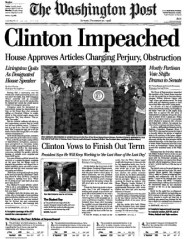
He was impeached in December 1998 on two counts — lying under oath and obstructing justice to cover up the affair — but acquitted by the U.S. Senate in February 1999 and served out the 23 months remaining in his term.

Separately, a federal judge found Clinton in contempt of court for having lied under oath about the Lewinsky affair. Clinton was barred from practicing law for five years and ordered to pay nearly $90,000 to the lawyers of Paula Jones, who had accused him of sexual harassment while he was governor of Arkansas.

Clinton was the second U.S. president impeached in office. The other was Andrew Johnson, in 1868.

ABC’s including Jefferson in its “double lives” roster was little short of baffling: Indeed, its writeup about Jefferson’s purported sexual liaison with a slave-mistress named Sally Hemings offered no small amount of exculpatory evidence.

In fact, the writeup referred to “the myth of Jefferson’s double life” and noted:

“To this day, Jefferson’s paternity of any of her children has not been established with any absolute certainty.”

ABC also pointed out that a recent and detailed study about the purported Jefferson-Hemings affair which “did not show much support for the accusations” of a sexual liaison.

That study, a 400-page work titled The Jefferson-Hemings Controversy: Report of the Scholars Commission, was compiled by a commission of Jefferson scholars charged with puncturing the myriad misunderstandings about the third president and a slave whom he rarely mentioned in his letters.

Among the misunderstandings was the DNA testing released in 1998 — about the time Clinton was facing impeachment charges — confirmed that Jefferson fathered children by Hemings.

“While the tests were professionally done by distinguished experts,” the scholars commission pointed out, “they were never designed to prove, and in fact could not have proven, that Thomas Jefferson was the father of any of Sally Hemings’ children.

“The tests merely establish a strong probability that Sally Hemings’ youngest son, Eston, was fathered by one of the more than two dozen Jefferson men in Virginia at the time ….”

One of the more than two dozen Jefferson men.

Yet, news media reports at the time characterized the DNA tests as offering “compelling evidence” of a sexual relationship between Jefferson and Hemings.

The scholars commission — a panel of 13 experts organized by the Thomas Jefferson Heritage Society — said that circumstantial evidence points more powerfully to Jefferson’s younger brother, Randolph (or his sons), in the paternity question.

Randolph Jefferson, the book says, was known to have socialized with the slaves at Monticello, Thomas Jefferson’s home near Charlottesville, VA.

Randolph Jefferson was a dozen years younger than the president, and the available record offers no evidence that Thomas Jefferson “enjoyed socializing at night with Monticello slaves,” the book points out.

Eston Hemings’ was conceived around August 1807, when Thomas Jefferson was 64 and in declining health — factors that further diminish the likelihood of his paternity.

Also making ABC’s roster of politicians who led “double lives” were Mark Sanford, a former governor of South Carolina; John Edwards, a former U.S. senator from North Carolina; Arnold Schwarzenegger, a former governor of California, and Anthony Wiener, a former congressman from New York City.

WJC

Many thanks to Instapundit
Glenn Reynolds for linking to this post.

Recent and related:

So it begins: Woodward, Bernstein, and excess in run-up to Watergate’s 40th

In Anniversaries, Debunking, Washington Post, Watergate myth on December 4, 2011 at 12:48 am

American journalists love anniversaries, so expect excess next year at the 40th anniversary of the Watergate break-in, which gave rise to the greatest scandal in U.S. politics — and to the media-driven myth that Washington Post journalists toppled a president.

Woodward: 40th anniversary honor

In fact, Watergate commemorative excess is already scheduled.

The Los Angeles Press Club announced the other day that it plans to recognize the Watergate reporting of Bob Woodward and Carl Bernstein at next year’s Southern California Journalism Awards program.

“Woodward and Bernstein’s series of articles for The Washington Post unraveled the biggest American political scandal to date, culminating in President Richard Nixon’s resignation in 1974. Four decades later, the stories still stand as a bellwether of investigative journalism,” the press club said in a news release.  “To mark the occasion, the Los Angeles Press Club will honor Woodward and Bernstein with the 2012 President’s Award.”

Woodward and Bernstein’s Watergate reporting won a Pulitzer Prize for the Post in 1973. But to say they “unraveled” Watergate is an exaggeration, a misreading of history.

As I discuss in my latest book, Getting It Wrong, the reporting of Woodward and Bernstein was at best a minor factor in bringing down Richard Nixon.

What ended Nixon’s presidency was the incontrovertible evidence of the president’s culpability in the crimes of Watergate — evidence captured on audiotapes that he secretly made of his conversations at the White House.

The decisive evidence — known as the “Smoking Gun” tape — revealed that Nixon at a meeting with his top aide, H.R. Haldemann, on June 23, 1972, sought to deflect or derail the FBI investigation into the break-in several days before at Democratic National headquarters  at the Watergate complex in Washington, DC.

The reporting of Woodward and Bernstein didn’t reveal the contents of that tape, which Watergate prosecutors had subpoenaed and which Nixon had refused to surrender until 1974, after the U.S. Supreme Court ordered him to do so.

Their reporting didn’t disclose the existence of Nixon’s taping system, either. It was revealed in July 1973, during hearings of the U.S. Senate Select Committee on Watergate.

In All the President’s Men, their book about their Watergate reporting, Woodward and Bernstein said they had received a tip about the taping system a few days before its existence was made public.

According to All the President’s Men, Ben Bradlee, then the Post‘s executive editor, suggested not expending much energy pursuing the tip. And Woodward and Bernstein didn’t.

What really “unraveled” Watergate, I write in Getting It Wrong, “was the collective if not always the coordinated forces of special prosecutors, federal judges, both houses of Congress, the Supreme Court, as well as the Justice Department and the FBI.

Even then, despite all that scrutiny and pressure, Nixon, I argue, “likely would have served out his term if not for the audiotape recordings he secretly made of most conversations in the Oval Office of the White House.”

Far more important the reporting of Woodward and Bernstein to the outcome of Watergate was the federal judge who presided at Watergate-related trials, John J. Sirica.

The Post acknowledged Sirica’s decisive role in unraveling Watergate in its obituary of the judge, published in 1992, shortly after his death.

The newspaper said Sirica’s “persistence in searching for the facts while presiding over the Watergate cases led to President Nixon’s resignation,” adding:

“Sirica’s order that tape recordings of White House conversations about the Watergate break-in be made available to prosecutors precipitated Nixon’s resignation in 1974. The tapes revealed that Nixon had approved plans for the Watergate coverup six days after the break-in at the Democratic National Committee’s headquarters in the Watergate complex by men who were working for the Committee to Reelect the President.

“In directing the White House to produce the tapes, Sirica set himself on a constitutional collision course with Nixon, who tried to invoke executive privilege and argue that the tapes were not subject to judicial scrutiny. But in a historic ruling, the U.S. Supreme Court upheld Sirica, ruling unanimously that the judiciary must have the last word in an orderly constitutional system.”

WJC

Recent and related:

Joe McGinniss, ‘Deep Throat,’ and anonymous sources

In Debunking, Washington Post, Watergate myth on October 11, 2011 at 1:02 am

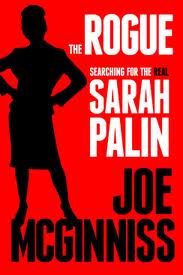
Joe McGinniss, author of a scathing biography about Sarah Palin, yesterday defended using anonymous sources in the book, asserting in a commentary in USA Today that “without Deep Throat, there wouldn’t have been any Watergate hearings, and Richard Nixon would never have resigned.”

'The Rogue,' by McGinniss

Deep Throat” was the anonymous, high-level source who conferred periodically in 1972 and 1973 with Bob Woodward of the Washington Post as the Watergate scandal unfolded.

As memorable as “Deep Throat” may be, his contributions to Watergate’s outcome were hardly as sweeping or decisive as McGinniss claimed.

As Woodward and his reporting colleague Carl Bernstein wrote in the book about their Watergate reporting, All the President’s Men, the principal role of “Deep Throat” was to “confirm information that had been obtained elsewhere and to add some perspective.”

Not only that, but “Deep Throat” and his conversations with Woodward were scarcely pivotal in the U.S. Senate’s decision to empanel a select committee and convene hearings in 1973 about the Watergate scandal.

In The Whole Truth, his memoir about the hearings, Sam Ervin Jr., the Democratic senator who chaired the select committee, saluted a lengthy roster of people who contributed to unwinding Watergate.

The roster included several journalists and news publications. But Ervin made no mention of Woodward’s shadowy “Deep Throat” source, who had been introduced in some detail in 1974, with publication of All the President’s Men.

“One shudders to think,” Ervin wrote in his memoir, “that the Watergate conspirators might have been effectively concealed … had it not been for the courage and penetrating understanding of [U.S. District] Judge [John] Sirica, the thoroughness of the investigative reporting of Carl Bernstein, Bob Woodward, Seymour Hersh, Clark Mollenhoff, and other representatives of a free press, the devotion to their First Amendment responsibilities of the Washington Post, The New York Times, Time magazine, Newsweek, and other publications, the labors of the Senate Select Committee, and the dedication and diligence of Special Prosecutors Archibald Cox and Leon Jaworski and their associates.”

No mention of “Deep Throat,” though.

The shadowy source was self-revealed in 2005 to have been W. Mark Felt Jr., formerly second in command at the FBI. Felt left the agency in 1973 — many months before Watergate reached its denouement in August 1974 with the resignation of Nixon.

All the President’s Men, and the like-titled 1976 movie version, touched off a years-long guessing about the identity of “Deep Throat” — speculation that surely inflated his importance in popular understanding about how Watergate was rolled up.

As I write in my latest book, Getting It Wrong, the speculation about “Deep Throat” brought “periodic and powerful reminders about the Post and its Watergate coverage, serving to keep Woodward and Bernstein in the public eye far longer than they otherwise would have been.

“They and the mysterious ‘Deep Throat’ source became central figures” in what the Philadelphia Inquirer once called “the parlor game that would not die.”

It’s important to keep in mind, too, that Felt hardly was a heroic figure, even though “Deep Throat” is portrayed that way in the cinematic version of All the President’s Men.

Felt in his senior position at the FBI authorized illegal burglaries in the early 1970s as part of the agency’s investigations into leftists linked to the radical Weather Underground.

Felt was convicted in 1980 on felony charges related to the break-ins, but was pardoned by President Ronald Reagan.

WJC

Many thanks to Instapundit
Glenn Reynolds for linking to this post

Recent and related:

Made-up Watergate line, ‘follow the money,’ crosses into the news

In Cinematic treatments, Debunking, Washington Post, Watergate myth on October 6, 2011 at 4:38 am

Kenneth H. Dahlberg, a minor Watergate figure, died the other day and Minnesota Public Radio recalled his role in the scandal by turning to the famous made-up line, “follow the money” — advice supposedly given to Washington Post reporters working the story.

The public radio station’s “News Cut” feature noted yesterday that “Dahlberg was the Midwest finance chairman for the Committee to Re-elect the President during President Richard M. Nixon’s 1972 campaign.

“A mysterious check, which later would be determined to be from the CEO of Archer Daniels Midland, was given to Dahlberg, who converted it to a cashier’s check. It was money from the campaign, destined for the Watergate burglars.”

The Minnesota Public Radio report added that when the stealthy, high-level “Deep Throat” source told Post reporters Bob Woodward and Carl Bernstein “to ‘follow the money,’ that was the money. And when Woodward called Dahlberg to confirm he handled the check, Dahlberg didn’t lie. … It ended up a critical part of the movie All The President’s Men.”

That last bit is true. Woodward’s telephone interview with Dahlberg became a memorable scene in the 1976 movie.

Otherwise, though, there’s a fair amount of wayward information in the “News Cut” report.

For starters, “Deep Throat” never met with Bernstein during Watergate.

More important, “Deep Throat” (self-revealed in 2005 to have been former FBI official W. Mark Felt) never advised Woodward to “follow the money.”

Felt: Never said it

That line appears nowhere in All the President’s Men, Woodward and Bernstein’s 1974 book about their Watergate reporting — reporting that did not, as I discuss in my latest work, Getting It Wrong, take down Nixon’s corrupt presidency.

Moreover, “follow the money” appeared in no Watergate-related article or editorial in the Washington Post  before 1981 — or long after Nixon resigned the presidency in disgrace.

Rather, “follow the money” was written into the screenplay of the cinematic version of All the President’s Men; the line was memorably uttered not by Felt, the real-life “Deep Throat,” but by Hal Holbrook, the actor who played him in the movie.

As I’ve noted at Media Myth Alert, Holbrook turned in an outstanding performance as a tormented and conflicted “Deep Throat.”

And he delivered his “follow the money” line with such steely assurance that it did seem to offer a way through the labyrinth that was the Watergate scandal.

But even if Woodward had been counseled to “follow the money,” such advice certainly would neither have unraveled Watergate nor led him to Nixon.

What forced Nixon from office in 1974 was not the grubby misuse of campaign funds but, rather, his active role in seeking to obstruct justice by covering up the signal crime of the Watergate scandal, the break-in at the headquarters of the Democratic National Committee in June 1972.

Rolling up the scandal of Watergate’s complexity and dimension was scarcely as straightforward as pursuing misused campaign contributions.

As I write in Getting It Wrong, unraveling Watergate required “the collective if not always the coordinated forces of special prosecutors, federal judges, both houses of Congress, the Supreme Court, as well as the Justice Department and the FBI.

“Even then,” I note “Nixon likely would have served out his term if not for the audiotape recordings he secretly made of most conversations in the Oval Office of the White House.

“Only when compelled by the Supreme Court did Nixon surrender those recordings, which captured him plotting the cover-up” and cost him the presidency.

WJC

Recent and related: