American journalists love anniversaries, so expect excess next year at the 40th anniversary of the Watergate break-in, which gave rise to the greatest scandal in U.S. politics — and to the media-driven myth that Washington Post journalists toppled a president.

Woodward: 40th anniversary honor
In fact, Watergate commemorative excess is already scheduled.
The Los Angeles Press Club announced the other day that it plans to recognize the Watergate reporting of Bob Woodward and Carl Bernstein at next year’s Southern California Journalism Awards program.
“Woodward and Bernstein’s series of articles for The Washington Post unraveled the biggest American political scandal to date, culminating in President Richard Nixon’s resignation in 1974. Four decades later, the stories still stand as a bellwether of investigative journalism,” the press club said in a news release. “To mark the occasion, the Los Angeles Press Club will honor Woodward and Bernstein with the 2012 President’s Award.”
Woodward and Bernstein’s Watergate reporting won a Pulitzer Prize for the Post in 1973. But to say they “unraveled” Watergate is an exaggeration, a misreading of history.
As I discuss in my latest book, Getting It Wrong, the reporting of Woodward and Bernstein was at best a minor factor in bringing down Richard Nixon.
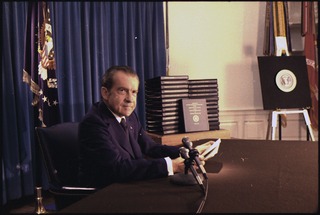
What ended Nixon’s presidency was the incontrovertible evidence of the president’s culpability in the crimes of Watergate — evidence captured on audiotapes that he secretly made of his conversations at the White House.
The decisive evidence — known as the “Smoking Gun” tape — revealed that Nixon at a meeting with his top aide, H.R. Haldemann, on June 23, 1972, sought to deflect or derail the FBI investigation into the break-in several days before at Democratic National headquarters at the Watergate complex in Washington, DC.
The reporting of Woodward and Bernstein didn’t reveal the contents of that tape, which Watergate prosecutors had subpoenaed and which Nixon had refused to surrender until 1974, after the U.S. Supreme Court ordered him to do so.
Their reporting didn’t disclose the existence of Nixon’s taping system, either. It was revealed in July 1973, during hearings of the U.S. Senate Select Committee on Watergate.
In All the President’s Men, their book about their Watergate reporting, Woodward and Bernstein said they had received a tip about the taping system a few days before its existence was made public.
According to All the President’s Men, Ben Bradlee, then the Post‘s executive editor, suggested not expending much energy pursuing the tip. And Woodward and Bernstein didn’t.
What really “unraveled” Watergate, I write in Getting It Wrong, “was the collective if not always the coordinated forces of special prosecutors, federal judges, both houses of Congress, the Supreme Court, as well as the Justice Department and the FBI.
Even then, despite all that scrutiny and pressure, Nixon, I argue, “likely would have served out his term if not for the audiotape recordings he secretly made of most conversations in the Oval Office of the White House.”
Far more important the reporting of Woodward and Bernstein to the outcome of Watergate was the federal judge who presided at Watergate-related trials, John J. Sirica.
The Post acknowledged Sirica’s decisive role in unraveling Watergate in its obituary of the judge, published in 1992, shortly after his death.
The newspaper said Sirica’s “persistence in searching for the facts while presiding over the Watergate cases led to President Nixon’s resignation,” adding:
“Sirica’s order that tape recordings of White House conversations about the Watergate break-in be made available to prosecutors precipitated Nixon’s resignation in 1974. The tapes revealed that Nixon had approved plans for the Watergate coverup six days after the break-in at the Democratic National Committee’s headquarters in the Watergate complex by men who were working for the Committee to Reelect the President.
“In directing the White House to produce the tapes, Sirica set himself on a constitutional collision course with Nixon, who tried to invoke executive privilege and argue that the tapes were not subject to judicial scrutiny. But in a historic ruling, the U.S. Supreme Court upheld Sirica, ruling unanimously that the judiciary must have the last word in an orderly constitutional system.”
Recent and related:
- Historian dismisses as ‘self-promotion’ the heroic-journalist interpretation of Watergate
- Misreporting Watergate
- Didn’t: A Watergate primer
- ‘Deep Throat’ garage marker errs about Watergate source disclosure
- The Post ‘took down a president’? That’s a myth
- WaPo ‘didn’t like Nixon–and that’s how we got Watergate: Huh?
- Six years on: Identity of Watergate’s ‘Deep Throat’ source revealed
- Every good historian a mythbuster
- Media myths and their spinoffs: The case of Watergate
- On media myths and the ‘golden age’ fallacy
- ‘Getting It Wrong’ wins SPJ award for Research about Journalism








 Media Myth Alert