W. Joseph Campbell

Posts Tagged ‘Washington Post’

A trope that knows few bounds: The hero-journalist myth

In Debunking, Media myths, Washington Post, Watergate myth on February 12, 2010 at 2:09 pm

The heroic-journalist myth of Watergate — the notion that intrepid news reporters for the Washington Post brought down Richard Nixon’s corrupt presidency — is a trope that knows few bounds.

It’s one of the favorite stories American journalism tells about itself, and it turns up often, even in such unexpected places as online celebrity gossip sites.
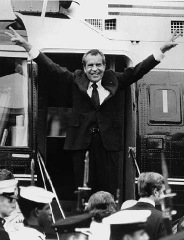
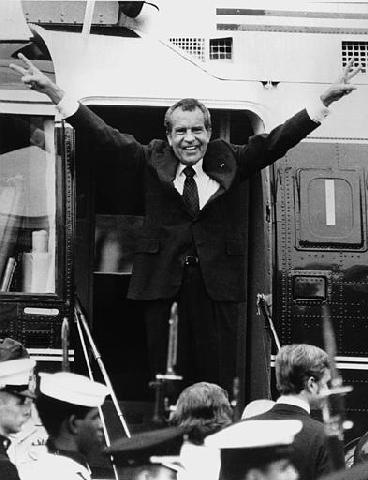
Nixon resigns, 1974

The well-known gossip columnist Liz Smith casually invoked the myth the other day, in an item at wowowow.com about Carl Bernstein. He is the former Washington Post reporter who figured prominently in the newspaper’s coverage of the unfolding Watergate scandal in 1972-73.

Smith referred to Bernstein as the “Watergate partner of Bob Woodward whose work for the Washington Post brought down the Nixon presidency.”

The heroic-journalist myth of Watergate is a hardy one: It lives on in textbooks, it’s taught in schools, and it rattles around in newsrooms.

It’s quite unrestrained in its reach, and over time has become the dominant popular narrative of the Watergate scandal.

But as I write in my forthcoming book about media-driven myths, Getting It Wrong, it’s also “a misleading interpretation, one that minimizes the more powerful and decisive forces that unraveled the scandal and ended Nixon’s corrupt presidency in the summer of 1974.”

As “earnest and revealing as their reporting was,” I further write, “Woodward and Bernstein did not uncover defining and decisive elements of the Watergate scandal—the cover-up and the payment of hush money” to the burglars who broke into the national headquarters of the Democratic Party at the Watergate complex in Washington, D.C.

The Senate Select Committee on Watergate–not Woodward and Bernstein–learned about, and disclosed the existence of, the White House tape recordings that captured Nixon’s complicity in the coverup. The special federal prosecutors on Watergate pressed for the release of the tapes. And the U.S. Supreme Court unanimously ordered Nixon to turn over the  tapes subpoenaed by the special prosecutor.

Those were pivotal events that led to Nixon’s resignation.

As I’ve mentioned in earlier blog postings, it’s intriguing that the Post from time to time has tried to make clear its reporting was not decisive to Nixon’s resignation.

For example, in 2005, Michael Getler, then the newspaper’s ombudsman, wrote in a column:

“Ultimately, it was not The Post, but the FBI, a Congress acting in bipartisan fashion and the courts that brought down the Nixon administration. They saw Watergate and the attempt to cover it up as a vast abuse of power and attempted corruption of U.S. institutions.”

This is not to say the Post’s Watergate reporting was without distinction.

As I write in Getting It Wrong, as “the scandal slowly unfolded in the summer and fall of 1972, Woodward and Bernstein progressively linked White House officials to a secret fund used to finance the burglary. The Post was the first news organization to establish a connection between the burglars and the White House, the first to demonstrate that campaign funds to reelect Nixon were used to fund the break-in, the first to implicate former Attorney General John Mitchell in the scandal….”

Those reports were published in the four months following the Watergate break-in.

Meanwhile, Nixon was on his way to reelection in a forty-nine state landslide.

WJC

The hero-journalist myth of Watergate

In Debunking, Media myths, Washington Post, Watergate myth on February 7, 2010 at 10:00 am

What I call “the dominant popular narrative” of the Watergate scandal made an appearance the other day, in a posting at the popular Huffington Post blog.

The occasion was a withering attack on James O’Keefe, the activist-undercover journalist arrested last month posing as a telephone repairman at the New Orleans offices of U.S. Senator Mary Landrieu.

The Huffington Post item unfavorably compared O’Keefe to Bob Woodward and Carl Bernstein, who reported most prominently on the Watergate scandal for the Washington Post in the early 1970s. The item declared:

“Woodward and Bernstein brought down a president and they didn’t have to break into anyone’s office.”

Neither did O’Keefe. But it is striking how routinely and off-handedly Woodward and Bernstein are credited with such an accomplishment, especially when the record of Watergate shows that the Post‘s reporting had a marginal effect on forcing Richard Nixon’s resignation from the presidency.

Nixon resigns, 1974

Also striking is how the  Post has acknowledged as much from time to time over the years.

Howard Kurtz, the newspaper’s media reporter, wrote in 2005, for example:

“Despite the mythology, The Post didn’t force Richard Nixon from office—there were also two special prosecutors, a determined judge, bipartisan House and Senate committees, the belated honesty of [former White House lawyer] John Dean and those infamous White House tapes.”

Nixon likely would have completed his term if not for the recordings of his conversations in the Oval Office, conversations that captured his guilty role in authorizing a coverup of the Watergate scandal.

The Senate Select Committee on Watergate–not Woodward and Bernstein–uncovered the existence of the White House tapes. The special federal prosecutors on Watergate (one of whom Nixon ordered fired) pressed for the release of the tapes. And the U.S. Supreme Court unanimously ordered Nixon to turn over the  tapes subpoenaed by the special prosecutor.

“The fact is, an incredible array of powerful actors all converged on Nixon at once—the FBI, prosecutors, congressional investigators, the judicial system,” a leading historian of Watergate, Stanley I. Kutler, has written.

Even so, the heroic-journalist myth long ago became the most familiar storyline, the dominant narrative of Watergate.

That’s partly because few Americans are familiar with the intricacies of the epic scandal, one that sent to jail nearly 20 men who were associated with Nixon’s presidency or his 1972 reelection campaign.

The myth of the heroic-journalist, I write in Getting It Wrong, my forthcoming book about media-driven myths, thus serves as ready short-hand “for grasping the scandal’s essence while avoiding its forbidding complexity.”

I also note in Getting It Wrong:

“How the Post and its reporters uncovered Watergate is deeply ingrained in American journalism as one of the field’s most important and self-reverential stories.”

But it is a misleading interpretation, one that minimizes the more powerful and decisive forces that unraveled the scandal and ended Nixon’s corrupt presidency in the summer of 1974.

WJC

Jessica Lynch and the lingering hero myth

In Jessica Lynch, Media myths, Washington Post on February 2, 2010 at 8:05 am

It’s amazing how “hero” still attaches to Jessica Lynch, the blonde, waiflike Army private from West Virginia who, through no exceptional effort of her own, became the best-known American military figure of the early days of the Iraq War.

Jessica Lynch, before the war

Lynch was in Florida the other day, promoting  I Am a Soldier, Too, a book about her that was written by Rick Bragg and published in November 2003 to decidedly mixed reviews.

In a report online, a Florida television station gave 267 words to Lynch’s visit; in that report, “hero” was invoked twice.

It’s amazing, too, how the media-driven aspect of her emergence to sudden fame usually is obscured these days. The Florida station made no mention of the Washington Post‘s overheated and erroneous report that gave rise to the hero-warrior myth of Jessica Lynch.

The myth is examined in detail in a chapter in my forthcoming book, Getting It Wrong, which is due out in the summer.

In it, I recount how Lynch was catapaulted to sudden and unsought fame during the first days of the war in Iraq. Lynch then was a 19-year-old supply clerk in the Army’s 507th Maintenance Company.

On March 23, 2003, elements of the 507th were ambushed by Iraqi irregulars in the southern city of Nasiriyah.  Lynch was badly injured in the crash of her Humvee and was taken prisoner.

Nine days later, she was rescued by a U.S. special operations unit from a hospital in Nasiriyah.

Two days after that, on April 3, 2003, the Washington Post published a sensational report on its front page that said Lynch had “fought fiercely” in Nasiriyah and had “shot several enemy soldiers after Iraqi forces ambushed” her unit, “firing her weapon until she ran out of ammunition.”

Washington Post's erroneous front-page report

The Post’s report cited “U.S. officials” who otherwise were unidentified as saying that Lynch had “continued firing at the Iraqis — even after she sustained multiple gunshot wounds and watched several other soldiers in her unit die around her in fighting March 23.”

One official was quoted anonymously as saying:

“‘She was fighting to the death. She did not want to be taken alive.’”

It was a terrific story that was immediately picked up by news outlets across the United States and around the world.

But it wasn’t true.

The battlefield heroics attributed to Lynch were, quite likely, the deeds of another soldier in her unit, a cook from Oregon named Donald Walters. He fought the Iraqis till his ammunition ran out, was captured, and was executed.

Central to the myth enveloping the Lynch case is that the U.S. military encouraged and promoted the phony hero-warrior story, to help boost public support for the war.

But as I describe in Getting It Wrong, one of the reporters on the Post’s erroneous “fighting to the death” report, told an NPR radio program in late 2003 that “the Pentagon … wouldn’t say anything about Jessica Lynch.”

The reporter, Vernon Loeb, also said in that interview: “I just didn’t see the Pentagon trying to create a hero where there was none.”

And the Post‘s erroneous “Fighting to the death” report about Lynch included this passage:

“Pentagon officials said they had heard ‘rumors’ of Lynch’s heroics but had no confirmation.”

The Post’s hero-warrior story about Lynch has had many unintended consequences beyond vaulting Lynch to celebrity status, which, as her appearance in Florida suggests, has never fully receded.

Her celebrity status also helped pave the way for her lucrative book contract with Bragg. And certainly it obscured the actions of Walters, whose conduct Nasiriyah probably saved the lives of some of his fellow soldiers.

WJC

The Watergate myth: Why debunking matters

In Debunking, Media myths, Washington Post, Watergate myth on January 27, 2010 at 8:05 am

My recent post about the heroic-journalist myth of Watergate prompted a few blinkered, ahistoric observations.

Among was this comment, posted at Romenesko‘s feedback site:

“Who cares?” the comment reads. “Watergate was in the early 1970s. …  Arguing the point now about what role a paper played almost 40 years later in a presidency that a significant number of people have no recollections of? Ya gotta admire those authors willing to tackle cutting-edge topics.”

So why does it matter? Why is addressing and debunking the heroic-journalist myth of Watergate — the notion that intrepid reporters for the Washington Post brought down Richard Nixon’s corrupt presidency — still important?

Several reasons present themselves, not the least of which is the vigor that characterizes the Watergate myth: It lives on in textbooks, in classrooms, in newsrooms. It’s a very robust myth, little-restrained in its reach and infiltration.

A hint of its reach came yesterday, in an email from former master’s student of mine, who himself now teaches journalism. He described how he approaches the Watergate story:

“I usually start the class discussion by asking the students to write a sentence that begins with ‘Watergate is the story of…’

“Inevitably, several students write something like ‘Watergate is the story of two young reporters who brought down a corrupt president.’ We then spend the rest of the class period challenging that historical narrative.”

Not only is this a great pedagogic technique; the student responses suggest how ingrained the Watergate myth has become.

A further reason debunking matters is that the Watergate myth severely misinterprets the news media’s capacity to exert decisive influence.

As I write in my forthcoming book, Getting It Wrong, media “myths are neither trivial nor innocuous. … Notably, they tend to distort understanding about the role and function of journalism in American society, conferring on the news media far more power and influence than they necessarily wield.

“Media myths often emerge from an eagerness to find influence and lasting significance in what journalists do and tend to extend credit where credit is not entirely due. The heroic-journalist myth of Watergate is a telling example.”

Indeed, the Watergate myth points unequivocally to presumed power of the news media, that they can expose corruption at the highest levels and thus make a significant and lasting difference.

As Jay Rosen, blogger and media scholar, wrote quite eloquently a few years ago, the heroic-journalist myth of Watergate stands as “the redemptive tale believers learn to tell about the press and what it can do for the American people.

“It is a story of national salvation: truth their only weapons, journalists save the day.”

What’s more, to debunk myths is to be aligned with a fundamental objective of journalism—that of seeking to get it right. The task of debunking is to insist on a demarcation between fact and fiction, and to assert there is intrinsic value in setting the record straight.

And finally, it’s not as if journalism’s past is irrelevant. It’s unevenly taught and poorly understood, a lot of it. But it’s scarcely irrelevant. Not in the digital century, when the media landscape is being so dramatically redrawn.

WJC

The Post ‘took down a president’? That’s a myth

In Debunking, Media myths, Washington Post, Watergate myth on January 24, 2010 at 6:58 pm

Nixon after his resignation, 1974

The Washington Post has tried from time to time over the years to distance itself from the media myth that its coverage of the Watergate scandal brought down Richard Nixon’s corrupt presidency.

The newspaper’s publisher at the time of Watergate, Katharine Graham, said at a program at the Newseum in 1997:

“Sometimes people accuse us of bringing down a president, which of course we didn’t do. The processes that caused [Nixon’s] resignation were constitutional.”

Michael Getler, then the newspaper’s ombudsman, wrote in a column in 2005:

“Ultimately, it was not The Post, but the FBI, a Congress acting in bipartisan fashion and the courts that brought down the Nixon administration. They saw Watergate and the attempt to cover it up as a vast abuse of power and attempted corruption of U.S. institutions.”

Still, the media myth that it was the Post — and, specifically, reporters Bob Woodward and Carl Bernstein — who exposed Nixon’s corrupt ways can be too tempting and too perfect to resist.

Such was the case in today’s edition of the Post, in a commentary by Dana Milbank, who declared that “in the mid-1970s,” the Post “took down a president.”

It was a passing reference in a commentary that challenged the dire assessment about the Post published in latest issue of New Republic.

Still, the “took down a president” passage hints at latent hubris and suggests how the Watergate meme can be used as a not-so-subtle reminder of greatness by Post loyalists and insiders.

But as I write in my forthcoming book, Getting It Wrong, to argue that the Post took down Nixon is to “misunderstand the scandal and to indulge in a particularly beguiling media-driven myth.”

It is, I further write, a misleading interpretation that “minimizes the far more decisive forces that unraveled the scandal and forced Nixon from office.”

What I call the “heroic-journalist myth of Watergate” took hold for a number of reasons, among them the sheer complexity of the scandal. Not only was Nixon turned from office but  19 men associated with his presidency or his 1972 reelection campaign went to jail.

The “heoric-journalist” myth has become, I also write in Getting It Wrong, “a proxy for grasping the scandal’s essence while avoiding its forbidding complexity.” That the Post and its reporters supposedly uncovered Watergate “is deeply ingrained in American journalism as one of the field’s most important and self-reverential stories.”

Despite, that is, the periodic protestations from the Post.

Hearty thanks to Jim Romenesko for linking to this post.

WJC

A nod to ‘Big Years’

In 1897, Year studies on December 13, 2009 at 8:21 pm

The “Outlook” section of today’s Washington Post carries an interesting look at recent books about important years.  “Year studies,” as they’re known in the academy.

The Post article, by the “Outlook” editor Carlos Lozada, noted that several studies were published in 2009 about years that changed the world or changed everything. “In an homage to anniversaries divisible by 10,” Lozada wrote, these books “focus on 1959, 1969, 1979 and, of course, 1989 (though ’99 is absent. Too soon?).”

As it turns out, he added, “there is plenty of competition in the Big Years department; identifying history’s most consequential calendar is a well-worn genre for journalists and historians, producing books such as David McCullough’s ‘1776,’ Margaret MacMillan’s ‘Paris 1919,’ Ray Huang’s brilliantly titled ‘1587: A Year of No Significance’ and countless more.”

Lozada might well have mentioned the first year study about U.S. media — my 2006 book, The Year That Defined American Journalism: 1897 and the Clash of Paradigms.

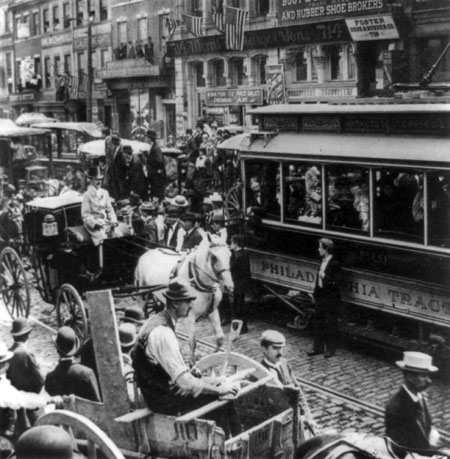
Philadelphia street scene in 1897

As I wrote in The Year That Defined American Journalism:

“Significantly, 1897 was the year when American journalism came face-to-face with a choice among three rival and incompatible visions, or paradigms, for the profession’s future. The emergence of these rival visions is central to the exceptionality of 1897. The choices that materialized then were to set a course for American journalism in the twentieth century and beyond.

“The most dramatic of the three paradigms was the self-activated, participatory model of [William Randolph] Hearst’s yellow journalism. Hearst called it the ‘journalism of action’ or the ‘journalism that acts.’ It was a paradigm of agency and engagement that went beyond gathering and publishing the news. Hearst’s New York Journal, the leading exemplar of the activist paradigm, argued that newspapers were obliged to inject themselves, conspicuously and vigorously, in righting the wrongs of public life, and in filling the void of government inaction and incompetence. …

“The antithesis of the ‘journalism of action’ was the conservative, counter-activist paradigm represented by the New York Times [of Adolph Ochs] and its lofty commitment to ‘All the News That’s Fit to Print.’ The Times model emphasized the detached, impartial, yet authoritative treatment of news. Unlike its conservative counterparts such as the New York Sun, the Times was not reluctant to adapt innovative technologies of the 1890s. The Times in 1897 made memorable use of halftone photographs in its upscale Sunday magazine supplement, presenting the images in a sober, restrained manner quite unlike the flashy treatment typical of Hearst’s yellow journalism.

The Year That Defined American Journalism: About the 'Big Year,' 1897

“The most eccentric of the three paradigms was non-journalistic, even anti-journalistic: It was a literary approach pursued by Lincoln Steffens upon his becoming city editor of the New York Commercial Advertiser in late 1897. Deliberately, and even demonstratively, Steffens shunned veteran newspapermen and instead recruited college-educated writers who had little or no experience in journalism. He then sent them out to write, to hone their talent by telling stories about the joys, hardships, and serendipity of life in New York City.”

Eighteen-ninety-seven also was the year of publication of what became American journalism’s best-known, most-reprinted editorial, the New York Sun‘s “Is There A Santa Claus?” It also was the year when the term “yellow journalism” first appeared in print, in the old New York Press. And the Times motto, “All the news that’s fit to print,” was given a permanent berth on the newspaper’s front page in 1897.

Moreover, the cinema in 1897 was in its “novelty year.” The presidential inauguration of William McKinley in March 1897 was the first to be captured on film.

But back to Lozada: He closed his article by ruminating about whether 2009 eventually will be recalled as a “Big Year.”

At this point, of course, who can tell? Lozada’s take: “it may not be a 1776 or a 1989, but 2009 seems destined to go down as a year of at least some significance. What for? Who knows. We just live here. Fortunately, it needn’t be for something that actually happened in these past 12 months, but perhaps for some future event that will be linked to our calendar.”

Not everyone finds the year study very appealing. A snarky review published during the summer in Canada’s National Post began by noting:

“Lately, it seems not a year goes by without a new book proclaiming a certain 12-month period the Most Important Year Ever.” That’s a fair point.

But in mild defense of the year-study approach, allow me to say that The Year That Defined American Journalism brought a measure of methodological freshness to journalism history. Before then, the single-year study had been neglected or overlooked in the field.

WJC

Jessica Lynch: One of the ‘buzziest’?

In Jessica Lynch, Media myths, Washington Post on December 8, 2009 at 12:17 pm

NBC’s Today show yesterday featured Jessica Lynch, perhaps the best-known American soldier of the Iraq War, as central figure of one of the decade’s  “buzziest” news stories.

Buzziest.”

That’s how the Lynch segment was introduced.

It was a brief report (see transcript here), in which Lynch talked about her life since she was catapaulted to sudden, unsought fame in the first days of the war in Iraq.  Lynch then was a private, a supply clerk in the Army’s 507th Maintenance Company.

On March 23, 2003, elements of the 507th were ambushed by Iraqi irregulars in the southern city of Nasiriyah.  Lynch was badly injured in the crash of her Humvee and was taken prisoner.

Nine days later, she was rescued from a hospital in Nasiriyah by a U.S. special operations unit.

The Washington Post's front page report about Jessica Lynch

Two days after that, the Washington Post published a sensational account on its front page, reporting that Lynch had “fought fiercely” in Nasiriyah and had “shot several enemy soldiers after Iraqi forces ambushed” her unit, “firing her weapon until she ran out of ammunition.”

The Post‘s report cited “U.S. officials” who otherwise were unidentified as saying that Lynch had “continued firing at the Iraqis even after she sustained multiple gunshot wounds and watched several other soldiers in her unit die around her in fighting March 23.” One official was quoted anonymously as saying:

“‘She was fighting to the death. She did not want to be taken alive.'”

It was a great story, one picked up by news outlets across the United States and around the world.

Only it wasn’t true.

The Post‘s report not only was grievously in error;  it became the launchpad for a tenacious media-driven myth, one that the Today show yesterday helped promote.

Meredith Vieira, the Today show personality who interviewed Lynch, described her as “a pawn of the military that was trying to sell, some said, a war to the American public.”

In reality, though, the U.S. military did little to promote the hero-warrior story about Lynch, who then was 19-years-old. The Lynch case is discussed in a chapter in my forthcoming book, Getting It Wrong .

One of the authors of the Post‘s erroneous report, Vernon Loeb, told an NPR radio program in late 2003 that “the Pentagon … wouldn’t say anything about Jessica Lynch.”

Loeb also said: “I just didn’t see the Pentagon trying to create a hero where there was none.”

Even so, the notion that the military promoted a phony hero-warrior lives on, and has become a central element of the narrative about the Lynch case.

The hoopla over Jessica Lynch in the first days of the Iraq War had another, lasting effect: That of obscuring recognition of an Army sergeant named Donald Walters who did fight to the death at Nasiriyah.

Walters’ heroics were mistakenly attributed to Lynch, apparently because of faulty translation of Iraqi battlefield reports.

Sgt. Donald Walters

Walters stayed behind as the ambushed 507th tried to flee  Nasiriyah. He was captured when his ammunition ran out and was executed. His body was recovered the day Lynch was rescued from the hospital in Nasiriyah.

Walters’ actions, when they became known, attracted little more than passing interest from the American news media.

And not surprisingly, they were not mentioned yesterday on the Today show’s “buzziest” segment.

Nor did Today point out that the Lynch myth took hold because of over-the-top reporting in the Washington Post. The segment contained nary a word about that.

WJC

Related:

The ‘five myths’ feature

In Washington Post on November 29, 2009 at 7:35 pm

Even on Sunday, the Washington Post has become a rather quick read. The fairly thin content clearly reflects the waves of staff reductions and other cost-cutting moves of recent years.

But one decidedly interesting element of the Sunday edition is a periodic feature in the “Outlook” section devoted to debunking “five myths” on a given topic. In past weeks, the topics have ranged from health care to Iran’s nuclear program to democratic elections.

The “five myths” addressed in today’s issue were, fittingly, about holiday shopping sprees. The article noted that only a fraction of retail sales takes place during the last two months of the year.

The author, Karen Dynan of the Brookings Institution in Washington, says:

“With so much attention focused on shopping and sales during the holidays, people often assume that the vast majority of our spending takes place around this time of year. But over the past decade, only about 19 percent of each year’s retail sales were in November and December.”

Dynan also says that online sales during the holiday season “made up less than 4 percent of fourth-quarter retail sales last year. Although this represents a big increase since earlier this decade, online shopping remains a modest part of overall spending.”

Interesting stuff. And an interesting feature.

WJC