W. Joseph Campbell

Posts Tagged ‘Yellow Journalism’

‘Famously rumored’: Hearst and his reputed vow

In 1897, Debunking, Furnish the war, Media myths, Spanish-American War on July 22, 2010 at 9:26 am

Media-driven myths are propelled by many forces, among them the reality that the tales sometimes are just too good, too delicious, to check out.

Hearst's Evening Journal, April 1898

So it was with a commentary posted yesterday at the “Unleashed” blog of the Australian Broadcasting Corporation.

The commentary invoked the well-known and often-repeated anecdote about William Randolph Hearst’s purported vow to “furnish the war” with Spain, stating:

“Hearst is famously rumored to have declared in writing to artist Frederic Remington: ‘I’ll furnish the war,’ referring, of course, to the Spanish-American War in 1898, henceforth referred to as ‘Mr Hearst’s War’….”

“Famously rumored,” eh? A flimsy construct, that, for making a point or building an argument.

It takes but a few minutes spent online to find evidence that the Hearstian vow is almost certainly a media-driven myth–a dubious, improbable tale masquerading as fact.

Chapter One in Getting It Wrong, my new book debunking 10 prominent media-driven myths, takes up and dismantles the Hearstian vow, and that chapter is readily accessible online.

Still, it’s clear that the anecdote’s simplistic directness have helped make it resistant to debunking. As I note in Getting It Wrong, media myths that can be reduced to a memorably pithy phrase are most likely to withstand debunking.

So it is with “furnish the war.”

The anecdote also is impressively flexible. It is useful, I write, “in illustrating any number of media sins and shortcomings. It has been invoked to illustrate the media’s willingness to compromise impartiality, promote political agendas, and indulge in sensationalism. It has been used, more broadly, to suggest the media’s capacity to inject malign influence into international affairs.”

Even more impressive, perhaps, is that the anecdote endures despite the near-complete absence of supporting documentation.

Hearst

“It lives on,” I write in Getting It Wrong, “even though the telegrams supposedly exchanged by Remington and Hearst have never turned up. It lives on even though Hearst denied ever sending such a message. It lives on despite an irreconcilable internal inconsistency: It would have been absurd for Hearst to vow to ‘furnish the war’ because war—specifically, the Cuban rebellion against Spain’s colonial rule—was the very reason Hearst sent Remington to Cuba in the first place. Anyone reading U.S. newspapers in early 1897 would have been well aware that Cuba was a theater of a nasty war.”

Hearst assigned Remington to Cuba 15 months before the Spanish-American War broke out. In early 1897, no one, including Hearst, could have known the United States would take up arms against Spain over Cuba.

WJC

Related:

Hearst, war, and the international appeal of media myths

In 1897, Debunking, Furnish the war, Media myths, Spanish-American War, Yellow Journalism on July 18, 2010 at 3:24 pm

I wrote the other day about the international appeal of prominent media-driven myths, an observation that was reconfirmed yesterday in the Correio do Brasil.

The Correio item recounted the purported exchange of telegrams between the artist Frederic Remington and newspaper publisher William Randolph Hearst, in which Hearst supposedly declared:

“You furnish the pictures, I’ll furnish the war.”

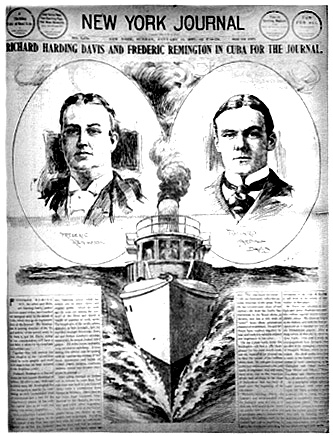
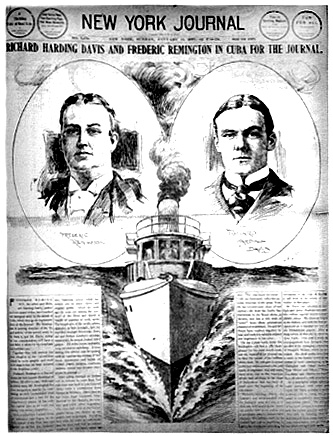
Remington at the time was in Cuba, on assignment for Hearst’s New York Journal to draw illustrations of the rebellion against Spanish colonial rule.

The exchange, if it took place, would have been in January 1897, during Remington’s six-day visit to the island. The anecdote was first recounted in 1901 by James Creelman, a bluff, cigar-chomping journalist who was neither with Hearst nor Remington in early 1897; he was in Europe at the time of the purported exchange, and never explained how he learned of it.

The anecdote Creelman told, though, is rich and delicious, suggesting the malign potential of media power as well as Hearst’s meddling ways. The anecdote often is cited in support of the dubious claim that Hearst and his yellow press fomented the Spanish-American War in 1898.

Trouble is, the “furnish the war” tale is almost certainly apocryphal.

As I discuss in Getting It Wrong, my new book debunking 10 media-driven myths, the reasons for doubting the anecdote are many and include the fact that the purported telegram containing Hearst’s vow has never surfaced; Hearst, himself, denied having sent such a message, and Remington apparently never discussed such an exchange.

Hearst’s purported message, moreover, is incongruous and illogical on its face: It would have made no sense for Hearst to have pledged to “furnish the war” because war–the Cuban rebellion against Spanish rule–was the very reason he sent the artist to Cuba in the first place.

I also note in Getting It Wrong that Remington’s work from Cuba further serves to impugn the anecdote. His sketches for Hearst’s Journal depicted unmistakable (if unremarkable) scenes of rebellion.

His work showed a scouting party of Spanish cavalry with rifles at the ready; a cluster of Cuban non-combatant captives being herded into Spanish lines; a scruffy Cuban rebel kneeling to fire at a small Spanish fort, and a knot of Spanish soldiers dressing a comrade’s wounded leg.

The sketches appeared in the Journal beneath headlines such as “Cuban War Sketches Gathered in the Field by Frederic Remington” and “Frederic Remington Sketches A Familiar Incident of the Cuban War.”

After his return to the United States, Remington wrote a letter to the Journal’s keenest rival, the New York World, in which he disparaged the Spanish colonial regime as a “woman-killing outfit down there in Cuba.”

As I write in Getting It Wrong, “Remington’s sketches and correspondence … leave no doubt that he had seen a good deal of war-related disruption in Cuba.”

In addition, I write, “there was no chance that telegrams such as those Creelman described would have flowed freely between Remington in Havana and Hearst in New York. Spanish control of the cable traffic in Havana was too vigilant and severe to have allowed such an exchange to have gone unnoticed and unremarked upon.

“A vow such as Hearst’s to ‘furnish the war’ surely would have been intercepted and publicized by Spanish authorities as a clear-cut example of Yankee meddling in Cuba.”

That element–because it reputedly suggests Yankee meddling–surely helps explain why the Remington-Hearst anecdote exerts appeal beyond the United States, especially in Latin America.

The anecdote, in addition, is broadly appealing in its simplicity and deliciousness.

Indeed, it is almost too delicious to check out.

WJC

Related:

War, the ‘apex of yellow journalism’? Not so

In Debunking, Jessica Lynch, Media myths, Spanish-American War on June 10, 2010 at 11:52 am

I’ve noted from time to time how some media-driven myths–those false, dubious, improbable stories about the news media that masquerade as factual–travel quite well, crossing linguistic barriers with frequency and ease.

Hearst's New York Evening Journal, 1898

One of the more hearty, adaptable, and internationally appealing media myths is that of American “yellow journalism,” and how its sensational and exaggerated content supposedly brought about the Spanish-American War in 1898.

That myth was debunked in my 2001 study, Yellow Journalism: Puncturing the Myths, Defining the Legacies. But it is probably too deliciously appealing, too neat and tidy, ever to die away.

Indeed, it popped up in an international way yesterday, in a commentary in the English-language edition of China’s Global Times. The commentary appeared beneath the headline, “Yellow journalism creeping into Chinese media,” and declared:

“The term yellow journalism was coined during … late 19th century when media barons William Randolph Hearst and Joseph Pulitzer’s respective newspapers, the New York Journal and the New York World, were in cutthroat competition. …

“The apex of US yellow journalism came when the two newspapers’ fear mongering and sensationalism led to the Spanish-American War in 1898.”

As I wrote in Yellow Journalism, the notion that the yellow press of Hearst and Pulitzer brought on the war with Spain over Cuba rests on a narrow, decidedly media-centric interpretation of the conflict’s causes.

That interpretation ignores, I noted, the “more relevant and immediate factors that give rise to armed conflict.

“In the case of the Spanish-American War,” I wrote in Yellow Journalism, “the policy objectives between the United States and Spain ultimately proved irreconcilable. Months of intricate diplomatic efforts ultimately failed to resolve what had become an intolerable state of affairs in Cuba, dramatized by the destruction of the [U.S. warship] Maine in a harbor under Spanish control and supervision.

“To indict the yellow press for causing the Spanish-American War is to misread the evidence and to ignore the intricacies of the diplomatic quandary that culminated in the spring of 1898 in an impasse that led to war.”

Failed diplomacy gave rise to the Spanish-American War, not the content of the yellow press of Hearst and Pulitzer.

Even so, it is intriguing how wartime can and does give rise to media-driven myths.

Of the 10 prominent myths addressed and debunked in my new book, Getting It Wrong, five of them (including the case of Jessica Lynch in the Iraq War) are related to conflict and upheaval.

I consider the linkage of war and media myth in Getting It Wrong, writing:

“That war can be a breeding ground for myth is scarcely surprising. The stakes in war are quite high, and the shock of combat is alien and unfamiliar to most people. Given their limited first-hand experience with war, media audiences usually find themselves in no position to challenge reports from the battlefield.

“The confusion and intensity inherent in warfare can lead journalists to place fragmented information that emerges from conflict into recognizable if sometimes misleading frames.

“In the process, distortion can arise and media myths can flourish.”

But unfamiliarity with warfare only partly explains the tenacity and international appeal of the myth that yellow journalism fomented the Spanish-American War.

Another, perhaps more important factor is that the anecdote outlines the purported extremes–the malevolent extremes–of media influence. That is, the news media can be so powerful that they can lead the country into war, if we’re not mindful.

Which is absurd.

WJC

Related:

On Hearst, yellow journalism, and war

In Debunking, Furnish the war, Media myths, Newspapers, Spanish-American War, Yellow Journalism on June 5, 2010 at 10:04 am

The dubious linkage of William Randolph Hearst, late 19th century yellow journalism,  and the Spanish-American War was invoked yesterday in a post at the Breaking Media online site.

The item discussed the latest deal by Hearst Corp., noting the reported acquisition was “not a newspaper, a magazine or even a website, but [iCrossing Inc.,] a company specializing in buying search keywords and performing social media“—and suggested that William Randolph, the company’s founder who died in 1951, would have approved.

Hearst before the war

Inevitably, perhaps, the Breaking Media item offered an historically flabby slice of context, asserting that “the Hearst name will forever be associated with yellow journalism techniques that led to a war and mainstream acceptance of all kinds of crazy pseudoscience.”

I don’t know about the last bit, the “acceptance of all kinds of crazy pseudoscience.”

But the claim about Hearst, yellow journalism, and war is an exaggeration, a media-driven myth.

The reference to “war” is, of course, to the Spanish-American War of 1898, the 114-day conflict in which the United States routed Spanish forces in Cuba, Puerto Rico, and the Philippines. The myth is that Hearst and his flamboyant yellow journalism whipped American public opinion to such an extent that war with Spain (over its harsh colonial rule of Cuba) became inevitable.

The myth is addressed, and debunked, in my 2001 book, Yellow Journalism: Puncturing the Myths, Defining the Legacies. A slice of the myth–that notion that Hearst vowed to “furnish the war” with Spain–is discussed in a chapter my new book, Getting It Wrong.

In Yellow Journalism, I noted that the argument that Hearst fomented the war with Spain over Cuba rests on a decidedly narrow, media-centric interpretation of the conflict’s causes.

That interpretation ignores, I noted, the “more relevant and immediate factors that give rise to armed conflict.

“In the case of the Spanish-American War,” I wrote, “the policy objectives between the United States and Spain ultimately proved irreconcilable. Months of intricate diplomatic efforts ultimately failed to resolve what had become an intolerable state of affairs in Cuba, dramatized by the destruction of the [U.S. warship] Maine in a harbor under Spanish control and supervision.

“To indict the yellow press for causing the Spanish-American War is to misread the evidence and to ignore the intricacies of the diplomatic quandary that culminated in the spring of 1898 in an impasse that led to war.”

Failed diplomacy gave rise to the Spanish-American War, not the content of Hearst’s newspapers in New York and San Francisco.

I also pointed out in Yellow Journalism:

“The notion that the yellow press incited or fomented the Spanish-American War stands, moreover, as testimony to the supposedly powerful, even malevolent effects of the news media—that they can and sometimes do act in dangerous, devious, and manipulative ways.”

And that’s an important reason why the myth about Hearst, yellow journalism, and war has proved so tenacious. It offers a lesson, however misleading, about the extreme hazards of unchecked media power: Unscrupulous media moguls can take us into wars that otherwise we would not fight.

WJC

Related:

‘Good narrative trumps good history’

In 1897, Cinematic treatments, Furnish the war, Media myths, Reviews, Yellow Journalism on May 28, 2010 at 1:53 pm

The Shotgun Blog today quotes an excerpt from my recent review of Evan Thomas’ disappointing new book, The War Lovers, and offers this telling observation:

“A good narrative trumps good history about nine times out of ten.”

The Shotgun Blog excerpt carries the headline, “You Furnish the Myth, We’ll Furnish the History,” and includes this passage from my review of War Lovers:

“Thomas embraced the media-driven myth of William Randolph Hearst’s purported vow to furnish the war with Spain–a vow supposedly contained in a telegram to the artist Frederic Remington, on assignment in Cuba” in 1897.

The Remingt0n-Hearst anecdote almost certainly is apocryphal, as I discuss in my 2001 book, Yellow Journalism: Puncturing the Myths, Defining the Legacies.

I revisit the anecdote in the first chapter of my soon-to-be-published book, Getting It Wrong, which debunks 10 prominent media-driven myths—false, dubious, or improbable stories about the news media that masquerade as factual.

The Shotgun Blog’s observation about good narrative routinely trumping good history is worthy of rumination, as it does often seem to be the case. It is a topic that I address in Getting It Wrong.

A reason narratives like the Remington-Hearst anecdote triumph is that they are succinct, savory, and easily remembered–as are many media-driven myths.

The Remington-Hearst anecdote is almost too good to be false, a narrative so delicious that it deserves to be true.

The anecdote lives on “despite a nearly complete absence of supporting documentation,” I note in Getting It Wrong, adding:

“It lives on even though telegrams supposedly exchanged by Remington and Hearst have never turned up. It lives on even though Hearst denied ever sending such a message.

“It lives on despite an irreconcilable internal inconsistency: It would have been absurd for Hearst to vow to ‘furnish the war’ because war—specifically, the Cuban rebellion against Spain’s colonial rule—was the very reason Hearst sent Remington to Cuba in the first place.

“Anyone reading U.S. newspapers in early 1897 would have been well aware that Cuba was a theater of a nasty war. By then, the Cuban rebellion had reached island-wide proportion and not a single province had been pacified by Spain’s armed forces.”

What pressed the “furnish the war” anecdote unequivocally into the public consciousness–what sealed the narrative’s triumph over history, if you will–was Citizen Kane, the 1941 motion picture based loosely on Hearst’s life and times.

Kane was not a commercial success, in part because of Hearst’s attempts to block its release, but the film is consistently ranked by critics among the finest ever made, as I note in Getting It Wrong.

A scene early in the film shows Charles Foster Kane, the newspaper tycoon who invites comparisons to Hearst, at his desk, tie untied, quarreling with his former guardian. They are interrupted by Kane’s business manager, “Mr. Bernstein,” who reports that a cable a just arrived from a correspondent in Cuba.

Bernstein reads the contents and Kane, who is played superbly by Orson Welles, dictates a reply that paraphrases Hearst’s purported vow.

Orson Welles

“You provide the prose poems,” Kane says, “and I’ll provide the war.”

Bernstein congratulates Kane on a splendid and witty reply.

Saying he rather likes it himself, Kane instructs Bernstein to send it at once.

WJC

Related:

In myth, a truism: Hearst’s vow ‘will forever live on’

In 1897, Debunking, Furnish the war, Media myths, Spanish-American War, Yellow Journalism on May 17, 2010 at 8:34 am

William Randolph Hearst’s purported vow to “furnish the war” with Spain “has achieved unique status as an adaptable, hardy, all-purpose anecdote,” I write in my forthcoming book about media-driven myths, Getting It Wrong.

The anecdote, I point out, “has been invoked to illustrate the media’s willingness to compromise impartiality, promote political agendas, and indulge in sensationalism. It has been used, more broadly, to suggest the media’s capacity to inject malign influence into international affairs.”

It is for such reasons the Hearstian anecdote endures, despite having been thoroughly debunked. The tale is revisited, and debunked anew, in the first chapter of Getting It Wrong.

But it may well be that Hearst’s purported vow “will forever live on in journalism history,” as a columnist for the Times of Northwest Indiana newspaper wrote in a commentary published yesterday.

Far from challenging or disputing the tale, the columnist embraced it, repeating as if factual the supposed exchange between Hearst and the artist Frederic Remington, in which Hearst reputedly asserted:

“You furnish the pictures, and I’ll furnish the war.”

Remington was in Cuba in January 1897, on assignment for Hearst’s New York Journal to draw sketches of the rebellion against Spanish colonial rule. If the exchange did take place, it would have been then, in early 1897.

As I write in Getting It Wrong,  the anecdote lives on despite a nearly complete absence of supporting documentation. It lives on even though the telegram that supposedly contained Hearst’s vow has never turned up. It lives on even though Hearst denied ever sending such a message.

And it lives on despite an irreconcilable internal inconsistency: It would have been absurd for Hearst to vow to “furnish the war” because war—specifically, the Cuban rebellion—was the reason he sent Remington to Cuba in the first place. (The rebellion gave rise in 1898 to the Spanish-American War.)

The sole source for the anecdote was a self-important journalist named James Creelman. He was neither in Cuba nor in New York at the time the exchange would have occurred. Creelman then was in Europe, as a correspondent for Hearst’s Journal.

That means Creelman learned about the tale second-hand.

Or made it up.

The durability of media myths such as the “furnish the war” anecdote is discussed in Getting It Wrong. I acknowledge that “some myths addressed [in the book] may prove resistant to debunking. They may still be widely believed despite the contrary evidence marshaled against them.”

I note that the “most resilient myths may be those that can be distilled to a catchy, pithy phrase.”

Quotations such as “You furnish the pictures, and I’ll furnish the war” are indeed neat, tidy, catchy, and delicious. They are easy to remember, fun to repeat, and too good not to be true.

Almost certainly, they will live on.

WJC

‘War Lovers’: A myth-indulging disappointment

In 1897, Furnish the war, Media myths, Spanish-American War, Yellow Journalism on May 2, 2010 at 3:37 pm

I had a chance today to thumb through The War Lovers, the widely reviewed new book by Evan Thomas about the run-up to Spanish-American War.

But I didn’t buy it. It’s a myth-indulging disappointment.

Remington in Cuba

In sections of the book about the yellow press period at the end of the 19th century, Thomas ignored–or was unaware of–recent scholarship that has cast serious doubt on anecdotes he included.

Notably, Thomas embraced the media-driven myth of William Randolph Hearst’s purported vow to “furnish the war” with Spain–a vow supposedly contained in a telegram to the artist Frederic Remington, on assignment in Cuba.

It is perhaps American journalism’s best-known tale. But as I wrote in my 2001 book, Yellow Journalism: Puncturing the Myths, Defining the Legacies, the anecdote almost certainly is apocryphal.

It lives on despite a nearly complete absence of supporting documentation. It lives on even though the telegram Hearst’s reputedly sent has never turned up. It lives on even though Hearst denied ever sending such a message.

And it lives on despite an obvious and irreconcilable internal inconsistency: It would have been absurd for Hearst to have vowed to “furnish the war” because war—specifically, the Cuban rebellion against Spain’s colonial rule—was the reason Hearst sent Remington to Cuba in the first place.

Remington was there in early 1897, at a time when anyone reading U.S. newspapers would have been quite aware that Cuba for two years had been a theater of a very nasty war. By 1897, Spain had sent nearly 200,000 soldiers to Cuba in a failed attempt to put down the rebellion, which in 1898 gave rise to the Spanish-American War.

Thomas–whose biography at Amazon.com says he “is one of the most respected historians and journalists writing today”–overlooked almost all of that.

He cited as his authority James Creelman, the pompous, hyperbolic reporter for Hearst’s New York Journal who recounted the anecdote, without documentation, in his 1901 memoir, On the Great Highway.

Creelman presented the “furnish the war” anecdote in an admiring way, saying it demonstrated how Hearst’s “yellow journalism” had an eye toward the future and was good at anticipating events. But over the years, the vow has taken on the more sinister overtones, of the sort that Thomas invoked in his book.

The anecdote’s evolution over the past 110 years is discussed in Chapter One of Getting It Wrong, my forthcoming book on media-driven myths.

Creelman, by the way, wasn’t with Remington in Cuba in early 1897. He wasn’t in New York with Hearst, either. Creelman was in Europe, as the Journal‘s special correspondent on the continent. So he would not have had first-hand knowledge about the “furnish the war” telegram, had Hearst sent it to Remington in Cuba.

Thomas indulged in another myth of yellow journalism, one that centers around what I call the greatest escape narrative in American media history.

In what also is known as the case of “jail-breaking journalism,” Hearst’s Journal organized the escape in 1897 of a 19-year-old Cuban political prisoner named Evangelina Cisneros.

By then, she had been held in a Havana jail, without trial, for 15 months on suspicion of conspiring to kill a senior Spanish military officer. Cisneros claimed the officer had made her the target of unwelcome sexual advances.

As I described in my 2006 book, a year-study titled The Year That Defined American Journalism: 1897 and the Clash of Paradigms,  Hearst sent a reporter named Karl Decker to Cuba, ostensibly as the Journal correspondent in Havana.

In reality, Decker was under orders to organize the rescue of Cisneros.

With the quiet help of U.S. diplomatic personnel in Cuba, and with the vital support of a clandestine smuggling network in Havana, Decker succeeded: He and two accomplices broke Cisneros out of jail in early October 1897. She was smuggled aboard a passenger steamer to New York City, where Hearst organized a delirious reception for her.

Thomas claimed that Decker, in articles the Journal published about jailbreak, “neglected to inform readers that he had bribed the guards, who arranged the theater of the escape as a way to save face.”

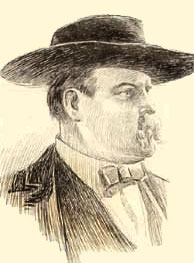
Decker

Such claims have circulated since 1897, mostly as a way to denigrate the Journal and its brazen accomplishment. Decker did say he tried, but failed, to bribe the jailer.

As is noted in The Year That Defined American Journalism, the evidentiary record to support the claim that bribes were paid is very, very thin.

“No one has identified to whom bribes were paid, how much, by what method, and how the purported payoffs secured the enduring silence of the authorities,” I wrote, adding:

“The allegations or suspicions of bribery rest more on assertion—and newspaper rivals’ contempt for the Journal—than on specific, persuasive documentation.”

It’s a good story, though. Like many media-driven myths, the Decker-bribery tale is delicious and enticing.

But it withers under scrutiny.

WJC

About the innovative social media deck, and ‘yellow blogging’

In 1897, Newspapers, Yellow Journalism on April 20, 2010 at 10:22 am

Kudos to my nephew, Rob Campbell, and the innovative social media deck he’s helped launch at the Cleveland Indians’ ballpark, Progressive Field.

The Tribe Social Deck, believed to be the first of its kind in a major professional sports venue, is described as “a press box for bloggers/social media types.”

The Deck was launched last week at the team’s home opener.

As far as is known, Rob has been quoted as saying, “the Tribe Social Deck is a one-of-a-kind endeavor.  Other professional sports teams have offered individual bloggers press credentials on occasion but to our knowledge there has never been a section exclusively catering to the internet and social media community.”

Rob heads up social media efforts for the Indians and posts frequently to the team’s Twitter site, Tribetalk.

In other developments in social media, a writer for the BetaNews blog has proposed “yellow blogging” as a latter day “reincarnation” of yellow journalism, which flared in the U.S. press more than 100 years ago.

By “yellow blogging,” he means those “gossip and rumor blogsites [that] ruthlessly compete for pageviews.”

Cool term, “yellow blogging.”  I like it.

But as heir to yellow journalism, as it was practiced in urban America at the end of the 19th century and early 20th century–unh-uh.

As I wrote in my 2001 book, Yellow Journalism: Puncturing the Myths, Defining the Legacies, “yellow journalism” has become a shorthand term–a cliché, really–for exaggerated, sensationalized, rumor-driven treatment of the news.

But that’s far from what “yellow journalism” was.

Hearst caricature, 1896

Newspapers of a century or so ago that can be classified as “yellow journals” (such as those of William Randolph Hearst and Joseph Pulitzer)  “were, at a minimum, typographically bold in their use of headlines and illustrations,” I wrote in Yellow Journalism, adding:

“They certainly looked different from their gray, conservative counterparts, and their use of design elements was more conspicuous and imaginative. They were, moreover, inclined to campaign against powerful interests and municipal abuses, ostensibly on behalf of ‘the people.’ And they usually were not shy about doing so.”

More specifically, yellow journalism–a term that emerged in 1897–was defined by these features and characteristics:

  • the frequent use of multicolumn headlines that sometimes stretched across the front page.
  • a variety of topics reported on the front page, including news of politics, war, international diplomacy, sports, and society.
  • the generous and imaginative use of illustrations, including photographs and other graphic representations such as locator maps.
  • bold and experimental layouts, including those in which one report and illustration would dominate the front page. Such layouts sometimes were enhanced by the use of color.
  • a tendency to rely on anonymous sources, particularly in dispatches of leading reporters.
  • a penchant for self-promotion, to call attention frequently to the newspaper’s accomplishments.

So the yellow press back then was certainly anything but boring, predictable, or uninspired—complaints of the sort that frequently are raised about contemporary American newspapers.

The yellow journals were hardly wretched scandal sheets, indulging in gossip and rumor.

WJC

Remembering the Maine — and a myth of yellow journalism

In Anniversaries, Debunking, Media myths, New York Times, Spanish-American War on April 6, 2010 at 5:33 pm

American yellow journalism of the late 19th century, led by the newspapers of William Randolph Hearst, has been often blamed for bringing on the Spanish-American War, which began 112 years ago this month.

Wreckage of the Maine (Library of Congress)

Wreckage of the Maine

It is an enduring media-driven myth, a misleading, media-centric interpretation that refuses to die, despite considerable evidence to the contrary.

The media myth of the Spanish-American War was invoked in a commentary posted today at the conservative online news site, Human Events.

The commentary–which contemplated parallels in the recent sinking of a South Korean Navy vessel and the destruction in Havana harbor in 1898 of the USS Maine– declared:

“While the cause of the explosion [that destroyed the Maine] remained a mystery, newspapers fighting for readership jumped on the incident as a means to increase sales. Exploiting and distorting the news—an industry art form that came to be called ‘yellow journalism’—reporters slanted the news to sensationalize it. As the Navy continued its investigation [into the causes of the battleship’s loss], the newspapers worked the American public’s emotions into a frenzy.”

There is, quite simply,  little evidence to support such a claim. (And coining the term “yellow journalism” predated the Maine‘s destruction by more than a year.)

Rather than stirring emotions “into a frenzy” in late winter 1898,  the American press was “notably becalmed and restrained,” as I wrote in my 2001 book, Yellow Journalism: Puncturing the Myths, Defining the Legacies.

I cited the trade journal Fourth Estate, which observed that the “frightful news from Havana, telling of the destruction of the . . . Maine, was treated here as a terrible calamity. The natural suspicion that Spanish methods of warfare had destroyed the ship moved men to cry for war, but the press as a whole published and reiterated the message from the [Maine’s] Captain, to ‘suspend judgment.’”

The trade journal also noted:

“Some of our papers, overheated with natural anger, have clamored for war, but the great majority have shown to the world that the press of the United States is in accord with the Government and is anxious for war only when it must be.” (Emphasis added.)

The Fourth Estate‘s reference to “some” papers clamoring for war no doubt was a reference to Hearst’s New York Journal and its racy sister publication, the Evening Journal. Hearst’s papers, as well as those of Joseph Pulitzer, were often speculative and over-the-top in their reporting.

But these newspapers, the leading exemplars of yellow journalism, hardly set an agenda for the American press in the aftermath of the Maine‘s destruction.

As I wrote in Yellow Journalism, scholarly “studies of the heartland press in 1898 signal the limited influence of the Hearst and Pulitzer newspapers—and note that few local newspapers immediately and vigorously advocated war” because of the loss of the Maine in a harbor under Spanish control.

The staid New York Times, which in the late 19th century began emerging as the antithesis to yellow journalism, also noted the generally calm reaction in the United States after the Maine‘s destruction.

The Times stated in late February 1898:

“No Latin race, we imagine, would have kept its head as well as the American people have kept theirs during the disturbing events of the past two weeks. In Spain or France or Italy there would have been tumultuous assemblages, much outcry in the streets, and incitements to riots.

“Outside of the reckless newspapers there has been no raving here.”

So it scarcely can be said that newspapers “worked the American public’s emotions into a frenzy” that led to the Spanish-American War. There is  little to support the notion that a journalistic war cry arose in the wake of the Maine’s destruction.

WJC

‘War means profits’? It didn’t for Hearst’s papers

In 1897, Debunking, Furnish the war, Media myths, Newspapers, Spanish-American War, Yellow Journalism on April 3, 2010 at 9:05 am

William Randolph Hearst’s purported vow to “furnish the war” with Spain in the late 1890s may be the anecdote most often told in American journalism.

Hearst

It’s a woolly tale that’s been in circulation since 1901, and it lives on despite repeated and thorough debunking. It’s one of the ten media-driven myths examined in my forthcoming book, Getting It Wrong.

“Furnish the war” is so tenacious because it offers a tidy summary of the news media at their worst. And it’s a pithy quotation, easily digested and readily recalled.

The anecdote reemerged the other day, in a commentary posted at TheCitizen.com, an online news site of Fayette Publishing in Fayetteville, GA. The commentary stated:

“William Randolph Hearst in 1897 [told] the artist Frederic Remington: ‘You furnish the pictures and I’ll furnish the war.’ Think for a minute what that statement means. War means business, war means profits and war means death.”

Hearst’s purported message to Remington is almost certainly apocryphal–as is the notion that war meant profits for Hearst’s newspapers. In their intensive coverage of the four-month Spanish-American War of 1898, his papers lost money.

As I wrote in my 2001 book, Yellow Journalism: Puncturing the Myths, Defining the Legacies, the Spanish-American War generally boosted newspaper circulation. But advertising revenues fell, as advertisers feared the war would undercut the nascent recovery from the hard economic times of the 1890s.

In addition, newsprint costs soared, as did news-gathering expenditures.

The trade journal Fourth Estate estimated in 1899 that Hearst’s New York Journal had spent $50,000 a week—the equivalent these days of more than $1 million—on cable tolls, reporters’ salaries, and dispatch boats that ferried correspondents’ reports from the war’s principal theater in Cuba to Jamaica and elsewhere for transmission to New York.

Hearst's 'New York Evening Journal'

The Journal scoffed at claims that it helped foment the conflict in a cynical scheme to build circulation and boost profits.

“Would you like to know what effect the war had on the money-making feature of this particular newspaper? The wholesale price of paper was greatly increased. Advertising diminished, expenses increased enormously,” the Journal said, adding that its expenses related to covering the conflict exceeded $750,000—the equivalent these days of more than $20 million.

During the war, which lasted 114 days, the Journal‘s racy sister publication, the Evening Journal,  produced as many as forty extra editions a day–a late 19th century manifestation of what contemporary journalists would recognize as the unrelenting, 24-hour news cycle.

WJC