W. Joseph Campbell

Archive for October, 2013|Monthly archive page

PBS squanders opportunity to offer ‘content that educates’ in ‘War of the Worlds’ doc

In Debunking, Error, Media myths, Media myths and radio, War of the Worlds on October 29, 2013 at 10:02 pm
Orson Welles

Orson Welles

Tonight’s snoozy PBS documentary about the 1938 radio dramatization of The War of the Worlds not only was tedious fare — it represented a missed opportunity to revisit the famous but much-misunderstood program in fresh and searching ways.

PBS could have confronted head-on the question of whether the radio show, which aired 75 years ago tomorrow night on CBS, really did provoke hysteria and mass panic in the United States. That’s the conventional wisdom, and it makes for a deliciously good yarn — that Americans back then were so skittish or doltish or unaccustomed to electronic media that they readily believed the story of the lethal Martian invasion of Earth, as described in The War of the Worlds broadcast.

The PBS documentary embraced the conventional wisdom.

But a growing body of scholarship — which the documentary utterly ignored — has impugned the conventional wisdom and has offered a compelling counter narrative: The War of the Worlds program sowed no widespread chaos and alarm. Instead, listeners in overwhelming numbers recognized the program for what it was: A clever radio show that aired in its scheduled Sunday time slot and featured the not-unfamiliar voice of the program’s 23-year-old star, Orson Welles.

This scholarship is neither obscure nor inaccessible.

Jeffrey Sconce, for example, pointed out in 2000 in his book, Haunted Media: Electronic Presence from Telegraphy to Television: “Direct evidence that thousands of Americans were in actual panic over the [War of the Worlds] broadcast is … limited at best. … And yet the legend of paralyzing ‘mass panic’ lives on.”

Edward Jay Epstein has dismissed as a “fictoid” the notion that the radio program touched off mass hysteria. “The accounts of suicides, heart attacks, traffic collisions and flights all proved to be unfounded,” Epstein wrote, adding:

“The program itself of course was a fiction. So was the ‘Mass Hysteria,’ which became part of American folklore about the power of the media.”

Michael Socolow, a journalism historian at the University of Maine, said this about The War of the Worlds broadcast in a thoughtful commentary for the Chronicle of Higher Education five years ago:

“Nobody died of fright or was killed in the panic, nor could any suicides be traced to the broadcast. Hospital emergency-room visits did not spike, nor, surprisingly, did calls to the police outside of a select few jurisdictions. The streets were never flooded with a terrified citizenry.”

Socolow more recently has written a superb assessment of the broadcast, which was posted today at Slate.com. In it, he wrote:

“The supposed panic was so tiny as to be practically immeasurable on the night of the broadcast.”

Fifteen years ago, at the 60th anniversary of The War of the Worlds dramatization, Robert E. Bartholomew, an international expert on mass panic, pointed to a “growing consensus among sociologists that the extent of the panic” created by Welles’ program, “was greatly exaggerated.

“The irony here,” Bartholomew wrote, “is that for the better part of the past sixty years many people may have been misled by the media to believe that the panic was far more extensive and intense than it apparently was.”

The panic, to be sure, was overstated. Exaggerated. And has become the stuff of a tenacious media-driven myth.

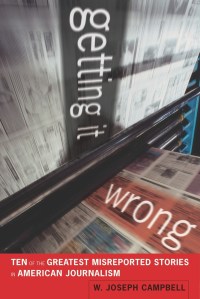
As I wrote in my 2010 mythbusting book, Getting It Wrong, “the notion that The War of the Worlds program sent untold thousands of people into the streets in panic, is a media-driven myth that offers a deceptive message about the influence radio wielded over listeners in its early days and, more broadly, about the media’s potential to sow fright, panic, and alarm.”

I also discuss in Getting It Wrong a little-studied secondary phenomenon associated with The War of the Worlds broadcast, that “a false-alarm contagion took hold that night” in which well-intentioned people possessing little more than an incomplete understanding of Welles’ program set out on their own to warn others about a sudden and terrible threat.Getting It Wrong_cover
These would-be Paul Reveres, I wrote, “burst into churches, theaters, taverns, and other public places, shouting that the country was being invaded or bombed, or that the end of the world was near.

“It had to have been a cruel and unnerving way of receiving word of a supposedly calamitous event — to be abruptly disturbed in familiar settings by a vague reports offered by people who themselves clearly were terror-stricken. … In more than a few cases, a contagion took hold: Many non-listeners became quite frightened, thus compounding for a short time the commotion and confusion stemming from The World of the Worlds program.”

PBS might well have examined that effect. It might have more seriously considered the broader counter-narrative that has taken shape about the radio dramatization.

PBS might have examined, in ways revealing to its audience, how media influences are not transmitted like a narcotic injected by hypodermic needle. News and entertainment media exert influences in ways that typically are far more subtle, nuanced, complex, and uneven.

But to believe The War of the Worlds radio program stirred chaos, mass panic, and widespread hysteria is effectively to embrace the hypodermic needle theory of media influence — a theory discredited long ago .

The age, class, wealth, education, political views, and life experiences of media audiences all are factors as to how media messages are absorbed and interpreted — if they are absorbed at all.

Socolow in his Chronicle article in 2008 noted the uneven and often-limited effects of media messages, writing:

“If we really know how to control people through the media, then why isn’t every advertising campaign a success? Why do advertisements sometimes backfire? If persuasive technique can be scientifically devised, then why do political campaigns pursue different strategies? Why does the candidate with the most media access sometimes lose?”

PBS — which says its mission is “to create content that educates, informs and inspires” — might have seized the opportunity of the 75th anniversary of The War of the Worlds broadcast to address such questions.

But, no: The documentary’s makers settled for a turgid program that was far less educational, informative, and inspiring than it could have been.

WJC

Many thanks to Instapundit
Glenn Reynolds for linking to this post

More from Media Myth Alert:

‘War of the Worlds’ made boring: PBS documentary is tedious fare

In Anniversaries, Media myths, Media myths and radio, War of the Worlds on October 27, 2013 at 12:27 pm

The War of Worlds made dull.

That’s what PBS has accomplished in an hour-long American Experience documentary about the famous radio dramatization of The War of the Worlds, which aired 75 years ago and told of a deadly invasion of the United States by Martians wielding heat rays.

Welles, the day after

Orson Welles, 1938

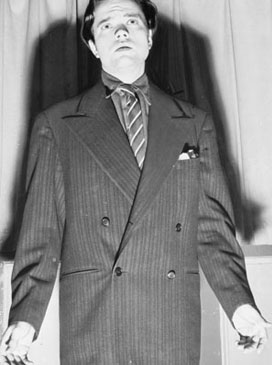
The PBS documentary to be broadcast Tuesday is a plodding, disjointed program that provides some back story to the famous program, which starred and was directed by Orson Welles (left).

And it tries much too hard to make the argument that a war scare in Europe in late September 1938 had all of America still on edge four weeks later, when the radio show aired.

But its greatest flaw lies in embracing as a premise the dubious assumption that The War of the Worlds dramatization on October 30, 1938, provoked chaos and scared Americans out of their wits.

The documentary seeks to underscore its dubious premise through commentary spoken by actors in period clothing. The actors pretend to be sitting for interviews as they give voice to sentiments contained in letters written in 1938 to Welles, the Federal Communications Commission, and CBS, which aired the dramatization.

The actors aren’t convincing, their comments seem stilted and contrived, and the effect is cheesy, eye-rolling, and suggestive of so much filler.

The letters, drawn from a well-known archive of Welles material at the University of Michigan, were of course hardly representative of the public’s reactions to The War of the Worlds dramatization. But PBS makes no mention of that.

The documentary claims that upwards “of a million people” were convinced, “if only briefly, that the United States was being laid waste by alien invaders.”

But no explanation is offered as to how the makers of the documentary arrived at such a figure.

Not only is it unsourced, but the figure is surely exaggerated.

As I discuss in my media mythbusting book, Getting It Wrong, most listeners, in overwhelming numbers, recognized the radio show for what it was — deliciously clever entertainment on the eve of Halloween in 1938.

The notion that The War of the Worlds program was so frightening that tens of thousands of people were sent into the streets in panic is, I wrote in Getting It Wrong, “a media-driven myth that offers a deceptive message about the influence radio wielded over listeners in its early days and, more broadly, about the media’s potential to sow fright, panic, and alarm.”

Had chaos and hysteria swept the United States that night long ago, “the trauma and turmoil surely would have resulted in many deaths and injuries,” I further wrote.

But no deaths and few injuries were conclusively linked to the program.

Indeed, there is only scant evidence that listeners acted on whatever fears they may have had. Many of them made the entirely rational decision to seek confirmation or clarification by calling external sources known to be usually reliable, such as local newspapers, police departments, and fire stations.

The PBS documentary, however, cites heightened call volumes as evidence of Americans being scared out of their wits.

Listeners that night also turned the radio dial to see whether other stations were carrying reports about an invasion from Mars.  None were, of course. The documentary ignores that reaction, too.

Discerning listeners, moreover, recognized that events in the radio play moved far too rapidly to be realistic. The pacing was such that within 30 minutes, the Martians blasted off from their home planet, traveled millions across space, landed in rural New Jersey, set up lethal heat rays, wiped out units of American soldiers, disrupted local and national communications, and forced declarations of martial law.

During the radio dramatization’s closing half-hour, the aliens marched on and destroyed much of New York City and took control of swaths of the United States before succumbing to the effects of humble earthly germs.

The documentary would have been far more compelling had it examined rather than swallowed whole the conventional wisdom about the radio play, had it raised searching questions as to whether the dramatization did provoke chaos and panic.

But the documentary makers took the easy way out and fashioned a program that dutifully and dully accepts the received wisdom without recognizing recent scholarship that has impugned what PBS took as a premise.

The radio dramatization of The War of the Worlds wasn’t panic-inducing. It was memorable and entertaining — neither of which can be said about the tedious fare that PBS will offer up in two days.

WJC

More from Media Myth Alert:

Feeling like 1995

In Media myths, Newspapers, Scandal, Washington Post, Watergate myth on October 3, 2013 at 12:27 pm

These days have evoked 1995 in more than a few respects.

The sale of the Washington Post closed Tuesday; the new owner is Jeff Bezos, who in July 1995 began selling books at Amazon.com, in near-total obscurity.

Amazon since then has made Bezos a multibillionaire and he has recently talked about leading the sometimes-arrogant Post to a new golden era, a vague reference to the Post’s mythologized reporting of the Watergate scandal 40 years ago.

The episode today in which a woman tried to rammed her car into a barricade near the White House, setting off a wild and deadly chase that ended near the Capitol, was faintly evocative of the night in May 1995 when an intruder scaled a fence near the White House, unloaded pistol in hand. “I’m here to see the president!” he shouted before being shot and wounded by a secret service agent.

Today also marks the 18th anniversary of the acquittal of O.J. Simpson in the slayings of his former wife and her friend. Simpson’s trial lasted more than nine months and its related controversies spread like a stain across 1995.

Crybaby Newt_1995NYDN

Recalling 1995: Newt and the shutdown (New York Daily News)

The strongest allusions to 1995 are of course to be found in the partial shutdown of the federal government — the first since the closures of November 14-19, 1995, and of December 16, 1995, to January 6, 1996.

The shutdowns, then and now, are alike in their effects — government workers sent home, federal landmarks and national parks closed — but differ notably in their immediate causes.

As the Wall Street Journal has noted, “The sticking points during that 1995-96 fight centered on demands from Republicans … for cuts in spending on entitlements such as Medicare, the health-care program for retirees, as well as other nondefense spending.” They also pressed President Bill Clinton to agree to balance the federal budget within seven years.

The second and longer shutdown took shape when Clinton and the Congressional Republicans, led by Speaker Newt Gingrich, differed over how to calculate whether the budget would be balanced in seven years, as the Journal pointed out.

The confrontations had improbable effects.

They allowed Clinton to steady his shaky administration; much of 1995 had been a time of missteps and gaffes for Clinton. He was reduced, for example, to insisting on his relevancy as a president amid a political landscape where Gingrich and the Republicans were ascendant following sweeping victories in midterm elections in 1994.

The government shutdowns of 1995 brought confirmation of Gingrich’s pricklinesss and volatility. One of the most remarkable moments of the government closure was his ill-considered outburst on November 15, 1995.

At a breakfast meeting with journalists, Gingrich acknowledged that a measure of personal pique was behind his toughening up the spending bill that Clinton vetoed to set in motion the furlough of 800,000 government employees.

Gingrich complained that Clinton had passed up an opportunity to negotiate the budget issues aboard Air Force One the week before, during a long trip home from Israel, where the president and congressional leaders had attended the funeral of Yitzhak Rabin.

Not only that, but Gingrich complained that he and Senate Majority Leader Bob Dole were forced to leave the Air Force One by the rear stairs after landing at Andrews Air Force base in Maryland.

“This is petty,” Gingrich said at the breakfast meeting. But “you land at Andrews and you’ve been on the plane for twenty-five hours [for the round trip to Israel] and nobody has talked to you and they ask you to get off the plane by the back ramp. . . . You just wonder, where is their sense of manners? Where is their sense of courtesy?”

The perceived slights and rude treatment, Gingrich said, were “part of [the reason] why you ended up with us sending down a tougher” spending measure, making Clinton’s veto and the government shutdown a certainty.

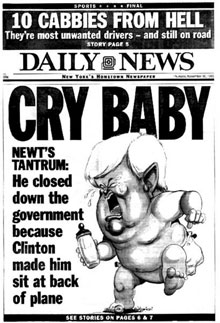
The outburst turned Gingrich into the petulant poster boy of the government shutdown. The New York Daily News caricatured him as a wailing toddler, stamping his foot in anger. Gingrich’s favorability ratings, which had been ebbing throughout 1995, fell further during the shutdowns.

Clinton may have steadied his presidency during the shutdowns. But he also engaged in conduct that would bring his administration to the brink of ruin.

On the night of Gingrich’s outburst, Clinton and Monica S. Lewinsky, a White House intern then 22-years-old, had their first sexual encounter at the White House — the first in a series of furtive liaisons that would lead, improbably, to Clinton’s impeachment three years later.

WJC

More from Media Myth Alert: