W. Joseph Campbell

Archive for January, 2017|Monthly archive page

WaPo book review invokes Hearst myth of ‘furnish the war’

In 1897, Debunking, Error, Furnish the war, Media myths, Newspapers, Quotes, Spanish-American War, Washington Post, Yellow Journalism on January 28, 2017 at 9:05 am

In a time of “fake news” circulated by shadowy Web sites, you’d think mainstream media would be extra-vigilant about not trafficking in media myths, those appealing tall tales about the exploits of journalists.

Not so the Washington Post, which repeats the mythical anecdote about William Randolph Hearst’s vow to wapologofurnish the war” with Spain at the end of the 19th century.

The Post’s blunder appeared in a review posted yesterday of The True Flag, a new book about America’s emergence as a colonial power during and after the Spanish-American War of 1898.

The review qualified the anecdote with the adverb “reputedly,” as if that insulates the writer or the newspaper from blame for peddling a dubious tale.

It doesn’t. If the anecdote’s false, or likely so, it ought to be left out.

Here’s how the offending passage reads:

“Yellow-press lord William Randolph Hearst reputedly cabled one of his photographers, ‘You furnish the pictures and I’ll furnish the war.'”

As I point out in my media-mythbusting book, Getting It Wrong (an expanded second edition of which was published recently), “the Hearst anecdote is succinct, savory, and easily remembered. It is almost too good not to be true.”
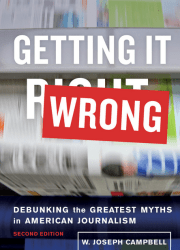
screen-shot-2016-09-23-at-3-53-56-pmIt also is one of American journalism’s most tenacious myths that circulates, I note, “despite a nearly complete absence of supporting documentation.”

The anecdote first appeared in 1901 in a book of reminiscences by James Creelman, a journalist prone to hyperbole and pomposity. Creelman’s book, On the Great Highway, did not explain how or where he learned about the “furnish the war” tale.

Creelman said Hearst’s vow was triggered by a telegram from Frederic Remington, a prominent artist and illustrator on assignment in Cuba for the New York Journal. (Contrary to the claim in the Post’s review, Remington was not a photographer.)

He spent six days in Cuba in January 1897, drawing sketches of the islandwide rebellion against Spanish rule, which preceded the wider war of 1898.

According to Creelman’s unsourced account, Remington wired Hearst, publisher of the Journal, to say: “Everything is quiet. There is no trouble here. There will be no war. I wish to return.”

Hearst said in reply, according to Creelman:

“Please remain. You furnish the pictures, and I’ll furnish the war.”

The tale gained traction only years later after Hearst, a lifelong Democrat, broke with President Franklin D. Roosevelt over the New Deal and backed a Republican, Alf Landon, in the 1936 presidential election. Hearst’s apostasy prompted vigorous criticism and his foes seized on “furnish the war” as an example of his dangerous, war-mongering ways.

The most truculent of biographies about Hearst — Ferdinand Lundberg’s slim polemic, Imperial Hearst — was published in 1936. And it repeated the “furnish the war” anecdote.

The tale has endured, even though the telegrams supposedly exchanged by Remington and Hearst have never turned up.

“It lives on,” I write in Getting It Wrong, “even though Hearst denied ever sending such a message. It lives on despite an irreconcilable internal inconsistency: it would have been absurd for Hearst to vow to ‘furnish the war’ because war — specifically, the Cuban rebellion against Spain’s colonial rule — was the very reason he sent Remington to Cuba in the first place.”

Not only that, I write, but “Spanish control of the cable traffic in Havana was too vigilant and severe to have allowed such an exchange to go unnoticed and unremarked upon. A vow such as Hearst’s to ‘furnish the war’ surely would have been intercepted and publicized by Spanish authorities as a clear-cut example of Yankee meddling in Cuba.”

The evidence arrayed against the hearty anecdote makes it clear that the exchange Creelman described never took place.

So what are the odds the arrogant Post will correct this lapse?

WJC

More from Media Myth Alert:

New year, old myths

In Debunking, Error, Furnish the war, Media myths, Newspapers, Scandal, Washington Post, Watergate myth, Yellow Journalism on January 15, 2017 at 3:33 pm

The first weeks of the new year have brought the reappearance of a number of hoary media myths, those false but irresistible tall tales that circulate widely in the news media even though they’ve been thoroughly debunked.

These myths include the narrative about Bob Woodward and Carl Bernstein — whose dogged reporting of the Watergate scandal for the Washington Post supposedly brought down Richard Nixon’s corrupt presidency in 1974.

Not the Post's doing

Not the Post‘s doing

David Zurawik, television critic for the Baltimore Sun, invoked that well-known trope the other day.

Writing at a Sun-affiliated blog, Zurawik referred to “legacy investigative journalism that Bob Woodward, Carl Bernstein and The Washington Post used to bring down Richard Nixon.”

This was not the first time Zurawik has invoked the heroic-journalist myth of Watergate: In early November, he called Bernstein “[o]ne of the journalistic elders who brought Nixon down.”

As I point out in my media-mythbusting book, Getting It Wrong — an expanded second edition of which came out not long ago — not even the Post’s Watergate-era principals bought into the notion that Woodward and/or Bernstein brought down Nixon.

The newspaper’s then-publisher, Katharine Graham, and its executive editor, Ben Bradlee, dismissed assertions that the Post’s reporting had toppled Nixon. Graham, for example, said pointedly in a program at the Newseum in 1997:

“Sometimes people accuse us of bringing down a president, which of course we didn’t do. The processes that caused [Nixon’s] resignation were constitutional.”

And Woodward, himself, has scoffed at the heroic-journalist myth, telling an interviewer for American Journalism Review in 2004:

To say the press brought down Nixon, that’s horse shit.”

Other prominent media myths circulate around Nixon — notably that of his “secret plan” to end the Vietnam War.

Supposedly, Nixon campaigned for the presidency in 1968 touting such a plan. An NPR commentary served up an extravagant and unsourced version of Nixon’s “secret plan,” flatly declaring 10 days ago:

“Richard Nixon won in 1968 while uniting his party around his ‘secret plan’ to end the war in Vietnam.”

The “secret plan” anecdote is perversely appealing in its expression of cunning and duplicity: The anecdote does seem thoroughly Nixonian.

But Nixon neither touted nor campaigned on a “secret plan,” let alone having used it to unite the Republican Party.

The pledge is one he never made.

In fact, candidate Nixon pointedly and publicly disavowed such a notion.

In an article published in the Los Angeles Times on March 28, 1968, Nixon was quoted as saying he had “no gimmicks or secret plans” for Vietnam.

“If I had any way to end the war,” he was further quoted as saying, “I would pass it on to President [Lyndon] Johnson.” (Nixon’s remarks were made just a few days before Johnson announced he would not seek reelection.)

Nixon may or may not have had a “secret plan” in mind in 1968. But he did not make such a claim a feature of his campaign that year.

That much is clear in the search results of a full-text database of leading U.S. newspapers in 1968, including the Baltimore Sun, Chicago Tribune, Los Angeles Times,  New York Times, Wall Street Journal, and Washington Post.

The search terms “Nixon” and “secret plan” returned no articles during the period from January 1, 1967, to January 1, 1969, in which Nixon was quoted as saying he had a “secret plan” for Vietnam. (The search period included the months of Nixon’s presidential campaign and its aftermath.)

Had Nixon’s campaign featured a “secret plan” for Vietnam, leading U.S. newspapers surely would have publicized it.

The hoary tale of William Randolph Hearst’s warmongering vow to “furnish the war” with Spain at the end of the Nineteenth Century — a media myth that, zombie-like, never dies — popped up in Fit for the Presidency? a book published January 1.

Fit for the Presidency? revisits the credentials of 15 one-time presidential candidates, doing so through the lens of an executive recruiter. The cases examined include that of Hearst, a media baron who unsuccessfully sought the Democratic nomination for president in 1904.

The book invokes the “furnish the war” anecdote this way:

Warmonger?

Hearst: Warmonger?

“The most controversial episode of [Hearst’s] career began when he got a telegram from Frederic Remington, who he had sent to Cuba to cover the revolution against Spain: ‘Everything is quiet. There is no trouble here. There will be no war. I wish to return.’ To which Hearst allegedly responded, ‘Please remain. You furnish the pictures, and I’ll furnish the war.’

“Yet, no one has been able to get a copy of either telegram, so there are strong suspicions that they never existed in the first place. Perhaps the story is a plant by [Hearst rival Joseph] Pulitzer, or it may have even been invented by Remington himself.”

The anecdote almost certainly is apocryphal, as I describe in detail in Getting It Wrong. The purported telegrams have indeed never turned up. Hearst, moreover, denied having sent such a message and Remington, a prominent artist of the American West, apparently never discussed the supposed exchange.

And the timing suggested by Fit for the Presidency? is a bit shaky, in that the anecdote was not in wide circulation when Hearst sought the presidential nomination in 1904.

The tale first appeared in 1901, in a book of reminiscences by James Creelman, a former reporter for Hearst who had a well-known reputation for injecting hyperbole in his writing. Creelman did not identify where or how he learned of the purported Remington-Hearst exchange.

In any case, the anecdote did not become prominently attached to Hearst until the mid-1930s, when he turned against President Franklin D. Roosevelt and his New Deal policies. Hearst, a lifelong Democrat, condemned Roosevelt while backing Republican Alf Landon for the presidency in 1936.

Landon carried two states, Maine and Vermont, in a landslide defeat of epic proportion.

Hearst’s apostasy angered Democrats and prompted foes to dig up mostly forgotten tales such as the “furnish the war” vow. Indeed, that anecdote became Exhibit A in a lineup of purported evidence that Hearst’s newspapers fomented the Spanish-American War in 1898. The claim became popular and took on a sinister cast not when Hearst sought the presidential nomination in 1904, but in 1936 — and has circulated vigorously thereafter.

WJC

More from Media Myth Alert: