Columbia Journalism Review says it seeks to be “the intellectual leader in the rapidly changing world of journalism.”
If that’s the objective, then it ought to brush up on some history of the field.
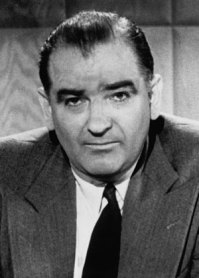
McCarthy, red-baiting senator
An essay posted the other day at CJR’s online site embraces the decades-old media myth about the legendary Edward R. Murrow and his critical television report in March 1954 about the red-baiting senator from Wisconsin, Joseph R. McCarthy.
The journalism review’s thinly sourced essay purports to explore why Republicans hate the news media and says the seeds of such prejudice were planted when McCarthy began campaigning about communist infiltration of the federal government.
“The press dutifully gave McCarthy a platform for his populist conspiracy-mongering,” the essay declares, “until at last CBS’s Edward R. Murrow exposed his lies, in a program in 1954.”
Murrow exposed McCarthy’s lies?
No, it wasn’t Murrow.
Murrow took on McCarthy years after other journalists had directed searching and critical attention to the senator and his tactics — and in some instances paid a price for having done so.
The belated nature of Murrow’s critical program on McCarthy was underscored years later by Murrow’s friend and CBS colleague, Eric Sevareid, who noted that the report “came very late in the day.”
Sevareid also said: “The youngsters read back and they think only one person in broadcasting and the press stood up to McCarthy and this has made a lot of people feel very upset, including me, because that program came awfully late.”
And as I pointed out in my media-mythbusting book, Getting It Wrong, McCarthy had no more relentless critic in journalism than Drew Pearson, author of the syndicated muckraking column, “Washington Merry-Go-Round.”
Pearson first took on McCarthy in February 1950, four years before Murrow’s show and shortly after the senator began his communists-in-government campaign, and persisted in questioning the substance and accuracy of McCarthy’s accusations.
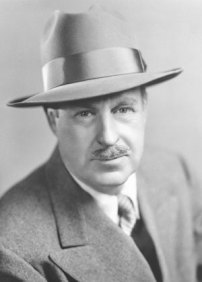
Pearson, attacked by a senator
McCarthy grew so unnerved by Pearson’s work that he physically assaulted the columnist in December 1950, in a brief but violent encounter in the cloakroom of the exclusive Sulgrave Club in Washington, D.C. Then-senator Richard M. Nixon broke up the confrontation.
(In his memoir RN, Nixon quoted McCarthy as saying: “You shouldn’t have stopped me, Dick.”)
Shortly after the confrontation at the Sulgrave, McCarthy took to the floor of the Senate to denounce Pearson as the “diabolically” clever “voice of international communism,” a “prostitute of journalism,” a “sugar-coated voice of [Soviet] Russia,” and a “Moscow-directed character assassin.”
The senator also said: “It is up to the American people — and above all, up to the newspapermen who are buying his column and the radio stations that are carrying his broadcasts — to see that this voice of international communism is stilled.”
McCarthy aimed a threat at Adam Hat Stores Inc., principal sponsor of Pearson’s Sunday night radio program, declaring that “anyone who buys from a store that stocks an Adams [sic] hat is unknowingly contributing at least something to the cause of international communism by keeping this communist spokesman on the air.”
A week later, Adam Hat said it would not renew its sponsorship of Pearson’s program, citing “a planned change in advertising media for 1951.”
Pearson later claimed that losing the Adam Hat sponsorship cut his gross radio income to $100,000 from $250,000. “I suppose no one newspaperman suffered more economically than I did from Joe McCarthy,” he mused a few years later.
In September 1951 — two and a half years before Murrow’s program on McCarthy — the New York Post began publishing a raw and unflattering 17-part series about McCarthy. It was, the Post said, “the first comprehensive newspaper account of [McCarthy’s] curious public career.” As I noted in Getting It Wrong, the series “is seldom recalled in the historiography of the McCarthy period.”
The first installment pointed to the source of McCarthy’s power, stating:
“By constant practice he has learned that all one needs to defeat or at least immobilize an opponent is to charge that he is linked with the Soviet enemy or just suggest that he has been in the past, might be now, or could conceivably be linked in the future.”
The closing installment likened McCarthy to “a drunk at a party who was funny half an hour ago but now won’t go home. McCarthy is camped in America’s front room trying to impress everybody by singing all the dirty songs and using all the four-letter words he knows. The jokes are pointless, the songs unfunny, the profanity a bore.”
So by the time Murrow’s program aired in 1954, McCarthy had been pilloried in the press for years. Americans in 1954 weren’t exactly “waiting for a white knight like Murrow to tell them what a toxic threat the senator posed,” as I wrote in Getting It Wrong. “By then, McCarthy and his tactics were well-known and he had become a target of withering ridicule — a sign of diminished capacity to inspire dread.”
On the day Murrow’s half-hour program aired, former President Harry Truman was asked about reports of an anonymous telephoned threat against McCarthy’s life. Truman replied, saying: “We’d have no entertainment at all if they killed him.”
More from Media Myth Alert:
- That heroic Ed Murrow: The myth endures
- Murrow ‘risked his career to confront demagogic Joe McCarthy’? Hardly
- Edward R. Murrow ‘had guts’ in taking on Joe McCarthy? Not really
- Murrow: No white knight – and not above the political fray
- 60 years on: Joe McCarthy assaults Drew Pearson
- Suspect Murrow quote pulled at Murrow school
- Blithely invoking the Murrow-McCarthy myth
- Murrow had McCarthy ‘on his show’? Not quite
- The journos who saved us
- Media history with Olbermann: Wrong and wrong
- The heroic-journalist myth of Watergate
- Mistaking conspiracy for sloppy history in Hearst’s ‘vow’ to ‘furnish the war’
- Media myths: Prominent cases of ‘fake news’ masquerading as fact
- On media myths and hallowed moments of exaggerated importance
- Where do they get this stuff?
- ‘Persuasive and entertaining’: WSJ reviews ‘Getting It Wrong’

 Media Myth Alert