W. Joseph Campbell

Archive for the ‘1897’ Category

Myth appeal runs deep abroad; Watergate a case in point

In 1897, Debunking, Furnish the war, Media myths, Spanish-American War, Washington Post, Watergate myth, Yellow Journalism on October 7, 2010 at 10:20 am

I  spoke about my new book, Getting It Wrong, at a superbly organized American University alumni event last night, at a venue commanding spectacular views of Seattle, Puget Sound, and the Olympic Mountains.

Following my talk, which focused on three of the 10 media-driven myths debunked in Getting It Wrong, I was asked by one of the people in attendance whether myths have similarly emerged about the media in other countries.

A very good question, I replied: I really don’t think so.

Maybe in Britain, I suggested, given the robust media scene there. But I couldn’t say for sure.

While I had to hedge a bit on the question, there’s no doubt that myth appeal runs deep from the United States to other countries. That is, news organizations outside the United States not infrequently repeat what are American media myths.

Media-driven myths, I have noted, can and do travel far, and well.  Take, for example, the heroic-journalist myth of Watergate.

The notion is often embraced in news media in the United States and overseas that the investigative reporting of Bob Woodward and Carl Bernstein, then-young reporters for the Washington Post, took down Richard Nixon and his corrupt presidency.

A measure of the myth’s international appeal can found in a report that aired today on Australia’s ABC radio network, which described Woodward as “one of the Washington Post journalists who brought down a U.S. President.”

Not even Woodward embraces that claim. He said in an interview in 2005:

“To say the press brought down Nixon, that’s horseshit.”

And he’s right. Earthy, perhaps, but right.

I discuss the heroic-journalist myth in Getting It Wrong, noting that it’s a simplistic and misleading interpretation of what was a sprawling and complex scandal. Watergate’s web of misconduct forced Nixon from office and landed nearly 20 of his top aides, associates, and cabinet officers in jail.

To roll up a scandal of such dimension, I write,  required the collective, if not always the coordinated, efforts of special prosecutors, bipartisan congressional panels, federal judges, the FBI, and, ultimately, the U.S. Supreme Court, which ordered Nixon to surrender audiotapes that proved his complicity in the Watergate cover-up.

Against that tableau, journalism’s contributions to unraveling Watergate were modest—certainly not decisive.

But because the heroic-journalist interpretation is such an unambiguous assertion of the media’s presumed power, it tends to travel well.

The same holds for the purported vow of William Randolph Hearst to “furnish the war” with Spain.

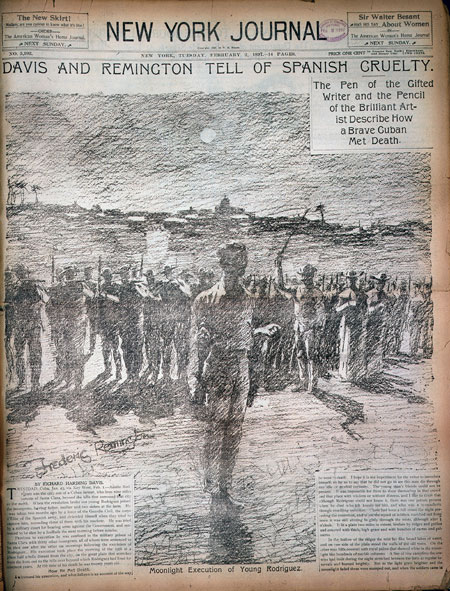
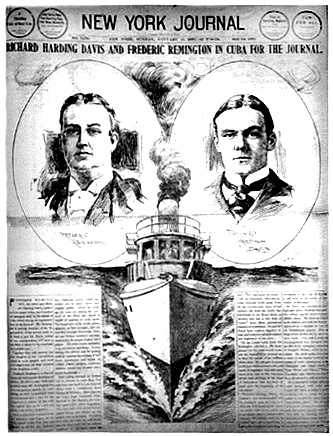
Hearst supposedly made the pledge in a cable to the artist Frederic Remington, who was in Cuba in early 1897, on assignment for Hearst’s New York Journal to draw illustrations of the rebellion against Spanish colonial rule.

The anecdote lives on as one of the most famous and delicious in American journalism—even though it is buttressed by no supporting documentation. And Hearst denied ever having made such statement.

It is, however, a tale almost too good to be disbelieved, given that it so effectively represents Hearst as warmonger. The tale’s sheer deliciousness is another reason why the anecdote turns up more than infrequently in news outlets abroad, especially in Spanish-language media.

The media myths associated with Watergate, the so-called “Cronkite Moment” of 1968, and the War of the Worlds radio dramatization of 1938 were the principal elements of my talk last night.

Those myths live on, I said, in part because “they are appealing reductive, in that they minimize the complexity of historical events and offer simplistic and misleading interpretations instead. The Washington Post no more brought down Nixon that Walter Cronkite swayed [Lyndon] Johnson’s views about Vietnam.

“Yet those and other media myths endure because they present unambiguous, easy-to-remember explanations for complex historic events.”

WJC

Recent and related:

1897 flashback: Committing ‘jailbreaking journalism’

In 1897, Anniversaries, Newspapers, Spanish-American War, Yellow Journalism on October 4, 2010 at 7:08 am

William Randolph Hearst‘s New York Journal pulled off one of the greatest coups in participatory journalism 113 years ago this week, in what a rival newspaper called the case of “jail-breaking journalism.”

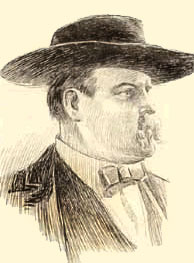
Decker

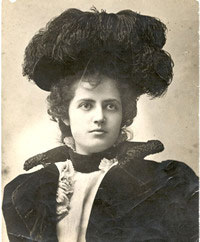
The episode centered around Karl Decker, a Journal reporter whom Hearst had sent to Cuba, and Evangelina Cisneros, a political prisoner jailed in Havana on suspicion of conspiring to kill a senior Spanish military officer.

Cisneros, who was 19, claimed the officer had made her the target of his unwelcome sexual advances.

She had been jailed more than a year, without trial, when Hearst’s Journal described her plight in a front-page article in August 1897.

The report claimed, incorrectly, that Cisneros already had been tried by a martial tribunal and was “in imminent danger” of being sentenced to 20 years’ imprisonment at Spain’s penal colony on Ceuta, off the north Africa coast.

As I wrote in my 2006 book, The Year That Defined American Journalism: 1897 and the Clash of Paradigms, the error mattered little to the Journal: “Far more important was that the prolonged imprisonment of Cisneros represented a brutish and unambiguous example of Spain’s cruel treatment of Cuban women—a topic of not infrequent attention in U.S. newspapers.”

In 1897, Spain still ruled Cuba, however tenuously. It had failed to put down an island-wide rebellion that began in 1895, despite having sent nearly 200,000 troops to Cuba. The Cuban rebellion was to give rise in 1898 to the Spanish-American War.

Following its disclosure about Cisneros’ jailing, the Journal organized a petition drive among American women, calling on the queen regent of Spain to release Cisneros. The newspaper claimed to have collected signatures from more than 10,000 women, but Spanish authorities were unmoved.

So in late summer 1897, Hearst sent Decker to Cuba, ostensibly as the Journal‘s correspondent in Havana. In reality, Decker was under orders to secure the release of Cisneros.

Evangelina Cisneros

With the quiet help of U.S. diplomatic personnel in Cuba–and with the crucial support of a clandestine smuggling network in Havana–Decker succeeded. In the early hours of October 7, 1897, Decker and two accomplices broke the bars of Cisneros’ cell and spirited her out of jail.

She was hidden for nearly three days at the home of one of the accomplices, Carlos F. Carbonell, an affluent, American-educated Cuban banker whom Cisneros later married.

Then, dressed as a boy, the diminutive Cisneros was smuggled aboard the Seneca, a passenger steamer bound for New York City, where Hearst organized a thunderous welcome for her.

Nearly 75,000 people turned out at New York’s Madison Square to welcome Cisneros and Decker, who had separately returned to the United States aboard a Spanish-flagged passenger vessel.

Cisneros “was rapturously received” in New York, I wrote in The Year That Defined American Journalism, “not because she was a daring and clever prison escapee, but because she was a frail and wily embodiment of the Cuban struggle for political independence from Spain.”

Some U.S. newspapers scoffed at the Journal‘s coup. “Jail-breaking journalism,” said the Chicago Times-Herald. But many other newspapers and trade journals cheered the exploit.

The Fourth Estate, for example, congratulated Decker and the Journal on an “international triumph” and saluted them for having “smashed journalistic records.”

For the Journal–which never was shy about self-promotion–the Cisneros jailbreak and rescue were “epochal,” the apogee of its brand of activist-oriented yellow journalism.

Interestingly, the Cisneros jailbreak fell quickly from the front pages of American newspapers–including those of the Journal. And the case was rarely mentioned in the American press, or by American political figures, as war loomed with Spain in the spring of 1898.

But “jail-breaking journalism” merits being recalled this week, as an episode unique in American journalism.

WJC

Recent and related:

<!–[if !mso]> the Journal, the Cisneros jailbreak and rescue was “epochal,”
/* Style Definitions */
table.MsoNormalTable
{mso-style-name:”Table Normal”;
mso-tstyle-rowband-size:0;
mso-tstyle-colband-size:0;
mso-style-noshow:yes;
mso-style-parent:””;
mso-padding-alt:0in 5.4pt 0in 5.4pt;
mso-para-margin:0in;
mso-para-margin-bottom:.0001pt;
mso-pagination:widow-orphan;
font-size:10.0pt;
font-family:”Times New Roman”;
mso-ansi-language:#0400;
mso-fareast-language:#0400;
mso-bidi-language:#0400;}
the Journal, the Cisneros jailbreak and rescue was “epochal,” the Journal, the Cisneros jailbreak and rescue was “epochal,”[i] a “supreme achievement of the journalism of action.”


[i]. Duval [Decker], “Evangelina Cisneros Rescued by the Journal,” New York Journal (10 October 1897).

On the high plateau of media distrust

In 1897, Debunking, Hurricane Katrina, Media myths, New York Times, Newspapers, Yellow Journalism on September 30, 2010 at 10:22 am

A Gallup poll released yesterday suggested that distrust of the news media has reached a high plateau among American adults.

Fifty-seven percent of Gallup’s respondents, the most ever, said they had little or no trust in the “mass media … when it comes to reporting the news fully, accurately, and fairly.” A year ago, the little-to-no trust response rate was 55 percent; in 2008 it was 56 percent.

As Andrew Malcolm noted at his engaging Top of the Ticket blog, the new “record high” in media distrust was reached “by one lousy percentage point.”

Even so, there’s little comfort in having reached such a plateau. And the factors accounting for a pronounced level of popular distrust are several–and hardly unfamiliar.

Surely one reason is that it’s commonplace to bad-mouth the news media as unreliable and unfair. Media-bashing has long been in fashion–and the news media are prone to beat up on themselves, and their rivals.

A commentary posted yesterday at the Atlantic blog put it well in saying that “media voices increasingly distinguish themselves by telling us not to trust the rest of the mainstream media. Think about all of the mass media today that tells us how stupid mass media is.”

True enough. That has to have an effect.

But the news media have long indulged in aiming brickbats and insults at one another. For the news media, media-bashing has long been an irresistible pasttime.

The ever-appealing and often-invoked epithet “yellow journalism” dates after all to 1897–and the efforts of a New York newspaper editor to find a pithy and imaginative way to denigrate what then was called the “new journalism” of William Randolph Hearst and Joseph Pulitzer.

Traditional and new, the media are everywhere these days and their ubiquity no doubt fosters some disdain and contempt. A hint of that contempt can be detected in the recent Pew Research Center’s news-consumption survey, which reported that 17 percent of American adults go newsless on a typical day.

Although the news media are everywhere, a sizable portion of the population has little use for them.

Going newsless can’t be easily accomplished, given the variety of readily accessible platforms by which news is delivered. But the going-newsless option is especially pronounced among American adults younger than 30: Pew’s report said 27 percent of that cohort gets no news on a typical day.

The prominent and well-documented fabrication scandals of several years ago doubt have contributed to the plateau of media distrust. The journalistic fraud committed by Jayson Blair of the New York Times and Jack Kelley of USA Today, among others, surely has left a bad taste for the media among many news consumers.

The inclination to distrust the media surely was reinforced by the highly exaggerated news coverage of Hurricane Katrina’s aftermath in New Orleans in 2005.

As I write in Getting It Wrong, my new book that debunks prominent media-driven myths, the Katrina coverage was “no high, heroic moment in American journalism. … On crucial details, journalists erred badly, and got it wrong. In the days following Katrina’s landfall, news reports described apocalyptic horror that the hurricane supposedly had unleashed.”

And that reporting was steeped in error.

The fifth anniversary of Katrina’s landfall was an occasion to revisit just how shoddy the news coverage was in the storm’s aftermath. And that anniversary fell shortly before Gallup conducted its annual media-trust survey.

Gallup said 1,019 adults were interviewed by telephone in a random survey conducted September 13-16. (The sampling error was plus or minus four percentage points, meaning the level of distrust could be as great as 61 percent, or as narrow as 53 percent.)

Mundane factors probably contribute to the plateau of distrust as well. Staff cuts at many U.S. newspaper, including the unsung heroes manning copy desks, have been blamed for an increase grammar, spelling, and factual errors.

It’s not that newspapers ever were mostly free of such lapses. Anecdotally at least, they seem more frequent and conspicuous. The ombudsman, or reader’s representative, at the Washington Post suggested as much last year in writing that growing numbers of readers were calling on him “to complain about typos and small errors” appearing in the newspaper.

And it’s become a cliché to say that such small-bore errors undermine credibility–or, perhaps more accurately, encourage media distrust.

And then there is the matter of limited viewpoint diversity in American newsrooms, a point I raise in Getting It Wrong.

Few journalists for mainstream national media “consider themselves politically conservative,” I note, referring to surveys conducted in 2004 and 2008 for the Washington-based Committee of Concerned Journalists. The surveys found that the overwhelming majority of national correspondents for U.S. news media considered themselves to be politically “moderate” or “liberal.”

Interestingly, Gallup reported that “Democrats and liberals remain far more likely than other political and ideological groups to trust the media and to perceive no bias.”

Viewpoint diversity in newsrooms “is an issue not much discussed in American journalism,” I write in Getting It Wrong. “But it is hardly irrelevant.”

Especially when distrust of the news media has found such a high plateau.

WJC

Recent and related:

Obama, journalism history, and ‘folks like Hearst’

In 1897, Debunking, Media myths, Yellow Journalism on September 29, 2010 at 9:45 am

President Obama stirred a fair amount of comment and criticism by declaring in a recent interview with Rolling Stone magazine that Fox News pursues a point of view that’s “ultimately destructive” to the country’s “long-term growth.”

As if Fox News, or any news organization, had such power.

And Obama offered another comment that signaled a less-than-profound grasp of American journalism history.

Media baron W.R. Hearst

That came when he invoked William Randolph Hearst, the much-misunderstood practitioner of activist yellow journalism who came to prominence in the 1890s. Obama said:

“We’ve got a tradition in this country of a press that oftentimes is opinionated. The golden age of an objective press was a pretty narrow span of time in our history. Before that, you had folks like Hearst who used their newspapers very intentionally to promote their viewpoints.”

Hearst, though, was something of an exception among newspaper publishers; there haven’t been many “folks like Hearst” in American journalism. Certainly not in the late 19th and early 20th centuries, the most innovative period of Hearst’s years as a press baron.

Hearst arrived in New York City from San Francisco in 1895 and promptly shook a media landscape dominated by the likes of James Gordon Bennett Jr., the often-absent owner of the New York Herald; Joseph Pulitzer, the ailing and churlish proprietor of the New York World, and Charles A. Dana, the prickly force behind the New York Sun.

They all were past their prime, and their newspapers were in decline.

As I discussed in my 2006 book, The Year That Defined American Journalism: 1897 and the Clash of Paradigms, Hearst’s entry into New York City journalism was something of “a seismic event.”

By late 1897, he had developed and began pursuing a robust and fairly progressive view of journalism, maintaining that newspapers had a duty and obligation to inject themselves conspicuously into public life, to fill the void left by government inaction and incompetence.

Hearst called this the “journalism of action” or the “journalism that acts.” It was journalism with a social conscience.

His New York Journal insisted in editorials that a newspaper’s duty should not be “confined to exhortation.”

Instead, the Journal declared, when “things are going wrong” the newspaper should step in and “set them right, if possible.”

Hearst’s “journalism of action” embraced an element of what we would recognize as consumer protection. In the aftermath of a snowstorm that swept New York late in January 1897, the Journal set up a relief effort, saying, “The time has come to help the poor who starve, who freeze. Charity’s hand is almost empty.”

There was no more stunning manifestation of Hearst’s activist vision of journalism than the jailbreak his Journal pulled off in Havana in October 1897, freeing a 19-year-old political prisoner named Evangelina Cisneros.

She had been jailed without trial for more than a year in a prison for women. Spanish authorities who then ruled Cuba spurned Hearst’s editorial campaign for Cisneros’ release.

In late August 1897 he sent Karl Decker, a reporter in the Journal‘s Washington bureau, to Havana, with instructions to win Cisneros’ freedom. And with the quiet help of U.S. diplomats in Cuba, and the vital assistance of a clandestine smuggling network in Havana, Decker broke Cisneros from prison.

Cisneros

She soon was smuggled out of Cuba and welcomed to New York City in a delirious reception organized by Hearst and the Journal.

It was American journalism’s greatest escape narrative. And it demonstrated the breathtaking scope and potential of the “journalism of action.”

Freeing Cisneros, the Journal declared, was “epochal” and a “supreme achievement of the journalism of action.” (Illicit “jail-breaking journalism” was more like it, scoffed the Chicago Times-Herald.)

Eventually, though, Hearst’s interest in developing the “journalism of action” was supplanted by his soaring, and mostly unfulfilled, political ambitions.

In 1902, Hearst was elected to the first of two terms in Congress.

He sought, but lost, the Democratic nomination for president in 1904. He lost the New York gubernatorial race in 1906. And he twice ran unsuccessfully for New York City mayor.

What’s more, I write in The Year That Defined American Journalism, “Hearst never completely shook the reputation of a spoiled little rich kid, and the ‘journalism of action’ surely suffered because of his personality.”

In his comment about “folks like Hearst,” Obama also seemed to embrace a version of the “golden age” fallacy, that there was a time in American journalism when newspapers were paragons of objectivity.

That’s a myth, really.

“Objectivity”–or what Richard Taflinger of Washington State University has succinctly termed “the detached and unprejudiced gathering and dissemination of news”–is a normative value or ambition in American journalism.

But it has never been practiced on anything approaching a sustained basis.

WJC

Recent and related:

My many thanks to fivefeetoffury and to Jim Romenesko for linking to this post.

New ‘Nueva York’ exhibition and the Spanish-American War

In 1897, Media myths, Spanish-American War, Yellow Journalism on September 18, 2010 at 7:56 am

The Nueva York (1613-1945) exhibition that opened yesterday at El Museo del Barrio in New York City looks to be terrific.

It was jointly developed by Museo de Barrio and the New-York Historical Society, and is billed as “the first museum exhibition to explore … New York’s long and deep involvement with Spain and Latin America.

Descriptive material posted online about Nueva York describes the show’s thematic presentation across five galleries.

The descriptive material also  contains a passage of particular interest to Media Myth Alert.

It says the Spanish-American War–which was fought over Cuba in 1898–“was a conflict sold to the American public by New York newspaper publishers including Joseph Pulitzer and William Randolph Hearst,” the city’s leading practitioners of yellow journalism.

That’s a media-centric interpretation of a much-misunderstood war.

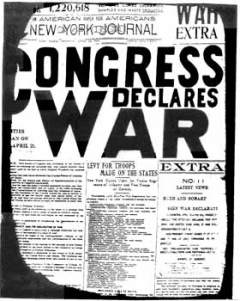
New York Evening Journal, April 1898

It’s a misleading characterization, too.

As I discussed in my 2001 book, Yellow Journalism: Puncturing the Myths, Defining the Legacies, such claims tend to rest on unsupported assumptions about the effects of newspaper content on readers in New York City and beyond, and on policymakers in Washington.

Critics who blame the yellow press for bringing on the war–or for selling the American public on the conflict–fail to explain precisely how the often-exaggerated content of the New York yellow journals was transformed into policy and military action.

As I state in Yellow Journalism:

“The yellow press is not to blame for the Spanish-American-War.

“It did not force—it could not have forced—the United States into hostilities with Spain over Cuba in 1898. The conflict was, rather, the result of a convergence of forces far beyond the control or direct influence of even the most aggressive of the yellow newspapers, William Randolph Hearst’s New York Journal.”

The Spanish-American War was the upshot of a prolonged, three-sided diplomatic impasse: Cubans who in 1895 launched what became an island-wide rebellion against Spanish rule would settle for nothing short of political independence. Spain, for reasons of political stability at home, could not agree to grant Cuba its independence. And the United States could tolerate no longer the disruptions caused by turmoil in Cuba.

Spain sent nearly 200,000 soldiers to the island in a mostly failed attempt to restore order. By early 1898, the Cuban rebellion had become a stalemate.

A particularly disastrous element of Spain’s strategy was to seek to deprive Cuban rebels of support in the hinterland by a policy called “reconcentration,” under which Cuban non-combatants–old men, women, and children–were forced into garrison towns. There, by the tens of thousands, the Cubans fell victim to disease and starvation.

A humanitarian disaster had taken hold in Cuba by early 1898, and the harsh effects of Spain’s “reconcentration” policy were often described in U.S. newspapers, yellow and otherwise.

In many ways, the U.S. entry in April 1898 into the rebellion on Cuba was a humanitarian crusade to end to abuses caused by Spain’s “reconcentration” policy. (A leading historian of the Spanish-American War, David F. Trask, has written that Americans in 1898 “went to war convinced that they had embarked upon an entirely selfless mission for humanity.”)

It was the human rights disaster on Cuba, not the press of New York City, that “sold” Americans on going war with Spain. Newspapers–including the yellow journals of Hearst and Pulitzer–were marginal in that equation.

WJC

Related:

Getting it right about ‘yellow journalism’

In 1897, Debunking, Media myths, Yellow Journalism on August 19, 2010 at 11:16 am

“Yellow journalism” is an evocative sneer that has morphed over the decades.

Hearst's New York Evening Journal, April 1898

The term these days is sometimes invoked as an off-hand description for sensational treatment of the news. Or, more broadly, it’s used to describe egregious journalistic misconduct of almost any kind.

Or, as AlterNet blog noted in a post yesterday, “sometimes, yellow journalism is seen as synonymous with [William Randolph] Hearst, himself.”

But that’s really an imprecise characterization of a robust genre practiced by Hearst and others in the late 19th century.

As I wrote in my 2001  book, Yellow Journalism: Puncturing the Myths, Defining the Legacies, yellow journalism was defined by these features and characteristics:

  • the frequent use of multicolumn headlines that sometimes stretched across the front page.
  • a variety of topics reported on the front page, including news of politics, war, international diplomacy, sports, and society.
  • the generous and imaginative use of illustrations, including photographs and other graphic representations such as locator maps.
  • bold and experimental layouts, including those in which one report and illustration would dominate the front page. Such layouts sometimes were enhanced by the use of color.
  • a tendency to rely on anonymous sources, particularly in dispatches of leading reporters.
  • a penchant for self-promotion, to call attention frequently to the newspaper’s accomplishments. This tendency was notably evident in crusades against monopolies and municipal corruption.

Given those defining features, I wrote in Yellow Journalism that the genre “certainly could not be called predictable, boring, or uninspired—complaints of the sort that are frequently raised about U.S. newspapers of the early twenty-first century.”

Moreover, yellow journalism of a century or more ago was often criticized–but its salient features, including its bold typography, were often emulated. As such, it exerted a powerful influence in American journalism of the late 19th and early 20th centuries.

So it was much more than merely sensational.

But largely due to its association with Hearst–a toxic personality who ran the New York Journal and later turned the newspaper into a platform for a succession of failed campaigns for high public office–“yellow journalism” has mutated into the caricature that’s commonplace today.

The AlterNet post, which assails Rupert Murdoch and his recent $1 million donation to the Republicans, also says “yellow journalism” was “originally coined to describe the journalistic practices of Joseph Pulitzer….”

Not so.

As I discuss in Yellow Journalism, the epithet was devised in early 1897 to impugn the journalism of both Pulitzer and Hearst.

Yellow journalism” first appeared in print in the New York Press, which was edited by the austere Ervin Wardman, who once was described as revealing his “Calvinistic ancestry in every line of his face.”

The term appeared in Wardman’s newspaper on January 31, 1897, and quickly caught on, as a way to denigrate what then was called the “new journalism” of Hearst’s Journal and of Pulitzer‘s New York World.  By the end of March 1897, references to “yellow journalism” had appeared in newspapers in Providence, Richmond, and San Francisco.

A sneer thus had been born.

Precisely how Wardman and the Press landed on “yellow journalism” is not clear, however.

As I note in Yellow Journalism, the newspaper’s own brief discussion of the term’s origins was vague and unrevealing: “We called them Yellow because they are Yellow,” it said in 1898 about the Journal and the World.

In the 1890s, the color yellow sometimes was associated with depraved literature, which may have been an inspiration to the Harvard-educated Wardman, who plainly despised Hearst and Pulitzer, and editorially supported an ill-fated boycott of their newspapers in New York City in 1897.

Related:

Silly season arrives? ‘Furnish the war’ sightings suggest as much

In 1897, Debunking, Furnish the war, Spanish-American War, Yellow Journalism on July 24, 2010 at 10:01 am

It must be the onset of summer’s silly season, the period from mid-July to the end of August when news content becomes noticeably lighter and fluff-filled.

How else to explain the recent sightings in the news, in the United States and abroad, of William Randolph Hearst’s mythical vow to “furnish the war” with Spain?

The purported Hearstian vow–which, as I describe in Chapter One of my new book, Getting It Wrong, is surely a media myth–appeared yesterday in a breezy travel piece posted at the Christian Science Monitor‘s online site.

The writer, Ruth Walker, tells of a recent cross-country road trip during which she turned often to Tippecanoe and Tyler Too: Famous Slogans and Catchphrases in American History, a 2008 book by Jan R. Van Meter.

The book, Walker writes, “is essentially a retelling of various chapters of American history through the catchphrases and slogans that emerged from them.”

She notes that a visit to the Hearst Castle in California “recalled William Randolph Hearst, the newspaper publisher who called for war with Spain after the USS Maine sank mysteriously in Havana Harbor.”

A memorable Hearstian line, Walker writes, was his “instruction to the artist Frederic Remington, whom he had sent to Cuba to ‘cover,’ as an illustrator, the anticipated war: ‘You furnish the pictures and I’ll furnish the war.'”

As is discussed in Getting It Wrong, reasons for doubting the veracity of the anecdote are many and include the significant fact that the purported telegram containing Hearst’s “furnish the war” vow has never surfaced.

Hearst, moreover, denied having sent such a message, and Remington apparently never discussed such an exchange.

Additionally, Hearst’s purported message is incongruous and illogical on its face: It would have made no sense for Hearst to have pledged to “furnish the war” because war–the Cuban rebellion against Spanish rule–was the reason he assigned Remington to Cuba in the first place.

The artist was on the island for six days in January 1897–15 months before the start of the Spanish-American War. The war was not “anticipated” in early 1897.

I further note in Getting It Wrong that Remington’s work from Cuba impugns the anecdote, too. His sketches for Hearst’s New York Journal depicted unmistakable (if unremarkable) scenes of the rebellion, which had begun in 1895.

Remington’s work for the Journal showed a scouting party of Spanish cavalry with rifles at the ready; a cluster of Cuban non-combatant captives being herded into Spanish lines; a scruffy Cuban rebel kneeling to fire at a small Spanish fort, and a knot of Spanish soldiers dressing a comrade’s wounded leg.

The sketches appeared in the Journal beneath headlines such as “Cuban War Sketches Gathered in the Field by Frederic Remington” and “Frederic Remington Sketches A Familiar Incident of the Cuban War.”

Remington clearly had seen many signs of war in Cuba.

For those and other reasons, the anecdote about Hearst’s vow is assuredly a media-driven myth, a dubious and improbable tale that deserves relegation to the closet of historical imprecision.

And that closet need not be opened at any time of year, not even during summer’s silly season when indulgence in the lighter side of the news becomes conspicuous.

WJC

Related:

Invoking media myths to score points

In 1897, Debunking, Furnish the war, Media myths, Spanish-American War, Yellow Journalism on July 23, 2010 at 8:25 am

Media-driven myths, those improbable tales about the news media that masquerade as factual, endure for a number of reasons–not the least of which is their value in scoring points about contemporary American journalism.

Evidence of that impulse appears today in a commentary posted at the Moderate Voice blog. The commentary assails conservative publisher Andrew Breitbart as a latter-day practitioner of “yellow journalism” and invokes what are media myths in making that claim.

“At the turn of the 19th century,” the commentary says, “Joseph Pulitzer and William Randolph Hearst ‘created a frenzy’ among the U.S. citizenry that pushed us into the Spanish-American War. Historians accuse Hearst of trying to boost his circulation by advocating war.”

In support of that dubious claim–most historians scoff at the notion that Pulitzer and Hearst “pushed us into” war with Spain–the Moderate Voice commentary offers the hoary tale of Hearst’s purported vow, supposedly contained in a telegram to the artist Frederic Remington, that stated:

“You furnish the pictures and I’ll furnish the war.”

Well, where to begin in unpacking the errors in such sweeping claims?

For starters, Hearst and Pulitzer were prominent in the 1880s and 1890s, not at “the turn of the 19th century.”

More significant, there is little evidence that the newspapers of Hearst and Pulitzer–the New York Journal and New York World, specifically–“created a frenzy” in the run-up to the Spanish-American War in 1898.

As I wrote in my 2001 book, Yellow Journalism: Puncturing the Myths, Defining the Legacies, Hearst and Pulitzer exerted no more than limited agenda-setting influence on the U.S. press in the run-up to the war.

As I noted in Yellow Journalism:

“A significant body of research indicates that newspapers in small-town and rural America scoffed at, condemned, and ignored the exaggerated and fanciful reports appearing in New York City’s yellow journals before and after the Maine’s destruction” in Havana harbor in mid-February 1898.

The mysterious destruction of the battleship U.S.S. Maine killed more than 260 Navy sailors and officers, and helped propel the war with Spain.

Moreover, I noted, “claims that the yellow press fomented the Spanish-American War contain almost no discussion about how, specifically, that influence was brought to bear” inside the administration of President William McKinley.

“There is,” I wrote in Yellow Journalism, “almost no evidence that the content of the yellow press, especially during the decisive weeks following the Maine’s destruction, shaped the thinking, influenced the policy formulation, or informed the conduct of key White House officials.”

The pithy “furnish the war” vow is almost certainly apocryphal, as I discuss in Getting It Wrong, my new book debunking 10 media-driven myths.

I note in Getting It Wrong that the purported vow has gained “unique status as an adaptable, hardy, all-purpose anecdote, useful in illustrating any number of media sins and shortcomings.

“It has been invoked to illustrate the media’s willingness to compromise impartiality, promote political agendas, and indulge in sensationalism.” The Moderate Voice commentary accomplishes all three.

I further note in Getting It Wrong that the tale about Hearst’s vow lives on “despite a nearly complete absence of supporting documentation. It lives on even though the telegram that supposedly contained Hearst’s vow has never turned up. It lives on even though Hearst denied ever sending such a message.”

Additionally, the tale endures in the face of what I call “an irreconcilable internal inconsistency.” It would have been illogical and absurd for Hearst to vow to “furnish the war” because war—specifically, the islandwide Cuban rebellion against Spain’s colonial rule—was the very reason Hearst sent Remington to Cuba in the first place.

Remington was in Cuba in early 1897, at a time when anyone reading U.S. newspapers would have been well aware that Cuba was a theater of a nasty war. By then, Spain had sent nearly 200,000 soldiers in a failed attempt to put down the rebellion, which gave rise in April 1898 to the Spanish-American War.

WJC

Related:

‘Famously rumored’: Hearst and his reputed vow

In 1897, Debunking, Furnish the war, Media myths, Spanish-American War on July 22, 2010 at 9:26 am

Media-driven myths are propelled by many forces, among them the reality that the tales sometimes are just too good, too delicious, to check out.

Hearst's Evening Journal, April 1898

So it was with a commentary posted yesterday at the “Unleashed” blog of the Australian Broadcasting Corporation.

The commentary invoked the well-known and often-repeated anecdote about William Randolph Hearst’s purported vow to “furnish the war” with Spain, stating:

“Hearst is famously rumored to have declared in writing to artist Frederic Remington: ‘I’ll furnish the war,’ referring, of course, to the Spanish-American War in 1898, henceforth referred to as ‘Mr Hearst’s War’….”

“Famously rumored,” eh? A flimsy construct, that, for making a point or building an argument.

It takes but a few minutes spent online to find evidence that the Hearstian vow is almost certainly a media-driven myth–a dubious, improbable tale masquerading as fact.

Chapter One in Getting It Wrong, my new book debunking 10 prominent media-driven myths, takes up and dismantles the Hearstian vow, and that chapter is readily accessible online.

Still, it’s clear that the anecdote’s simplistic directness have helped make it resistant to debunking. As I note in Getting It Wrong, media myths that can be reduced to a memorably pithy phrase are most likely to withstand debunking.

So it is with “furnish the war.”

The anecdote also is impressively flexible. It is useful, I write, “in illustrating any number of media sins and shortcomings. It has been invoked to illustrate the media’s willingness to compromise impartiality, promote political agendas, and indulge in sensationalism. It has been used, more broadly, to suggest the media’s capacity to inject malign influence into international affairs.”

Even more impressive, perhaps, is that the anecdote endures despite the near-complete absence of supporting documentation.

Hearst

“It lives on,” I write in Getting It Wrong, “even though the telegrams supposedly exchanged by Remington and Hearst have never turned up. It lives on even though Hearst denied ever sending such a message. It lives on despite an irreconcilable internal inconsistency: It would have been absurd for Hearst to vow to ‘furnish the war’ because war—specifically, the Cuban rebellion against Spain’s colonial rule—was the very reason Hearst sent Remington to Cuba in the first place. Anyone reading U.S. newspapers in early 1897 would have been well aware that Cuba was a theater of a nasty war.”

Hearst assigned Remington to Cuba 15 months before the Spanish-American War broke out. In early 1897, no one, including Hearst, could have known the United States would take up arms against Spain over Cuba.

WJC

Related:

Hearst, war, and the international appeal of media myths

In 1897, Debunking, Furnish the war, Media myths, Spanish-American War, Yellow Journalism on July 18, 2010 at 3:24 pm

I wrote the other day about the international appeal of prominent media-driven myths, an observation that was reconfirmed yesterday in the Correio do Brasil.

The Correio item recounted the purported exchange of telegrams between the artist Frederic Remington and newspaper publisher William Randolph Hearst, in which Hearst supposedly declared:

“You furnish the pictures, I’ll furnish the war.”

Remington at the time was in Cuba, on assignment for Hearst’s New York Journal to draw illustrations of the rebellion against Spanish colonial rule.

The exchange, if it took place, would have been in January 1897, during Remington’s six-day visit to the island. The anecdote was first recounted in 1901 by James Creelman, a bluff, cigar-chomping journalist who was neither with Hearst nor Remington in early 1897; he was in Europe at the time of the purported exchange, and never explained how he learned of it.

The anecdote Creelman told, though, is rich and delicious, suggesting the malign potential of media power as well as Hearst’s meddling ways. The anecdote often is cited in support of the dubious claim that Hearst and his yellow press fomented the Spanish-American War in 1898.

Trouble is, the “furnish the war” tale is almost certainly apocryphal.

As I discuss in Getting It Wrong, my new book debunking 10 media-driven myths, the reasons for doubting the anecdote are many and include the fact that the purported telegram containing Hearst’s vow has never surfaced; Hearst, himself, denied having sent such a message, and Remington apparently never discussed such an exchange.

Hearst’s purported message, moreover, is incongruous and illogical on its face: It would have made no sense for Hearst to have pledged to “furnish the war” because war–the Cuban rebellion against Spanish rule–was the very reason he sent the artist to Cuba in the first place.

I also note in Getting It Wrong that Remington’s work from Cuba further serves to impugn the anecdote. His sketches for Hearst’s Journal depicted unmistakable (if unremarkable) scenes of rebellion.

His work showed a scouting party of Spanish cavalry with rifles at the ready; a cluster of Cuban non-combatant captives being herded into Spanish lines; a scruffy Cuban rebel kneeling to fire at a small Spanish fort, and a knot of Spanish soldiers dressing a comrade’s wounded leg.

The sketches appeared in the Journal beneath headlines such as “Cuban War Sketches Gathered in the Field by Frederic Remington” and “Frederic Remington Sketches A Familiar Incident of the Cuban War.”

After his return to the United States, Remington wrote a letter to the Journal’s keenest rival, the New York World, in which he disparaged the Spanish colonial regime as a “woman-killing outfit down there in Cuba.”

As I write in Getting It Wrong, “Remington’s sketches and correspondence … leave no doubt that he had seen a good deal of war-related disruption in Cuba.”

In addition, I write, “there was no chance that telegrams such as those Creelman described would have flowed freely between Remington in Havana and Hearst in New York. Spanish control of the cable traffic in Havana was too vigilant and severe to have allowed such an exchange to have gone unnoticed and unremarked upon.

“A vow such as Hearst’s to ‘furnish the war’ surely would have been intercepted and publicized by Spanish authorities as a clear-cut example of Yankee meddling in Cuba.”

That element–because it reputedly suggests Yankee meddling–surely helps explain why the Remington-Hearst anecdote exerts appeal beyond the United States, especially in Latin America.

The anecdote, in addition, is broadly appealing in its simplicity and deliciousness.

Indeed, it is almost too delicious to check out.

WJC

Related: