W. Joseph Campbell

Archive for the ‘Cronkite Moment’ Category

CBS marks a Cronkite anniversary, invokes a tenacious media myth

In Anniversaries, Cronkite Moment, Debunking, Media myths on April 17, 2012 at 3:23 pm

CBS News yesterday marked what has to be among the more obscure anniversaries in broadcast journalism — the 50th anniversary of the debut of Walter Cronkite’s old evening news show.

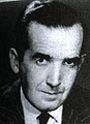
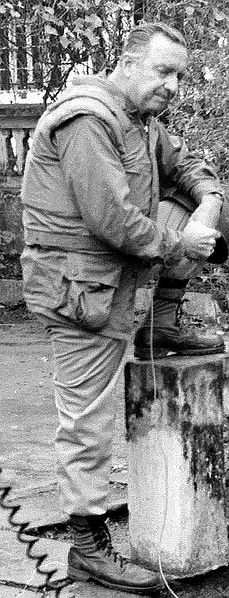
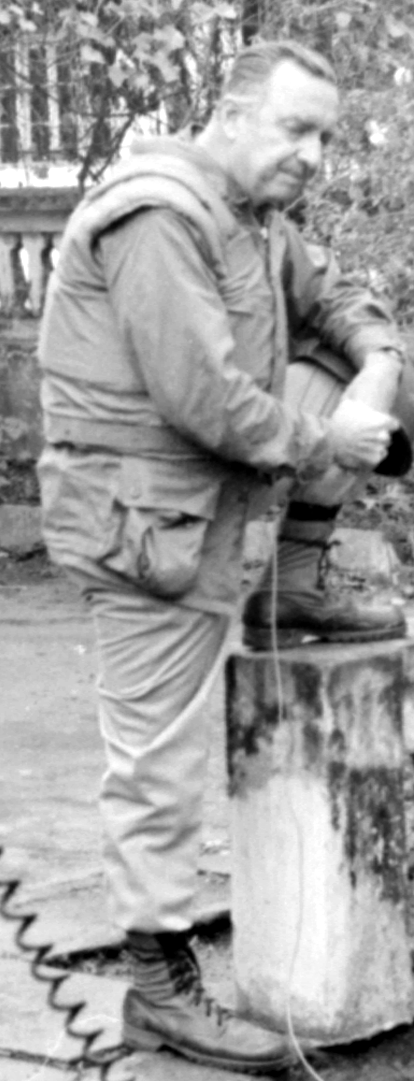
Cronkite in Vietnam, 1968

And in a flattering writeup recalling the occasion, CBS invoked a prominent media-driven myth — the notion that Cronkite’s on-air assessment in 1968 about the war in Vietnam exerted enormous influence. Until late in his life, not even Cronkite believed that was the case.

Even so, the CBS article declared:

“Cronkite’s intense focus on objectivity gave his rare dose of opinion — especially his 1968 assessment of the war in Vietnam — an enormous weight.”

The writeup quoted an executive producer, Susan Zirinsky, as saying:

“Lyndon Johnson remarked, because he looked at that broadcast, and he said, ‘If I’ve lost Walter Cronkite, I’ve lost the country.'”

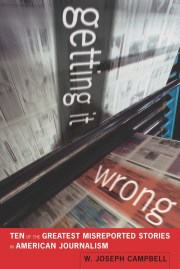
President Lyndon Johnson’s purported comment lies at the heart of this tenacious media myth — one of the 10 I address and debunk in my latest book, Getting It Wrong.

Interestingly, the comment so often attributed to Johnson has been described in so many ways. That is, there is no single version of what the president supposedly said in reacting to Cronkite’s assessment that the war was stalemated.

There’s the version Zirinsky invoked: “‘If I’ve lost Walter Cronkite, I’ve lost the country.”

More common is: “If I’ve lost Walter Cronkite, I’ve lost Middle America.”

Another variant has the president saying: “If I’ve lost Cronkite, I’ve lost the war.”

And so on.

As I point out in Getting It Wrong, “Version variability of that magnitude signals of implausibility. It is a marker of a media-driven myth.”

And it’s highly likely that Johnson said nothing of the sort.

He did not, after all, not see Cronkite’s report about Vietnam when it aired on CBS on February 27, 1968. The president that night was not in front of a television set when, near the close of the program, Cronkite declared that the U.S. military was “mired in stalemate” in Vietnam.
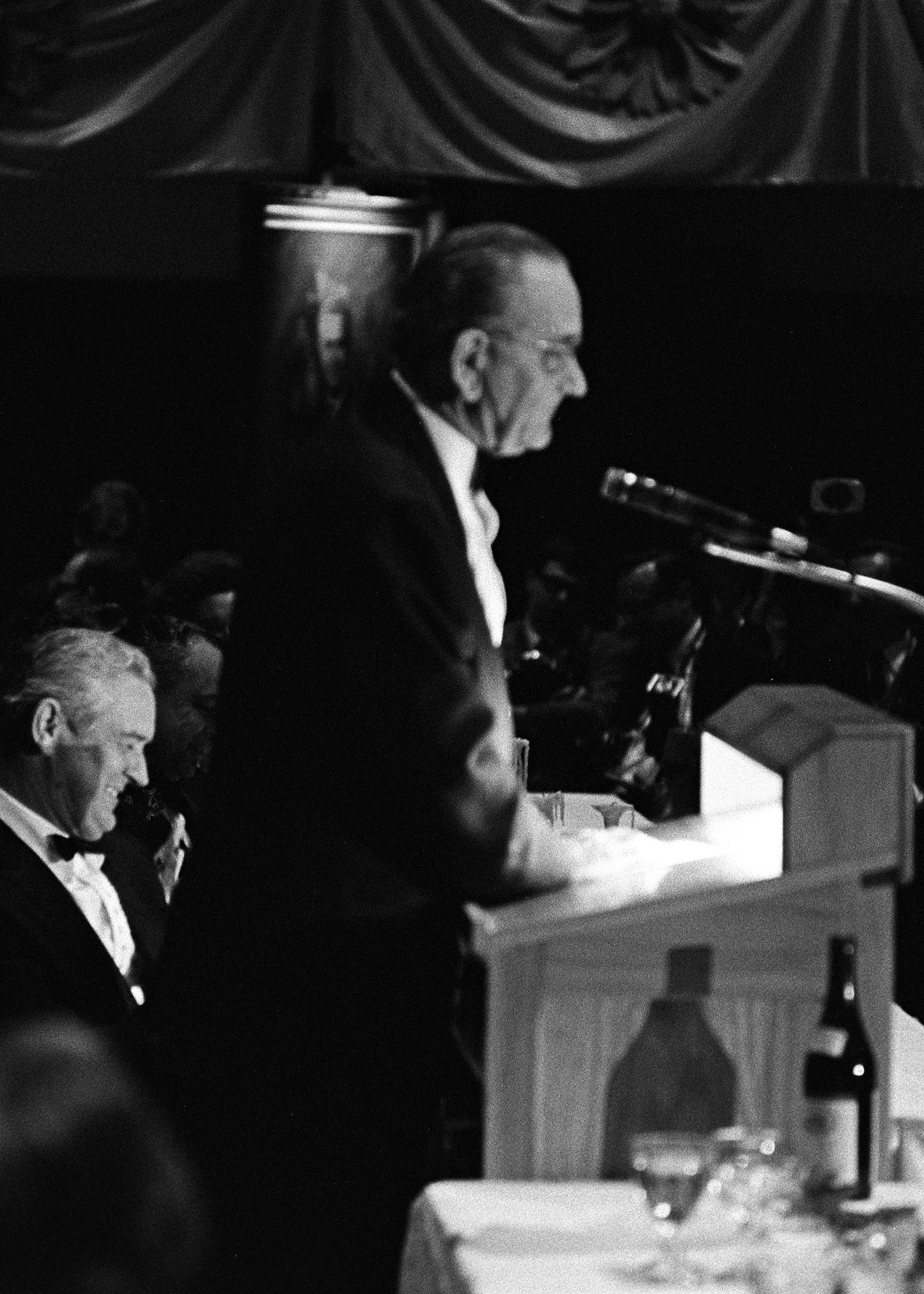
Johnson: Not in front of a TV

Johnson at that moment was at a black-tie birthday party for Texas Governor John Connally. The president poked fun at Connally, who was marking his 51st birthday.

“Today you are 51, John,” the president said. “That is the magic number that every man of politics prays for — a simple majority.”

It is difficult to fathom how Johnson could have been much moved by a program he did not see. And the power of what often is called the “Cronkite Moment” stems from the supposedly immediate and visceral effect the anchorman’s assessment had on the president.

But what Cronkite had to say on air that night was hardly earth-shaking, hardly stunning or novel.

If anything, Cronkite’s observation about “stalemate” was a rehash of what other news organizations, such as the New York Times, had been saying for months.

For example in August 1967, the Times inserted “stalemate” into the headline over a front-page news analysis about the war. The Times headline read:

Vietnam: The Signs of Stalemate.”

The newspaper’s analysis was filed from the South Vietnamese capital, Saigon, and noted:

“‘Stalemate’ is a fighting word in Washington. President Johnson rejects it as a description of the situation in Vietnam. But it is the word used by almost all Americans here, except the top officials, to characterize what is happening” in the war.

Before that, on July 4, 1967, the Times published a news analysis that said of the war effort:

“Many officers believe that despite the commitment of 466,000 United States troops now in South Vietnam … the military situation there has developed into a virtual stalemate.”

So in the context of the war in Vietnam, “stalemate” was hardly new by the time Cronkite turned to the word.

WJC

Recent and related:

Wasn’t so special: Revisiting the ‘Cronkite Moment,’ 44 years on

In Anniversaries, Cronkite Moment, Debunking, Media myths on February 27, 2012 at 12:59 am

A legendary moment in network news came 44 years ago tonight, when CBS News anchorman Walter Cronkite pronounced at the close of special report that the U.S. military was “mired in stalemate” in Vietnam and said negotiations might offer a way out.

Johnson: Not in front of a TV

Cronkite’s report aired February 27, 1968, and examined the Tet offensive that communist forces had launched across South Vietnam four weeks earlier.

At the White House that night, President Lyndon B. Johnson supposedly watched the Cronkite report. Upon hearing the popular anchorman’s downbeat assessment, Johnson realized his war policy was a shambles. The report was, the story goes, an epiphany for the president.

Johnson snapped off the television set and said to an aide or aides:

“If I’ve lost Cronkite, I’ve lost Middle America.”

Or something to that effect.

The report was so singularly and unexpectedly decisive that it has come to be celebrated as the “Cronkite Moment,” a totem of courage and insight, a revered model for broadcast journalism.

Except the “Cronkite Moment” wasn’t so special. Cronkite’s assessment about the war wasn’t novel or particularly insightful.

It was, if anything, a rehash of what other news organizations had been saying for weeks and months. “Stalemate” was much in the news back then.

The New York Times, for example, wrote “stalemate” into the headline over a news analysis about the war that was published on its front page in August 1967 — nearly seven months before Cronkite’s televised report. The Times headline read:

Vietnam: The Signs of Stalemate.”

The Times analysis, which was filed from the South Vietnamese capital, Saigon, noted:

“‘Stalemate’ is a fighting word in Washington. President Johnson rejects it as a description of the situation in Vietnam. But it is the word used by almost all Americans here, except the top officials, to characterize what is happening” in the war.

So “stalemate” had been often invoked, and much-debated, by the time Cronkite turned to the word.

Even more damaging to the purported exceptionality of the “Cronkite Moment” was that Johnson did not see the Cronkite report when it aired.

As such, the president could not have had the abrupt, visceral reaction that endows the purported “Cronkite Moment” with special power and resonance.

As I discuss in my latest book, Getting It Wrong, Johnson wasn’t at the White House on February 27, 1968; he wasn’t in front of a television set, either, when Cronkite intoned his “mired in stalemate” assessment.

The president was in Austin, Texas, attending the 51st birthday party of a political ally, Governor John Connally. About the time Cronkite made his on-air editorial comment, Johnson was making light of Connally’s age, saying:

“Today you are 51, John. That is the magic number that every man of politics prays for— a simple majority.”

As I also discuss in Getting It Wrong, there is no persuasive evidence that Johnson later saw Cronkite’s report on videotape.

Even if he had, it would have made no difference to his thinking about Vietnam.

Not long after the Cronkite report, Johnson delivered a rousing speech in Minneapolis, urging “a total national effort” to win the war in Vietnam. The speech was given March 18, 1968, and in it, the president declared:

“We love nothing more than peace, but we hate nothing worse than surrender and cowardice.”

Johnson, who died in 1973, did not mention the purported “Cronkite Moment” in his memoir, The Vantage Point.

For his part, Cronkite often described the program in modest terms, likening its effect on U.S. policy to a straw on a camel’s back. He turned to that analogy in writing his memoir, for example.

But in the years immediately before his death in 2009, Cronkite began to interpret the program in a somewhat grander light. He came to embrace the presumptive power of the “Cronkite Moment.”

In an interview with Esquire in 2006, for example, he said:

“To be honest, I was rather amazed that my reporting from Vietnam had such an effect on history.”

Interestingly, Cronkite also said he had never discussed the program and his famous editorial comment with Johnson.

According to a report in the Austin American-Statesman, Cronkite said in a teleconference call with a journalism class at Southwest Texas State University in 1997 that Johnson “never brought it up and I certainly never did.”

WJC

Many thanks to Instapundit
Glenn Reynolds for linking to this post.

Recent and related:

Just what we need: Barbra Streisand, media critic

In Cronkite Moment, Debunking, Media myths, Murrow-McCarthy myth on February 5, 2012 at 9:25 am

Celebrities and movie stars rarely make thoughtful, searching media critics, as Barbra Streisand demonstrated in a tedious and predictable essay the other day at Huffington Post.

The actress indulged a bit in the golden age fallacy, recalling broadcast journalists Edward R. Murrow and Walter Cronkite as exemplary newsmen whose talents these days are sorely missed.

“Americans,” Streisand wrote, “are busy, working hard to support and provide for their families. They don’t have time to parcel out fact from fiction. They depend on the Fourth Estate to guide them and to hold individuals running for office, especially the highest office in our country, accountable.”

The claim that Americans “depend on the Fourth Estate to guide them” is surely overstated, given evidence that many Americans go newsless and ignore media content altogether.

Streisand went on, extolling media icons of the past:

Murrow

“Journalists like Walter Cronkite and Edward R. Murrow knew it was their duty to know the facts and disseminate them to the public. That responsibility in today’s media world seems to be diminishing.”

Murrow, who came to fame on CBS radio in the 1940s and on CBS television in 1950s, was no white knight, though. He hardly was above the political fray.

As I note in my media mythbusting book, Getting It Wrong, Murrow privately donated time and expertise in acquainting Adlai Stevenson, the 1956 Democratic presidential candidate, with television.

I cite A.M. Sperber, one of Murrow’s leading biographers, who wrote that Murrow agreed “to help the Democrats” in offering Stevenson tips on “the finer points of speaking to the camera.”

Sperber, who characterized Murrow’s move “a radical departure from his usual practice,” said Stevenson “barely endured” the tutoring.

What’s more, Murrow is the subject of one of American journalism’s more savory and tenacious myths — that he stood up to the red-baiting senator, Joseph R. McCarthy, when no other journalist would, or dared.

Which is nonsense.

As I discuss in Getting It Wrong, Murrow was quite late in confronting McCarthy, doing so long after a number of journalists – including the muckraking columnist Drew Pearson– had become persistent and searching critics of the senator, his record, and his tactics.

Cronkite, the famous CBS News anchorman from 1963 to 1981, likewise is the subject of a durable media-driven myth — that his editorializing about the war in Vietnam in February 1968 forced President Lyndon B. Johnson to realize the folly of his policy.

Legend has it that Johnson was watching at the White House when Cronkite pronounced the U.S. military “mired in stalemate” in Vietnam. Cronkite also suggested the negotiations might offer a way out of the morass.

Upon hearing Cronkite’s downbeat assessment, Johnson supposedly leaned over and snapped off the television set, telling an aide or aides, “If I’ve lost Cronkite, I’ve lost Middle America.”

Or something to that effect. Versions vary, markedly.

But as I discuss in Getting It Wrong, Johnson did not see the program in which Cronkite made his editorial comment.

Johnson in Austin: Didn't see Cronkite show

Johnson at the time was in Austin, Texas, attending the 51st birthday party of Governor John Connally, a longtime political ally. About the time Cronkite was intoning “mired in stalemate,” Johnson was joking about Connally’s age, saying:

“Today you are 51, John. That is the magic number that every man of politics prays for—a simple majority.”

It’s illogical to argue that Johnson could have been much moved by a television report he hadn’t seen.

Granted, Cronkite’s editorial comment about Vietnam — tepid though it was — represented something of a departure for the avuncular anchorman. He usually tried to play it straight, because he had to.

As media critic Jack Shafer pointed out shortly after Cronkite’s death in 2009, the anchorman’s impartiality was partly a function of the federal “Fairness Doctrine,” which sought to encourage balanced reporting on the air.

Shafer wrote that “between 1949 and 1987 — which come pretty close to bookending Cronkite’s TV career — news broadcasters were governed by the federal ‘Fairness Doctrine.’ The doctrine required broadcast station licensees to address controversial issues of public importance but also to allow contrasting points of view to be included in the discussion.

“One way around the Fairness Doctrine was to tamp down controversy,” which he notes, the three U.S. television networks of the time “often did.”

So, no: Murrow and Cronkite weren’t exactly paragons of play-it-straight journalism. Pining for them while deploring today’s freewheeling media landscape is neither very sophisticated nor very useful.

Nor even fair to the historical record.

WJC

Recent and related:

‘Getting It Wrong’ goes on ‘One Hour of Hope’

In Anniversaries, Cinematic treatments, Cronkite Moment, Debunking, Jessica Lynch, Media myths, Washington Post, Watergate myth on January 10, 2012 at 12:15 pm

I recently was on “One Hour of Hope,” a satirically named radio show in Gainesville, Florida, to speak about several of the media-driven myths debunked in my latest book, Getting It Wrong.

Among them are the heroic-journalist trope of Watergate, the so-called “Cronkite Moment” of 1968, and the battlefield derring-do misattributed to Jessica Lynch early in the Iraq War.

The host of “One Hour of Hope,” Doug Clifford, noted at the outset of the interview that 2012 marks the 40th anniversary of the Watergate scandal’s signal crime, the breakin in June 1972 at the headquarters of the Democratic National Committee.

I am sure the anniversary will give rise  to a resurgence of the heroic-journalist interpretation of Watergate, which holds that the dogged investigative reporting of Washington Post reporters Bob Woodward and Carl Bernstein uncovered the scandal and brought about President Richard M. Nixon’s resignation in August 1974.

That media myth has become the dominant narrative of Watergate, I noted during the radio interview, which aired on WSKY-FM.

The persistence of that misreading narrative, I said, can be traced to All the President’s Men, Woodward and Bernstein’s 1974 book about their Watergate reporting, and especially to the 1976 movie by the same title.

The movie, by focusing on the exploits of Woodward and Bernstein, projects the notion that the reporters, with help from a the stealthy, high-level source code-named “Deep Throat,” unearthed the evidence that forced Nixon to quit.

That, I said, is a very simplistic interpretation, “a serious misreading of history” that ignores the far more powerful forces and factors that combined to uncover evidence of Nixon’s culpability.

Those forces, I noted, were typically subpoena-wielding and included committees of both houses of Congress, the Justice Department, the FBI, and a federal judge in Washington named John Sirica.

(Interestingly, the Washington Post, in its obituary of Sirica, said the judge’s “persistence in searching for the facts while presiding over the Watergate cases led to President Nixon’s resignation.”)

The myth of the “Cronkite Moment” represents another serious misreading of history, I said.

Clifford summarized the purported “Cronkite Moment,” that President Lyndon Johnson, in reaction to the CBS News anchor Walter Cronkite’s pessimistic assessment of the Vietnam War, said, “If I’ve lost Cronkite, I’ve lost America.”

I noted that versions of what the president said vary markedly and also include:

  • “If I’ve lost Cronkite, I’ve lost Middle America.”
  • “If I’ve lost Cronkite, I’ve lost the country.”
  • “If I’ve lost Cronkite, I’ve lost the war.”

(Version variability of such magnitude, I write in Getting It Wrong, is a revealing marker of a media-driven myth.)

I noted in the interview that there’s no evidence Johnson saw Cronkite’s television report about Vietnam when it aired February 27, 1968. At the time, the president was attending a birthday party for Governor John Connally on the campus of the University of Texas at Austin.

Nor is there any credible evidence that Cronkite’s reporting about Vietnam influenced  Johnson’s decision, announced in late March 1968, not to seek reelection.

Clifford asked about reporting of the Jessica Lynch case, and I said the bogus tale of her battlefield heroics was largely due to “sloppy reporting by the Washington Post.”

I described the newspaper’s electrifying report, published April 3, 2003, that cited otherwise unidentified “U.S. officials” in saying Lynch had fought fiercely in the ambush of Army unit in Iraq, that she had kept firing at Iraqi attackers even as she suffered gunshot and stab wounds.

But none of that proved true. Lynch fired not a shot in the attack. She was wounded not in the firefight with the Iraqis but in the crash of her Humvee as it tried to flee the ambush.

I also noted in the interview how a “false narrative that the military made up the story” has come to define the Lynch tale.

One of the reporters on the Post’s botched story, I pointed out, has said that the Pentagon wasn’t the newspaper’s source, and also has said that far “from promoting stories about Lynch, the military didn’t like the story.”

The false narrative, I added, has had the additional effect of obscuring recognition of the heroics of Donald Walters, a cook-sergeant who apparently performed the heroics deeds wrongly attributed to Lynch.

Walters laid down covering fire as Lynch and others in their unit sought to escape. He was captured when he ran out of ammunition, and soon afterward executed.

Clifford said his show’s title, “One Hour of Hope,” is a satiric gesture; his once-weekly, 60-minute program leans left while much of the rest of the station’s talk-show content is conservative in political orientation.

WJC

Recent and related:

Taking stock: Top mythbusting posts of 2011

In Anniversaries, Bra-burning, Cronkite Moment, Debunking, Jessica Lynch, Media myths, Murrow-McCarthy myth, Quotes, Washington Post, Watergate myth on December 31, 2011 at 4:45 am

Reviewing the year in media-mythbusting reveals a number of memorable posts. Here are the Media Myth Alert five top writeups of 2011, with a roster of other mythbusting posts of note:

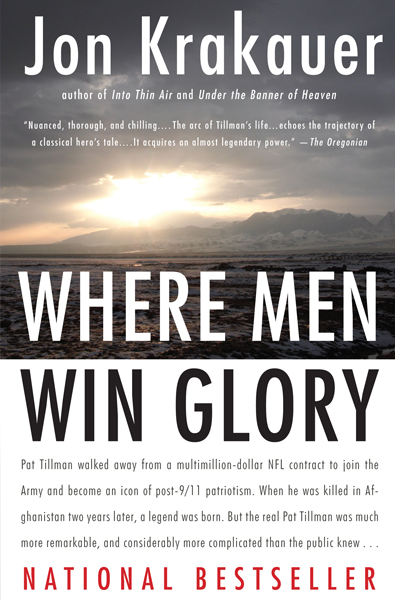
Krakauer retreats from Lynch-source claim (posted November 11): This post revealed author Jon Krakauer’s quiet retreat from claims in a 2009 book that Jim Wilkinson, a former White House official, was the source for the bogus Washington Post report about Jessica Lynch and her supposed battlefield heroics in the Iraq War in 2003.

The claims in Krakauer’s book were unattributed — and vigorously denied by Wilkinson, who sought a correction.

When it came, the correction was inserted unobtrusively in a new printing of the paperback edition of Krakauer’s book, Where Men Win Glory. It read:

“Earlier editions of this book stated that it was Jim Wilkinson ‘who arranged to give the Washington Post exclusive access’ to this leaked intelligence [about Jessica Lynch]. This is incorrect. Wilkinson had nothing to do with the leak.”

I’ve noted that the Post’s enduring silence about its sources on the Lynch story has allowed for the emergence not only of false allegations such as those about Wilkinson, but of a false narrative that the military concocted the tale about Lynch’s derring-do.

The false narrative  also has deflected attention from the soldier whose heroics apparently were misattributed to Lynch. He was Sgt. Donald Walters, a cook in Lynch’s unit.

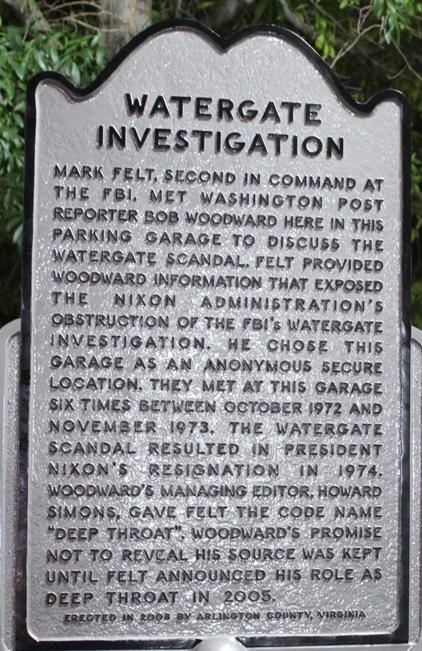
‘Deep Throat’ garage marker errs about Watergate source disclosures (posted August 18): A handsome historical marker went up in August outside the parking garage in Arlington, Virginia, where Bob Woodward of the Post conferred occasionally in 1972 and 1973 with his stealthy Watergate source, “Deep Throat.”

The marker, I pointed out, errs in describing the information Woodward received from the “Deep Throat” source, who in 2005 revealed himself as W. Mark Felt, formerly the FBI’s second in command.

The marker says:

“Felt provided Woodward information that exposed the Nixon administration’s obstruction of the FBI’s Watergate investigation.”

Which just isn’t so.

Such evidence, had “Deep Throat” offered it to Woodward, would have been so damaging and so explosive that it surely would have forced Richard Nixon to resign the presidency well before he did, in August 1974.

Felt didn’t have that sort of information — or (less likely) didn’t share it with Woodward.

I noted in my post about the marker that All the President’s Men, the book Woodward wrote with Carl Bernstein about their Watergate reporting, says Woodward’s conversations with “Deep Throat” were intended “only to confirm information that had been gathered elsewhere and to add some perspective.”

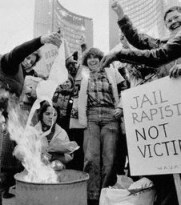
Bra-burning in Toronto: Confirmed (posted February 19): I ascertained in this post that an image of a bra-burning protest in Toronto in 1979 was no hoax, that the photograph was authentic.

I had not seen the photograph before it appeared in February with an article at the online site of  London’s Guardian newspaper.

I had doubts about the photo’s authenticity — given the periodic claims that no bras ever were burned at a feminist protest. The Toronto image, I suspected, might have been unethically altered.

Turns out that was not the case.

I tracked down one of the participants at the Toronto protest and she confirmed the bra-burning, saying by phone from Vancouver:

“The photo is authentic. Absolutely. It happened.”

The participant was Vicki Trerise, who appears at the far right in the photograph above.

The photograph shows a moment of demonstrative bra-burning, although Trerise said it “wasn’t a focal point” of the protest, which took place not far from Toronto’s City Hall.

The bra-burning came near the end of the demonstration, which was called to protest what the organizers said was an illogical report about rape, prepared by the Ontario Provincial Police.

Trerise said the demonstrators in Toronto were media-savvy and “knew that if they burned a bra, someone would take their picture.”

Suspect Murrow quote pulled at Murrow school (posted February 17): The online welcome page of the dean of the Edward R. Murrow College of Communication at Washington State University contained a quotation attributed to Murrow that’s only half-true.

Murrow

The quote reads:

“We must not confuse dissent with disloyalty. When the loyal opposition dies, I think the soul of America dies with it.”

As I’ve reported previously, the first portion of the quote was indeed spoken by Murrow, in his mythical 1954 television program that addressed Senator Joseph McCarthy’s red-baiting ways.

The second part of the quote — “When the loyal opposition dies, I think the soul of America dies with it” — is apocryphal.

In February, I found that the full quotation — accompanied by a facsimile of Murrow’s signature — was posted at the welcome page of Dean Lawrence Pintak of Murrow College at Washington State, Murrow’s alma mater.

I asked the dean what knew about the quote’s provenance, noting that I had consulted, among other sources, a database of historical newspapers which contained no articles quoting the “loyal opposition” passage.

Pintak referred my inquiry to an instructor on his faculty who, a few hours later, sent an email to the dean and me, stating:

“While [the ‘loyal opposition’ quotation] seems to reflect the Murrow spirit, the lack of evidence that he phrased it that way is indeed suspicious.”

He added: “I feel the evidence says no, Murrow did not say this.”

By day’s end, the suspect quote had been pulled from the welcome page. Just the authentic portion — “We must not confuse dissent with disloyalty” — remained posted there.

Mythmaking in Moscow: Biden says WaPo brought down Nixon (posted March 12): Joe Biden, the hapless U.S. vice president, repeated the dominant but misleading narrative about the Watergate scandal in March by telling an audience in Moscow that the Washington Post had “brought down” Richard Nixon’s corrupt presidency.

The gaffe-prone Biden told his audience:

“In my country it was a newspaper, not the FBI, or the Justice Department, it was a newspaper, the Washington Post that brought down a President for illegal actions.”

It’s a version of scandal that few serious historians accept. Not even the Washington Post buys into such a myth-encrusted interpretation.

Indeed, principals at the Post from time to time have sought to distance the newspaper from that misleading assessment.

For example, Katharine Graham, the newspaper’s publisher during and after the Watergate scandal, said in 1997, at a program marking the 25th anniversary of the scandal:

“Sometimes people accuse us of bringing down a president, which of course we didn’t do. The processes that caused [Nixon’s] resignation were constitutional.”

More recently, Michael Getler, then the newspaper’s ombudsman, wrote in 2005:

“Ultimately, it was not The Post, but the FBI, a Congress acting in bipartisan fashion and the courts that brought down the Nixon administration.”

Such comments are not the expressions of false modesty. Instead, they represent a more accurate reading of the history of Watergate than Biden offered up in Moscow.

Even so, in the run-up to the scandal’s 40th anniversary in 2012, the Watergate myth — the heroic-journalist trope — is sure to emerge often and insistently.

But the Post and its reporting of Watergate assuredly did not bring down Nixon, as I discuss in Getting It Wrong, my latest book which was published in 2010.

WJC

Many thanks to Instapundit
Glenn Reynolds for linking to this post.

Other memorable posts of 2011:

Cronkite, Johnson, and the deceptive ‘yardstick’

In Cronkite Moment, Debunking, Media myths on December 7, 2011 at 11:25 am

Cronkite: Wasn't watching Cronkite

The Huffington Post blog bit on the mythical “Cronkite Moment” yesterday, declaring it “a yardstick for how much things have changed.”

That is, how news media once were trusted and respected and influential. Nowadays, not so much.

But if the “Cronkite Moment” is a yardstick of any kind, it’s a measure of how profoundly the media myth has become embedded in the lore of American journalism.

The purported “Cronkite Moment” was on February 27, 1968, when CBS News anchorman Walter Cronkite declared the U.S. military was “mired in stalemate” in Vietnam and suggested that negotiations ultimately might offer a way out.

President Lyndon B. Johnson, as the myth has it, watched the Cronkite report at the White House and, upon hearing the “mired in stalemate” assessment, declared:

“If I’ve lost Cronkite, I’ve lost Middle America.” (Or something to that effect.)

The Huffington Post essay invoked the president’s purported comment in referring to the presumptive “Cronkite Moment,” asserting:

“LBJ famously commented, ‘If I’ve lost Cronkite, I’ve lost Middle America,’ after the beloved journalist called the war ‘unwinnable.’ Several weeks later, Johnson announced that he would not seek reelection as president.”

That paragraph embraces some of the most prominent myths and misunderstandings that have grown up around the presumptive “Cronkite Moment.” Let’s peel them back.

First, Cronkite did not declare the war in Vietnam “unwinnable.” He said the U.S. military was “mired in stalemate” — which hardly was a novel or stunning assessment in early 1968. Many news organizations in fact had used “stalemate” months before Cronkite’s program to characterize the war.

Second, Johnson’s decision not to seek reelection in 1968 had nothing to do with Cronkite’s program. Indeed, there’s strong evidence that Johnson never intended to seek another term, that in 1967, or even earlier, he had decided against another campaign for the presidency.

Johnson wrote in his memoir, The Vantage Point: “Long before I settled on the proper forum to make my announcement, I had told a number of people of my intention not to run again.”

Third, and perhaps most important, is that Johnson did not see Cronkite’s report about Vietnam when it aired.

As I discuss in my latest book, Getting It Wrong, Johnson at the time wasn’t at the White House but at a black-tie party in Austin, Texas, marking the 51st birthday of Governor John Connally.

The president wasn’t agonizing that night over the supposed loss of Cronkite’s support; he wasn’t lamenting having “lost Cronkite.”

Instead, Johnson was offering light-hearted comments about Connally’s age, saying:

“Today you are 51, John. That is the magic number that every man of politics prays for—a simple majority. Throughout the years we have worked long and hard—and I might say late—trying to maintain it, too.”

As I note in Getting It Wrong, there’s no evidence Johnson saw the Cronkite program at a later date, on videotape.

Even if he had, it made no difference to his thinking about Vietnam.

Not long after Cronkite’s program, Johnson delivered a rousing speech in Minneapolis, where he urged “a total national effort” to win the war in Vietnam. That speech was given March 18, 1968, and in it, the president declared:

“We love nothing more than peace, but we hate nothing worse than surrender and cowardice.”

Under scrutiny, then, the presumptive “Cronkite Moment” dissolves as illusory. And not  surprisingly so.

As I point out in Getting It Wrong:

“Seldom, if ever, do the news media exert truly decisive influences in decisions to go to war or to seek negotiated peace. Such decisions typically are driven by forces and factors well beyond the news media’s ability to shape, alter, or significantly influence. So it was in Vietnam, where the war ground on for years after the “Cronkite moment.”

WJC

Recent and related:

A thumbsucker commentary and the Zhou misinterpretation

In Cronkite Moment, Debunking, Furnish the war on December 2, 2011 at 12:49 am

A thumbsucker is what some American journalists call a self-indulgent article or commentary that tends to go on and on, usually about an obscure or time-worn topic.

At its online site yesterday, Britain’s Guardian newspaper posted a thumbsucker that ruminated about the close of historical periods, offering observations such as this:

“Bloodied soldiers didn’t stand around on the battlefield at Bosworth and immediately reflect that, though it had been a hard-fought day, at least the later Middle Ages had now ended.”

Obscure, perhaps, but not altogether uninteresting.

But what caught the eye of Media Myth Alert was the reference to the conventional but erroneous version of Zhou Enlai’s famous and often-quoted comment in 1972, that it was “too early” to assess the implications of the French Revolution.

That version is frequently offered as evidence of China’s sage, patient, and far-sighted ways. That’s rather how the Guardian thumbsucker-commentary referred to it, saying:

“If, as Zhou Enlai said, it is too soon to have a view of the French Revolution, then it is probably too soon to say if the [governing] coalition [in Britain] is a failed government.”

But Zhou was not referring to the French Revolution that began in 1789.

He was speaking about the political turmoil in France of 1968.

We know this from a retired U.S. diplomat, Charles W.  (Chas) Freeman Jr., who was present when Zhou made the comment during President Richard Nixon’s visit to China in 1972.

Freeman, who was Nixon’s interpreter during the historic, weeklong trip, offered the revised interpretation almost six months ago at a panel discussion in Washington.  The discussion’s moderator was Richard McGregor, a journalist and China expert who wrote about Freeman’s comments for the Financial Times of London.

In a subsequent interview with me, Freeman elaborated on his recollection about Zhou’s comment, saying it probably was made over lunch or dinner, during a conversation about revolutions that had succeeded and failed. The discussion, Freeman said, touched on the Prague Spring of 1968 and the Hungarian uprising of 1956, both of which the Soviet Union crushed.

Freeman said it was “absolutely clear” from the context of the discussion that Zhou was speaking about 1968.

Just how Zhou’s remark came to be so dramatically misinterpreted, Freeman was unable to say.

“I cannot explain the confusion about Zhou’s comment except in terms of the extent to which it conveniently bolstered a stereotype (as usual with all stereotypes, partly perceptive) about Chinese statesmen as far-sighted individuals who think in longer terms than their Western counterparts,” Freeman said. “It was what people wanted to hear and believe, so it took” hold.

Stereotyping is but one hazard of dubious quotes like Zhou’s.

Dubious and misinterpreted quotes tend to are falsehoods masquerading as the truth — as suggested by the delicious but apocryphal tale about William Randolph Hearst and his purported vow to “furnish the war” with Spain at the end of the 19th century.

Dubious quotes also dishonor their purported authors — as in the comment often attributed to President Lyndon B. Johnson. Upon hearing newsman Walter Cronkite’s downbeat assessment about the war in Vietnam, Johnson supposedly said:

“If I’ve lost Cronkite, I’ve lost Middle America.”

Or something to that effect.

But as I note in my latest book, Getting It Wrong, there’s no persuasive evidence that Johnson ever made such a comment.

Besides, he didn’t see Cronkite’s report about Vietnam when it aired in late February 1968.

So it’s very difficult to believe the president could have been much moved by a show he didn’t see.

Or that he would have uttered such a comment, if he had seen the program.

WJC

Recent and related:

What ‘lesson’ from Cronkite?

In Cronkite Moment, Debunking, Media myths on November 18, 2011 at 2:20 am

The presumptive “Cronkite Moment” of 1968 has gained significance far beyond what little influence it exerted at the time.

Cronkite in Vietnam

The “Cronkite Moment” came February 27, 1968, when CBS News anchorman Walter Cronkite declared in a special report that the U.S. military was “mired in stalemate” in Vietnam and said negotiations might eventually offer a way out.

As I point out in my latest book, Getting It Wrong, the program has “become the stuff of legend — certainly among the most unforgettable moments in American journalism.”

The gauzy legend was embraced yesterday in a commentary at the “Philly Post,” a blog of Philadelphia Magazine.

The commentary argued that journalists should emphasize truth-seeking rather than impartiality in their reporting, and invoked the “Cronkite Moment” to support that claim.

“In one of his most famous newscasts,  the ‘most trusted man in America’  threw objectivity out the window” and offered the “mired in stalemate” assessment about Vietnam, the commentary said, adding:

“In calling it like he saw it, Cronkite was not being impartial, but that doesn’t mean he was being biased. He was stating the conclusion he was led to by the evidence; and Americans — at least those sensible enough to listen— respected him for it. Among the many lessons modern journalists can learn from Cronkite, this is perhaps the most important.”

So that was Cronkite’s “most important” lesson?

A thin lesson it was, then.

As I note in Getting It Wrong, Cronkite’s “mired in stalemate” assessment  “was neither notable nor extraordinary” in early 1968.

That’s because “stalemate” had been in use by U.S. news media months before the so-called “Cronkite Moment.”

In August 1967, for example, the New York Times said in a news analysis that the war in Vietnam “is not going well.”

U.S. victory, the Times said, “is not close at hand. It may be beyond reach.”

The Times’ analysis was published on the front page, beneath the headline:

Vietnam: The Signs of Stalemate.”

Also in August 1967, the syndicated columnist James J. Kilpatrick wrote:

“So long as the present ground rules obtain in Vietnam, this war will drag along its indecisive way. … [T]he condition is stalemate.”

And a few weeks before Cronkite’s on-air commentary, the Times declared in an editorial:

“Politically as well as militarily, stalemate increasingly appears as the unavoidable outcome of the Vietnam struggle.”

The real lesson of the “Cronkite Moment” was how the vaunted anchorman trailed the emerging media consensus about the war, turning to “stalemate” only after the characterization had been tested and invoked often, by other news organizations.

Cronkite also trailed public opinion as it turned against the war.

A Gallup poll in October 1967 reported, for the first time, that a plurality of Americans — 47 percent — felt sending troops to fight in Vietnam had been a mistake.

A little more than two years earlier, only 24 percent of respondents said they thought sending American forces to Vietnam had been a mistake.

So in his assessment about Vietnam, Cronkite was neither brave nor cutting edge.

Nor legendary at all.

WJC

Recent and related:

Public opinion, Vietnam, and Cronkite’s ‘untouchable aura of authority’

In Cronkite Moment, Debunking, New York Times on November 5, 2011 at 8:58 am

The fantasy that Walter Cronkite represented an ideal of dispassionate, authoritative news reporting is so alluring that even the anchorman’s long-ago birthday has become an occasion for honoring his “untouchable aura of authority.”

The Smithsonian Institution’s “Around the Mall” blog did just that yesterday, in a post that recalled Cronkite, who was born November 4, 1916, as “an anchor who [spoke] with the authority of a religious leader or founding father.”

A “religious leader or founding father”?

Oh, spare us the hyperbole.

Cronkite read the news for 19 news as anchor of the CBS Evening News program. And his purported trustworthiness was more likely than not a function of a relic of mid-20th century broadcasting called the “Fairness Doctrine.”

Media critic Jack Shafer called attention to this linkage in a fine column written shortly after Cronkite’s death in 2009.

Shafer wrote:

“Accepting for the moment the argument the public trusted Cronkite because he practiced trustworthy journalism, it’s worth mentioning that between 1949 and 1987 — which come pretty close to bookending Cronkite’s TV career — news broadcasters were governed by the federal ‘Fairness Doctrine.’

“The doctrine required broadcast station licensees to address controversial issues of public importance but also to allow contrasting points of view to be included in the discussion. One way around the Fairness Doctrine was to tamp down controversy, which all three networks often did.”

Not often did Cronkite court controversy on the air.

The hagiographic “Around the Mall” piece hints at one of those few occasions — in late February 1968 when Cronkite, after a visit to Vietnam, declared the U.S. military effort there was “mired in stalemate.”

“Around the Mall” asserted that “Cronkite’s untouchable aura of authority led droves of viewers to change their opinions on Vietnam.”

And what evidence did the blog post produce?

A comment by David Ward, an historian at the National Portrait Gallery who is the biographer of Charles Willson Peale. Ward was quoted as saying about Cronkite’s reporting:

“He comes back [from Vietnam] and raises real questions about what our aims are, and whether the aims are being accurately reported to the American people. In 1968, there were plenty of people who were protesting the war in Vietnam. It’s the fact that he’s a firmly established, mainstream, church-going, centrist, respectable person that matters.”

Well, maybe. But the historian’s remark is hardly evidence that Cronkite’s views “led droves of viewers to change their opinions on Vietnam.”

More precisely, it was the other way round: Cronkite followed rather than led public opinion on the war.

As I discuss in my latest book, Getting It Wrong, public support for the war in Vietnam had begun declining months before Cronkite went on the air to say the conflict was “mired in stalemate.”

A Gallup poll conducted in October 1967 found for the first time that a plurality of Americans — 47 percent — felt sending troops to fight in Vietnam had been a mistake.

A little more than two years earlier, only 24 percent of respondents said they thought sending American forces to Vietnam had been a mistake.

I also point out in Getting It Wrong that print journalists detected a softening in support of the war long before Cronkite’s “mired in stalemate” assessment.

In December 1967, for example, Don Oberdorfer, a national correspondent for the Knight newspapers, noted that the “summer and fall of 1967 [had] been a time of switching, when millions of American voters — along with many religious leaders, editorial writers and elected officials — appeared to be changing their views about the war.”

What’s more, Cronkite’s “mired in stalemate” observation was hardly a novel or stunning characterization.

Journalists had been using the term “stalemate” for months in commentaries, analysis, and news reports about the war.

For example, syndicated columnist James J. Kilpatrick wrote in August 1967:

“So long as the present ground rules obtain in Vietnam, this war will drag along its indecisive way. … [T]he condition is stalemate.”

Also in August 1967, the New York Times said in a news analysis that the war in Vietnam “is not going well.”

U.S. victory, the Times said, “is not close at hand. It may be beyond reach.”

The analysis was published on the front page, beneath the headline:

“Vietnam: The Signs of Stalemate.”

So not only did he trail public opinion, Cronkite followed news media interpretations of the war as well.

WJC

Recent and related:

Expansive claims for a mythical ‘moment’

In Cronkite Moment, Debunking on October 24, 2011 at 1:05 am

Cronkite in Vietnam, 1968

The claims about the presumed power of the “Cronkite Moment” of 1968 — when CBS News anchorman Walter Cronkite declared on-air that the U.S. military was “mired in stalemate” in Vietnam — are expansive and ever-expanding.

What supposedly made the “Cronkite Moment” so powerful and memorable was its effect of President Lyndon Johnson who, upon hearing the anchorman’s assessment, purportedly exclaimed:

“If I’ve lost Cronkite, I’ve lost Middle America.”

Or something to that effect.

Versions vary, markedly.

But as I discuss in my latest book, Getting It Wrong, Johnson did not see the Cronkite show when it aired on February 27, 1968. The president at the time was offering light-hearted remarks at the 51st birthday party of John Connally, then the governor of Texas.

So it’s hard to fathom how Johnson could have been much moved by a program he did not see.

Another expansive claim for the presumptive “Cronkite Moment” was that the “mired in stalemate” assessment turned American public opinion against the war.

Forbes magazine offered up that claim in a recent commentary, which declared:

“After viewing the carnage of a real war on televised nightly news for a few years, Middle America eventually agreed with CBS anchor Walter Cronkite, the ‘most trusted man in America,’ when he declared in 1968 that the war would end in stalemate.”

Agreed with Cronkite? In fact, Cronkite was following rather than leading American public opinion on the war.

As I discuss in Getting It Wrong, support for the war had begun ebbing months before the Cronkite program.

A Gallup poll in October 1967 found for the first time that a plurality of Americans — 47 percent — felt sending troops to fight in Vietnam had been a mistake.

A little more than two years earlier, only 24 percent of respondents said they thought sending American forces to Vietnam had been a mistake.

Not only that, but Cronkite’s “mired in stalemate” was hardly a remarkable or original assessment.

U.S. news media had used “stalemate” to describe the war months before Cronkite used the word in his on-air editorial comment.

For example, syndicated columnist James J. Kilpatrick wrote in August 1967:

“So long as the present ground rules obtain in Vietnam, this war will drag along its indecisive way. … [T]he condition is stalemate.”

And a few weeks before Cronkite’s on-air commentary, the NewYork Times declared in an editorial:

“Politically as well as militarily, stalemate increasingly appears as the unavoidable outcome of the Vietnam struggle.”

The Times’ observation, published February 8, 1968, anticipated Cronkite’s quite similar assessment of February 27, 1968:

“To say we are mired in stalemate seems the only realistic, yet unsatisfactory, conclusion.”

WJC

Recent and related: