W. Joseph Campbell

Archive for the ‘Debunking’ Category

CBC modifies its Bay of Pigs claim — but still has it wrong

In Anniversaries, Bay of Pigs, Debunking, Media myths, New York Times on April 19, 2011 at 2:03 pm

After my post Sunday that called attention to its erroneous characterization of  the New York Times reporting in the run-up to the Bay of Pigs invasion, CBC News in Canada modified its claim that at “the direct request” of the President John F. Kennedy, the Times “played down” its story about the pending invasion of 50 years ago.

The CBC now says the Times “played down their story at the direct request of the Kennedy administration.” It’s a slight modification, but a significant shift in storyline, away from Kennedy to an unnamed person or persons in his administration.

Even so, the CBC offered no compelling evidence about who in the Kennedy administration made such a request to the Times, when, to whom, or how.

The modification does little more than muddy matters.

And the CBC still doesn’t have it right about Kennedy, the Times, and the run-up to the ill-fated Bay of Pigs invasion.

As I point out in Getting It Wrong, my media-mythbusting book that devotes a chapter to the New York Times-Bay of Pigs suppression myth, there is no compelling evidence that Kennedy or anyone in his administration pressured, lobbied, or persuaded the Times to modify, emasculate, or sanitize the article it published April 7, 1961, which lies at the heart of this media-driven myth.
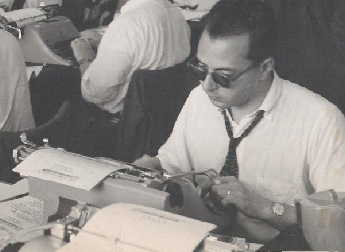
Szulc of the Times

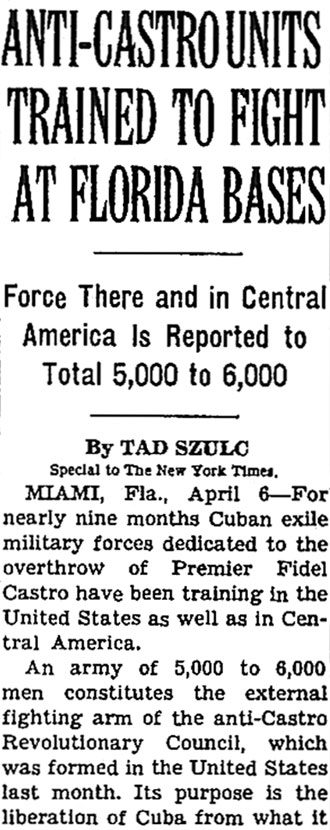
That article was written by a veteran correspondent named Tad Szulc, who reported that a force of Cuban exiles had been training in the United States and Central America, preparing to launch an armed assault on the regime of Fidel Castro.

I point out in Getting It Wrong that the recollections of none of the principal figures in the Times-suppression episode say that Kennedy pressured the newspaper’s editors about the Szulc story.

These recollections, I write, “include the memoirs of Turner Catledge, then the managing editor of the Times; of James (Scotty) Reston, then the chief of the Times’ Washington bureau; of Pierre Salinger, Kennedy’s press secretary, and of Arthur M. Schlesinger Jr., an award-winning Harvard historian who was a White House adviser to Kennedy.”

It’s highly improbable that a such juicy detail as Kennedy’s purported interference with the Times’ news judgment would have been so thoroughly ignored by such a disparate cast.

Moreover, the compelling insider’s account written by Harrison E. Salisbury, a former Times senior editor and Pulitzer Prize-winning correspondent, asserted that the Kennedy White House neither knew about, nor meddled in, the newspaper’s deliberations about its pre-invasion coverage.

Salisbury was unequivocal about that, writing in his 1980 work, Without Fear or Favor:

“The government in April 1961, did not … know that The Times was going to publish the Szulc story, although it was aware that The Times and other newsmen were probing in Miami. Nor did President Kennedy telephone Dryfoos, Scotty Reston or Turner Catledge about the story…. The action which The Times took [in editing Szulc’s report] was on its own responsibility,” the result of its internal discussions and deliberations.

“Most important,” Salisbury added, “The Times had not killed Szulc’s story.” The newspaper, he wrote, “believed it was more important to publish than to withhold. Publish it did.”

Even with the modification of its article about the Bay of Pigs, the CBC was not inclined to abandon entirely the notion that Kennedy, somehow, took a direct role in meddling with the Times. In a sidebar article posted Sunday, the CBC asserted:

“Numerous sources say that President Kennedy spoke with someone at the New York Times about their reporting there was going to be an invasion of Cuba.”

Many sources may have made such a claim. But assertion is not evidence. And none of the sources mentioned by the CBC offered documentation for their claims.

The CBC sidebar referred specifically to David Halberstam, who wrote The Powers That Be, and Peter Wyden, author of Bay of Pigs: The Untold Story.

Halberstam offered a highly colorful  yet uncorroborated claim that Kennedy called Reston “and tried to get him to kill” Szulc’s article.

Kennedy “argued strongly and passionately about what the Szulc story would do to his policy,” Halberstam wrote, adding that the president warned that the Times would risk having blood on its hands were the article published and the invasion a failure.

Wyden claimed that Orvil Dryfoos, then the Times president, “was in touch with” Kennedy, and the president “was upset” by plans to publish the report.

In a footnote, Wyden added: “It can no longer be determined whether Dryfoos contacted the President or whether Kennedy was told about the story and took the initiative.”

The CBC sidebar referred to yet another version, offered in a history of the Times titled The Trust: The Private and Powerful Family Behind the New York Times. According to that account, Reston took the initiative to call the CIA director, Allen Dulles, to speak with him about Szulc’s story as it was being prepared for publication.

“Dulles advised Scotty [Reston] that, for national security reasons, it would be best not to publish the story,” according to The Trust’s version. “However, if the Times decided it absolutely must publish, it should keep [references to] the CIA out of it.”

Such a conversation, however, was neither mentioned nor hinted at by Reston in his memoir, Deadline, which discussed in some detail the Times’ handling of the Szulc story.

And if it Dulles did offer such pre-invasion advice, the suggestions were made in response to Reston’s inquiry — which is quite apart from the Kennedy administration’s calling on, and lobbying, the Times.

Significantly, the versions of Halberstam, Weyden, and The Trust do not agree on who called whom, or what was discussed. Collectively, they offer a great deal of version variability — shifting accounts of what Kennedy supposedly said, and with whom at the Times he supposedly spoke.

Version variability of such magnitude can be a marker of a media-driven myth, as I point out in Getting It Wrong.

That Kennedy took the initiative and called on the Times to encourage the newspaper to tread lightly in its pre-invasion reporting is at the heart of this media myth. And there’s no evidence to support that claim — as the CBC’s modification indicates.

WJC

Recent and related:

Canada’s CBC invokes Bay of Pigs suppression myth

In Anniversaries, Bay of Pigs, Debunking, Media myths, New York Times, Newspapers on April 17, 2011 at 2:38 am

CBC News in Canada invoked the hardy New York Times-Bay of Pigs suppression myth this weekend in a lengthy online article recapping the failed invasion of Cuba, which was launched 50 years ago today.

The suppression myth has it that the Times, at the behest of President John F. Kennedy, spiked or emasculated its detailed report about invasion preparations.

But as I discuss in Getting It Wrong, my media-mythbusting book that came out last year, neither Kennedy nor anyone in his administration asked or lobbied the Times to kill or tone down the pre-invasion report, which was published on the newspaper’s front page on April 7, 1961.

Moreover, the Times coverage of the pending invasion was not confined to that article.

As I point out in Getting It Wrong: “The suppression myth … ignores that several follow-up stories and commentaries appeared in the Times during the run-up to the invasion.”

The CBC, however, invoked the hoary suppression myth as if it were genuine. It declared, in reference to the Times report of April 7, 1961:

“The Times had actually played down their story at the direct request of Kennedy, something both he and The Times’ editors later regretted. Shortly after the invasion, Kennedy reportedly told a Times editor, ‘if you had printed more about the operation, you would have saved us from a colossal mistake.'”

No call to the Times

While Kennedy did not call on Times editors before the invasion, he did say on separate occasions in the months afterward that had the newspaper printed more details about the pending invasion, it “would have saved us from a colossal mistake.”

Of course, such comments were quite self-serving. I note in Getting It Wrong that they “represented an attempt to deflect blame for the debacle” at the Bay of Pigs, where the invasion force of CIA-trained exiles was rolled up within three days.

James (“Scotty”) Reston of the Times later characterized Kennedy’s comments as “a cop-out,” adding:

“It is ridiculous to think that publishing the fact that the invasion was imminent would have avoided this disaster. I am sure the operation would have gone forward” nonetheless.

I note in Getting It Wrong that the Times’ pre-invasion coverage cited no prospective date for the invasion. But the newspaper’s front-page reports in April 1961 unmistakably signaled that something was afoot, that an attempt to oust Castro by arms was forthcoming. And on April 17, 1961, at the Bay of Pigs in southern Cuba, the invasion force of some 1,400 exiles launched their ill-fated attack.

The Times wasn’t alone, either, in reporting about the pending invasion. Its competition on the pre-invasion story included the Miami Herald, the New York Herald Tribune, and Time magazine.

According to a critique published in May 1961 in The Reporter, a journalists’ trade publication, the pre-invasion story “was covered heavily if not always well” by the U.S. news media.

So what, then, accounts for the emergence and tenacity of the Times-Bay of Pigs suppression myth?

I write in Getting It Wrong that the myth’s most likely derivation lies in confusion with a separate episode during the Cuban Missile Crisis in October 1962, when Kennedy did ask the Times to hold off publishing a report about the Soviets having deployed nuclear-tipped weapons in Cuba.

On that occasion, when the prospect of a nuclear exchange seemed in the balance, the Times complied, holding off publication 24 hours.

“What likely has happened is that, over the years, distinctions between the separate incidents surrounding the Times and Cuba became blurred,” I write. “That is, it was mistakenly thought that Kennedy had called the Times executives about the newspaper’s coverage in the days before the Bay of Pigs invasion when, in fact, his call came on an entirely different matter in 1962.”

WJC

Recent and related:

More mythical claims for WaPo’s Watergate reporting

In Debunking, Media myths, Washington Post, Watergate myth on April 16, 2011 at 8:35 am

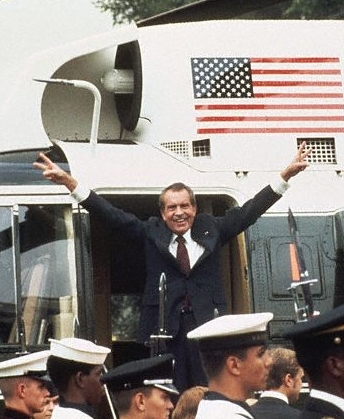
Nixon quits

The claims for the Watergate reporting of Bob Woodward and Carl Bernstein seldom are very modest. The mythical notion that their reporting brought down President Richard Nixon in 1974 is among the most cherished — and extravagant — tales in American journalism.

But the assertions posted yesterday at the online site of a Texas alternative newspaper were extraordinary in their lavishness.

The newspaper, the Austin Chronicle, declared:

“In the summer of 1972, when the unlikely duo of Washington Post reporters Woodward and Bernstein stumbled onto what would turn out to be the most important hard news story of the century, investigative journalism and the gritty and laborious, but ultimately necessary, processes it entailed reached a zenith.

“Public people in positions of great – and presumably unassailable – power went to prison as a result of Woodward and Bernstein’s dogged determination not to allow what was initially perceived as a nonstory to die out. They stuck to their guns, their guts, and their deadlines. And in the end, President Richard Milhous Nixon, facing impeachment and charges of high crimes and misdemeanors, was forced out of office by genuine, bipartisan outrage. Absolute hubris corrupted absolutely. It was a brief, shining moment when American journalism not only shook the pillars of power but also very nearly toppled them.”

There’s a lot of exaggeration to unpack there, so let’s focus on key claims:

  • Woodward and Bernstein “stumbled onto what would turn out to be the most important hard news story of the century.”
  • “Public people” went to prison because of their Watergate reporting.
  • Woodward and Bernstein’s work on Watergate was a moment when “American journalism … shook the pillars of power.”

This is not to quibble with word choice, but Woodward and Bernstein certainly did not stumble onto the Watergate scandal. They were assigned by editors at the Washington Post to dig into the highly suspicious breakin in June 1972 at the headquarters of the Democratic national committee.

As Edward Jay Epstein pointed out in his brilliant 1974 essay, the reporting of Woodward and Bernstein was highly derivative, sustained by leaks from federal investigations into the crimes of Watergate.

And I note in my media-mythbusting book, Getting It Wrong, that “Woodward and Bernstein did not uncover defining and decisive elements of the Watergate scandal” — the White House attempt to cover-up crimes associated with the breakin and the payment of hush money to the Watergate burglars.

Those aspects of the scandal, Woodward was quoted as saying in 1973, were “held too close. Too few people knew. We couldn’t get that high.”

As for the claim that Woodward and Bernstein sent “public people” to jail: Well, who were they?

This is not a claim that Woodward and Bernstein are known to make publicly. And it’s not a claim that appears in their book, All the President’s Men, which describes their reporting on Watergate.

A case might be made that their reporting about the “dirty tricks” organized by Donald Segretti, a minor figure in the Watergate scandal, led to his imprisonment. Segretti pleaded guilty to three misdemeanor charges of distributing illegal campaign materials during the 1972 Democratic primaries and spent 4 1/2 months in prison.

But as Epstein noted in his essay, “neither the prosecutors, the grand jury, nor the Watergate Committee … found any evidence to support the Bernstein-Woodward thesis that Watergate was part of the Segretti operation.” Segretti’s dirty tricks were a sideshow, not central elements of the Watergate scandal.

Nor can it be accurately said that Woodward and Bernstein’s work on Watergate represented a moment when “American journalism … shook the pillars of power.”

Those pillars were shaken by an unprecedented constitutional crisis caused not by investigative journalism but by the illegal conduct of Nixon, his senior aides, and officials in reelection campaign.

Nixon resigned the presidency in August 1974 following release of audiotapes he secretly made; the content of the tapes showed he had approved an attempt to divert the FBI from investigating the crimes of Watergate. The incriminating tapes were surrendered only after the Supreme Court ruled unanimously that the president must turn them over to federal prosecutors.

Nixon, then, was forced from office only after the disclosure of unequivocal proof that he had obstructed justice in the investigation of the crimes of Watergate. The Washington Post had nothing to do with those disclosures.

As Ben Bradlee, the Post’s executive editor during the Watergate period has said: It “must be remembered that Nixon got Nixon. The Post didn’t get Nixon.”

Or as Woodward put it in an interview in 2004:

To say the press brought down Nixon, that’s horseshit.”

That’s earthy but telling perspective. And it represents a useful antidote to breathtaking and lavish claims about the effects of newspaper reporting.

WJC

Recent and related:

A fiasco for the press, too: Error, hype marked Bay of Pigs reporting

In Anniversaries, Bay of Pigs, Debunking, New York Times, Newspapers, Washington Post on April 15, 2011 at 3:17 am

The Wall Street Journal told of at least three landings in “a land, air and sea struggle” to topple Fidel Castro’s regime in Cuba.

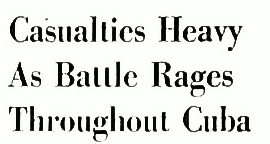
Miami Herald headline

The Miami Herald spoke of battles raging “throughout” the island.

The United Press International wire service said invading “revolutionaries … appeared to have knocked back Fidel Castro’s forces in the initial assault.”

Thus, a sampling of some of the erroneous first U.S. news reports about the ill-fated invasion of Cuba, launched 50 years ago this weekend at the Bay of Pigs.

Castro’s military overwhelmed the assault in less than three days; the CIA-trained invasion force of some 1,400 Cuban exiles never gained much more than a bitterly contested beachhead.

The thwarted invasion entrenched Castro’s dictatorship and represented a major foreign policy setback for the United States and the three-month-old administration of President John F. Kennedy.

It was something of a fiasco for the U.S. news media as well.

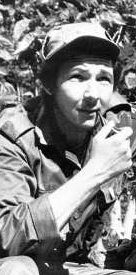
Raul Castro: Not captured

No correspondents were with the invading forces and Castro’s regime imposed a blackout on U.S. correspondents assigned to Cuba. The first news accounts of the invasion of April 17, 1961, as a result were wildly inaccurate and, in some cases, highly colorful and imaginative.

Those initial reports, while still interesting on their face, offer timeless testimony to the extraordinary difficulties of covering conflict from afar.

They also offer a lesson the U.S. news media seem intent on never remembering: First reports from the battlefield, or from the scene of a disaster, almost reliably will be in error. Cautious reporting and scrutiny of sources are thus always advisable amid uncertain and shifting conditions.

Such lessons tend to remain unlearned, however — as was apparent in the highly exaggerated news reports about violence and mayhem that supposedly swept New Orleans in the immediate aftermath of Hurricane Katrina’s landfall in 2005.

As I note in my media-mythbusting book, Getting It Wrong, “the erroneous and exaggerated reporting [about post-Katrina New Orleans] had the cumulative the effect of painting for America and the rest of the world a scene of surreal violence and terror, something straight out of Mad Max or Lord of the Flies.”

I further note that “initial and worst-case estimates of disaster casualties almost always are exaggerated. … Recognition of this tendency may well have helped to temper or curb the exaggerated reports of lawlessness and violence” in Katrina’s wake.

Revisiting the Bay of Pigs coverage also demonstrates how wished-for outcomes can color and distort news coverage.

The Miami Herald, which clearly wanted Castro gone, was eager to report imagined gains by the undermanned exile force, while offering no sources at all in its breathless accounts.

Beneath a banner headline that read, “Invaders Slug Into Interior,” the Herald reported on April 18, 1961, that the anti-Castro rebels “were pushing into the interior of Cuba” after launching assaults “at several key points” on the island.

“It was brother against brother,” the Herald said of the fighting, adding, “A virtual blackout was stretched across Cuba since the first shot of the civil war was fired.”

The newspaper further reported — while citing no sources — that it had “learned that the rebel troops are paying heavily for every mile gained.”

The Herald also attempted to divine the invaders’ strategy, asserting: “Rebels pouring in from Las Villas in the soft underbelly of Cuba were headed towards Central Highway in an apparent attempt to control the strategic road and cut the island in two.”

While somewhat more cautious than the colorful account in the Miami Herald, the Wall Street Journal of April 18, 1961, reported that at “least three widely scattered landings” had “brought an immediate state of emergency and brisk fighting inside Cuba and rapid repercussions around the globe.”

The Journal noted that the “cutoff of telephone and cable communications by the Castro government and conflicting battle reports made the tide of fighting difficult to assess,” but added:

“The invaders seem bent on cutting Cuba in half, then wheeling westward to Havana, about 100 miles from their original beachhead.”

The Journal didn’t hold back from publishing what it acknowledged were unverified reports that anti-Castro forces had captured the Isle of Pines and freed 10,000 political prisoners; had taken Santiago de Cuba, the country’s second-largest city, and had seized Raul Castro, Fidel’s brother.

“None of these reports were confirmed, however,” the Journal added — as if such a disclaimer were of much value after having offered up what proved to be wild and fanciful rumors.

The Washington Post of April 18, 1961, turned to wire service dispatches in compiling its first account of the invasion. It led with a United Press International report that breathlessly declared:

“Invading Cuban revolutionary troops, landed from the sea and dropped from planes, fought a bloody battle yesterday in the swamps 90 miles southeast of Havana and appeared to have knocked back Fidel Castro’s forces in the initial assault.

“There were reports that segments of the Cuban Navy had revolted.

“The revolutionary front directed by former Castro Premier Jose Miro Cardona in a secret United States headquarters was estimated to have thrown 5,000 anti-Castro Cubans into action in 48 hours on the east and south coasts.”

The Post’s report incorporated an Associated Press dispatch that said “the invaders hit the beaches in four of Cuba’s six provinces.”

Within weeks of the failed invasion, one of the leading journalists in America, James (“Scotty”) Reston of the New York Times, charged in a column that U.S. government officials and the CIA had fed reporters erroneous information about the assault on Cuba.

“When the landings started,” Reston wrote, “American reporters in Miami were told that this was an ‘invasion’ of around 5,000 men — this for the purpose of creating the impression among the Cuban people that they should rise up to support a sizable invasion force.

“When the landing … began to get in trouble, however,” Reston added, “officials here in Washington put out the story — this time to minimize the defeat in the minds of the American people — that there was no ‘invasion’ at all, but merely a landing of some 200-400 men to deliver supplies to anti-Castro guerrillas already in Cuba.

“Both times the press was debased for the Government’s purpose.”

Could be, but journalists amply demonstrated in their reporting that they were inclined to be gullible accomplices — eager at least to embrace wishful scenarios about the invasion. Official disinformation only partly explains the media credulity in reporting the Bay of Pigs.

News outlets bear a far heavier burden for botching the coverage.

WJC

Recent and related:

Always ‘follow the money’ — even if it’s made up

In Anniversaries, Cinematic treatments, Debunking, Media myths, Washington Post, Watergate myth on April 11, 2011 at 10:26 am

Watergate’s single most famous line — “follow the money” — is impressively durable and versatile.

Especially so for a made-up line.

Follow the money” wasn’t guidance offered during the Watergate scandal of 1972-74. It wasn’t advice crucial to unraveling the most significant case of corruption in American history.

It was a line written into the screenplay of All the President’s Men, the 1976 motion picture that dramatized the Watergate reporting of Bob Woodward and Carl Bernstein for the Washington Post.

“Follow the money” was spoken by Hal Hollbrook, who played Woodward’s stealthy “Deep Throat” source in All the President’s Men. (The real-life “Deep Throat” was revealed in 2005 to have been W. Mark Felt, formerly the second-ranking official at the FBI.)

The line is so pithy — and seems to offer such sage and telling advice — that it crossed long ago from the cinema to the vernacular, and has become embedded in Watergate lore.

A telling example of how deeply “follow the money” has burrowed into popular culture was apparent in a commentary posted yesterday by the scrappy Washington Times newspaper.

The commentary discussed companies that pay no corporate federal taxes, declaring: “For too long the American public has been hornswoggled by this century’s ‘robber barons.'”

The commentary included this passage:

“No wonder corporations court politicians. As Deep Throat so wisely told reporter Bob Woodward, ‘Always follow the money.‘”

Always follow the money, eh?

Even if Felt, Woodward’s real-life “Deep Throat” source, had offered such guidance, it wouldn’t have been sufficient to implicate Nixon in the crimes of  Watergate.

Unraveling the scandal required much more than identifying and following a trail of illicit fundraising and money-laundering. Those were elements of Watergate, but they weren’t decisive in forcing President Richard Nixon’s resignation in August 1974.

As I note in Getting It Wrong, my media-mythbusting book that came out last year, some 20 men associated with Nixon’s  presidency or reelection campaign went to jail for crimes linked to Watergate.

To roll up a scandal of such dimension, I write in Getting It Wrong, “required the collective if not always the coordinated forces of special prosecutors, federal judges, both houses of Congress, the Supreme Court, as well as the Justice Department and the FBI.

“Even then,” I note, “Nixon likely would have served out his [second] term if not for the audiotape recordings he secretly made of most conversations in the Oval Office of the White House. Only when compelled by the Supreme Court did Nixon surrender those recordings, which captured him plotting the cover-up and authorizing payments of thousands of dollars in hush money.”

Those were the disclosures that brought about Nixon’s resignation in August 1974.

The reporting of the Washington Post was marginal to that outcome, despite the message and storyline of All the President’s Men.

WJC

Recent and related:

Fast and loose: ‘Kennedys’ miniseries and Bay of Pigs history

In Bay of Pigs, Debunking, Media myths, New York Times on April 10, 2011 at 7:35 am

I suspected it would be dreadful, but I was still curious about how the Bay of Pigs invasion of 50 years ago would be treated. So I tuned in yesterday afternoon to part of a marathon showing of the Reelz television miniseries, The Kennedys.

I watched the Bay of Pigs installment, a turgidly acted episode that played fast and loose with the historical record.

Blessedly, the episode did not take up the New York Times-Bay of Pigs suppression myth, as I thought it might.

That topic no doubt was too intricate for set-piece drama that depicts President John F. Kennedy as mirthless and insecure; his wife as clueless, and his father as domineering and routinely intrusive.

Only the president’s brother, Robert (played by Barry Pepper), put in a strong performance in the Bay of Pigs episode, dressing down an insolent Air Force general and lording it over J. Edgar Hoover.

But surely no one turned to The Kennedys miniseries for historical insight; it’s no documentary and its inaccuracies came as little surprise. Still, they were striking — and deserve to be called out.

The president was depicted as upset that Fidel Castro’s military was not caught unawares when U.S.-trained Cuban exiles came ashore at the Bay of Pigs on April 17, 1961.

In reality, preparations for the invasion were much an open secret, especially in Miami, where the Cuban exile community had buzzed for weeks about a pending assault on Castro’s regime. And Kennedy knew that very well.

As I note in my media-mythbusting book, Getting It Wrong, pre-invasion news coverage reached a point where Kennedy, a week before the assault, told his press secretary, Pierre Salinger:

“I can’t believe what I’m reading! Castro doesn’t need agents over here. All he has to do is read our papers. It’s all laid out for him.”

Salinger, himself, noted: “To declare in mid-April of 1961 that  I knew nothing of the impending military action against Cuba except what I read in the newspapers or heard on the air was to claim an enormous amount of knowledge.”

Tad Szulc, a veteran New York Times reporter who covered the invasion and its run-up, recalled in June 1961 that it had been “the most open operation which you can imagine.”

A surprise the invasion was not.

The Reelz episode also claimed a full moon helped Castro’s forces thwart the ill-fated landings at the Bay of Pigs.

That’s a nice bit of detail.

But it’s pure invention.

There was no full moon the day of the invasion. The lunar phase on April 17, 1961, was waxing crescent. The next full moon was on April 30, 1961.

The Reelz episode also depicted Kennedy as a stand-up guy, bravely taking blame at a news conference for an assault that had failed.

Kennedy in fact did no such thing.

Took no questions on Cuba

He declined to take questions about Cuba at his news conference that followed invasion. He told newsmen:

“I know that many of you have further questions about Cuba. I made a statement on that subject yesterday afternoon. … I do not think that any useful national purpose would be served by my going further into the Cuban question this morning. I prefer to let my statement of yesterday suffice for the present.”

That news conference was on April 21, 1961, four days after the invasion was launched and two days after the assault had been rolled up by Castro’s forces.

Kennedy did talk at length about Cuba the day before, in a speech to the American Society of Newspaper Editors.

But he was hardly penitent or conciliatory. The transcript of his speech makes clear that Kennedy that day was in full Cold Warrior mode.

He didn’t apologize for the failed the invasion. He said the United States did “not intend to be lectured on ‘intervention’ by those whose character was stamped for all time on the bloody streets of Budapest” — a reference to the Soviet-backed crackdown in Hungary in 1956.

Kennedy said the Bay of Pigs invasion was “not the first time that Communist tanks have rolled over gallant men and women fighting to redeem the independence of their homeland. Nor is it by any means the final episode in the eternal struggle against tyranny anywhere on the face of the globe, including Cuba itself.”

The president was emphatic about the communist threat in the Western Hemisphere, asserting: “We and our Latin friends will have to face the fact that we cannot postpone any longer the real issue of survival of freedom in this hemisphere itself.”

So Kennedy was scarcely apologetic in the invasion’s aftermath. He wasn’t the wounded, wimpish, repentant character depicted in the mind-numbing miniseries.

WJC

Recent and related:

Inspirations to journalists: Woodward, Bernstein — and Gaga?

In Cinematic treatments, Debunking, Media myths, Washington Post, Watergate myth on April 9, 2011 at 7:41 am

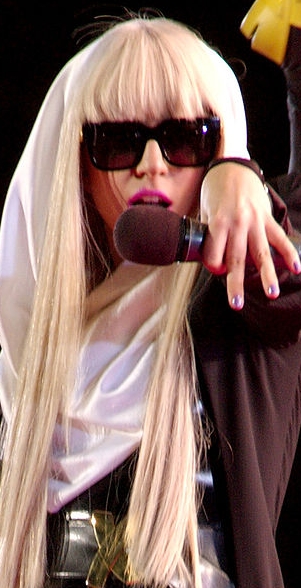
The Poynter Institute, a journalism training center dedicated to “teaching and inspiring journalists and media leaders,” offered up a myth of Watergate yesterday in an article that ruminated about Lady Gaga’s potential to “awaken her young fans to 21st century journalism.”

Gaga: Inspiring?

The Poynter piece discussed the, ahem, news that pop star Gaga would guest-edit the May 17 editions of the giveaway newspaper Metro. The freesheet is available in many large cities in North America, Europe, and Asia. Metro was launched by a Swedish company in 1995.

Of particular interest to Media Myth Alert is not so much Lady Gaga’s one-off editing adventure but the Poynter article’s reference to Bob Woodward and Carl Bernstein, lead Washington Post reporters on the Watergate scandal of the 1970s.

The article stated:

“As Lady Gaga takes her celebrity into the worlds of journalism and photography, does it bring cachet to a struggling and confused industry that might need a tad of glamour and inspiration? She certainly has encouraged her fans to blog, create videos and design costumes.

“In the 1970s Bob Woodward and Carl Bernstein inspired a generation to major in journalism and become investigative reporters. … Could Lady Gaga awaken her young fans to 21st century journalism?”

Woodward

The notion that the work of Woodward and Bernstein “inspired a generation” of journalism students is a persistent subsidiary myth of Watergate.

There’s no evidence to support it.

I note in my media-mythbusting book, Getting It Wrong, that the subsidiary myth “lives on despite its thorough repudiation in scholarly research.”

One study was financed by the Freedom Forum media foundation and released in 1995. In it, researchers Lee B. Becker and Joseph D. Graf reported finding that “growth in journalism education result[ed] not from specific events as Watergate … but rather to a larger extent from the appeal of the field to women, who ha[d] been attending universities in record numbers. The growth also in part reflect[ed] the applied nature of the field and its link to specific job skills.”

Becker and Graf added:

“There is no evidence … that Watergate had any effect on enrollments.”

Seven years earlier, Maxwell E. McCombs reported in the Gannett Center Journal that “the boom in journalism education was underway at least five years before” the Watergate break-in in 1972. That also was the year Woodward and Bernstein published the investigative reports about Watergate that won for the Post the coveted Pulitzer Prize for public service.

McCombs, a veteran mass communication scholar, further wrote:

“It is frequently, and wrongly, asserted that the investigative reporting of Woodward and Bernstein provided popular role models for students, and led to a boom in journalism school enrollments. The data … reveal, however, that enrollments already had doubled between 1967 and 1972….”

The appeal of the subsidiary myth, I write in Getting It Wrong, stems from the fact that it is so “easily understood: It endures because it seems irresistibly logical and straightforward—too obvious, almost, not to be true.”

That is, Woodward and Bernstein made journalism seem sexy, vital, urgent. They were, after all, subjects of a major motion picture, All the President’s Men, which was based on their best-selling book by the same title.

And their reporting did bring down a corrupt president.

Or so goes the central myth of Watergate — that of the heroic-journalist. The heroic-journalist meme holds that Woodward and Bernstein exposed the crimes and misdeeds of Richard Nixon’s presidency, forcing him from office.

But as I point out in Getting It Wrong, not even the Post buys into that simplistic interpretation of American journalism’s greatest political scandal.

To explain Watergate “through the lens of the heroic-journalist is to abridge and misunderstand the scandal and to indulge in a particularly beguiling media-driven myth,” I write, noting:

“The heroic-journalist interpretation minimizes the far more decisive forces that unraveled the scandal and forced Nixon from office.”

Those forces typically wielded subpoenas and included special Watergate prosecutors, federal judges, bipartisan panels of both houses of Congress, the Supreme Court, the Justice Department, and the FBI.

“Even then,” I write in Getting It Wrong, “Nixon likely would have served out his term if not for the audiotape recordings he secretly made of most conversations in the Oval Office of the White House. Only when compelled by the Supreme Court did Nixon surrender those recordings, which captured him plotting the cover-up and authorizing payments of thousands of dollars in hush money.”

WJC

My thanks to LittleMissAttila for linking to this post.

Recent and related:

No one-off story: Reporting the run-up to Bay of Pigs

In Anniversaries, Bay of Pigs, Debunking, Media myths, New York Times, Newspapers on April 7, 2011 at 7:46 am

The tenacious New York Times-Bay of Pigs suppression myth centers around a single story that the Times supposedly bungled or censored in its issue 50 years ago today.

But reporting about the pending assault on Fidel Castro’s Cuba went beyond a single story. The Times and other U.S. news outlets reported frequently —  if not always accurately — about the run-up to the Bay of Pigs invasion, which was launched April 17, 1961, and was rolled up within three days.

The suppression myth has it that at President John F. Kennedy’s behest, the Times spiked or emasculated a story telling of preparations by U.S.-trained Cuban exiles to attack Cuba.

The suppression tale is untrue, however. The Times of April 7, 1961, was no artifact of censorship: It reported what it knew about the unfolding invasion preparations.

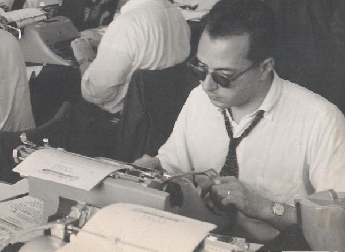
Szulc, undated photo (Courtesy Anthony Szulc)

Best testimony to that comes from reading what was published: Doing so reveals that the news report at heart of the myth appeared beneath the byline of a veteran correspondent named Tad Szulc; the article was displayed above the newspaper’s front-page fold.

The Times, didn’t thereafter drop the invasion-preparations story, either. Szulc’s report of 50 years ago was no one-off effort.

As I point out in Getting It Wrong, my media-mythbusting book that came out last year:

“The suppression myth fails to recognize or acknowledge that the Times coverage was not confined to Szulc’s article ten days before the invasion. It ignores that several follow-up stories and commentaries appeared in the Times during the run-up to the invasion.”

Reporting by Szulc and others for the Times after April 7, 1961, “kept expanding the realm of what was publicly known about a coming assault against Castro,” I write.

For example, on April 8, 1961, the Times published a front-page article about the Cuban exiles and their eagerness to toppled Castro.

That report, which appeared beneath the headline, “Castro Foe Says Uprising Is Near,” quoted the president of the U.S.-based umbrella group of exiles, the Cuban Revolutionary Council, as saying that a revolt against the Castro regime was “imminent.”

The following day, the Times published two articles about Cuba on its front page. One of them was the lead story, which appeared beneath the headline, “Castro Foes Call Cubans To Arms; Predict Uprising,” and discussed the vow of the exiled Cuban Revolutionary Council to topple Castro.

“Duty calls us to the war against the executioners of our Cuban brethren,” the Revolutionary Council declared. “Cubans! To victory! For democracy! For the Constitution! For social justice! For liberty!”

The Times front page of April 9, 1961, also carried a report by Szulc, who described how the exile leaders were attempting to cover over rivalries and divisions in advance of what Szulc termed the coming “thrust against Premier Fidel Castro.”

The “first assumption” of the leaders’ plans, Szulc wrote, “is that an invasion by a ‘liberation army,’ now in the final stages of training in Central America and Louisiana, will succeed with the aid of internal uprising in Cuba. It is also assumed that a provisional ‘government in arms’ will be established promptly on the island.”

With those sentences, Szulc effectively summarized the strategic objectives of what became the Bay of Pigs invasion.

As I point out in Getting It Wrong, none of the Times’ pre-invasion reports included a prospective date for the invasion. But they unmistakably signaled that something was afoot, that an attempt to oust Castro by arms was forthcoming.

Moreover, on April 11, 1961, James Reston, the Washington bureau chief, reported on the Times’ front page that Kennedy administration officials were divided “about how far to go in helping the Cuban refugees to overthrow the Castro Government.”

Reston described in detail how the president had been receiving conflicting counsel from advisers at the White House, the Central Intelligence Agency, and the State and Defense departments. Reston also identified the time pressures confronting the president, writing:

“It is feared that unless something is done fairly soon nothing short of direct military intervention by United States forces will be enough to shake the Castro Government’s hold over the Cuban people.”

Reston, I note in Getting It Wrong, “followed that report the next day with a commentary that addressed the moral dimensions of an armed attempt to topple Castro. His column noted that ‘while the papers have been full of reports of U.S. aid to overthrow Castro, the moral and legal aspects of the question have scarcely been mentioned.'”

Nor was the Times alone in reporting about invasion preparations. Its competition on the pre-invasion story included the Miami Herald, the New York Herald Tribune, and Time magazine.

According to a critique published in May 1961 in The Reporter, a journalists’ trade publication, the pre-invasion story “was covered heavily if not always well.” The Reporter added:

“Remarkably detailed reports were published and broadcast describing the stepped-up preparations” for the assault on Cuba.

Indeed, reporting and commentary about invasion plans reached such  intensity that according to Kennedy’s press secretary, Pierre Salinger, the president complained a week before the invasion, saying:

“I can’t believe what I’m reading! Castro doesn’t need agents over here. All he has to do is read our papers. It’s all laid out for him.”

The CIA’s planning for the Bay of Pigs invasion was cloaked in secrecy of the skimpiest kind. In the days and weeks before the assault, the Cuban exile community in Miami teemed with talk about an invasion.

“It was,” Szulc recalled about two months later, in testimony before a closed session of a Senate Foreign Relation subcommittee,  “the most open operation which you can imagine.”

WJC

Recent and related:

Busting the NYTimes suppression myth, 50 years on

In Anniversaries, Bay of Pigs, Debunking, Media myths, New York Times on April 6, 2011 at 7:30 am

Few tales in American journalism offer such rich, potent, and timeless lessons as that of the New York Times’ censoring itself in the run-up to the Bay of Pigs invasion 50 years ago this month.

Had the Times reported all it knew about the planned assault on Fidel Castro’s Cuba, had the Times not held back, the ill-fated invasion may well have been called off and the United States would have been spared an acute foreign policy reversal.

Or so the media myth has it.

The New York Times-Bay of Pigs suppression myth — one of 10 media-driven myths debunked in my latest book, Getting It Wrong — endures as a telling reminder about the hazards that can befall journalists when they yield to the government’s agenda on national security.

Indeed, the Times’ purported spiking has been called the “symbolic journalistic event of the 1960s.”

Only the Times didn’t censor itself.

It didn’t kill, spike, or otherwise emasculate the news report published 50 years ago tomorrow that lies at the heart of this media myth.

That article was written by a veteran Times correspondent named Tad Szulc, who reported that 5,000 to 6,000 Cuban exiles had received military training for a mission to topple Fidel Castro’s regime; the actual number of invaders was about 1,400.

But overstatement was hardly the article’s most controversial or memorable element.

Supposedly, editors at the Times caved in to pressure from the White House of President John F. Kennedy and eviscerated Szulc’s article, removing key elements about the invasion plans.

That Kennedy intervened in the Times’ editorial decisionmaking in April 1961 is widely believed, and lives on as a cautionary tale. As the trade publication Editor & Publisher put it a few years ago:

“The Times, of course, famously held off on the story at the request of President John F. Kennedy, who later regretted the decision.”

Even the Times has bought into this erroneous meme.

The newspaper’s executive editor, Bill Keller, wrote in a column a few weeks ago:

“We may err on the side of keeping secrets (President Kennedy reportedly wished, after the fact, that The Times had published what it knew about the planned Bay of Pigs invasion, which possibly would have helped avert a bloody debacle) or on the side of exposing them. We make the best judgments we can.”

Had Keller taken time to consult a database of issues of his newspaper, he would have found that the Times reported in detail about preparations to infiltrate the CIA-trained exiles into Cuba, in hopes of sparking an uprising that would overthrow Castro.

As I write in Getting It Wrong, “the notion that Kennedy asked or persuaded the Times to suppress, hold back, or dilute any of its reports about the pending Bay of Pigs invasion is utter fancy. There is no evidence that Kennedy or his administration knew in advance” about Szulc’s dispatch, which was filed from Miami on April 6, 1961.

The article was published the following day – above the fold on the Times front page.

Nor, I write, is there any evidence “that Kennedy or anyone in his administration lobbied or persuaded the Times to hold back or spike that story, as so many accounts have said.”

After the cruise

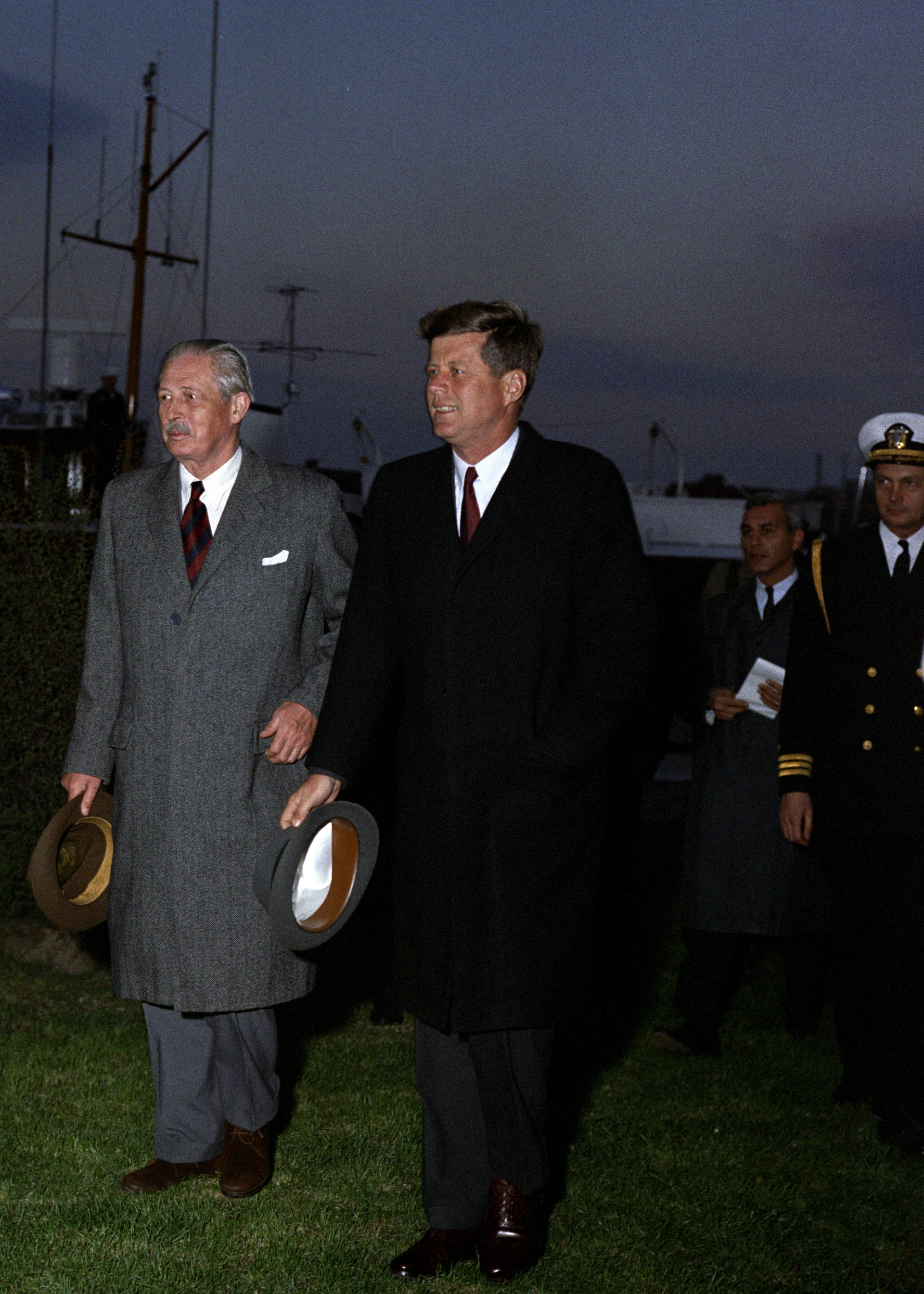
Indeed, while Szulc’s dispatch was edited in New York on the afternoon of April 6, 1961, Kennedy was playing host to Harold Macmillan, the British prime minister, on a lengthy cruise down the Potomac River to Mount Vernon.

Kennedy returned to the White House around 6:30 that evening, leaving almost no time for the president to have intervened and negotiated with Times editors before the newspaper’s first edition hit the streets around 7 p.m.

According to the Kennedy presidential library, White House telephone logs reveal that no calls were placed on April 6, 1961, to top Times executives such as President Orvil E. Dryfoos, Managing Editor Turner Catledge, or Washington bureau chief James “Scotty” Reston. (In The Powers That Be, David Halberstam depicted Kennedy as having called Reston to argue “strongly and passionately” against the Times’ publishing Szulc’s story.)

In his book, Without Fear or Favor, an insider’s look at the Times, Harrison Salisbury offered a detailed account about the handling of Szulc’s dispatch.

“The government in April 1961,” Salisbury wrote, “did not … know that The Times was going to publish the Szulc story, although it was aware that The Times and other newsmen were probing in Miami. Nor did President Kennedy telephone Dryfoos, Scotty Reston or Turner Catledge about the story…. The action which The Times took [in editing Szulc’s report] was on its own responsibility,” the result of internal discussions and deliberations.

The editing was conservative but not unreasonable.

A reference to the invasion’s imminence was removed, serving to improve its accuracy. The force of Cuban exiles did not launch the assault until April 17, 1961, 10 days after Szulc’s report appeared. Such an interval hardly suggests “imminence.”

Besides, as Reston pointed out in his memoir, “imminence” is a prediction, not a fact.

References to the CIA’s role in training the Cuban exiles were omitted in favor of the more nebulous terms “U.S. officials” and “U.S. experts.” Catledge, the managing editor, said he reasoned that the U.S. government had more than a few intelligence agencies, “more than most people realize, and I was hesitant to specify the CIA when we might not be able to document the charge.”

An entirely defensible if cautious editorial decision.

The prominence given the Szulc report also was modified, from a planned four-column display to a single column. If the invasion was not imminent, then a four-column headline was difficult to justify, Catledge reasoned.

Those decisions were judicious, not unreasonable, and had the effect of improving the accuracy of Szulc’s dispatch.

“Most important,” as Salisbury wrote, “The Times had not killed Szulc’s story. … The Times believed it was more important to publish than to withhold. Publish it did.”

The Times-suppression myth, I point out in Getting It Wrong, likely stems from confusion with a separate episode during the Cuban Missile Crisis in October 1962, when Kennedy did ask the Times to postpone publication of a report about the Soviets having deployed nuclear-tipped weapons in Cuba.

On that occasion, when the prospect of a nuclear exchange seemed in the balance, the Times complied, holding off publication 24 hours.

WJC

Many thanks to Instapundit
Glenn Reynolds for linking to this post

Recent and related:

NYT-Bay of Pigs suppression myth: Check out new trailer

In Anniversaries, Bay of Pigs, Debunking, Media myths, New York Times on April 4, 2011 at 8:20 am

Fifty years ago this week, the New York Times bowed to pressure from the White House of President John F. Kennedy and suppressed or emasculated a story offering details about the pending Bay of Pigs invasion.

Had the Times not censored itself, had it published it knew about the planned assault on Fidel Castro’s Cuba, the invasion likely would have been scuttled, and the United States would have been spared a humiliating foreign policy setback.

Or so the media myth has it.

What I call the New York Times-Bay of Pigs suppression myth is a hardy, tenacious tale that is addressed and debunked in my latest book, Getting It Wrong.

The suppression myth is the subject of a new video trailer, posted online last night by my graduate assistant, Jeremiah N. Patterson.

At the heart of the suppression myth is a report filed from Miami by veteran correspondent Tad Szulc and published on the Times front page April 7, 1961, 10 days before the ill-fated invasion.

Supposedly, editors at the Times so thoroughly watered down Szulc’s dispatch that when published, it was a mere wisp of what the correspondent had filed. Supposedly, the report was emasculated in New York.

But that’s just not so.

As I discuss in Getting It Wrong, Szulc’s dispatch received editing at the Times that was judicious, restrained, and well-considered — editing that had the effect of improving the story’s accuracy.

But it wasn’t spiked. It wasn’t suppressed.

It ran to 1,000 words and was published above the fold on the Times front page — prime real estate in American journalism.

Nor is there any evidence that Kennedy or officials in his administration knew about the Szulc report and asked, lobbied, or otherwise cajoled the Times to suppress the dispatch or water it down.

That notion, I write in Getting It Wrong, “is utter fancy.”

Indeed, I add, “the recollections of none of the principal figures in the Times-suppression episode say that Kennedy pressured the newspaper’s editors.

“These include the memoirs of Turner Catledge, then the managing editor of the Times; of James (Scotty) Reston, then the chief of the Times’ Washington bureau; of Pierre Salinger, Kennedy’s press secretary, and of Arthur M. Schlesinger Jr., an award-winning Harvard historian who was a White House adviser to Kennedy.”

Harrison Salisbury in his Without Fear or Favor, an insider’s look at the Times, offers a detailed account of the handling of the Szulc dispatch.

And Salisbury’s version is unequivocal. “The government in April 1961,” he wrote, “did not … know that The Times was going to public the Szulc story, although it was aware that The Times and other newsmen were probing in Miami. Nor did President Kennedy telephone [Times president Orvil] Dryfoos, Scotty Reston or Turner Catledge about the story.”

“Most important,” Salisbury added, “The Times had not killed Szulc’s story. … The Times believed it was more important to publish than to withhold. Publish it did.”

The trailer discussing the New York Times-Bay of Pigs media myth is the latest video Patterson has prepared on topics related to Getting It Wrong.

Early this year, he produced a trailer about the book and in Fall 2010 prepared a trailer about the media myths surrounding The War of the Worlds radio dramatization of 1938.

WJC

Recent and related: