W. Joseph Campbell

Archive for the ‘Hurricane Katrina’ Category

‘Exquisitely researched and lively’

In Cronkite Moment, Debunking, Hurricane Katrina, Media myths, Reviews on September 16, 2010 at 9:40 am

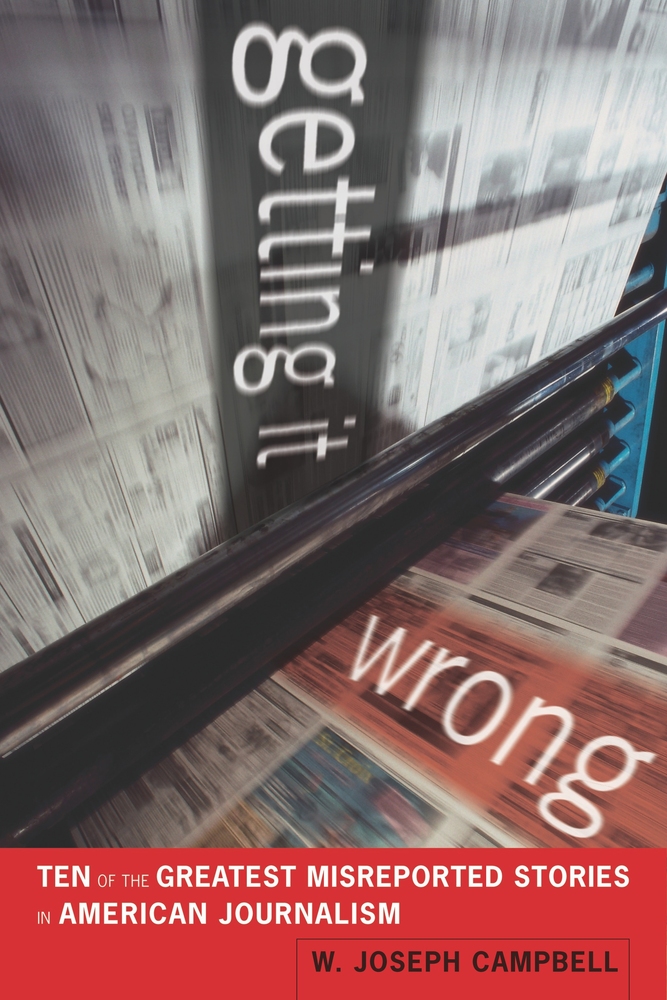
That’s the Denver Post‘s take on Getting It Wrong, my new book on media-driven myths which the newspaper recently reviewed.

The Post offers a discerning summary of the book, noting that it “takes a critical look at 10 stories that were either total fabrications or blown way out of proportion and yet became part of our popular culture.”

It also says Getting It Wrong offers “an exquisitely researched and lively look at an industry that too often shines the light on itself more than it does on events and public figures.”

And it notes, quite correctly:

“Much of the ‘wrong’ coverage through the years comes from the media’s self-congratulatory preening.”

The review points out that the sternest criticism in Getting It Wrong is reserved “for coverage, mainly by television, of the chaotic aftermath of Hurricane Katrina in New Orleans in 2005.

“Hyperactive reporters told tales of snipers roaming the streets, ‘hundreds’ of bodies stacked up in the Super Dome and babies being raped and murdered, none of which could be verified.

The upshot of the exaggerated coverage of the storm’s aftermath, the review notes, “was that rescue operations were hindered by fear, and prejudices of a watching public against poor people and minorities were confirmed.”

The review was written by Dick Kreck, a former reporter and columnist for the Post who has written three books. Kreck is an engaging storyteller and the go-to source for details about the lusty history of Denver journalism. (Full disclosure: Kreck spoke at a program at the Denver Post during last month’s convention of the Association for Education in Journalism and Mass Convention. I helped organize the program.)

Kreck opens the review of Getting It Wrong by declaring:

“Memo to media: Get over yourself. You’re not that important.”

He later cites a passage in Getting It Wrong quoting Robert Samuelson, a columnist who writes on economic issues for the Washington Post:

“Because the media are everywhere—and inspire much resentment—their influence is routinely exaggerated. The mistake is confusing visibility with power and the media are often complicit in the confusion. We [in the news media] embrace the mythology, because it flatters our self-importance.”

Getting It Wrong indeed offers a brief for modest media effects.

To bust media myths, I write in the book, “is to confront the reality that the news media are not the powerful agents they, and many others, assume them to be.

“It is exceedingly rare for any news report to trigger a powerful, immediate and decisive reaction akin to President Lyndon Johnson’s purported response to [Walter] Cronkite’s televised assessment about Vietnam: ‘If I’ve lost Cronkite ….’

“Researchers long ago dismissed the notion the news media can create such profound and immediate effects, as if absorbing media messages were akin to receiving potent drugs via a hypodermic needle,” I note, adding:

“Media power tends to be modest, nuanced, diffused, and situational.” And typically trumped by other, more powerful forces and factors.

WJC

Related:

‘Getting It Wrong’ goes on WTIC talk radio

In Anniversaries, Debunking, Hurricane Katrina, Media myths, Media myths and radio, Washington Post, Watergate myth on September 12, 2010 at 11:38 am

I was interviewed about Getting It Wrong the other day by Ray Dunaway on WTIC AM radio in Hartford, where years ago I was a reporter for the Hartford Courant newspaper.

The interview was live, brisk, and wide-ranging, covering a number of topics discussed in Getting It Wrong, my new book which debunks 10 prominent media-driven myths–those dubious and improbable stories about the media that masquerade as factual.

Topics that Dunaway and I discussed included the media myths associated with the Washington Post and the Watergate scandal, with Edward R. Murrow and his 1954 program on Senator Joseph McCarthy, and with coverage of Hurricane Katrina’s aftermath in 2005.

Dunaway, a veteran talk-shown host in Connecticut (with whom I had never previously spoken), said in introducing the segment:

“There are a lot of things we believe growing up and some of these are very near and dear to my heart. One would be–and I think this is absolutely true–when I was in graduate school, everybody, especially on the print side, everybody wanted to be the next Carl Bernstein and Bob Woodward [of Watergate fame] and, you know, bring down a president. That was kind of their dream.”

He added:

“Anyhow, there’s a great book out now. And what you believe ain’t necessarily so. W. Joseph Campbell has written a book … called Getting It Wrong

“First of all,” Dunaway said in launching into the interview, “I must tell you how much I enjoyed the book. It was a trip down memory lane, but maybe in a different direction than I originally thought.”

He asked whether I wrote the book to “set the record straight a bit.”

“That’s exactly right,” I replied. “The book is not really a media-bashing book but really aligns itself with a central objective of news-gathering, which is to try to get it right. And the book does seek to set the record straight by offering reappraisals of some of the best-known stories in American journalism.”

I added:

“I think these stories live on because they do offer simplistic explanations and simplistic answers to very complex historical events. So it’s a way of distilling what went on in the past [in] a very digestible and understandable way.

“In the process of simplification, though, there are exaggerations made–and myths are born. And I think that’s a recurring theme in this book. … These stories are appealing stories. They’re delicious stories. They’re almost too good to be checked out, and I think that’s another reason why these have lived on.”

We spent some time discussing the heroic-journalist interpretation of Watergate–that the investigative reporting of Woodward and Bernstein in the Washington Post brought about President Richard Nixon’s resignation in 1974.

“Woodward and Bernstein–the Watergate story–is another example of the David-and-Goliath encounter,” another thread that runs through Getting It Wrong, I said, adding that Nixon’s fall in the Watergate scandal “was the consequence of his own criminal conduct and that was exposed through the convergence of many forces and factors.

“And the Washington Post, although it did some good reporting in the aftermath of the Watergate breakin in 1972–it wasn’t the decisive factor.

“Its reporting did not bring down Richard Nixon.”

Dunaway, who described Getting It Wrong as “well worth reading,” turned the interview to Hurricane Katrina and what I call “the myth of superlative reporting.”

The coverage of Katrina’s aftermath was highly exaggerated and represented “no high heroic moment for American journalism,” I pointed out.

We spoke about exaggerated estimated death tolls in New Orleans in Katrina’s wake–estimates of 10,000 fatalities or more that were offered by public officials including the city’s then-mayor, Ray Nagin.

I noted:

“Nagin’s estimate is another example of why journalists and reporters have an obligation to themselves and to their audiences to question sources closely. ‘How did you find that information, Mr. Mayor? Could we talk to people who came up with that estimate?’ I mean, not being credulous but being searching, and a bit skeptical.

“I think skepticism was absent in the aftermath of Hurricane Katrina, and the apocalyptic horror that the hurricane supposedly unleashed was absolutely untrue.”

Dunaway wrapped up the interview by calling the book “more of a learning experience than a critique.”

That was an interesting characterization with which to close an engaging and thoughtful interview.

WJC

Related:

Katrina and the myth of superlative reporting

In Anniversaries, Debunking, Hurricane Katrina, Media myths, Newspapers on September 1, 2010 at 7:34 am

Five years ago this month, a few weeks after Hurricane Katrina battered the Gulf Coast and left much of New Orleans under water, former CBS anchorman Dan Rather went on Larry King Live to extol television’s coverage of the deadly storm.

Rather,  whose early career had been propelled by covering hurricanes, was extravagant in his praise, saying the Katrina coverage was “one of the quintessential great moments in television news,” ranking “right there with the Nixon/Kennedy debates, the Kennedy assassination, Watergate coverage, you name it.”

The coverage, Rather declared, was nothing short of “landmark.”

As I write in Getting It Wrong, my new book debunking prominent media-driven myths, Rather’s praise was “more than a little misleading.”

Rather’s comments also helped give rise to what I call the “myth of superlative reporting”–the notion that coverage of Katrina represented a memorable occasion of the news media’s finding their voice, of standing up to public officials and holding them accountable for an inept and muddled response,  especially in New Orleans.

But the notion the reporting was superlative is inexact and misleading. Katrina’s aftermath, as I write in Getting It Wrong, “was no high, heroic moment in American journalism.

“The coverage was in important respects flawed and exaggerated. On crucial details, journalists erred badly, and got it wrong. In the days following Katrina’s landfall, news reports described apocalyptic horror that the hurricane supposedly had unleashed.”

Five years on, it’s instructive to recall how extreme and over the top the reporting was from New Orleans in Katrina’s aftermath; it’s revealing to revisit what journalists said and wrote.

On CNN five years ago today, Paula Zahn spoke about “very discouraging reports out of New Orleans” about “bands of rapists going from block to block, people walking around in feces, dead bodies floating everywhere. And we know that sniper fire continues.”

She also said:

“We are getting reports that describe it as a nightmare of crime, human waste, rotten food, dead bodies everywhere. Other reports say sniper fire is hampering efforts to get people out.”

Also that day, John Burnett of National Public Radio said on the All Things Considered show: “We understand that there was a 10-year-old girl who was raped in the [New Orleans] Convention Center in the last two nights. People are absolutely desperate there. I’ve never seen anything like this.”

The Associated Press news service reported on September 1, 2005, that New Orleans had “descended into anarchy” as “corpses lay abandoned in street medians, fights and fires broke out, cops turned in their badges and the governor declared war on looters who have made the city a menacing landscape of disorder and fear.”

In her column published September 3, 2005, in the New York Times, Maureen Dowd referred to New Orleans as “a snake pit of anarchy, death, looting, raping, marauding thugs, suffering innocents, a shattered infrastructure, a gutted police force, insufficient troop levels and criminally negligent government planning.”

International news organizations, I note in Getting It Wrong, were quite “keen to report the horror stories from New Orleans, as if the hurricane had exposed pathologies in American society that otherwise would remain obscure.”

The British press landed with notable eagerness on the Katrina-unleashed-mayhem narrative.

The Sunday Observer of London reported on September 4, 2005, that New Orleans had become “a city … subsumed beneath waves of violence, rape and death.”

And a columnist for London’s Independent newspaper offered a colorful and highly imaginative account that was published five years ago today:

“Reports from New Orleans ring like prophecies of the apocalypse. Corpses float hopelessly in what used to be a thriving and distinctive downtown; coffins rise from the ground; alligators, sharks and snakes ply the poisonous waters ….”

Few if any of the nightmarish accounts of violence, anarchy, and mayhem proved true.

No shots were fired at rescue helicopters. There were no known child rape victims, no bodies stacked like cordwood, no “bands of rapists going from block to block,” no sharks plying the flood waters.

As I write in Getting It Wrong, “the erroneous and exaggerated reporting had the cumulative the effect of painting for America and the rest of the world a scene of surreal violence and terror, something straight out of Mad Max or Lord of the Flies.”

The coverage of Katrina’s aftermath was no “quintessential” great moment in journalism.

Far from it.

As a bipartisan congressional report on Katrina noted in 2006:

“If anyone rioted, it was the media.”

WJC

Related:

Many thanks to Instapundit Glenn Reynolds for linking to this post

Many thanks to the National Review Corner for linking to this post

Absent in looking back: Katrina’s lessons for the press

In Anniversaries, Debunking, Hurricane Katrina, Media myths, Watergate myth on August 31, 2010 at 6:06 am

The anniversary of Hurricane Katrina’s landfall has prompted a fair amount of hand-wringing and knitted-brow discussions about lessons still to be absorbed, five years after the storm’s onslaught on the Gulf Coast.

The Washington Post, for example, carried a lengthy and rather preachy commentary the other day about “Katrina’s unlearned lessons.” The commentary included this warning:

“Barring urgent action, if the gulf region is hit by another big hurricane this fall, its communities will be knocked down–and this time, many will not be able to get back up.”

Possibly. But it’s highly speculative.

Largely absent in the retrospective assessments about the hurricane are discussions about lessons the news media should take, or should have taken, from their often-exaggerated reporting about the nightmarish violence Katrina supposedly brought to New Orleans.

As I write in Getting It Wrong, my new book that debunks 10 prominent media-driven myths, the coverage of Katrina’s aftermath “was in important respects flawed and exaggerated.

“On crucial details, journalists erred badly, and got it wrong. In the days following Katrina’s landfall, news reports described apocalyptic horror that the hurricane supposedly had unleashed.”

Little of it was true.

What’s more, I write, the exaggerated, over-the-top reporting about mayhem and unspeakable violence “was neither benign nor without consequences.

“It had the very real and serious effects of delaying the arrival of aid to New Orleans, of diverting and distorting the deployment of resources and capabilities, of heightening the anxiety of evacuees at the [New Orleans] Superdome and Convention Center, and of broadly stigmatizing a city and its people.”

In the weeks following Katrina’s landfall, leading news organizations produced a brief flurry of reports revisiting, and criticizing, the accounts of mayhem and anarchy in New Orleans.

“The media joined in playing whisper-down-the-lane,” the Philadelphia Inquirer said in late September 2005 about post-Katrina coverage from New Orleans, “and stories that defied common sense were treated as news.”

But as I write in Getting It Wrong, “The news media’s contrition and introspection did not last for long, however. The self-critical articles tended to be one-off assessments that usually received little prominence. The Los Angeles Times, Philadelphia Inquirer, and Washington Post all placed their retrospective articles on inside pages, for example.

“After the flurry of post-Katrina assessments in late September and early October 2005,” I add, “the news media demonstrated little interest in sustaining or revisiting the self-critique.”

Five years on, Katrina’s lessons and reminders for the news media remain relevant. Among them is the near-certainty that erroneous reports will proliferate in the immediate aftermath of any major disaster.

As Kathleen Tierney of the Natural Hazards Center at the University of Colorado-Boulder told a congressional panel investigating Katrina’s consequences, “misleading or completely false media reports should have been among the most foreseeable elements of Katrina.”

As her comment suggested, the news media’s susceptibility to reporting disaster-related falsehoods and rumors has long been recognized. I cite in Getting It Wrong a prescient article titled “Coping With the Media in Disasters: Some Predictable Problems” that was published in the mid-1980s in Public Administration Review.

The authors–in an observation that anticipated Katrina’s aftermath–noted that news organizations “can spread rumors, and so alter the reality of disaster, at least to those well away from it, that they can bias the nature of the response. They can and do create myths about disasters, myths which will persist even among those with contrary disaster experience.”

The near-complete breakdown of communication networks in Katrina’s aftermath certainly complicated matters for reporters. Telephone service was out across New Orleans after Katrina roared through. Cell phones did not function. Electricity was scarce.

Amid such conditions, stories that at first may have had some factual underpinning became “exaggerated and distorted as they were passed orally—often the only mode of communication—through extraordinarily frustrated and stressed multitudes of people, including refugees, cops, soldiers, public officials and, ultimately, the press,” wrote Brian Thevenot in “Mythmaking in New Orleans,” a fine article published at the end of 2005 in American Journalism Review.

While the communications breakdown helps explain why exaggerated reporting was rampant in New Orleans in Katrina’s aftermath, it does not exonerate the flawed coverage or let journalists off the hook.

In varying degrees, communication disruptions are elements of all major disasters.

And as I write in Getting It Wrong, the collapse of communication networks should have given reporters pause, leaving them “more cautious and more wary about what they heard and reported, and thus less likely to traffic in wild and dubious claims.”

WJC

Related:

Mainstream media ‘fractured’ in covering Katrina

In Anniversaries, Hurricane Katrina, Media myths on August 27, 2010 at 11:27 am

The Nation offered yesterday an incisive assessment of the news media’s coverage of post-Katrina New Orleans that was as thoughtful as any I’ve seen amid the indulgence in “anniversary journalism” in recent days.

The article was not entirely a critique of the media’s performance but sought to reconstruct what it called the “story of the storm.” At times it was predictably dogmatic (i.e., “The levees broke and so did the bulwarks that protected the president,” a reference to George W. Bush’s popularity).

But the article was pretty much spot-on in characterizing the media’s over-the-top reporting about the violence, mayhem, and anarchy that Katrina supposedly unleashed on New Orleans. It’s a topic discussed in the closing chapter of Getting It Wrong, my new book that debunks prominent media-driven myths.

I write in Getting It Wrong that post-Katrina reporting from New Orleans represented “no high, heroic aftermath in American journalism.”  The coverage, I note, “was in important respects flawed and exaggerated. On crucial details, journalists erred badly, and got it wrong.”

The Nation describes the U.S. mainstream media as having “fractured under the pressure of reporting such a huge and complex story. Journalists on the ground often wrote empathic and accurate stories and broke out of their ‘objective’ roles to advocate for the desperate and rail against systemic failures.

“Meanwhile … credulous television, online and print reporters spread lurid rumors about baby rapists and mass murders and treated minor and sometimes justified thefts as the end of civilization. They used words like ‘marauding’ and ‘looting’ as matches, struck over and over until they got a conflagration of opinion going.”

That’s well-put.

As is this passage:

“The stories of social breakdown were quietly retracted in September and October 2005, but the damage had been done. A great many found new confirmation of the old stereotypes that in times of crisis people—particularly poor and nonwhite people—revert to a Hobbesian war of each against each.”

So why does all this still matter, five years on?

The anniversary of Katrina’s onslaught presents an opportunity for journalists to revisit and reexamine the flawed reporting from New Orleans, with an eye toward taking lessons by which to improve coverage of adversity and disasters.

After all, the exaggerated, over-the-top reporting from New Orleans was, I write in Getting It Wrong, “neither benign nor without consequences. It had the very real and serious effects of delaying the arrival of aid to New Orleans, of diverting and distorting the deployment of resources and capabilities, of heightening the anxiety of evacuees at the Superdome and Convention Center, and of broadly stigmatizing a city and its people.”

It’s also useful for journalists covering disasters to hone a pronounced measure of skepticism about pronouncements by senior public officials.

In post-Katrina New Orleans, the mayor and the police commissioner “were sources for some of the most shocking and exaggerated reports about the disaster,” I note in Getting It Wrong.

Mayor Ray Nagin said in a memorable appearance September 6, 2005, on Oprah Winfrey’s television show that “hundreds of armed gang members” were terrorizing storm-evacuees inside the Superdome.

The mayor also said conditions there had deteriorated to “an almost animalistic state” and evacuees had been “in that frickin’ Superdome for five days, watching dead bodies, watching hooligans killing people, raping people.”

The police commissioner, Eddie Compass, spoke of other horrors, saying “little babies [were] getting raped” inside the Superdome.

Their accounts were widely reported—and proved to be almost totally without foundation. In all, six people died in the Superdome in Katrina’s aftermath. None of those deaths was related to violent crime.

As the Nation‘s article notes, “Most ordinary people behave remarkably well when their city is ripped apart by disaster. They did in San Francisco after the 1906 earthquake; in New Orleans during Hurricane Betsy in 1965; in Mexico City after the 1985 earthquake; in New York City in the aftermath of 9/11; and in most disasters in most times and places.

“Those in power, on the other hand, often run amok.”

And post-Katrina New Orleans was an object lesson for journalists.

WJC

Related:

Many thanks to Instapundit Glenn Reynolds for linking to this post

Give the press ‘D-minus’ on post-Katrina coverage

In Anniversaries, Debunking, Hurricane Katrina, Media myths on August 26, 2010 at 4:42 pm

Harry Shearer, director of The Big Uneasy, a new film about why levees failed in New Orleans following Hurricane Katrina’s onslaught, offered a searing critique the other night about the news media and their coverage of the deadly storm.

Shearer was quoted by AOL’s DailyFinance site as saying the New York Times “did okay” in its post-Katrina coverage five years ago.

“I think the rest of the press gets a D, and probably a D-minus for their efforts at patting themselves on the back about how well they did speaking truth to power,” Shearer said in an interview Tuesday night with Jeff Bercovici, the media columnist for DailyFinance.

Shearer cited the encounter September 1, 2005, between CNN’s Anderson Cooper and U.S. Senator Mary Landrieu.

Cooper on that occasion snapped at Landrieu, telling her: “And to listen to politicians thanking each other and complimenting each other, you know, I got to tell you, there are a lot of people here who are very upset, and very angry, and very frustrated.”

Shearer said of Cooper’s tongue-lashing the senator: “Like that’s the person you need to lecture.”

Shearer was further quoted as saying: “It was grandstanding and showboating in place of telling a story–partly because they left. They left. Water leaves, story over” in post-Katrina New Orleans.

He noted that the New Orleans Times-Picayune newspaper won two Pulitzer Prizes for its Katrina-related coverageTimes-Picayune reporters “couldn’t leave,” Shearer said. “They lived there. They had to stay.”

So, a “D” or “D-minus” overall for post-Katrina coverage? Harsh grades, those.

But certainly not undeserved.

News reporting in the immediate aftermath of Katrina’s landfall represented “no high, heroic aftermath in American journalism,” I write in Getting It Wrong, my new book debunking 10 prominent media-driven myths–among them the myth of superlative reporting in Katrina’s aftermath.

“The coverage,” I write, “was in important respects flawed and exaggerated. On crucial details, journalists erred badly, and got it wrong.”

I further write:

“They reported snipers firing at medical personnel. They reported that shots were fired at helicopters, halting evacuations from the Convention Center [in New Orleans].

“They told of bodies being stacked there like cordwood. They reported roving gangs were preying on tourists and terrorizing the occupants of the Superdome, raping and killing. They said children were victims of sexual assault, that one seven-year-old was raped and her throat was slit. They reported that sharks were plying the flooded streets of New Orleans.”

In the end, none of those reports was verified or substantiated, I note.

I point out in Getting It Wrong that no single news organization committed all those errors. And not all those lapses were committed at the same time, although they were largely concentrated during the first days of September 2005.

In any case, I write, the erroneous and over-the-top reporting “had the cumulative the effect of painting for America and the rest of the world a scene of surreal violence and terror, something straight out of Mad Max or Lord of the Flies.”

Estimates of Katrina’s death toll in New Orleans also were wildly exaggerated.

U.S. Senator David Vitter, a Louisiana Republican, said on September 2, 2005, that fatalities in the state could reach 10,000 or more.

Vitter described his estimate as “only a guess,” but it was nonetheless taken up by the then-New Orleans mayor, Ray Nagin, and reported widely.

In all, the death toll in Louisiana from Katrina was around 1,500.

About the inaccurate estimates of fatalities, the Times of London said it had become clear by in mid-September 2005 “that 10,000 people could have died only if more than 90 per cent of them had locked themselves into their homes, chained themselves to heavy furniture and chosen to drown instead of going upstairs as the waters rose.”

But the Times rationalized the flawed reporting, suggesting that it was inevitable: When “nature and the 24-hour news industry collide, hyperbole results.”

A weak excuse, that. Besides, post-Katrina reporting from New Orleans was more than hyperbolic: It described apocalyptic horrors that the hurricane supposedly unleashed.

“D-minus” is none too generous.

WJC

Related:

H/T Jim Romenesko

Many thanks to Instapundit Glenn Reynolds for linking to this post

NBC’s Katrina retrospective sidesteps media failings

In Anniversaries, Debunking, Hurricane Katrina, Media myths on August 22, 2010 at 9:47 pm

I watched this evening’s NBC Dateline retrospective  about Hurricane Katrina, and couldn’t help but wonder: What’s the point?

The hour-long program lacked a news peg, other than it aired in the run-up to the fifth anniversary of the storm’s landfall on the Gulf Coast.

Recollections of NBC anchorman Brian Williams, who covered Katrina and its aftermath in New Orleans, were the centerpiece of the show, which went strong on the images of suffering throngs of people at the New Orleans Superdome and the Convention Center in the days following the hurricane.

But beyond vague references to government incompetence, there was little explanation as to why the suffering there was so intense. Without analysis, such images seemed gratuitous, and voyeuristic.

New Orleans, post-Katrina

In his recollections, which were recorded in 2005, Williams veered close to embracing what I call the myth of superlative reporting–the notion that news coverage of Katrina’s aftermath was little short of heroic, that journalists stood tall in telling truth to power.

“People say, on this crisis, the media found their voice,” Williams said on Dateline, adding, “We owed it to these people [suffering in New Orleans] to ride herd of these officials.”

I write about the myth of superlative reporting in my new book, Getting It Wrong, and note:

“Journalists did confront incompetent government officials who seemed to dither in the face of the disaster. Journalists did let their emotions show. Many of them took great risks in New Orleans to report a demanding, multidimensional story in a city that was 80 percent under water. Some journalists there went days without much of a break, sleeping little and toiling amid despairing conditions.”

But I also write that “Katrina’s aftermath was no high, heroic moment in American journalism.

“The coverage was in important respects flawed and exaggerated. On crucial details, journalists erred badly, and got it wrong. In the days following Katrina’s landfall, news reports described apocalyptic horror that the hurricane supposedly had unleashed.”

The Dateline show addressed none of that–none of the exaggerated descriptions of Mad Max-like violence and mayhem that many news reports said gripped post-Katrina New Orleans.

The exaggerated reporting, I write, “had the cumulative the effect of painting for America and the rest of the world a scene of surreal violence and terror.” And little of it was true.

I also write in Getting It Wrong that reports of “nightmarish violence and wanton criminality in New Orleans following Hurricane Katrina’s landfall … defamed a battered city and impugned its residents at a time of their deep despair.”

Moreover, the over-the-top reporting “had the very real and serious effects,” I write, “of delaying the arrival of aid to New Orleans, of diverting and distorting the deployment of resources and capabilities, of heightening the anxiety of evacuees at the Superdome and Convention Center.”

I cite in Getting It Wrong a nearly 600-page report about Katrina’s aftermath, prepared by a bipartisan select committee of the House of Representatives. The report, titled “Failure of Initiative,” stated that  “accurate reporting was among Katrina’s many victims.

“If anyone rioted, it was the media.”

The House report also declared:

“Many stories of rape, murder, and general lawlessness were at best unsubstantiated, at worst simply false. And that’s too bad because this storm needed no exaggeration.”

I suspect in the days ahead, as the news media indulge in “anniversary journalism” about Hurricane Katrina, that we’ll read and hear little about their failings five years ago in covering the deadly storm.

WJC

Related:

Many thanks to Jim Romenesko for linking to this post