The heroic-journalist myth of Watergate — the notion that intrepid news reporters for the Washington Post brought down Richard Nixon’s corrupt presidency — is a trope that knows few bounds.
It’s one of the favorite stories American journalism tells about itself, and it turns up often, even in such unexpected places as online celebrity gossip sites.
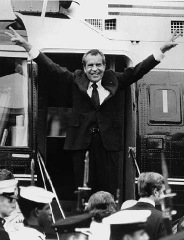
Nixon resigns, 1974
The well-known gossip columnist Liz Smith casually invoked the myth the other day, in an item at wowowow.com about Carl Bernstein. He is the former Washington Post reporter who figured prominently in the newspaper’s coverage of the unfolding Watergate scandal in 1972-73.
Smith referred to Bernstein as the “Watergate partner of Bob Woodward whose work for the Washington Post brought down the Nixon presidency.”
The heroic-journalist myth of Watergate is a hardy one: It lives on in textbooks, it’s taught in schools, and it rattles around in newsrooms.
It’s quite unrestrained in its reach, and over time has become the dominant popular narrative of the Watergate scandal.
But as I write in my forthcoming book about media-driven myths, Getting It Wrong, it’s also “a misleading interpretation, one that minimizes the more powerful and decisive forces that unraveled the scandal and ended Nixon’s corrupt presidency in the summer of 1974.”
As “earnest and revealing as their reporting was,” I further write, “Woodward and Bernstein did not uncover defining and decisive elements of the Watergate scandal—the cover-up and the payment of hush money” to the burglars who broke into the national headquarters of the Democratic Party at the Watergate complex in Washington, D.C.
The Senate Select Committee on Watergate–not Woodward and Bernstein–learned about, and disclosed the existence of, the White House tape recordings that captured Nixon’s complicity in the coverup. The special federal prosecutors on Watergate pressed for the release of the tapes. And the U.S. Supreme Court unanimously ordered Nixon to turn over the tapes subpoenaed by the special prosecutor.
Those were pivotal events that led to Nixon’s resignation.
As I’ve mentioned in earlier blog postings, it’s intriguing that the Post from time to time has tried to make clear its reporting was not decisive to Nixon’s resignation.
For example, in 2005, Michael Getler, then the newspaper’s ombudsman, wrote in a column:
“Ultimately, it was not The Post, but the FBI, a Congress acting in bipartisan fashion and the courts that brought down the Nixon administration. They saw Watergate and the attempt to cover it up as a vast abuse of power and attempted corruption of U.S. institutions.”
This is not to say the Post’s Watergate reporting was without distinction.
As I write in Getting It Wrong, as “the scandal slowly unfolded in the summer and fall of 1972, Woodward and Bernstein progressively linked White House officials to a secret fund used to finance the burglary. The Post was the first news organization to establish a connection between the burglars and the White House, the first to demonstrate that campaign funds to reelect Nixon were used to fund the break-in, the first to implicate former Attorney General John Mitchell in the scandal….”
Those reports were published in the four months following the Watergate break-in.
Meanwhile, Nixon was on his way to reelection in a forty-nine state landslide.








 Media Myth Alert