W. Joseph Campbell

Archive for the ‘New York Times’ Category

One paragraph, three myths

In Cronkite Moment, Debunking, Media myths, Murrow-McCarthy myth, New York Times, Washington Post, Watergate myth on April 21, 2010 at 11:45 am

A column posted today at a Canadian online news site achieved the feat of working three media-driven myths into a single paragraph.

Here’s what the columnist wrote, in a paean to the power and influence that traditional news media once wielded, supposedly:

“A Walter Cronkite could, however belatedly, expose the pointlessness of Vietnam. Famously, Edward R. Murrow deflated McCarthy. A pair of scruffy reporters could bring down a Nixon.”

Three sentences, three myths–a trifecta that is very rare.

All three media-driven myths are addressed, and debunked, in my book, Getting It Wrong, to be published in summer by the University of California Press.

The reference to Cronkite is to the CBS anchorman’s report of February 27, 1968, in which he said the U.S. military was “mired in stalemate” in Vietnam. As I write in Getting It Wrong, such a characterization was scarcely original or exceptional at the time. It was no exposé.
Indeed, nearly seven months before Cronkite’s pronouncement, the New York Times had suggested in a front-page report that the war was stalemated.

Victory in Vietnam, the Times report said, “is not close at hand. It may be beyond reach.”

That Murrow “deflated” Senator Joseph R. McCarthy is another media myth, stemming from Murrow’s See It Now television program of March 9, 1954.

Murrow in fact was quite belated in confronting McCarthy and the senator’s communists-in-government witch hunt.

The half-hour See It Now program on McCarthy came many months–even years–after other journalists had pointedly challenged the senator and his bullying tactics. Eric Sevareid, a friend and CBS colleague of Murrow, pointedly noted that Murrow’s program “came very late in the day.”

In an interview in 1978, Sevareid said: “The youngsters read back and they think only one person in broadcasting and the press stood up to McCarthy and this has made a lot of people feel very upset, including me, because that program came awfully late.”

And by the time Murrow’s report aired, McCarthy’s favorable ratings had been in decline for three months, as also I note in Getting It Wrong.

The Canadian columnist’s reference to “a pair of scruffy reporters” who supposedly brought down Richard Nixon is, of course, to Carl Bernstein and Bob Woodward, who covered the Watergate scandal for the Washington Post.

As I’ve noted in previous posts at MediaMythAlert, the notion that the reporters brought down Nixon and his corrupt presidency is a myth that even the Post has tried to dismiss.

Howard Kurtz, the newspaper’s media reporter, wrote in 2005, for example:

“Despite the mythology, The Post didn’t force Richard Nixon from office—there were also two special prosecutors, a determined judge, bipartisan House and Senate committees, the belated honesty of [former White House lawyer] John Dean and those infamous White House tapes.”

Kurtz’s observations parallel those of Stanley I. Kutler, a leading historian of the  Watergate scandal, who has written:

“The fact is, an incredible array of powerful actors all converged on Nixon at once—the FBI, prosecutors, congressional investigators, the judicial system.”

The three myths are stories well-known and even cherished in American journalism. They almost always are cited as examples of media power and influence, of journalists at their courageous best.

But as I write in Getting It Wrong:

“To identify these tales as media myths is to confront the reality that the news media are not the powerful agents they, and many others, assume them to be.”

WJC

Remembering the Maine — and a myth of yellow journalism

In Anniversaries, Debunking, Media myths, New York Times, Spanish-American War on April 6, 2010 at 5:33 pm

American yellow journalism of the late 19th century, led by the newspapers of William Randolph Hearst, has been often blamed for bringing on the Spanish-American War, which began 112 years ago this month.

Wreckage of the Maine (Library of Congress)

Wreckage of the Maine

It is an enduring media-driven myth, a misleading, media-centric interpretation that refuses to die, despite considerable evidence to the contrary.

The media myth of the Spanish-American War was invoked in a commentary posted today at the conservative online news site, Human Events.

The commentary–which contemplated parallels in the recent sinking of a South Korean Navy vessel and the destruction in Havana harbor in 1898 of the USS Maine– declared:

“While the cause of the explosion [that destroyed the Maine] remained a mystery, newspapers fighting for readership jumped on the incident as a means to increase sales. Exploiting and distorting the news—an industry art form that came to be called ‘yellow journalism’—reporters slanted the news to sensationalize it. As the Navy continued its investigation [into the causes of the battleship’s loss], the newspapers worked the American public’s emotions into a frenzy.”

There is, quite simply,  little evidence to support such a claim. (And coining the term “yellow journalism” predated the Maine‘s destruction by more than a year.)

Rather than stirring emotions “into a frenzy” in late winter 1898,  the American press was “notably becalmed and restrained,” as I wrote in my 2001 book, Yellow Journalism: Puncturing the Myths, Defining the Legacies.

I cited the trade journal Fourth Estate, which observed that the “frightful news from Havana, telling of the destruction of the . . . Maine, was treated here as a terrible calamity. The natural suspicion that Spanish methods of warfare had destroyed the ship moved men to cry for war, but the press as a whole published and reiterated the message from the [Maine’s] Captain, to ‘suspend judgment.’”

The trade journal also noted:

“Some of our papers, overheated with natural anger, have clamored for war, but the great majority have shown to the world that the press of the United States is in accord with the Government and is anxious for war only when it must be.” (Emphasis added.)

The Fourth Estate‘s reference to “some” papers clamoring for war no doubt was a reference to Hearst’s New York Journal and its racy sister publication, the Evening Journal. Hearst’s papers, as well as those of Joseph Pulitzer, were often speculative and over-the-top in their reporting.

But these newspapers, the leading exemplars of yellow journalism, hardly set an agenda for the American press in the aftermath of the Maine‘s destruction.

As I wrote in Yellow Journalism, scholarly “studies of the heartland press in 1898 signal the limited influence of the Hearst and Pulitzer newspapers—and note that few local newspapers immediately and vigorously advocated war” because of the loss of the Maine in a harbor under Spanish control.

The staid New York Times, which in the late 19th century began emerging as the antithesis to yellow journalism, also noted the generally calm reaction in the United States after the Maine‘s destruction.

The Times stated in late February 1898:

“No Latin race, we imagine, would have kept its head as well as the American people have kept theirs during the disturbing events of the past two weeks. In Spain or France or Italy there would have been tumultuous assemblages, much outcry in the streets, and incitements to riots.

“Outside of the reckless newspapers there has been no raving here.”

So it scarcely can be said that newspapers “worked the American public’s emotions into a frenzy” that led to the Spanish-American War. There is  little to support the notion that a journalistic war cry arose in the wake of the Maine’s destruction.

WJC

The murky derivation of ‘All the News That’s Fit to Print’

In 1897, Media myths, New York Times, Year studies on February 11, 2010 at 8:39 am

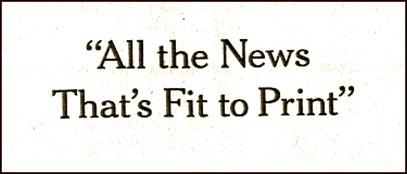
Prominent and famous though it is, the derivation of “All the News That’s Fit to Print,” the New York Times’ famous motto, is shrouded in a bit of media myth.

The version the Times advanced at its centenary in 1951, in a house newsletter called Times Talk, described the motto as “a hybrid.” Times Talk said Adolph Ochs, who acquired the then-beleaguered Times in 1896, borrowed a key portion of the slogan from the Philadelphia Times.

The Times Talk account was cited by Susan E. Tifft and Alex S. Jones in their prodigious study, The Trust: The Private and Powerful Family Behind The New York Times.

Supposedly, Ochs borrowed “All the News,” the motto of the Philadelphia Times, appended “That’s Fit to Print,” and thus concocted the most famous seven-word phrase in American journalism.

The account, however, is incorrect.

The Philadelphia Times never used “All the News” as its motto during the summer and fall of 1896, when Ochs acquired control of the Times and began using “All the News That’s Fit to Print” as a marketing and advertising slogan.

A thorough review of issues of the Philadelphia Times published in the summer and fall of 1896 showed that the newspaper carried a number of promotional statements, none of which was particularly pithy, or memorable.

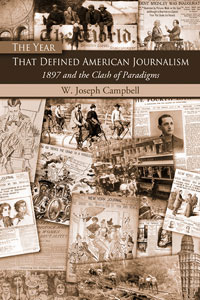
As I wrote in my 2006 book, a year study titled The Year That Defined American Journalism: 1897 and the Clash of Paradigms, the nearest approximation to “All the News” was this rambling assertion, which appeared a few times beneath the front page nameplate of the Philadelphia Times:

“If You Want All the News of Every Description Attractively Presented You Will Read the Times.”

That clunky phrase appeared in the Philadelphia Times on August 4, 11, and 17, 1896. Ochs, according to Tifft and Jones, was installed as the New York Times publisher on August 18, 1896.

“All the News That’s Fit to Print” did not makes its début until early October 1896, spelled out in a row of red lights on an advertising sign above New York’s Madison Square.

Later that month, “All The News That’s Fit to Print” appeared in New York Times advertisements published in the trade journal Fourth Estate. By the end of October 1896, the phrase had taken a place in a corner of the Times’ editorial page.

And 113 years ago yesterday, on February 10, 1897, the Times moved the phrase without notice or fanfare to the upper left corner, the left “ear,” of its front page—a place of prominence that it has occupied ever since.

What prompted the motto’s move to the front page is not entirely clear. But the intent seems undeniable: To offer a rebuke to the bold, self-promoting yellow journalism of William Randolph Hearst and Joseph Pulitzer.

But it appears that “All the News That’s Fit to Print” was Ochs’ creation, as Harrison E. Salisbury maintained in Without Fear or Favor: The New York Times and Its Times, an impressive insider’s study of the Times. (Salisbury cited as his source an Ochs manuscript in the Times archives.)

By the way, I quote Salisbury’s Without Fear or Favor in Getting It Wrong, my forthcoming book about media-driven myths.

Without Fear or Favor was a useful source in the chapter in Getting It Wrong that addresses the myth surrounding the Times’ reporting in the run-up to the Bay of Pigs invasion in April 1961.

WJC

‘Yours neatly, sweetly, completely’: Revisiting the Times’ motto contest

In 1897, New York Times, Year studies, Yellow Journalism on February 10, 2010 at 12:06 am

How about this as the motto for the New York Times? “Clean, crisp, bright, snappy; read it daily and be happy.”

Or this? “Bright as a star and there you are.”

Or? “Pure in Purpose, Diligent in Service.”

Or? “You do not want what the New-York Times does not print.”

They were among thousands of entries submitted in a “motto contest” organized by the Times and its new owner, Adolph Ochs, in autumn 1896.

The contest ostensibly was to encourage readers to propose “a phrase more expressive of the Times’ policy” than “All the News That’s Fit to Print,” which Ochs had begun using as a marketing and advertising slogan in early October 1896. By the end of that month, the phrase had taken a modest place in a corner of the Times’ editorial page.

And on February 10, 1897–113 years ago today–“All the News That’s Fit to Print” appeared in the upper left corner, the “left ear,” of the Times’ front page, a place the motto has occupied ever since.

The 1896 motto contest was in reality a way to call attention to the Times in New York’s crowded newspaper market—one dominated by the yellow journalism of William Randolph Hearst and Joseph Pulitzer. Ochs had acquired the beleaguered Times in August 1896 and faced such rough going that Pulitzer’s New York World declared several months later:

“The shadow of death is settling slowly but surely down upon” the Times.

The motto contest, cheesy though it may seem today, stirred a fair amount of attention–and reader interaction–in 1896. The Times promised to pay $100 to the person who proposed in ten words or fewer a slogan deemed better than “All the News That’s Fit to Print,” which had first appeared in early October 1896, spelled out in a row of red lights on an advertising sign above New York’s Madison Square.

Among the entries sent to the Times were clunky such suggestions as: “All the News Worth Telling,” “All the News That Decent People Want,” and “The Fit News That’s Clean and True.”

Other were:

“Full of meat, clean and neat.”

“Instructive to all, offensive to none.”

“The people’s voice, good the choice.”

“Aseptic journalism up to date.”

“Yours neatly, sweetly, and completely.”

As I wrote in my 2006 book, a year study titled The Year That Defined American Journalism: 1897 and the Clash of Paradigms: “Before the contest ended, the Times altered the stakes by making clear it would not abandon ‘All the News That’s Fit to Print.’

“The Times justified this change of heart by saying no phrase entered in the contest was more apt and expressive than ‘All the News That’s Fit to Print.’ The $100 prize would be awarded, to the person adjudged to have submitted the best entry. But the motto would not be changed.”

Indeed, “All the News That’s Fit to Print” lives on as the most famous slogan in American journalism, the “leitmotif not merely for the Times, but also … for most other general-interest papers in the country,” a columnist for the Wall Street Journal once wrote.

The Times characterized its motto contest not as a grubby publicity stunt but as an opportunity for high-minded rumination about New York City newspapers. The contest, it said, had “set the people of this city to thinking upon the subject of newspaper decency in a more attentive and specific way than has been their custom.”

In any event, a committee of Times staffers winnowed the entries to 150 semi-finalists, which were submitted to Richard Watson Gilder, editor of The Century magazine. Gilder selected four finalists, which were:

  • Always decent; never dull.
  • The news of the day; not the rubbish.
  • A decent newspaper for decent people.
  • All the world’s news, but not a school for scandal.

As I wrote in The Year That Defined American Journalism, Gilder noted “that terms of the contest had changed from the original intent of selecting a slogan that ‘more aptly express the distinguishing characteristics of the New-York Times’ to the more theoretical task of determining which entry ‘would come nearest to it in aptness.’”

That entry, Gilder determined, was submitted by D.M. Redfield of New Haven, Connecticut. Redfield’s suggestion:

“All the world’s news, but not a school for scandal.”

Catchy.

WJC

The seven most famous words in American journalism

In 1897, New York Times on February 9, 2010 at 8:10 am

I’ve written that 1897 was a decisive year in American journalism.

The evocative sneer “yellow journalism” first appeared in print in 1897.

What became the best-known, most-reprinted editorial in American journalism, the New York Sun‘s “Is There A Santa Claus?,” was published in 1897.

William Randolph Hearst’s New York Journal developed its bold and interventionist model of “journalism of action” in 1897.

And the seven most famous words in American journalism, “All the News That’s Fit to Print,” took a permanent place on the front page of the New York Times in 1897.

The motto appeared without comment, notice, or fanfare in the upper-left corner, the left “ear,” of the Times front page 113 years ago tomorrow — February 10, 1897.

The smug and tidy slogan has occupied the spot ever since. As  I noted in my 2006 book, The Year That Defined American Journalism: 1897 and the Clash of Paradigms, the motto represents “an enduring statement of guiding principle of what has long been recognized as the best newspaper in America.”

I also noted that the Times motto has been endlessly parodied and analyzed. Even admirers of the newspaper have acknowledged it’s a bit “overweening” and “elliptical.”

The motto has evoked lofty claims over the years. The Times in 1901, at the fiftieth anniversary of its founding, referred to “All the News That’s Fit to Print” as its “covenant.”

An historian of the Times, Elmer Davis, said the motto had served as “a war cry.”

In 2001, a columnist for the Wall Street Journal described the motto as the “leitmotif not merely for the Times, but also, by a process of osmosis and emulation, for most other general-interest papers in the country, as well as for much of the broadcast media.”

It was also, I wrote in The Year That Defined American Journalism, “a pithy summation of the Times’ … vision for American journalism,” a model of detachment in newsgathering “that stood in apposition to the extravagance and self-promotion” of Hearst’s “journalism of action.”

Indeed, “All the News That’s Fit to Print” is a timeless rebuke to the practices of Hearst and, to an extent, of Joseph Pulitzer — aggressive and flamboyant techniques that critics scorned as “yellow journalism.”

Interestingly, “All the News That’s Fit to Print” was at first a feature of a marketing campaign by the Times which, in August 1896, had been acquired in bankruptcy court by Adolph S. Ochs, a newspaperman from Tennessee. “All The News That’s Fit to Print” appeared in advertisements in the trade journal Fourth Estate in mid-October 1896. By month’s end, the phrase had taken a modest place in a corner of the Times’ editorial page.

The seven most famous words in American journalism made their debut in early October 1896, in a row of red lights arrayed across a huge advertising sign above Manhattan’s Madison Square. The illuminated sign was on the north wall of the old Cumberland Hotel building at Broadway and 22d Street.

Ochs, who turned 39 in 1897, had a bit of a flair for self-promotion, as the illuminated sign at Madison Square suggested. Securing the space “was nothing less than a coup” for the newcomer to New York journalism, I wrote in The Year That Defined American Journalism.

“The sign’s bright, multi-colored lights could be seen for many blocks away. Nowhere in the country, or in Europe, the Times immodestly crowed, was there ‘so large and perfect a display.'”

It was illuminated by four rows of lights. White lights of the top and bottom rows spelled, “New-York Times” and “Have You Seen It?” A row of blue, white, and green lights spelled out “Sunday Magazine Supplement.” The red lights, which formed the second row of illumination, announced:

“All the News That’s Fit to Print.”

WJC

in mid-October 1896 and by month’s end had taken a place in the upper-left corner of the newspaper’s editorial page.