W. Joseph Campbell

Archive for the ‘Newspapers’ Category

The media myths of Watergate: Part Three

In Anniversaries, Debunking, Media myths, Newspapers, Quotes, Washington Post, Watergate myth on June 19, 2012 at 5:25 am

This is the third of five posts addressing prominent media-driven myths about the Watergate scandal, which began
unfolding 40 years ago this week with the foiled burglary at the headquarters in Washington of the Democratic National Committee.
This installment discusses the most famous made-up line of Watergate.

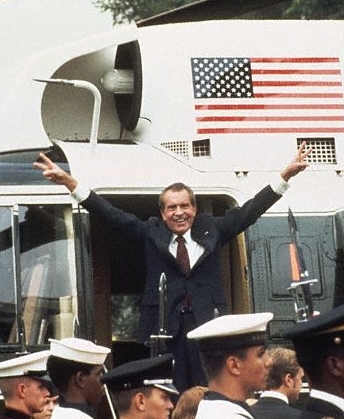
“Follow the money.” It’s the best-known, most popular turn-of-phrase associated with the Watergate scandal of 1972-74.

Felt: Never said it

It’s often said that “follow the money” was sage counsel offered by the stealthy, high-level “Deep Throat” source with whom Bob Woodward of the Washington Post periodically met as the scandal unfolded.

The guidance to “follow the money” supposedly proved crucial in understanding and unraveling the labyrinthine scandal that was Watergate.

Except that it really wasn’t.

“Deep Throat” never advised Woodward to “follow the money.”

The passage appears in no Watergate-related article or editorial in the Post until June 1981, nearly seven years after Nixon’s resignation. It doesn’t appear, either, in All the President’s Men, the book Woodward and his Post colleague, Carl Bernstein, wrote about their Watergate reporting.

Follow the money” was written into the screenplay of All the President’s Men, the cinematic adaptation of Woodward and Bernstein’s book.

The line was spoken by Hal Holbrook, the actor who played “Deep Throat” in the movie. (The real “Deep Throat” was self-revealed in 2005 to have been W. Mark Felt, a senior FBI official.)

Holbrook in All the President’s Men turned in a marvelous performance as a twitchy, conflicted, chain-smoking “Deep Throat.”
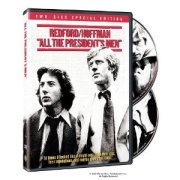
‘All the President’s Men,’ the movie

He delivered the line, “follow the money,” with such raspy assurance and conviction that it seemed for all the world to be vital to understanding the scandal that began unfolding 40 years ago.

Follow the money” is certainly Watergate’s most memorable and mythical phrase; it is so pithy and emphatic that it seems almost too good not to be true.

Indeed, “follow the money” tends to be treated with reverence by news media. A “credo,” it’s been called.

Take, for example, a recent post at the “Daily Intel” blog of New York Magazine. The blog post began by invoking the famous phrase, with emphasis:

Follow the money. The pithy investigative advice Woodward and Bernstein attributed to Deep Throat is still brilliant and important, whatever else the Watergate reporters may have embellished.”

Brilliant and important?

Made up is more like it.

But even if Woodward had been counseled to “follow the money,” the advice neither would have unraveled the Watergate scandal nor led him to Nixon.

Besides, Woodward and Bernstein already were on the money trail.

One of their most important stories was in reporting that a $25,000 check to Nixon’s reelection campaign had been deposited in the bank account of one of the Watergate burglars.

The scandal, though, was much more than Nixon’s improper use of campaign funds. The president was forced to resign because he obstructed justice by approving a plan to cover up the burglary at the Democratic National Committee.

The simplified, follow-the-money construct not only is inaccurate and misleading: It serves to deflect attention from the array of forces that combined to expose Nixon’s crimes.

As I note in my 2010 book Getting It Wrong, rolling up a scandal of Watergate’s depth and dimension required “the collective if not always the coordinated forces of special prosecutors, federal judges, both houses of Congress, the Supreme Court, as well as the Justice Department and the FBI.

“Even then,” I write, “Nixon likely would have served out his term if not for the audiotape recordings he secretly made of most conversations in the Oval Office of the White House.

“Only when compelled by the Supreme Court did Nixon surrender those recordings, which captured him plotting the cover-up” that cost him the presidency.

WJC

Recent or related:

The media myths of Watergate: Part Two

In Anniversaries, Debunking, Media myths, Newspapers, Scandal, Washington Post, Watergate myth on June 18, 2012 at 5:42 am

This is the second of five posts addressing prominent media-driven myths about the Watergate scandal, which began unfolding 40 years ago this week with
the foiled burglary at the headquarters in Washington
of the Democratic National Committee.
This installment discusses the notion
that the 
Washington Post “uncovered” the Watergate story.

Post’s Watergate story, June 18, 1972 (Ransom Center, University of Texas)

Watergate was America’s gravest political scandal. It began as a police beat story.

News of the scandal’s seminal crime — the thwarted break-in of June 17, 1972, at the headquarters of the Democratic National Committee at the Watergate complex in Washington, D.C. — was circulating within hours.

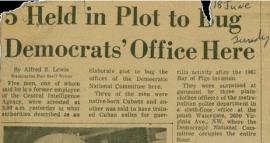
The opening paragraph of the Posts front-page report about the burglary, published 40 years ago today, made it clear that details had come from investigating authorities. The paragraph read:

“Five men, one of whom said he is a former employee of the Central Intelligence Agency, were arrested at 2:30 a.m. yesterday in what authorities described as an elaborate plot to bug the offices of the Democratic National Committee here.”

So it can’t be said the Post “uncovered” the Watergate story.

Nor can it be said that the newspaper “uncovered” crucial elements of the deepening scandal, which ultimately forced President Richard Nixon to resign the presidency in August 1974.

Take, for example, Nixon’s secret audiotaping system at the White House.

Existence of the tapes was disclosed in July 1973 to a bipartisan select committee of the U.S. Senate (see video clip below).

http://youtu.be/MeQXopJ5U-Q

The tapes were decisive to Watergate’s outcome; Watergate’s leading historian, Stanley I. Kutler, has characterized them as “the gift of the gods.”

The so-called “smoking gun” tape revealed that Nixon had approved a plan to divert the FBI’s investigation of the break-in of DNC headquarters.

He did so in a conversation June 23, 1972, with his top aide, H.R. Haldeman. The contents of the “smoking gun” tape were made public in early August 1974, shortly after the U.S. Supreme Court ordered Nixon to turn it over to investigators.

The “smoking gun” tape sealed Nixon’s fate and led to his resigning the presidency.

(As Kutler has noted, Nixon-White House tapes “released in 1997 clearly reveal” that the president knew about “hush money” payments to the Watergate burglars.)

Interestingly, the Post’s Watergate reporters, Bob Woodward and Carl Bernstein, later claimed to have had a solid lead about Nixon’s taping system — a lead they did not pursue.

They mentioned in their book, All the President’s Men, that Woodward had spoken about the tip with Ben Bradlee, then the Post’s executive editor.

Bradlee advised: “See what more you can find out, but I wouldn’t bust one on it.”

And they didn’t.

Had they, Woodward and Bernstein may well have broken a pivotal story about the scandal.

Principals at the Post often have said that the newspaper’s reporting kept the Watergate story alive during the summer and fall of 1972, a time when few other news organizations seemed interested in pursuing the scandal.

Leonard Downie, who succeeded Bradlee as executive editor, renewed that claim in a recent commentary in the Post.

For “several months after the Watergate burglary in 1972,” Downie wrote, “Woodward, Bernstein and their colleagues on the local news staff of The Post were alone on the story.

“We were ignored and doubted by the rest of the news media and most of the country, and under heavy fire from the Nixon administration and its supporters.”

It’s a heroic interpretation.

But it’s not entirely accurate.

As I point out in my 2010 book, Getting It Wrong, “The Post may well have led other newspapers on the Watergate story — principally was because Watergate at first was a local story, based in Washington, D.C.

“But rival news organizations such as Los Angeles Times and New York Times did not ignore Watergate as the scandal slowly took dimension during the summer and fall of 1972.”

The Los Angeles Times, for example, published a first-person account in early October 1972 of Alfred C. Baldwin III, a former FBI agent who acted as a lookout man in the Watergate burglary.

Significantly, the New York Times was the first news organization to report the payment of hush money to the burglars, a pivotal disclosure in mid-January 1973. The Times report made clear that efforts were under way to cover up and conceal the roles of others in the scandal.

John Dean, Nixon’s former counsel, recalled in a memoir published years later that the Times report about hush-money payments “hit home!”

The disclosure, Dean wrote, “had everyone concerned and folks in the White House and at the reelection committee were on the wall.”

And as Edward Jay Epstein pointed out in a classic essay in 1974, the Post and other newspapers were joined during the summer of 1972 by the General Accounting Office, the investigative arm of Congress, and Common Cause, a foundation that seeks accountability in government office, in directing attention to the scandal.

Moreover, George McGovern, Nixon’s hapless Democratic challenger for the presidency in 1972, not infrequently invoked Watergate in his campaign appearances. At one point in the summer of 1972, McGovern charged that Nixon was “at least indirectly responsible” for the Watergate burglary.

So in the summer and fall of 1972, the Post was one of several institutions seeking to delineate the reach and contours of Watergate.

The Post, as I note in Getting It Wrong, “was very much not alone.”

WJC

Recent or related:

The media myths of Watergate: Part One

In Anniversaries, Cinematic treatments, Debunking, Media myths, Newspapers, Reviews, Scandal, Washington Post, Watergate myth on June 17, 2012 at 6:00 am

This is the first of five posts addressing prominent media-driven myths about the Watergate scandal, which began unfolding 40 years ago with the foiled burglary at the headquarters in Washington of the Democratic National Committee. This installment discusses the tenacious myth
that reporting by the 
Washington Post brought down
Richard Nixon’s corrupt presidency
.

Other posts in this series
may be accessed here, here, here, and here.

For years, the dominant narrative of Watergate has been that the dogged reporting of Bob Woodward and Carl Bernstein for the Washington Post revealed the crimes that forced Richard Nixon to resign the presidency in August 1974.

That’s also a media-driven myth — the heroic-journalist myth, as I called it in my 2010 book, Getting It Wrong.

I note in Getting It Wrong that the media-centric heroic-journalist construct “has become the most familiar storyline of Watergate,” serving as “ready short-hand for understanding Watergate and its denouement, a proxy for grasping the scandal’s essence while avoiding its forbidding complexity.”

The misdeeds of Watergate were many. Twenty men associated with Nixon’s presidency or his 1972 reelection campaign went to jail for crimes such as perjury, obstruction of justice, and conspiracy.

Three powerful and related factors have propelled and solidified the heroic-journalist trope in the popular consciousness.

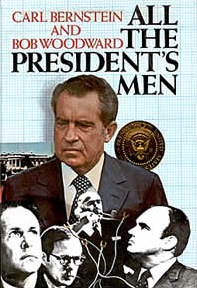
One factor was Woodward and Bernstein’s engaging book about their Watergate reporting, All the President’s Men, which came out in June 1974, just as the scandal was nearing culmination.

As Stanley I. Kutler, Watergate’s preeminent historian, has written, All the President’s Men “offered a journalistic brief to the nation as it prepared to understand and judge for itself” the growing evidence of Nixon’s guilt.

All the President’s Men was quite the success, holding the top spot on the New York Times’ non-fiction best-seller list for 15 weeks — through the climatic days of Watergate and beyond.

“The book’s impeccable timing,” I write in Getting It Wrong, served to “promote an impression that Woodward and Bernstein were central to Watergate’s ultimate outcome.”

The book that helped promote a myth

That impression was deepened in the cinematic version of All the President’s Men, which was released to great fanfare and rave reviews in April 1976.

The movie placed Woodward and Bernstein at the center of Watergate’s unraveling — and minimized or ignored the far more decisive contributions of subpoena-wielding investigators.

Indeed, rolling up a scandal of Watergate’s dimension and complexity required the collective efforts of special prosecutors, federal judges, both houses of Congress, the Supreme Court, as well as the Justice Department and the FBI.

And even then, as I write in Getting It Wrong, Nixon likely would have survived the scandal and served out his term if not for the audiotape recordings he secretly made of conversations in the Oval Office of the White House.

Only when compelled by the Supreme Court did Nixon surrender the recordings, which captured him approving a plan to divert the FBI’s investigation into Watergate’s seminal crime, the break-in June 17, 1972, at the headquarters of the Democratic National Committee.

The third factor in pressing the heroic-journalist myth firmly into the popular consciousness was the 30-year guessing game about the identity of Woodward’s stealthy, high-level source whom a Post editor code-named “Deep Throat.”

Speculation about the identity of “Deep Throat” came not infrequently and was often prominent. The guessing game offered periodic reminders about the Post and its Watergate coverage. The speculation effectively kept Woodward and Bernstein in the public eye far longer than they otherwise might have.

In 2005, W. Mark Felt, formerly second in command at the FBI, disclosed that he had been the “Deep Throat” source — giving rise to yet another round of reminiscing about the heroic journalists  of Watergate.

Such preening was misplaced, of course.

As Max Holland, author of Leak, a recent book about Watergate and “Deep Throat,” has aptly put it:

“Federal prosecutors and agents never truly learned anything germane from The Washington Posts [Watergate] stories — although they were certainly mortified to see the fruits of their investigation appear in print. … The government was always ahead of the press in its investigation of Watergate; it just wasn’t publishing its findings.”

Interestingly, principals at the Post have periodically scoffed at and rejected the heroic-journalist narrative.

For example, Katharine Graham, the Post’s publisher during and after Watergate, said at a program in 1997 marking the scandal’s 25th anniversary:

“Sometimes people accuse us of bringing down a president, which of course we didn’t do. The processes that caused [Nixon’s] resignation were constitutional.”

And Woodward  complained in 1996 that “the mythologizing of our role in Watergate has gone to the point of absurdity, where journalists write … that I, single-handedly, brought down Richard Nixon.

“Totally absurd.”

Indeed. To explain Watergate through the lens of the heroic-journalist is to simplify and misunderstand the scandal. It is to misread history and indulge in a beguiling media-driven myth.

WJC

Recent or related:

Four weeks on: No answer from WaPo about empty links to Jessica Lynch stories

In Debunking, Jessica Lynch, Media myths, Newspapers, Washington Post on May 25, 2012 at 6:55 am

Lynch photo at WaPo’s Iraq archive

Want to read the Washington Post article of April 10, 2003, about the fall of Baghdad to U.S. forces? The article’s online link is here.

How about the Post’s report about the Iraqi lawyer who helped lead U.S. rescuers to Jessica Lynch, the Army private taken prisoner and hospitalized following a deadly ambush in the war’s early days? Here’s the link to that story,  which the Post published on its front page April 4, 2003.

How about the Post’s front-page article of the day before, which told of Lynch’s supposed heroism in the ambush, how she had fought fiercely and “continued firing at the Iraqis even after she sustained multiple gunshot wounds and watched several other soldiers in her unit die around her”?

It was an electrifying report, one picked up by news organizations around the world.

But it turned out that the Post’s hero-warrior tale about Lynch was embarrassingly wrong in all important details. Lynch never fired a shot in Iraq; she was neither shot nor stabbed, as the Post had reported, but badly injured in the crash of a Humvee as it fled the ambush.

Try finding the botched hero-warrior story at the Post’s online site. All that turns up is a headline, byline, and date of publication. Otherwise, it’s an empty link. No content, in other words.

That’s also true for a column published April 20, 2003, by Michael Getler, the newspaper’s then-ombudsman, who criticized the hero-warrior story: Another empty, no-content link.

Same for the Post’s partial rollback of the hero-warrior story, published in mid-June 2003: Also an empty link.

So what gives? Why is some of the Post’s content about the Iraq War — and Jessica Lynch — freely available online while the more embarrassing material shows up as empty links?

Is this a matter of digital scrubbing, akin to Vogue magazine’s excising of a flattering profile of the wife of the Syrian dictator, Bashar al-Asad? The Post last month described the Vogue matter as “an almost-unheard-of step for a mainstream media organization.”

Periodically over the past four weeks, I’ve asked the Post’s ombudsman, Patrick Pexton, about the digitally unavailable versions of the newspaper’s reports about Lynch.

Pexton has  promised to look into my questions.

But four weeks on, he has yet to offer a substantive reply.

I have asked him: “Does the embarrassment quotient explain this apparent inconsistency?” That is, is the Post too embarrassed by its botched reporting about Lynch to make the links freely available online?

I suspect it is.

In his most recent email to me, on May 16, Pexton said he receives “200 to 300 e-mails per day and we’re always behind. We are working on trying to get you some answers on this.”

I replied the following day, thanking him for the update and saying I hoped to hear from him soon.

I also wrote:

“I believe my request can be distilled thusly:

“Why is some Lynch-related content from 2003 freely available online (see here), while content more embarrassing to the Post (see empty links here, here, and here) not available? Shouldn’t those empty links be restored, and added to the Post’s link-rich Iraq War archive, where Lynch’s name and image already appear?”

That email produced no response from Pexton, however.

The Post‘s digital archive of the Iraq War offers a functioning link to the article about the Iraqi lawyer who helped guide rescuers to Lynch.

In fact, the only U.S. soldier identified by name and image at the archive is Jessica Lynch.

I discuss the Post’s reporting of the Lynch case in a chapter in my latest book, Getting It Wrong.

WJC

Many thanks for Instapundit
Glenn Reynolds for linking to this post

Recent and related:

Two weeks on: Still waiting for WaPo on missing Jessica Lynch online content

In Debunking, Jessica Lynch, Media myths, Newspapers, Washington Post on May 11, 2012 at 9:41 am

Lynch photo at WaPo’s Iraq archive

Two weeks ago, the Washington Post ombudsman promised to look into questions I had posed about the unavailable digital versions of the newspaper’s embarrassingly wrong reports about Jessica Lynch’s supposed heroics during the Iraq War.

I’m still waiting a response from the ombudsman, Patrick Pexton.

At issue are empty links for at least three articles and commentaries about Lynch that appeared in the Post in 2003 — all of which are keenly embarrassing to the newspaper. Among them is the Post’s infamous “Fighting to the Death” story of April 3, 2003, which is at the heart of the bogus hero-warrior tale about Lynch.

That story — which isn’t available at the Post’s online site — described Lynch’s purported derring-do on the battlefield, saying she fought fiercely in an ambush in Nasiriyah and was captured only after running out of ammunition.

As it turned out, the story was utterly wrong in all important details. Lynch never fired a shot in Iraq; she was neither shot nor stabbed, as the Post had reported, but badly injured in the crash of a Humvee as it fled the ambush. (I discuss the Post’s handling of the Lynch case in a chapter in my latest book, Getting It Wrong.)

Another element of the Post’s narrative about Lynch that’s missing online is a column written several days later by Michael Getler, then the newspaper’s ombudsman. Getler criticized the hero-warrior story, noting that readers thought it suspicious.

In mid-June 2003, the Post grudgingly walked back from aspects of its hero-warrior tale — an embarrassment that media critic Christopher Hansen characterized as “the journalistic equivalent of Napoleon’s retreat from Moscow.”

The Post’s walk-back article also is unavailable online.

But at least one of the Post’s  stories about Lynch in 2003 is freely available online, as I’ve noted in email messages to Pexton.

That article — which is decidedly non-embarrassing to the Post — was published April 4, 2003; there’s a functioning link to it at the newspaper’s link-rich digital archive about the Iraq War. Interestingly, the only U.S. soldier identified by name and image at the archive site is Jessica Lynch.

So why aren’t the Post’s other reports about Lynch available at that online archive? If some Lynch-related content from 2003 is freely available, why not the rest? Wouldn’t restoring all Lynch content make the digital archive richer, more comprehensive, and more balanced?

I believe it would.

I’ve asked Pexton: “Does the embarrassment quotient explain this apparent inconsistency?” In other words, is the Post too embarrassed by its botched reporting about Lynch to make the links freely available online?

I suspect so.

Pexton did say in an email 14 days ago that his looking into my questions “will take some considerable time to research, but I’ll check into it. It’s very hard to trace some of this back when The Post has gone through several computer systems since that time, but I’ll make an effort.”

In reply, I suggested that the matter could be readily distilled by focusing on this question:

“Why is some Lynch-related content from 2003 freely available online (see here), while other and more embarrassing content (see empty links here, here, and here) not available?”

I sent Pexton follow-up email messages on May 1 and May 7. In those email, I asked why the empty links about the Lynch case couldn’t be restored and added to the digital archive about the Iraq War.

I have received no reply.

And that’s a bit odd because Pexton, in a column in March, pointedly urged Post staffers to be responsive to inquiries, writing:

“Return the blessed phone calls and e-mails from readers! And do it with courtesy, respect and politeness, even when the caller, or writer, is persistent or even unpleasant. Please.”

That’s advice too good to be ignored.

WJC

Recent and related:

National Press Club invokes media myths of Watergate

In Media myths, Newspapers, Scandal, Washington Post, Watergate myth on April 30, 2012 at 5:45 am

The National Press Club indulged in a couple of tenacious media myths about Watergate in announcing the other day it was giving its top award to Bob Woodward, one of the Washington Post’s lead reporters on what was the country’s greatest political scandal.

In its statement that Woodward will receive this year’s Fourth Estate Award, the Press Club declared that his “work on the Watergate scandal led to the resignation of an American president” — an interpretation that not even Woodward embraces.

He once told the PBS “Frontline” program that “the mythologizing of our role in Watergate has gone to the point of absurdity, where journalists write … that I, single-handedly, brought down [President] Richard Nixon. Totally absurd.”

And on another occasion, Woodward declared more bluntly:

To say that the press brought down Nixon, that’s horseshit.”

As I note in my latest book, Getting It Wrong, the simplified notion that Woodward’s Watergate reporting for the Post led to Nixon’s resignation serves to diminish “the far more decisive forces that unraveled the scandal and forced Nixon from office.”

To roll up a scandal of the dimension of Watergate required, I write, “the collective if not always the coordinated forces of special prosecutors, federal judges, both houses of Congress, the Supreme Court, as well as the Justice Department and the FBI.

“Even then, Nixon likely would have served out his term if not for the audiotape recordings he secretly made of most conversations in the Oval Office of the White House” — recordings the U.S. Supreme Court ruled that he had to surrender.

So the notion that Woodward’s reporting for the Post was decisive to Watergate’s outcome is absurd.

So, too, is the subsidiary myth that Watergate reporting — and the cinema’s depiction of the Post’s coverage in All the President’s Men — made the field seem so alluring  that enrollments in college journalism programs surged as a result.

The Press Club statement about Woodward’s award invokes that myth, too, asserting that “enrollment in journalism departments rose in the post-Watergate era, especially after ‘All the President’s Men’ was made into a movie.” It was based on a book by the same title, which was written by Woodward and his Post colleague, Carl Bernstein.

As I point out in Getting It Wrong, however, separate scholarly studies have debunked the notion of Watergate’s  propellant effect on college enrollments in journalism.

One study, conducted for the Freedom Forum media foundation and released in 1995, said that “growth in journalism education result[ed] not from specific events as Watergate … but rather to a larger extent from the appeal of the field to women, who ha[d] been attending universities in record numbers.”

The study’s author, Lee Becker and Joseph Graf, stated flatly:

“There is no evidence … that Watergate had any effect on enrollments.”

A separate study, conducted by veteran journalism scholar Maxwell E. McCombs and published in 1988, reported that “the boom in journalism education was underway at least five years before” the Watergate break-in in 1972.

McCombs further wrote:

“It is frequently, and wrongly, asserted that the investigative reporting of Woodward and Bernstein provided popular role models for students, and led to a boom in journalism school enrollments. The data … reveal, however, that enrollments already had doubled between 1967 and 1972….”

So why are these Watergate myths so appealing, and so tenacious, that even the National Press Club embraces them?

One reason is that they’re simplistic, easy-to-remember narratives that locate the news media heroically at the heart of unraveling America’s greatest political scandal.

Indulging in myths such as the heroic-journalist trope of Watergate also offers a subtle way of investing the Press Club award with even greater distinction.

And as I note in Getting It Wrong, the tale about how “the Post and its reporters uncovered Watergate is deeply ingrained in American journalism as one of the field’s most important and self-reverential stories.”

It’s a myth that’s no doubt too resilient, too media-centric, and too widely applicable ever to eradicate.

WJC

Woodward and Bernstein: The ‘only superstars newspapers ever produced’?

In Cinematic treatments, Debunking, Media myths, Newspapers, Washington Post, Watergate myth on April 16, 2012 at 5:11 am

The 40th anniversary of the debut of the Watergate scandal falls in two months and we’re certain read many effusive tributes to the Washington Post’s reporters who often —  but wrongly — are said to have exposed the scandal and brought down Richard Nixon’s corrupt presidency.

It’s a safe bet that many of the tributes to the Post and its Watergate reporting team of Bob Woodward and Carl Bernstein will be exaggerated and erroneous.

Take, for example, this passage, which appeared over the weekend in a column in the Toronto Sun:

“The only superstars newspapers ever produced were Woodward and Bernstein, the Washington Post investigative team who broke the Watergate story that led to the downfall of U.S. president Richard Nixon.”

Maybe they were the only superstars of newspaperdom, although that claim might provoke an argument from the committee at New York University that recently selected 100 outstanding U.S. journalists of the past 100 years. (The list included several dubious entries, such as the self-important Christiane Amanpour of CNN; photojournalist and probable fraud Robert Capa; mythmaking writer David Halberstam, and broadcast journalism’s flawed saint, Edward R. Murrow.)

Woodward and Bernstein made NYU’s rather predictable list, too.

If they are newspapering’s lone superstars, their self-promotion had a lot to do with it.  Woodward and Bernstein’s book about their Watergate reporting, All the President’s Men, came out in June 1974, about two months before Nixon’s resignation.

The book, a months-long best-seller, had been written with the movies in mind; the cinematic version of All the President’s Men came out in April 1976 and starred Robert Redford as Woodward and Dustin Hoffman as Bernstein.

But more important than Woodward and Bernstein’s superstar status is the claim in the Sun’s column that they “broke the Watergate story.”

They did no such thing.

The signal crime of Watergate — the June 1972 burglary at Democratic National Committee headquarters — wasn’t broken by the Post. The break-in was interrupted by police and within hours, news was circulating of the arrest of five burglars at the Watergate complex.

The story in the Post about the break-in appeared beneath the byline of Alfred E. Lewis, a veteran police reporter, and its opening paragraph made quite clear that details were from investigators:

“Five men, one of whom said he is a former employee of the Central Intelligence Agency, were arrested at 2:30 a.m. yesterday in what authorities described as an elaborate plot to bug the offices of the Democratic National Committee here.”

Watergate reporting by the Post did not expose the cover-up of crimes linked to the break-in or the payment of hush money to the burglars, either.

As I note in my latest book, Getting It Wrong, which includes a chapter about the media myths of Watergate, Woodward was quoted in 1973 as saying that those crucial aspects of the scandal were “held too close. Too few people knew. We couldn’t get that high.”

Woodward: 'held too close'

Nor did Woodward and Bernstein uncover or disclose the existence of the White House audiotaping system, which was decisive to the outcome of Watergate.

The tapes secretly made by President Richard Nixon captured him approving a plan in June 1972 intended to thwart the FBI’s investigation of the Watergate break-in.

That contents of that tape — the so-called “smoking gun” of Watergate — sealed Nixon’s fate and directly led to his resignation in August 1974.

The White House taping system had been disclosed 11 months before, not by Woodward and Bernstein but by investigators of the Senate select committee on Watergate.

As I point out in Getting It Wrong, Woodward and Bernstein later claimed to have had a solid lead about the taping system.

In All the President’s Men, the book, Woodward recalled having spoken with Post Executive Editor Ben Bradlee about the lead.

Bradlee advised:

“I wouldn’t bust one” in checking it out.

Had they followed the lead, Woodward and Bernstein may well have broken a pivotal story about Watergate.

But they didn’t.

WJC

Recent and related:

Online at BBC News: Recalling the derivation of ‘All the news that’s fit to print’

In 1897, Anniversaries, New York Times, Newspapers, Yellow Journalism on February 11, 2012 at 12:10 am

The most famous seven words in American journalism — “All the news that’s fit to print” — took a permanent place 115 years ago yesterday in the upper left corner, or left “ear,” of the New York Times masthead.

On front page for 115 years

And I recalled that occasion in a piece for the BBC News online site, writing:

“The motto appeared on the Times’ front page without notice, commentary, or fanfare. In the years since, the phrase has been admired as a timeless statement of purpose, interpreted as a ‘war cry’ for honest journalism, and scoffed at as pretentious, overweening, and impossibly vague.

“Even the Times hasn’t been entirely consistent in its embrace and interpretation of those seven words. In 1901, at the 50th anniversary of its founding, the Times referred to ‘All the news that’s fit to print’ as its ‘covenant. In 2001, a Times article commemorating the newspaper’s 150th anniversary said of the motto:

“’What, exactly, does it mean? You decide. The phrase has been debated, and endlessly parodied, both inside and outside the Times for more than a century.’

“On occasion, the motto has been taken far too seriously, as in 1960 when Wright Patman, a U.S. congressman from Texas, asked the Federal Trade Commission to investigate whether ‘All the news that’s fit to print’ amounted to false and misleading advertising.

“’Surely this questionable claim has a tendency to make the public believe, and probably does make the public believe, that the New York Times is superior to other newspapers,’ Patman wrote.

“The Trade Commission declined to investigate, saying: ‘We do not believe there are any apparent objective standards by which to measure whether “news” is or is not “fit to print.”’

“No matter how it’s interpreted, the motto certainly is remarkable in its permanence. One-hundred fifteen years on the front page has invested the motto with a certain gravitas. It often has been associated with fairness, restraint, and impartiality — objectives that nominally define mainstream American journalism.

“A commentary in the Wall Street Journal in 2001 addressed those sentiments, describing the motto as the ‘leitmotif not merely for the Times, but also, by a process of osmosis and emulation, for most other general-interest papers in the country, as well as for much of the broadcast media.

“Interestingly, the ‘leitmotif’ of American journalism had its origins in marketing and advertising.

“’All the news that’s fit to print’ first appeared on an illuminated advertising sign, spelled out in red lights above New York’s Madison Square in early October 1896. That was about six weeks after Adolph S. Ochs had acquired the newspaper in bankruptcy court.

“Ochs, patriarch of the family that still controls and publishes the Times, had come to New York from Tennessee. His task was to differentiate the Times from its larger, aggressive, and wealthier rivals — notably the yellow press of William Randolph Hearst and Joseph Pulitzer. It was a tall order, given the beleaguered status of the Times in New York’s crowded newspaper market.

“Ochs possessed a keen sense of promotion and turned to a number of techniques to call attention to the Times. The illuminated sign at Madison Square was one. An even more successful promotion was a contest inviting readers to propose a better motto.

“In late October 1896, the Times announced it was offering $100 for the phrase of ten words or fewer that ‘more aptly’ captured the newspaper’s ‘distinguishing characteristics’ than ‘All the news that’s fit to print.’

“Hundreds of entries poured in. …  As the contest unfolded in the fall of 1896, the Times amended the rules, making clear it would not abandon ‘All the news that’s fit to print’ but would still pay $100 for the best suggestion. And entries kept coming in.

“A committee of Times staff narrowed the field to 150, which in turn was winnowed to four by the motto contest judge, Richard W. Gilder, editor of The Century magazine. The finalists were:

  • “Always decent; never dull”
  • “The news of the day; not the rubbish”
  • “A decent newspaper for decent people”
  • “All the world’s news, but not a School for Scandal”

“The latter entry, Gilder determined, was the best of the lot, and the Times paid the prize money to the author of the phrase, D.M. Redfield of New Haven, Connecticut.

“What exactly prompted Ochs to move ‘All the news that’s fit to print’ to the front page 115 years ago is not entirely clear. But his intent was unmistakable — to throw down a challenge to the yellow press, a challenge that Ochs ultimately won. The Times has long outlived the New York newspapers of Hearst and Pulitzer.

“So the motto lives on as a reminder, as a daily rebuke to the flamboyant extremes of fin-de-siècle American journalism that helped inspire ‘All the news that’s fit to print.'”

WJC

Recent and related:

Virginia (of ‘Yes, Virginia’) tells of her famous letter, 97 years ago

In 1897, Anniversaries, New York Sun, Newspapers on December 23, 2011 at 4:55 am

Young Virginia O'Hanlon

In a newspaper database of the Library of Congress, I found a long-overlooked interview conducted 97 years ago with Virginia O’Hanlon, who as an 8-year-old in 1897 wrote the letter that prompted the most famous newspaper editorial in American journalism.

O’Hanlon said in the interview on Christmas Eve 1914 that she had sent her letter despite her father’s admonition:

“A newspaper has no time to waste on a little girl.”

The editorial that became a classic was published in the old New York Sun, in response to Virginia’s imploring: “Please tell me the truth. Is there a Santa Claus?”

The Sun in its timeless reply reassured young Virginia as well as generations of children who have read the editorial, which memorably declares:

“Yes, Virginia, there is a Santa Claus. He exists as certainly as love and generosity and devotion exist, and you know that they abound and give to your life its highest beauty and joy. Alas! how dreary would be the world if there were no Santa Claus. It would be as dreary as if there were no Virginias.”

The editorial’s closing passages were similarly reassuring in saying:

“No Santa Claus! Thank God! he lives, and he lives forever. A thousand years from now, Virginia, nay, ten times ten thousand years from now, he will continue to make glad the heart of childhood.”

In the interview with the Sun 97 years ago, Virginia O’Hanlon discussed her motivation in writing to the newspaper and her proud reaction when the essay was published — comments that offer revealing insight about the back story to the famous editorial.

“I think that I have never been so happy in my life as when the Sun told me that there was a Santa Claus and that he would live forever,” she said in the interview.

Virginia O’Hanlon was then 25-years-old and had been married 18 months to Edwin Malcolm Douglas. Her only child, Laura Virginia Douglas, was nine months old.

O’Hanlon said in the 1914 interview that she decided to write to the Sun in part because of its importance in her family’s household.

She said her father, Philip, “was always talking about the Sun and how you could always find what you wanted in the Sun, and how mother, who loved whist, wrote letters to the whist editor.”

O’Hanlon recalled telling her father: “I am going to write to the Sun and ask it to tell me the truth, the honest to goodness truth, about Santa Claus,” whose existence her schoolmates had scoffed at.

She added: “If the Sun says there isn’t any [Santa Claus] I’ll believe it; if it tells me Santa Claus is real I’ll make those girls at school sorry they ever teased me.

“Father laughed,” she recalled, quoting him as saying:

“The Sun is too busy writing about Presidents and Governors and important people, Virgina. … A newspaper has no time to waste on a little girl. Write if you want to, but don’t be disappointed if you never hear from your letter.”

“Well,” Virginia said, “I sat down and wrote a short letter, trying to say just what was in my heart. Day after day I looked for a letter in reply. I never for a minute thought the Sun would print a long editorial mentioning me by name and using my whole letter.

“Father teased me now and then,” she said, “but I kept hoping and finally” her letter was answered, in an essay published September 21, 1897, in the third of three columns of editorials.

(O’Hanlon indicated on another occasion that she wrote her letter shortly after her eighth birthday in July 1897. “My birthday was in July and, as a child, I just existed from July to December, wondering what Santa Claus would bring me,” she told an audience of Connecticut high school students in 1959. “I think I was a brat.”)

Word that the newspaper had published an editorial to answer her letter prompted Philip O’Hanlon to rush from their home on West 95th Street in Manhattan to buy a stack of that day’s Sun.

“Father hustled out and came back loaded down like a pack mule,” she said. “He scattered them all over town, I think, he was so proud.

“And me? It spoiled me for a while until I was big enough to understand that I, Virginia O’Hanlon, didn’t count for much in the editorial but that the important thing was the beautiful thoughts expressed by Mr. Church and the charming English in which he put his philosophy.”

She was referring to Francis P. Church, a veteran journalist who wrote the essay in the course of a day’s work, without an inkling it would become a classic.

His authorship was revealed by the Sun shortly after his death in April 1906.

The Sun’s editorial, O’Hanlon said in the interview, “was a wonderful thing in my life, and I mean it to be a wonderful thing in my baby’s. As soon as she masters her A B C’s, it will be the first thing she will read.”

The comment anticipated the commitment of her descendants who, over the years, have embraced the obligations associated with the much-remembered and often-reprinted editorial.

O’Hanlon’s grandchildren, notably, have become what the New York Times last year described as “ambassadors of the Christmas spirit, crossing the country to appear at events honoring her, and reading the letter and the response to children in schools and to their own children at home.”

Virginia O’Hanlon was 81 when she died in 1971. The Times reported her death on its front page.

But by then, though, the Sun had ceased to exist as an independent publication. It was merged with another New York newspaper, the World-Telegram, in January 1950.

WJC

Recent and related:

A ‘certain American paper brought down a certain president’

In Debunking, Media myths, Newspapers, Washington Post, Watergate myth on September 29, 2011 at 4:14 am

It’s impressive how strictly American media myths can win such eager embrace in international contexts.

A certain American president leaves office

The heroic-journalist myth of Watergate is a telling example.

India’s leading English-language newspaper, the Hindu, invoked that myth the other day in a commentary that declared:

“More than 30 years ago, a certain American newspaper brought down a certain president by courageously exposing his wrongdoings entirely on the strength of information supplied by an anonymous source. It was not until some quarter of a century later that the real identity of Washington Post’s source for its expose of the Watergate scandal was revealed.”

Alright, let’s unbundle that myth-freighted paragraph:

  • Richard Nixon’s corrupt presidency was not brought down by the Washington Post, or by any other American newspaper — a topic I discuss in my media mythbusting book, Getting It Wrong.
  • Nixon’s fall in 1974 had nothing to do with “information supplied by an anonymous source” — a reference to the Post’s stealthy, high-level contact code-named “Deep Throat.” In 2005, a former senior FBI official named W. Mark Felt announced that he had been the Post’s Deep Throat.”

I note in Getting It Wrong that the heroic-journalist interpretation of Watergate — “the endlessly appealing notion that the dogged reporting of two young, hungry, and tireless Washington Post journalists, Bob Woodward and Carl Bernstein, brought down Nixon and his corrupt presidency” — has become the dominant narrative of the greatest scandal in American political history.

“But to explain Watergate through the lens of the heroic-journalist is,” I write, “to abridge and misunderstand the scandal and to indulge in a particularly beguiling media-driven myth.”

I point out that the heroic-journalist trope “minimizes the far more decisive forces that unraveled the scandal and forced Nixon from office.”

Those forces, I write, included “the collective if not always the coordinated forces of special prosecutors, federal judges, both houses of Congress, the Supreme Court, as well as the Justice Department and the FBI.”

But even then, Nixon likely would have served out his second term as president if not for the audiotape recordings he secretly made of most conversations in the Oval Office of the White House.

Only when compelled by the Supreme Court in July 1974 did Nixon surrender the recordings that captured him plotting to cover up his administration’s ties to the burglary at the headquarters of the Democratic National Committee in Washington.

I note that the heroic-journalist interpretation “has become the dominant popular narrative of the Watergate scandal for several reasons,” including:

Woodward and Bernstein’s book about their reporting of the unfolding Watergate scandal; the popular cinematic version of their book, All the President’s Men, and the years-long guessing game about the identity of “Deep Throat,” with whom Woodward (but never Bernstein) met periodically in 1972 and 1973, while investigating Watergate.

The role of “Deep Throat,” the reporters wrote in All the President’s Men, was to “confirm information that had been obtained elsewhere and to add some perspective.”

Those factors, I write, “combined to place Woodward and Bernstein at the center of Watergate in popular consciousness” while projecting and reinforcing the erroneous notion that the scandal’s outcome pivoted on disclosures reported by the news media.

WJC

Recent and related: