W. Joseph Campbell

Archive for the ‘Washington Post’ Category

Four weeks on: No answer from WaPo about empty links to Jessica Lynch stories

In Debunking, Jessica Lynch, Media myths, Newspapers, Washington Post on May 25, 2012 at 6:55 am

Lynch photo at WaPo’s Iraq archive

Want to read the Washington Post article of April 10, 2003, about the fall of Baghdad to U.S. forces? The article’s online link is here.

How about the Post’s report about the Iraqi lawyer who helped lead U.S. rescuers to Jessica Lynch, the Army private taken prisoner and hospitalized following a deadly ambush in the war’s early days? Here’s the link to that story,  which the Post published on its front page April 4, 2003.

How about the Post’s front-page article of the day before, which told of Lynch’s supposed heroism in the ambush, how she had fought fiercely and “continued firing at the Iraqis even after she sustained multiple gunshot wounds and watched several other soldiers in her unit die around her”?

It was an electrifying report, one picked up by news organizations around the world.

But it turned out that the Post’s hero-warrior tale about Lynch was embarrassingly wrong in all important details. Lynch never fired a shot in Iraq; she was neither shot nor stabbed, as the Post had reported, but badly injured in the crash of a Humvee as it fled the ambush.

Try finding the botched hero-warrior story at the Post’s online site. All that turns up is a headline, byline, and date of publication. Otherwise, it’s an empty link. No content, in other words.

That’s also true for a column published April 20, 2003, by Michael Getler, the newspaper’s then-ombudsman, who criticized the hero-warrior story: Another empty, no-content link.

Same for the Post’s partial rollback of the hero-warrior story, published in mid-June 2003: Also an empty link.

So what gives? Why is some of the Post’s content about the Iraq War — and Jessica Lynch — freely available online while the more embarrassing material shows up as empty links?

Is this a matter of digital scrubbing, akin to Vogue magazine’s excising of a flattering profile of the wife of the Syrian dictator, Bashar al-Asad? The Post last month described the Vogue matter as “an almost-unheard-of step for a mainstream media organization.”

Periodically over the past four weeks, I’ve asked the Post’s ombudsman, Patrick Pexton, about the digitally unavailable versions of the newspaper’s reports about Lynch.

Pexton has  promised to look into my questions.

But four weeks on, he has yet to offer a substantive reply.

I have asked him: “Does the embarrassment quotient explain this apparent inconsistency?” That is, is the Post too embarrassed by its botched reporting about Lynch to make the links freely available online?

I suspect it is.

In his most recent email to me, on May 16, Pexton said he receives “200 to 300 e-mails per day and we’re always behind. We are working on trying to get you some answers on this.”

I replied the following day, thanking him for the update and saying I hoped to hear from him soon.

I also wrote:

“I believe my request can be distilled thusly:

“Why is some Lynch-related content from 2003 freely available online (see here), while content more embarrassing to the Post (see empty links here, here, and here) not available? Shouldn’t those empty links be restored, and added to the Post’s link-rich Iraq War archive, where Lynch’s name and image already appear?”

That email produced no response from Pexton, however.

The Post‘s digital archive of the Iraq War offers a functioning link to the article about the Iraqi lawyer who helped guide rescuers to Lynch.

In fact, the only U.S. soldier identified by name and image at the archive is Jessica Lynch.

I discuss the Post’s reporting of the Lynch case in a chapter in my latest book, Getting It Wrong.

WJC

Many thanks for Instapundit
Glenn Reynolds for linking to this post

Recent and related:

Two weeks on: Still waiting for WaPo on missing Jessica Lynch online content

In Debunking, Jessica Lynch, Media myths, Newspapers, Washington Post on May 11, 2012 at 9:41 am

Lynch photo at WaPo’s Iraq archive

Two weeks ago, the Washington Post ombudsman promised to look into questions I had posed about the unavailable digital versions of the newspaper’s embarrassingly wrong reports about Jessica Lynch’s supposed heroics during the Iraq War.

I’m still waiting a response from the ombudsman, Patrick Pexton.

At issue are empty links for at least three articles and commentaries about Lynch that appeared in the Post in 2003 — all of which are keenly embarrassing to the newspaper. Among them is the Post’s infamous “Fighting to the Death” story of April 3, 2003, which is at the heart of the bogus hero-warrior tale about Lynch.

That story — which isn’t available at the Post’s online site — described Lynch’s purported derring-do on the battlefield, saying she fought fiercely in an ambush in Nasiriyah and was captured only after running out of ammunition.

As it turned out, the story was utterly wrong in all important details. Lynch never fired a shot in Iraq; she was neither shot nor stabbed, as the Post had reported, but badly injured in the crash of a Humvee as it fled the ambush. (I discuss the Post’s handling of the Lynch case in a chapter in my latest book, Getting It Wrong.)

Another element of the Post’s narrative about Lynch that’s missing online is a column written several days later by Michael Getler, then the newspaper’s ombudsman. Getler criticized the hero-warrior story, noting that readers thought it suspicious.

In mid-June 2003, the Post grudgingly walked back from aspects of its hero-warrior tale — an embarrassment that media critic Christopher Hansen characterized as “the journalistic equivalent of Napoleon’s retreat from Moscow.”

The Post’s walk-back article also is unavailable online.

But at least one of the Post’s  stories about Lynch in 2003 is freely available online, as I’ve noted in email messages to Pexton.

That article — which is decidedly non-embarrassing to the Post — was published April 4, 2003; there’s a functioning link to it at the newspaper’s link-rich digital archive about the Iraq War. Interestingly, the only U.S. soldier identified by name and image at the archive site is Jessica Lynch.

So why aren’t the Post’s other reports about Lynch available at that online archive? If some Lynch-related content from 2003 is freely available, why not the rest? Wouldn’t restoring all Lynch content make the digital archive richer, more comprehensive, and more balanced?

I believe it would.

I’ve asked Pexton: “Does the embarrassment quotient explain this apparent inconsistency?” In other words, is the Post too embarrassed by its botched reporting about Lynch to make the links freely available online?

I suspect so.

Pexton did say in an email 14 days ago that his looking into my questions “will take some considerable time to research, but I’ll check into it. It’s very hard to trace some of this back when The Post has gone through several computer systems since that time, but I’ll make an effort.”

In reply, I suggested that the matter could be readily distilled by focusing on this question:

“Why is some Lynch-related content from 2003 freely available online (see here), while other and more embarrassing content (see empty links here, here, and here) not available?”

I sent Pexton follow-up email messages on May 1 and May 7. In those email, I asked why the empty links about the Lynch case couldn’t be restored and added to the digital archive about the Iraq War.

I have received no reply.

And that’s a bit odd because Pexton, in a column in March, pointedly urged Post staffers to be responsive to inquiries, writing:

“Return the blessed phone calls and e-mails from readers! And do it with courtesy, respect and politeness, even when the caller, or writer, is persistent or even unpleasant. Please.”

That’s advice too good to be ignored.

WJC

Recent and related:

National Press Club invokes media myths of Watergate

In Media myths, Newspapers, Scandal, Washington Post, Watergate myth on April 30, 2012 at 5:45 am

The National Press Club indulged in a couple of tenacious media myths about Watergate in announcing the other day it was giving its top award to Bob Woodward, one of the Washington Post’s lead reporters on what was the country’s greatest political scandal.

In its statement that Woodward will receive this year’s Fourth Estate Award, the Press Club declared that his “work on the Watergate scandal led to the resignation of an American president” — an interpretation that not even Woodward embraces.

He once told the PBS “Frontline” program that “the mythologizing of our role in Watergate has gone to the point of absurdity, where journalists write … that I, single-handedly, brought down [President] Richard Nixon. Totally absurd.”

And on another occasion, Woodward declared more bluntly:

To say that the press brought down Nixon, that’s horseshit.”

As I note in my latest book, Getting It Wrong, the simplified notion that Woodward’s Watergate reporting for the Post led to Nixon’s resignation serves to diminish “the far more decisive forces that unraveled the scandal and forced Nixon from office.”

To roll up a scandal of the dimension of Watergate required, I write, “the collective if not always the coordinated forces of special prosecutors, federal judges, both houses of Congress, the Supreme Court, as well as the Justice Department and the FBI.

“Even then, Nixon likely would have served out his term if not for the audiotape recordings he secretly made of most conversations in the Oval Office of the White House” — recordings the U.S. Supreme Court ruled that he had to surrender.

So the notion that Woodward’s reporting for the Post was decisive to Watergate’s outcome is absurd.

So, too, is the subsidiary myth that Watergate reporting — and the cinema’s depiction of the Post’s coverage in All the President’s Men — made the field seem so alluring  that enrollments in college journalism programs surged as a result.

The Press Club statement about Woodward’s award invokes that myth, too, asserting that “enrollment in journalism departments rose in the post-Watergate era, especially after ‘All the President’s Men’ was made into a movie.” It was based on a book by the same title, which was written by Woodward and his Post colleague, Carl Bernstein.

As I point out in Getting It Wrong, however, separate scholarly studies have debunked the notion of Watergate’s  propellant effect on college enrollments in journalism.

One study, conducted for the Freedom Forum media foundation and released in 1995, said that “growth in journalism education result[ed] not from specific events as Watergate … but rather to a larger extent from the appeal of the field to women, who ha[d] been attending universities in record numbers.”

The study’s author, Lee Becker and Joseph Graf, stated flatly:

“There is no evidence … that Watergate had any effect on enrollments.”

A separate study, conducted by veteran journalism scholar Maxwell E. McCombs and published in 1988, reported that “the boom in journalism education was underway at least five years before” the Watergate break-in in 1972.

McCombs further wrote:

“It is frequently, and wrongly, asserted that the investigative reporting of Woodward and Bernstein provided popular role models for students, and led to a boom in journalism school enrollments. The data … reveal, however, that enrollments already had doubled between 1967 and 1972….”

So why are these Watergate myths so appealing, and so tenacious, that even the National Press Club embraces them?

One reason is that they’re simplistic, easy-to-remember narratives that locate the news media heroically at the heart of unraveling America’s greatest political scandal.

Indulging in myths such as the heroic-journalist trope of Watergate also offers a subtle way of investing the Press Club award with even greater distinction.

And as I note in Getting It Wrong, the tale about how “the Post and its reporters uncovered Watergate is deeply ingrained in American journalism as one of the field’s most important and self-reverential stories.”

It’s a myth that’s no doubt too resilient, too media-centric, and too widely applicable ever to eradicate.

WJC

Digitally scrubbing WaPo’s embarrassment on Jessica Lynch?

In Debunking, Jessica Lynch, Media myths, Washington Post on April 27, 2012 at 2:15 pm

The Washington Post carried a fine story yesterday about Vogue magazine’s apparent removal from its online site of an unaccountably flattering profile of Asma al-Assad, wife of Syrian dictator Bashar al-Assad.

Where's the digital version?

The Post said the 3,200-word puff piece in Vogue “apparently proved so embarrassing to the magazine that it scrubbed it from its Web site, an almost-unheard-of step for a mainstream media organization and a generally acknowledged violation of digital etiquette.”

That observation — “violation of digital etiquette” — evoked for me the unavailability online of the Post’s embarrassingly wrong-headed reports in 2003 about Jessica Lynch and her supposed heroism early in the Iraq War.

In an electrifying account published on its front page April 3, 2003, the Post reported that Lynch, then a 19-year-old Army private, had fought fiercely in the ambush of her unit in Nasiriyah, in southern Iraq.

Lynch, according to the Post,  “continued firing at the Iraqis even after she sustained multiple gunshot wounds and watched several other soldiers in her unit die around her in the fighting,” which took place March 23, 2003.

The hero-warrior tale about Lynch turned out to be utterly wrong in all crucial details. She was neither shot nor stabbed, as the Post reported; she suffered shattering injuries in the crash of a Humvee fleeing the ambush.

Lynch was taken prisoner and moved to an Iraqi hospital where she lingered near death until her rescue by U.S. special forces on April 1, 2003.

The Post’s hero-warrior tale appeared two days later.

But try finding the Post’s digitized version of that story. Here’s the link; but clicking through turns up the article’s headline, byline, date of publication, and page placement. But no text.

(The Post’s story is available in full at the online site of the Pittsburgh Post-Gazette.)

Later in April 2003, the Post’s then-ombudsman, Michael Getler, published a critical column about the hero-warrior story, noting that “several readers wrote to complain, saying they did not doubt ‘the gravity of Lynch’s situation,’ as one put it, but that The Post, ‘using unnamed sources,’ was ‘creating a sensationalist story riddled with inaccuracies.’ ‘I smell an agenda,’ said one reader, suspecting wartime ‘propaganda.’ Another was suspicious of the ‘Hollywood-like telling of the story.'”

Try finding Getler’s column online.

Here’s the link; but in this case, too, just the headline, byline, publication date, and page reference are available.

In mid-June 2003, the Post revisited and grudgingly walked back from aspects of its hero-warrior story about Lynch. One media critic characterized the article as “the journalistic equivalent of Napoleon’s retreat from Moscow.”

(And as I point out in my latest book, Getting It Wrong, the walk-back story “included a nervy attempt by the Post to deflect blame from its central role in spreading the hero-warrior myth of Jessica Lynch.”

(The Post, I note, “faulted the U.S. military and the administration of President George Bush for failing to correct an error for which the Post was responsible. ‘Neither the Pentagon nor the White House publicly dispelled the more romanticized initial version of her capture,’ the Post said, ‘helping to foster the myth surrounding Lynch and fuel accusations that the Bush administration stage-managed parts of Lynch’s story.’  It was an astounding assertion: The Post, alone, was responsible for propagating the ‘romanticized initial version’ that created the hero-warrior myth. To claim the Pentagon and the White House should have done more to dispel that report was, in short, exceedingly brazen.”)

Well, good luck in finding the Post’s walk-back story online.

Here’s the link; but, again, only the headline, byline, publication date, and page reference show up.

So has the Post excised the digital reminders of an embarrassing misstep, of a dramatic story that it thoroughly and singularly botched? Has it, at a minimum, committed a “violation of digital etiquette”?

Rather looks like it. (The Post’s ombudsman, Patrick Pexton, promised to “check into” my questions. He also said in an email today: “It’s very hard to trace some of this back when The Post has gone through several computer systems since that time, but I’ll make an effort.”)

Separately, I’ve been told that Post stories published before 2005 have largely been placed behind a paywall. For the most part, that is, they’re not freely available online.

But some special sections are accessible online without payment — and they include the Post’s link-rich “War in Iraq” digital archive.

And in a box at the lower right corner of the digital archive is an Army photograph of none other than Jessica Lynch.

Lynch photo at WaPo's Iraq War archive

The box carries the headline, “Saving Pfc Lynch,” and offers a link to an article published in the Post April 4, 2003, a day after the botched hero-warrior tale.

The April 4 article ran to 1,500 words in discussing the Iraqi lawyer who helped set in motion Lynch’s rescue.

And that article is available in full.

WJC

Recent and related:

Woodward and Bernstein: The ‘only superstars newspapers ever produced’?

In Cinematic treatments, Debunking, Media myths, Newspapers, Washington Post, Watergate myth on April 16, 2012 at 5:11 am

The 40th anniversary of the debut of the Watergate scandal falls in two months and we’re certain read many effusive tributes to the Washington Post’s reporters who often —  but wrongly — are said to have exposed the scandal and brought down Richard Nixon’s corrupt presidency.

It’s a safe bet that many of the tributes to the Post and its Watergate reporting team of Bob Woodward and Carl Bernstein will be exaggerated and erroneous.

Take, for example, this passage, which appeared over the weekend in a column in the Toronto Sun:

“The only superstars newspapers ever produced were Woodward and Bernstein, the Washington Post investigative team who broke the Watergate story that led to the downfall of U.S. president Richard Nixon.”

Maybe they were the only superstars of newspaperdom, although that claim might provoke an argument from the committee at New York University that recently selected 100 outstanding U.S. journalists of the past 100 years. (The list included several dubious entries, such as the self-important Christiane Amanpour of CNN; photojournalist and probable fraud Robert Capa; mythmaking writer David Halberstam, and broadcast journalism’s flawed saint, Edward R. Murrow.)

Woodward and Bernstein made NYU’s rather predictable list, too.

If they are newspapering’s lone superstars, their self-promotion had a lot to do with it.  Woodward and Bernstein’s book about their Watergate reporting, All the President’s Men, came out in June 1974, about two months before Nixon’s resignation.

The book, a months-long best-seller, had been written with the movies in mind; the cinematic version of All the President’s Men came out in April 1976 and starred Robert Redford as Woodward and Dustin Hoffman as Bernstein.

But more important than Woodward and Bernstein’s superstar status is the claim in the Sun’s column that they “broke the Watergate story.”

They did no such thing.

The signal crime of Watergate — the June 1972 burglary at Democratic National Committee headquarters — wasn’t broken by the Post. The break-in was interrupted by police and within hours, news was circulating of the arrest of five burglars at the Watergate complex.

The story in the Post about the break-in appeared beneath the byline of Alfred E. Lewis, a veteran police reporter, and its opening paragraph made quite clear that details were from investigators:

“Five men, one of whom said he is a former employee of the Central Intelligence Agency, were arrested at 2:30 a.m. yesterday in what authorities described as an elaborate plot to bug the offices of the Democratic National Committee here.”

Watergate reporting by the Post did not expose the cover-up of crimes linked to the break-in or the payment of hush money to the burglars, either.

As I note in my latest book, Getting It Wrong, which includes a chapter about the media myths of Watergate, Woodward was quoted in 1973 as saying that those crucial aspects of the scandal were “held too close. Too few people knew. We couldn’t get that high.”

Woodward: 'held too close'

Nor did Woodward and Bernstein uncover or disclose the existence of the White House audiotaping system, which was decisive to the outcome of Watergate.

The tapes secretly made by President Richard Nixon captured him approving a plan in June 1972 intended to thwart the FBI’s investigation of the Watergate break-in.

That contents of that tape — the so-called “smoking gun” of Watergate — sealed Nixon’s fate and directly led to his resignation in August 1974.

The White House taping system had been disclosed 11 months before, not by Woodward and Bernstein but by investigators of the Senate select committee on Watergate.

As I point out in Getting It Wrong, Woodward and Bernstein later claimed to have had a solid lead about the taping system.

In All the President’s Men, the book, Woodward recalled having spoken with Post Executive Editor Ben Bradlee about the lead.

Bradlee advised:

“I wouldn’t bust one” in checking it out.

Had they followed the lead, Woodward and Bernstein may well have broken a pivotal story about Watergate.

But they didn’t.

WJC

Recent and related:

Did Watergate’s ‘Deep Throat’ know he was ‘Deep Throat’?

In Anniversaries, Debunking, Scandal, Washington Post, Watergate myth on April 15, 2012 at 11:48 am

Felt: Did he know he was 'Deep Throat'?

Barry Sussman, the Washington Post’s Watergate editor in the early 1970s, raises a provocative question about the newspaper’s famous high-level source, W. Mark Felt, a senior FBI official when the Watergate scandal was unfolding.

Did Felt realize that the Post regarded him as “Deep Throat,” as a vital source in reporting the unfolding Watergate scandal? Sussman asks.

The question is pertinent and intriguing, Sussman writes in a recent commentary at the Nieman Watchdog blog, because Felt as a source offered “so little” to Bob Woodward, one of the Post’s lead reporters on Watergate.

And yet it is widely believed Felt offered vital information to Woodward about the emergent scandal.

Although Sussman doesn’t specifically address it, the implication of his observation is that “Deep Throat” may have been more composite than a single source — a literary device to infuse drama in All the President’s Men, the book Woodward wrote with Post colleague Carl Bernstein about their Watergate reporting.

It has long been suspected, though never confirmed, that “Deep Throat” was a composite.

Adrian Havill, the author of Deep Truth, a deliciously scathing biography of Woodward and Bernstein, speculated that “Deep Throat” was “a hybrid of three or four main sources.”

Edward Jay Epstein, in his fine 1976 essay about the Post and Watergate, stated he believed “Deep Throat” was “a composite character.”

More recently, James Rosen, chief Washington correspondent for Fox News, speculated in a book review that “‘Deep Throat’ was more than just Mark Felt.”

Prodded by his family, Felt came forward in 2005 and pronounced himself the source who had been “Deep Throat.” Woodward soon confirmed Felt’s self-disclosure.

But Felt was frail and suffering from dementia. He was forgetful and seldom able to carry on prolonged interviews. (Woodward quoted Felt’s daughter as saying in 2002 that Felt “goes in and out of lucidity.”)

Sussman, as he has on other occasions, asserts that “Deep Throat wasn’t an important source at all” to the Post.

“He was nice to have around, helpful on occasion,” Sussman writes, adding that Woodward and Bernstein “have blown up Felt’s importance for almost four decades or nodded in assent when others did….”

Sussman acknowledges he didn’t know that Felt was supposedly “Deep Throat” before 2005. He also notes that Felt, who died in 2008, often denied having been “Deep Throat.”

And that’s true. In a memoir published in 1979, Felt insisted: “I never leaked information to Woodward and Bernstein or to anyone else!”

Years later, Felt told a Connecticut newspaper that had he been “Deep Throat,” he “would have done it better.”

Felt may have been a liar. Or, as Sussman says, he may not have fully understood that he was considered the source whom the Post referred to as “Deep Throat.”

Sussman’s commentary was prompted by a recent book titled Leak, which claims that Felt was a crucial if sometimes duplicitous source for Woodward on Watergate. (Bernstein, by the way, met Felt only weeks Felt’s death.)

Sussman asserts that Leak “is way off base when it comes to the Post.”

The author of Leak, Max Holland, “accepts a key part of the Watergate myth that really is hokum – that Deep Throat was an important, sine qua non source for the Washington Post,” Sussman writes.

“He not only accepts it; it is his basic premise. This is where his book runs into trouble.”

So why does all this matter now, nearly 40 years after the Watergate scandal began unfolding?

It matters because the mystery of “Deep Throat” was central to establishing the heroic-journalist myth of Watergate, the enduring if misleading notion that Woodward and Bernstein, through their dogged reporting, brought down Richard Nixon’s corrupt presidency.

The identity of “Deep Throat,” as I write in my latest book, Getting It Wrong, was the subject of a 30-year, post-Watergate guessing game — a guessing game that “provided periodic and powerful reminders about the Post and its Watergate coverage, serving to keep Woodward and Bernstein in the public eye far longer than they otherwise would have been.”

Those reminders helped solidify the heroic-journalist myth of Watergate, which to this day endures as the dominant thought misleading narrative about the country’s greatest political scandal.

Recent and related:

Why WaPo should reveal sources on bogus Jessica Lynch tale

In Debunking, Jessica Lynch, Media myths, Washington Post on April 3, 2012 at 12:36 pm

On this date in 2003, the Washington Post published on its front page the electrifying but stunningly wrong hero-warrior tale about Pfc. Jessica Lynch, a botched report that carried the headline:

She was fighting to the death

Lynch, then a 19-year-old Army supply clerk, had fought fiercely in the attack of her unit in Nasiriyah, in southern Iraq, according to the Post, which cited anonymous “U.S. officials” as its sources.

One of them told the Post that Lynch had suffered gunshot and stab wounds “and watched several other soldiers in her unit die around her” in the ambush March 23, 2003.

It was exhilarating stuff and the Post’s report was picked up by news organizations around the world.

But it was wrong in almost all important details. Lynch was neither shot nor stabbed. She did not fire a shot in the ambush. She suffered crushing injuries in the crash of a Humvee as it attempted to flee the ambush.

She was taken prisoner and treated at an Iraqi hospital, from where she was rescued April 1, 2003, by a U.S. special operations team.

As Lynch herself insists, she was no hero (although she has said she could have embraced the hero-warrior tale and no one would’ve been the wiser).

Years later, it’s time for the Post to disclose just who it was that led it astray. It’s time to reveal the sources on the bogus story about Lynch.

It may be akin to sacrilege to argue that a newspaper should lift the veil of anonymity. But reasons  for making something of an exception in the Lynch case are several and compelling.

For one, news organizations owe little to anonymous sources that provide bad information. The grant of confidentiality isn’t meant to be a vehicle for diffusing falsehood.

In this case, the embarrassment quotient remains high enough for the Post to identify its Lynch sources — if not by name, then by affiliation.

Another compelling reason to lift the veil of anonymity is that the veil has been partly lifted already. One of the reporters on the botched story, Vernon Loeb, is on record as saying who the sources were not.

So it should be a small step to saying who they were.

Loeb, in an interview on NPR’s “Fresh Air” program in December 2003, stated unequivocally:

“Our sources for that story were not Pentagon sources.”

He also said he “could never get anybody from the Pentagon to talk about” the Lynch case.

“They wouldn’t say anything about Jessica Lynch,” Loeb said, adding:

“I just didn’t see the Pentagon trying to create a hero where there was none,” he added. “I mean …they never showed any interest in doing that, to me.”

Loeb also described them as “some really good intelligence sources” in Washington.

Despite Loeb’s insistence that the sources weren’t Pentagon sources, the narrative has taken hold that the military made up the story about Lynch’s heroics and somehow persuaded the Post to buy it.

This has become the dominant narrative of the Lynch case, as I point out in my book, Getting It Wrong.

By identifying its sources on the Lynch story, the Post could demolish the military-made-it-up narrative and, by doing so, strike a blow for accuracy and truth-telling.

There’s another compelling reason for the Post to lift anonymity in this case: The newspaper’s long silence on its sourcing has allowed twisted and erroneous claims to circulate as factual.

Notable in this regard are the claims Jon Krakauer made in his 2009 book Where Men Win Glory about Jim Wilkinson, an aide to the commander of U.S. forces in Iraq in 2003, General Tommy Franks.

Krakauer wrote that Wilkinson “duped reporters and editors at the Washington Post” by giving them exclusive access to the bogus tale about Lynch’s battlefield heroics.

Krakauer in the book also called Wilkinson a “master propagandist” and said he was “the guy who deserved top billing for creating the myth of Jessica Lynch.”

Wilkinson denied Krakauer’s allegations and met with the author to discuss a retraction.

Krakauer quietly retreated from his unattributed charges about Wilkinson, removing the unflattering passages from a recent paperback edition of Where Men Win Glory. That edition also contains a footnote, saying:

“Earlier editions of this book stated that it was Jim Wilkinson ‘who arranged to give the Washington Post exclusive access’ to this leaked intelligence [about Jessica Lynch]. This is incorrect. Wilkinson had nothing to do with the leak.”

Had the Post been transparent about the sourcing on its Lynch story,  Krakauer’s unsubstantiated allegations likely never would have been raised.

WJC

Many thanks to Instapundit
Glenn Reynolds for linking to this post.

Recent and related:

The ‘seismic cultural shifts’ of the 1960s: Protests, assassination — and bra-burning?

In Bra-burning, Debunking, Media myths, Washington Post on March 25, 2012 at 9:59 am

Feminist “bra-burning” of the late 1960s was more media myth than sustained reality.

But a commentary in today’s Washington Post places “bra-burning” among the “[s]eismic cultural shifts” of the late 1960s.

A column that promoted a media trope

Yes, “bra burning.”

This bizarre and baseless claim appears in a commentary that ruminates about the Mad Men television series.

The opening paragraph says:

“On ‘Mad Men,’ the AMC television show that returns for its fifth season Sunday night, booze, cigarettes, unprotected sex, cholesterol-rich foods and negligent parenting play starring roles in a surprisingly accurate and yet idealized picture of a New York ad agency in the mid-1960s. Seismic cultural shifts — Vietnam War protests, bra-burning and the assassination of Martin Luther King Jr. — are just over the horizon.”

The show, the Post’s commentary avers, “gives us a window into the mind-sets of our parents and grandparents.”

Oh, sure it does.

But even frivolous ruminations can bring opportunities for myth-busting, and bra-burning was hardly a “seismic” event of the late 1960s.

It hardly signaled “cultural shift.”

In fact, feminist “bra-burning” was mostly a non-event.

I call it a “nuanced myth” in my latest book, Getting It Wrong, which debunks 10 prominent media-driven myths.

The derivation of the nuanced myth can be traced to September 7, 1968, and the women’s liberation protest against the Miss America pageant at Atlantic City, N.J. The protest was organized by a small group called New York Radical Women.

The demonstrators included about 100 women who traveled to the Atlantic City boardwalk to denounce the pageant as a “degrading Mindless-Boob-Girlie symbol” that placed “women on a pedestal/auction block to compete for male approval” and promoted a “Madonna Whore image of womanhood.”

The harsh rhetoric notwithstanding, the daylong protest on the boardwalk wasn’t very raucous. A centerpiece was what the demonstrators called the “Freedom Trash Can,” into which they tossed “instruments of torture” such as brassieres, girdles, high-heeled shoes, and copies of Playboy and Cosmopolitan.”

One demonstrator held a girdle over the Freedom Trash Can, according to the New York Times, and chanted:

“No more girdles, no more pain. No more trying to hold the fat in vain.”

The protest’s organizers had let it be known in advance of the demonstration that they planned to set fire to bras and other items at Atlantic City. But once there, plans supposedly were abandoned in favor of what of was called a “symbolic bra-burning.”

And through the years, the demonstration’s organizers have been adamant that no bras were burned during the protest.

Nonetheless, newspaper columnists writing in the demonstration’s aftermath offered highly imaginative accounts of “bra-burning” at Atlantic City.

Notably, Harriet Van Horne wrote in the New York Post that a highlight of the demonstration “was a bonfire in a Freedom Trash Can.”

Van Horne, who was not at the Atlantic City protest, also wrote:

“With screams of delight they consigned to the flames such shackling, demeaning items as girdles, bras, high-heeled slippers, hair curlers and false eyelashes.”

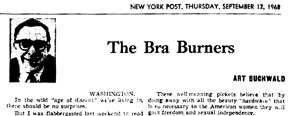
Nationally syndicated humor columnist Art Buchwald also picked up on the bra-burning meme, writing with tongue in cheek that he was “flabbergasted to read that about 100 women had picketed the Miss America pageant in Atlantic City against ‘ludicrous beauty standards’ that had enslaved the American woman.’”

Buchwald also wrote: “The final and most tragic part of the protest took place when several of the women publicly burned their brassieres.”

And a media myth took hold.

What nuances the myth are witness accounts, discussed in Getting It Wrong, that bras were set afire, if briefly, during the protest.

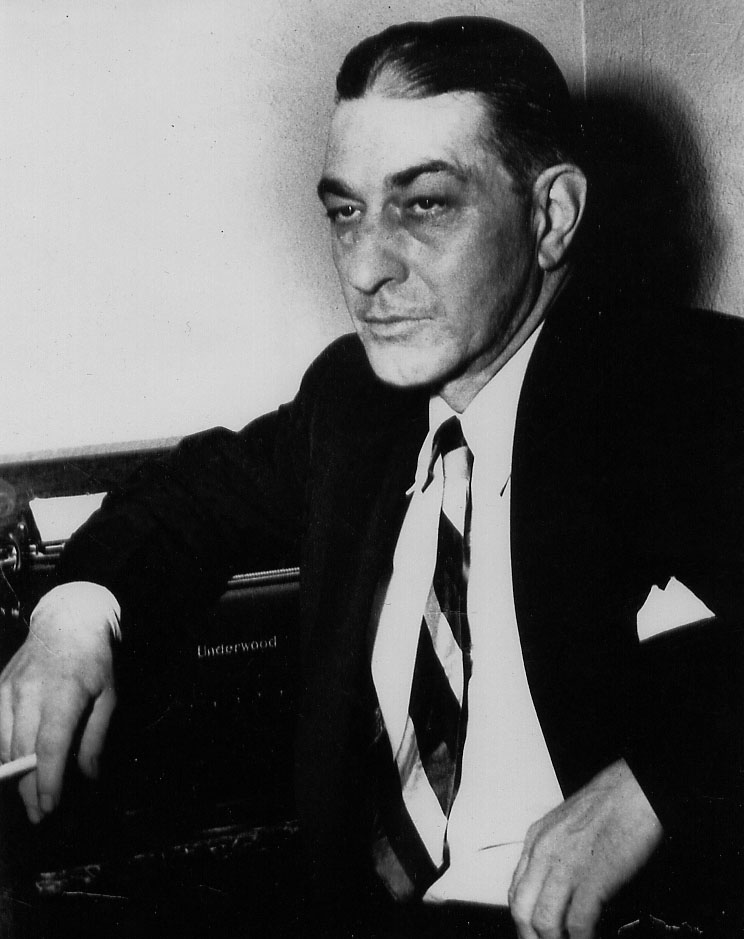
Boucher, 1949 photo

One witness account appeared in the Press of Atlantic City the day after the protest. The newspaper’s first-hand report, written by a veteran reporter named John L. Boucher, included this passage:

“As the bras, girdles, falsies, curlers, and copies of popular women’s magazines burned in the ‘Freedom Trash Can,’ the demonstration reached the pinnacle of ridicule when the participants paraded a small lamb wearing a gold banner worded ‘Miss America.’”

Also covering the demonstration was Jon Katz, then a young reporter for the Atlantic City Press. In my research into bra-burning, Katz told me:

“I quite clearly remember the ‘Freedom Trash Can,’ and also remember some protestors putting their bras into it along with other articles of clothing, and some Pageant brochures, and setting the can on fire. I am quite certain of this.”

As I point out in Getting It Wrong, these accounts that bras were burned in the “Freedom Trash Can” cannot be “taken lightly, dismissed or ignored.”

At the same time,  I write, the witness accounts “offer no evidence to corroborate a widely held image of angry feminists demonstratively setting fire to their bras and tossing the flaming undergarments into a spectacular bonfire.”

There was no mass bra-burning at Atlantic City, no feminists twirling flaming bras over the heads. Fire at most was a modest and fleeting aspect of the protest on that long ago September day.

It was, to be sure, no seismic event.

WJC

Recent and related:

Assessing the propellant effect: Was Watergate a powerful stimulant to journalism?

In Anniversaries, Debunking, Scandal, Washington Post, Watergate myth on March 10, 2012 at 4:34 am

The April number of Vanity Fair brushes against an entrenched media myth in declaring that the cinematic depiction of the Washington Post’s Watergate reporting stimulated great interest in careers in journalism.

Vanity Fair, April 2012

Alas,Vanity Fair offered no data or documentation to support its claim.

Instead, the magazine referred broadly to “the noble, sleeves-rolled sleuthing of Robert Redford and Dustin Hoffman as [Bob] Woodward and [Carl] Bernstein in All the President’s Men,” saying the movie which came out in 1976 “prompted legions of baby-boomers to dream of careers in journalism.”

Legions?

Anecdotally, it’s not uncommon to hear that the movie, or Woodward and Bernstein’s award-winning reporting for the Post, did inspire boomers to become journalists.

But beyond impression and anecdote, what supports the claim that Watergate reporting — or All the President’s Men — was a powerful stimulant for career-seeking in journalism?

Not much, as it turns out.

As I discuss in my latest book, Getting It Wrong (which includes a chapter on what I call the heroic-journalist myth of Watergate), two scholarly studies about enrollments in collegiate journalism programs found no evidence that Watergate was a propellant.

Enrollment data are reasonably good proxies, in that they would have captured heightened interest in careers in the profession. If Watergate and All the President’s Men inspired broad interest in careers in journalism, evidence of the stimulus should be apparent in surging in college enrollments.

But the evidence is not there.

A study conducted for the Freedom Forum media foundation and released in 1995 found that “growth in journalism education result[ed] not from specific events as Watergate … but rather to a larger extent from the appeal of the field to women, who ha[d] been attending universities in record numbers. The growth also in part reflect[ed] the applied nature of the field and its link to specific job skills.”

The study’s author, Lee Becker and Joseph Graf, stated flatly:

“There is no evidence … that Watergate had any effect on enrollments.”

A separate study, conducted by veteran journalism scholar Maxwell E. McCombs and published in 1988, reported that “the boom in journalism education was underway at least five years before” the Watergate break-in in 1972.

McCombs also wrote:

“It is frequently, and wrongly, asserted that the investigative reporting of Woodward and Bernstein provided popular role models for students, and led to a boom in journalism school enrollments. The data … reveal, however, that enrollments already had doubled between 1967 and 1972….”

I write in Getting It Wrong that the notion that Watergate reporting made journalism appealing and sexy endures “because it seems irresistibly logical and straightforward— too obvious, almost, not to be true.”

The presumed stimulus on journalism is an appealing yet simplistic story, easy to grasp and easy to understand.

And such characteristics — easy to grasp, easy to understand — often are propellants. Propellants of media-driven myths.

WJC

Recent and related:

Liz Trotta mangles Jessica Lynch ‘fairy tale’

In Debunking, Jessica Lynch, Media myths, Washington Post on February 20, 2012 at 10:12 am

Veteran broadcast journalist Liz Trotta went on Fox News yesterday to condemn plans to ease restrictions on women in Army combat positions.

In doing so, Trotta referred to — and mangled — key elements of the saga of Jessica Lynch, the Army private thrust into an international spotlight by a newspaper’s botched report about her battlefield heroics in Iraq in March 2003.

Trotta said in an appearance on the Fox program “America’s News HQ” that “the political correctness infecting the Pentagon has resulted in silly and dishonest fairy tales about female heroism. Has anyone forgotten the Jessica Lynch story?

“A PFC captured by the Iraqis and by all accounts, including her own, not mistreated. Yet the Pentagon saw fit to send in the SEALs to rescue her from a hospital in a videotaped operation that seemed headed straight to Hollywood.”

Whoa.

Let’s call out the errors there: Lynch was mistreated, and videotaping her rescue was routine practice in high-priority military operations —  not done with Hollywood in mind.

By Lynch’s own account — contained in a book by Rick Bragg and titled I Am a Soldier, Too — she was knocked out in the crash of a Humvee in attempting to escape an ambush in Nasiriyah, in southern Iraq. While unconscious, Lynch “was a victim of anal sexual assault,” the book says, adding:

“The records do not tell whether her captors assaulted her almost lifeless, broken body after she was lifted from the wreckage [of the Humvee], or if they assaulted her and then broke her bones into splinters until she was almost dead.”

She was rescued from an Iraqi hospital on April 1, 2003, in an operation that included not only Navy SEALS but Marines and Army Rangers as well.

It was the first rescue of a captured American solder from behind enemy lines since World War II.

I discuss the mythology of the Lynch case in my latest book, Getting It Wrong, noting that the Defense Department’s inspector general found no evidence to support the notion Lynch’s rescue “was a staged media event.”

The then-acting inspector general, Thomas F. Gimble, said in a report to Congress in 2007 that the rescue operation was determined to have been “a valid mission” to recover a prisoner of war “under combat conditions.”

That the rescue was videotaped was not unusual, Gimble said, noting that combat cameramen routinely filmed high-priority operations. In the Lynch case, he said, there was “no indication that any service member was acting for the camera during the rescue mission.”

Gimble also said the extrication team “fully expected to meet stiff resistance” in mounting the rescue.

Trotta’s mangled account was the latest in a succession of erroneous characterizations about the Lynch case, which burst into prominence April 3, 2003, in a sensational, front-page report in the Washington Post.

The newspaper cited otherwise unidentified “U.S. officials” and said Lynch, a supply clerk, had fought fiercely in the ambush at Nasiriyah, that she had “continued firing at the Iraqis even after she sustained multiple gunshot wounds and watched several other soldiers in her unit die around her ….”

The Post quoted one of the anonymous officials as saying: “She was fighting to the death. She did not want to be taken alive.”

But the report was bogus. Little of it was true.

Lynch, who was not in a combat unit, never fired a shot in the ambush; her weapon jammed.

Not was she shot, as the Post reported. She suffered shattering injuries in the crash of the Humvee.

The Post, moreover, has never adequately explained how it erred so utterly in its hero-warrior story about Lynch, a story that was picked up by news organizations around the world.

More recently, in an interview with Lynch last month, Fox News anchorman Shepard Smith claimed without providing evidence that “the government” had made up the tale about Lynch’s battlefield heroics in Iraq.

He ignored the singular role of the Washington Post in placing the hero-warrior tale about Lynch into the public domain.

WJC

Recent and related: