W. Joseph Campbell

No, ‘Politico’ — Viewer-listener disagreement is a myth of JFK-Nixon debate

In Anniversaries, Debate myth, Debunking, Error, Media myths, Television on September 26, 2017 at 1:31 pm

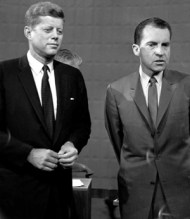
Fifty-seven years ago tonight, John F. Kennedy and Richard M. Nixon met in the first-ever televised debate between major party presidential candidates.
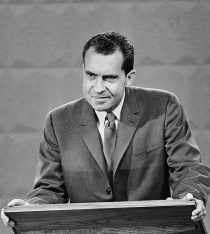
Not everyone thought he looked awful: Nixon debating, 1960
(AP photo)

Soon enough, a hardy media myth grew up around the 1960 debate: It’s a robust trope that says radio listeners thought Nixon won while television viewers favored Kennedy.

Politico is the latest media outlet to give expression to the myth (or at least to its juiciest half).

An essay posted today declares that “most people who heard the debate on the radio, which focused on domestic issues, thought Nixon had won. But Nixon’s sickly image counted for more; most viewers focused on what they saw and not on what they heard.”

What’s remarkable about this hoary media myth is that it persists despite its thorough dismantling 30 years ago by David Vancil and Sue D. Pendell.

They noted in a journal article that evidence for viewer-listener disagreement is thin, flawed, and anecdotal. Moreover, no public opinion surveys conducted in the immediate aftermath of the debate were aimed specifically at gauging reactions radio audiences.

For the media, Harvey was no Katrina redux; here’s why

In Anniversaries, Hurricane Katrina, Media myths, Newspapers, Photographs on September 2, 2017 at 10:58 am

Twelve years ago today, newspaper headlines across the United States told of chaos and anarchy that supposedly was sweeping New Orleans in the aftermath of Hurricane Katrina’s devastating landfall.

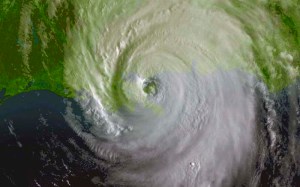
Katrina churns, 2005

“Anger, Anarchy, Desperation,” declared the front page of the San Francisco Chronicle of  September 2, 2005.

“Crisis to Chaos,” said the Scottsdale Tribune in Arizona. “Toward Anarchy,” cried the Waterbury Republican in Connecticut. “Descent into Chaos,” asserted the San Diego Union-Tribune.

“Snipers fired on cops and rescue workers” in New Orleans, reported the New York Daily News. “Gangs of looters took anything that wasn’t nailed down.”

In New Orleans, the Times-Picayune newspaper (see image nearby) declared on its front page of September 2, 2005, that “chaos and lawlessness rule the streets.”
The horror and mayhem that news organizations so widely reported 12 years ago proved highly exaggerated, but it had the effect of tainting a city and its residents at a time of their great vulnerability.

As I noted in my media-mythbusting book, Getting It Wrong, the reporting of Katrina’s aftermath was no high, heroic moment in American journalism, despite some attempts to characterize it as such.

“In the days following Katrina’s landfall,” I wrote, “news reports described apocalyptic horror that the hurricane supposedly had unleashed. They reported snipers firing at medical personnel. … They told of bodies being stacked there like cordwood. They reported that roving gangs were preying on tourists and terrorizing the occupants of the Superdome [where hundreds of storm evacuees took shelter], raping and killing. They said that children were victims of sexual assault, that one seven-year-old was raped and her throat was slit. They reported that sharks were plying the flooded streets of New Orleans.

“None of those reports was verified or substantiated.” Little of it was true.

D-minus was a grade none too severe for the post-Katrina coverage.

“Americans depend on timely and accurate reporting, especially during times of crisis,” a bipartisan select committee of the House of Representatives later said in a 600-page report about the hurricane’s aftermath, adding that “accurate reporting was among Katrina’s many victims.

“If anyone rioted,” the report declared, “it was the media. Many stories of rape, murder, and general lawlessness were at best unsubstantiated, at worst simply false.”

It is useful now to recall the erroneous and exaggerated coverage of Katrina’s aftermath because the destructive sweep of Hurricane Harvey in southeast Texas at the end of last month gave rise to little such egregious misreporting and produced few if any examples of the media having “rioted” in their storm coverage.

For news organizations, Harvey was no Katrina.

Here are some reasons why:

• Reasonably competent public officials. In Texas, state and local officials — including the mayor of Houston — were more credible, knowledgeable, and restrained than were senior public officials in New Orleans. Ray Nagin, the then-mayor of New Orleans, and Eddie Compass, the then-police commissioner, were sources for some of the most gruesome yet erroneous reports of lawlessness in Katrina’s immediate aftermath.

At one point, Nagin asserted that “hundreds of armed gang members” were terrorizing evacuees inside the Superdome. The mayor said conditions there had deteriorated to “an almost animalistic state” and evacuees had been “in that frickin’ Superdome for five days, watching dead bodies, watching hooligans killing people, raping people.”

Compass spoke of other horrors. “We had little babies in there, little babies getting raped,” the police commissioner said of the Superdome where, he claimed, police officers had been shot and wounded.

Their accounts of violence in New Orleans were widely reported — but were almost completely without foundation. (Months later, Compass said he passed along rumors of violence because he “didn’t want people to think we were trying to cover anything up. So I repeated things without being substantiated, and it caused a lot of problems.”)

By contrast, Houston’s mayor, Sylvester Turner, projected an image of even-tempered authority. He spoke often to the news media, typically in measured and sedate tones. He didn’t preen for the cameras, and certainly didn’t mischaracterize his city as having been seized by violence and lawlessness. The only significant controversy to swirl around Turner was whether he should have ordered a mandatory evacuation as Harvey approached from the Gulf of Mexico.

No narrative-shifting surprises. Katrina’s aftermath marked by a surprising and decisive turn after the storm had passed: Not long after it appeared the city had been spared the hurricane’s worst effects, levees protecting the city began to fail, sending floodwaters across much of New Orleans. That development abruptly shifted news coverage of Katrina from having escaped a close call to something more grim and devastating. New Orleans was mostly under water and rumors of social disintegration, many of which made their way into news reports, soon were circulating.

Harvey was forecast to drop upwards of 50 inches of rain on parts of southeastern Texas, predictions that proved largely accurate. Journalists, at least in broad terms, knew what to expect; the absence of a narrative-altering surprise allowed them to keep story lines trained on storm victims, rescues and evacuations, without having to chase bleak rumors of mayhem and violence.

Principal controversies that arose about post-Harvey coverage focused on questions of media ethics — whether it was appropriate for a reporter to send Twitter messages about what he considered looting, and when a reporter should pull back from an on-camera interview of a clearly distraught storm victim.

Dubious memes were quickly debunked. An image of a shark plying floodwaters in Texas received a brief and apparently credulous mention on the Fox News Channel, but the photograph soon was exposed as fake. For a time, the Washington Post’s “Intersect” blog kept a running list of storm-related hoaxes and exaggerations that appeared on social media. Such compilations helped keep a lid on the over-the-top stuff.

Social media platforms — most of which hadn’t been developed in 2005 — seemed to have performed fairly well, overall. Notably, Facebook and Twitter became in Harvey’s aftermath lifelines for storm victims and their families.

Stirring images. Some of the most memorable photographs of Harvey were not of agony and grim misery (like the Times-Picayune front page of September 2, 2005) but were heartening — such as the one of a Houston police SWAT officer striding in knee-deep flood water, carrying woman who was cradling her 13-month-old son. The image was taken by an Associated Press photographer and became “a symbol of the storm and rescue efforts,” as a Houston television station described it.

AP photo/David J. Phillip

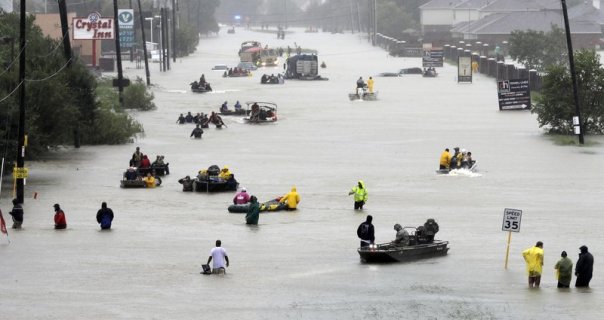
The AP photographer, David J. Phillip, captured another memorable image of the storm — a panorama of a flooded Houston boulevard where a swarm of human forms confronted the waters in a tableau of evident grit, resilience, and aquatic rescue. The photo at once testified to turmoil the hurricane had created and to an absence of turmoil in response.

The post-landfall coverage of Harvey may not have been magnificent, but in all it didn’t merit a D-minus.

I’d give it a B, at least.

WJC

More from Media Myth Alert:


Getting it excruciatingly wrong about Hearst, Remington, Cuba, and war

In 1897, Debunking, Error, Furnish the war, Media myths, Quotes, Spanish-American War, Year studies, Yellow Journalism on August 14, 2017 at 9:01 am

William Randolph Hearst died 66 years ago today but remains a bogeyman of American media, routinely accused of journalistic misconduct such as fomenting the Spanish-American War in 1898, after vowing to a prominent artist that he would do just that.

Such claims of Hearst’s misconduct are nonsense: They are the stuff of media myth. Enduring media myth, in fact — as made clear by a rambling column posted the other day at the Los Angeles CityWatch site.

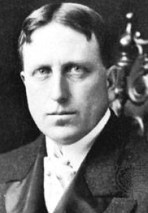
Hearst, gone these 66 years

The column demonstrates how excruciatingly wrong accounts of history can sometimes be.

Here are excerpts from the column, with inaccuracies and dubious claims highlighted in bold.

  • Hearst literally cooked up a war with Spain so he could increase his circulation. … That war was called the Spanish American War and was over pretty much after it started.
  • [Hearst’s journalism] was called “Yellow Journalism” mainly because the front page was printed on yellow paper.
  • The name “Yellow Journalism” came to mean those items or events that possibly held a germ of truth but were greatly exaggerated.
  • Famed western illustrator, sculptor and writer Frederic Remington worked for Hearst at the time. He went to Cuba to take pictures of all the horrible things Spain was doing it to Cuban citizens, but he couldn’t find a lot to photograph. Hearst reportedly told him, ‘You furnish the pictures and I’ll furnish the war.'”

Let’s address those inaccuracies and flawed claims in turn.

Hearst stands wrongly accused of having brought on the war with Spain in 1898, as I discussed in detail in my book, Yellow Journalism: Puncturing the Myths, Defining the Legacies. The war, I noted, was “the result of a convergence of forces far beyond the control or direct influence of … Hearst’s New York Journal,” the leading exemplar of what then was known as “yellow journalism.”

Claims that yellow journalism brought on the war, I wrote, “are exceedingly media-centric, often rest on the selective use of evidence, and tend to ignore more relevant and immediate factors that give rise to armed conflict.”

In 1898, those factors centered around a diplomatic impasse between the United States and Spain over Spanish rule of Cuba, the scene of an islandwide rebellion since early 1895.

In a failed attempt to put down the rebellion, Spanish authorities sent as many as 200,000 troops to the island and imposed a policy called “reconcentration,” which moved thousands of Cubans — mostly old men, women, and children — into garrison towns where they could offer neither support nor supplies to the rebels.

Spain’s “reconcentration” policy gave rise to malnutrition and disease: Tens of thousands of Cuban non-combatants died from illness and starvation.

It turned into a humanitarian disaster that “inevitably stirred outrage and condemnation in the United States,” I wrote in Yellow Journalism. The desperate conditions on Cuba were in 1897 and early 1898 a frequent topic of reporting in the American press — including, but certainly not limited to, the Hearst press.

What’s clear is that the yellow press reported on, but it did not create, the terrible hardships of Spain’s “reconcentration” policy.

As leading historian of that period, Ivan Musicant, correctly observed, the abuses and suffering created by that policy “did more to bring on the Spanish-American War than anything else the Spanish could have done.”

In the end, the humanitarian crisis on Cuba, and Spain’s inability to resolve the crisis, weighed decisively in the U.S. decision to go to war in 1898. The content of the yellow press was a non-factor.

Almost always ignored in claims that Hearst brought about the war is any explanation about how newspaper content accomplished the trick: By what mechanism was Hearst’s newspaper content transformed into policy and military action?

It is left unaddressed because there was no such mechanism. Hearst did not “literally” cook up war with Spain.

Nor was the term “yellow journalism” inspired by the color of front page newsprint. Nothing of the sort.

Wardman: He gave us ‘yellow journalism’

“Yellow journalism” was a sneer, coined by Ervin Wardman, a fastidious, Hearst-hating editor of the old New York Press. Wardman loathed what Hearst called “New Journalism” and took to experimenting with pithy turns of phrase to denigrate the flamboyant style.

In a one-line editorial comment in the Press in January 1897, Wardman suggested calling it “Nude Journalism,” to suggest that Hearst’s journalism was bereft of morals and decency.

Wardman soon landed on “yellow-kid journalism,” a term in part inspired by the popular comic running at the time in Hearst’s Journal and in the rival New York World of Joseph Pulitzer. Both newspapers carried version of the comic which featured a wise-cracking urchin of the slums typically called the “Yellow Kid.”

At the end of January 1897, “yellow-kid journalism” was modified to “the Yellow Journalism,” and the sneer was born.

“Yellow journalism,” as practiced in the late 19th century, was defined by much more than exaggeration. Indeed, it was a genre characterized by:

  • the frequent use of multicolumn headlines that sometimes stretched across the front page.
  • a variety of topics reported on the front page, including news of politics, war, international diplomacy, sports, and society.
  • the generous and imaginative use of illustrations, including photographs and other graphic representations such as locator maps.
  • bold and experimental layouts, including those in which one report and illustration would dominate the front page. Such layouts sometimes were enhanced by rudimentary use of color.
  • a tendency to rely on anonymous sources, particularly in dispatches of leading reporters.
  • a penchant for self-promotion, to call attention frequently to the newspaper’s accomplishments. This tendency was notably evident in crusades against monopolies and municipal corruption.

Given those features, I noted in Yellow Journalism, the genre “certainly could not be called predictable, boring, or uninspired—complaints of the sort that are frequently raised about U.S. newspapers of the early twenty-first century.”

No media myth in American journalism is more enduring than that of Hearst’s purported vow to “furnish the war” with Spain.

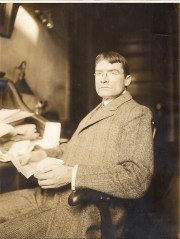
It supposedly was contained in a telegram to the artist, Frederic Remington, who went to Cuba for Hearst’s Journal in January 1897. Remington was an artist, sculptor, and writer: He was no photographer. His assignment in Cuba to draw illustrations of the rebellion against Spanish rule, the precursor to the Spanish-American War.

As myth has it, Remington before leaving sent a telegram to Hearst, saying, “Everything is quiet. There will be no war. I wish to return.”

In reply, Hearst’s supposedly stated:

“Please remain. You furnish the pictures, and I’ll furnish the war.”

The anecdote of the Remington-Hearst exchange lives on, as I note in my media-mythbusting book, Getting It Wrong, “despite a nearly complete absence of supporting documentation.”

It lives on “even though Hearst denied ever sending such a message,” I wrote. “It lives on despite an irreconcilable internal inconsistency: it would have been absurd for Hearst to vow to ‘furnish the war’ because war — specifically, the Cuban rebellion against Spain’s colonial rule — was the very reason he sent Remington to Cuba in the first place.”

Not only that, I added, but Spanish control and censorship of the cable traffic in Havana “was too vigilant and severe to have allowed such an exchange to go unnoticed and unremarked upon. A vow such as Hearst’s to ‘furnish the war’ surely would have been intercepted and publicized by Spanish authorities as a clear-cut example of Yankee meddling in Cuba.”

Debunking the Hearstian vow is the subject of Chapter One in Getting It Wrong; the chapter may be accessed here.

WJC

More from Media Myth Alert: