W. Joseph Campbell

Posts Tagged ‘1897’

Recalling Hearst to bash Murdoch: Superficial and off-target

In Debunking, Hurricane Katrina, Media myths, Spanish-American War, Yellow Journalism on July 18, 2011 at 12:26 am

Hearst: Murdoch's model?

The fallout from the phone-hacking scandal rocking Rupert Murdoch’s media holdings in Britain has prompted unflattering comparisons that the tough old media mogul is but a latter-day reincarnation of William Randolph Hearst, American press lord of the late 19th and early 20th centuries.

Trouble is, such comparisons are facile and no better than superficial. Hearst, for example, hardly established the international presence that Murdoch commands.

And these off-target comparisons have become an occasion to indulge in the hoary media myth that Hearst and his yellow press fomented the Spanish-American War in 1898.

The Sun Herald newspaper of Mississippi, a winner of the Pulitzer Prize for public service in 2006 for coverage of the Hurricane Katrina disaster on the Gulf Coast, did just that in an editorial published over the weekend.

“Not since William Randolph Hearst’s newspaper empire sensationalized news and gave a distinctive yellow tinge to journalism has the world seen the likes of Rupert Murdoch, the Australian/American media lord whose News Corporation has spread its tabloid brand in print and on the airwaves to so many corners of the globe,” the Sun Herald harrumphed in its editorial.

Of Hearst, the Sun Herald further stated:

“His newspapers were so powerful in molding public opinion that they were credited with pushing the United States into war with Spain in 1898.”

Really?

No.

As I pointed out in my 2001 book, Yellow Journalism: Puncturing the Myths, Defining the Legacies, critics who blame the yellow press of Hearst (and his rival, Joseph Pulitzer) for bringing on the war invariably fail to explain how the contents of those newspapers came to be transformed into policy and military action.

How did that work? What was the mechanism? Why was the yellow press so singularly powerful at that moment in American history?

In truth, as I’ve noted previously at Media Myth Alert, there was no mechanism by which the newspapers’ contents were translated into policy and a decision to go to war. They were not that powerful.

Had the newspapers of Hearst and Pulitzer brought about the war with Spain, then “researchers should be able to find some hint of, some reference to, that influence in the personal papers and the reminiscences of policymakers of the time,” I wrote in Yellow Journalism, adding:

“But neither the diary entries of Cabinet officers nor the contemporaneous private exchanges among American diplomats indicate that the yellow newspapers exerted any influence at all. When it was discussed within the McKinley administration, the yellow press was dismissed as a nuisance or scoffed at as a complicating factor.”

In short, senior officials in the administration of President William McKinley largely disregarded the content of what was called the yellow press. They did not turn to it for guidance or insight in policymaking.

Their thinking was not shaped by yellow journalism.

A variation of the Murdoch-Hearst criticism is to assail Murdoch — as a commentary  posted yesterday at Huffington Post put it — “the latest prime purveyor of so-called ‘yellow journalism’.”

The author, novelist Terence Clarke, declared that yellow journalism as practiced by Hearst and Pulitzer “sacrificed truth in favor of sensationalism in order simply to sell more papers.

“It was a business ploy, not an example of high journalistic ideals. Now, with Murdoch leading the way, journalism in many instances has fallen victim to the same wish for sales, and has descended, again, from the high ground it should occupy.”

Oh, spare us such superficiality.

The yellow press of Hearst and Pulitzer was much more than merely sensational.

Anyone who has spent much time reading through their newspapers of the late 19th century invariably comes away impressed with the aggressive and news-oriented approaches they took.

David Nasaw, author of a commendably even-handed biography of Hearst, pointed this out notably well, writing:

“Day after day, Hearst and his staff improved on their product. Their headlines were more provocative than anyone else’s, their drawings more lifelike … the writing throughout the paper outstanding, if, at times, a bit long-winded.”

Not only that, but Hearst was willing to spend lavishly to get the news. He, much more so than Pulitzer, was inclined to tap prominent writers, such as Mark Twain, and pay them well to cover important events for his New York Journal.

Hearst paid $3,000 to the novelist, playwright, and foreign correspondent Richard Harding Davis to spend a month for the Journal in Cuba in early 1897, writing reports about the Cuban rebellion that was the proximate cause of the Spanish-American War.

That sum is the equivalent today of more than $50,000.

Moreover, the yellow press of the late 19th century exerted a lasting and profound influence on American journalism history.

As I wrote in Yellow Journalism, the genre “was much decried but its salient features often were emulated.”

Yellow journalism “was appealing and distinctive in its typography, in its lavish use of illustrations, in its aggressive newsgathering techniques,” I noted, adding:

“To a striking degree, features characteristic of the yellow press live on in American journalism, notably in the colorful layouts that characterize the formerly staid titles that used to disparage the yellow press—titles such as the New York Times and Washington Post.”

WJC

Recent and related:

BBC calls Hearst vow apocryphal, quotes it anyway

In 1897, Debunking, Furnish the war, Media myths, Spanish-American War, Yellow Journalism on July 15, 2011 at 10:28 am

Apocryphal but still quotable.

That’s how Britain’s venerable broadcaster, the BBC, treated the mythical anecdote about media titan William Randolph Hearst and his purported vow to “furnish the war” with Spain in the late 19th century.

In an article posted online yesterday, the BBC described Hearst as the “definitive [news] baron” and declared:

“He’s credited with the invention of tabloid journalism in the 1890s when his New York Journal began a bitter circulation war with Joseph Pulitzer’s New York World. He also had a reputation as a warmonger.

“‘You furnish the pictures and I’ll furnish the war,’ goes an apocryphal instruction he was supposed to have sent in a telegram to an illustrator in Havana.”

That’s right, the line is apocryphal. What, then, is the point in using it? As a none-too-clever, back-handed way of buttressing the dubious notion that Hearst and his newspapers were capable of fomenting a war?

That’s sloppy journalism from a leading international news organization.

As I discuss in my latest book, Getting It Wrong, Hearst’s purported vow to “furnish the war” with Spain is a particularly tenacious media-driven myth — a prominent but dubious tale about journalism that masquerades as factual.

I note that the tale about Hearst’s vow “has achieved unique status as an adaptable, hardy, all-purpose anecdote, useful in illustrating any number of media sins and shortcomings.

“It has been invoked to illustrate the media’s willingness to compromise impartiality, promote political agendas, and indulge in sensationalism. It has been used, more broadly, to suggest the media’s capacity to inject malign influence into international affairs.”

Hearst: Didn't say it

Reasons for doubting the presumptive Hearstian vow are many, I point out in Getting It Wrong, and include the fact that the telegram in which Hearst supposedly made the statement — in an exchange with the artist Frederic Remington, on assignment to Cuba — has never turned up.

Plus, Hearst denied making such a vow.

Not only that, but the anecdote lives on lives on despite what I call “an irreconcilable internal inconsistency.” That is, it would have been absurd for Hearst to vow to “furnish the war” because war— specifically, the Cuban rebellion against Spanish colonial rule— was the reason he sent Remington to Cuba in the first place.

The artist was in Cuba for just six days in January 1897. By that time, the Cuban rebellion — a war for political independence — had reached islandwide proportions. “Anyone reading U.S. newspapers in early 1897 would have been well aware that Cuba was a theater of a nasty war,” I write in Getting It Wrong.

Given the context, Hearst’s purported vow is utterly illogical.

And to invoke the anecdote knowing that it’s apocryphal is little short of disingenuous.

The BBC’s reference to Hearst’s being “credited with the invention of tabloid journalism in the 1890s” also is questionable.

Hearst’s style of flamboyant journalism certainly helped inspire the epithetyellow journalism,” but he was no father of tabloid journalism.

If anything, Hearst was a latecomer to that genre.

As David Nasaw wrote in The Chief, his admirably even-handed biography of Hearst, the press baron didn’t embrace the tabloid until the 1920s “because he was not comfortable with the format.

“He  had no interest in publishing a picture newspaper that had little room for political coverage, columns, cartoons, and the editorials he cared so much about.”

WJC

Many thanks to Instapundit
Glenn Reynolds for linking to this post.

Recent and related:

‘News of World’ closure breaks link to 19th century yellow journalism

In 1897, Debunking, Year studies on July 10, 2011 at 12:04 am

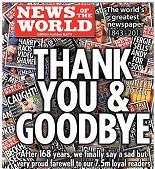
The abrupt closure of Britain’s largest Sunday tabloid, Rupert Murdoch’s raunchy, scandal-ridden News of the World, breaks a link to the yellow journalism that flared in urban America at the end of the 19th century.

Jail-breaking journalism

I’m not referring to the News of the World’s tabloid flamboyance, which certainly evoked the typographic boldness of William Randolph Hearst’s New York Journal, a broadsheet that was the leading exemplar of American yellow journalism.

The link went deeper than appearances.

The News of the World was an heir to Hearst’s activist-oriented, participatory journalism — a self-engaging, self-promoting style of newspapering unheard of these days in the United States.

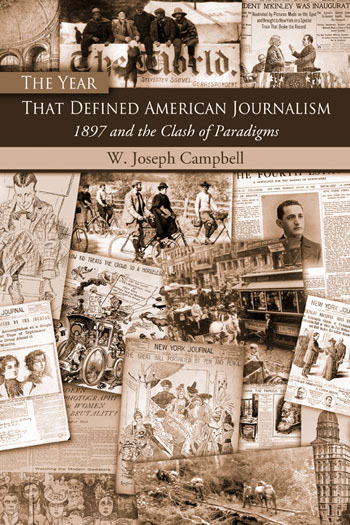
As I note in my book The Year That Defined American Journalism: 1897 and the Clash of Paradigms, Hearst’s Journal at the end of the 19th century sought to set a standard for the American press, insisting, I write, “that newspapers were obliged to inject themselves, conspicuously and vigorously, in righting the wrongs of public life, and in filling the void of government inaction and incompetence.”

The year 1897 brought memorable evidence of Hearst’s style of activist journalism.

In the summer that year, Hearst deployed a phalanx of Journal reporters to solve the grisly case of headless torso murder in New York.

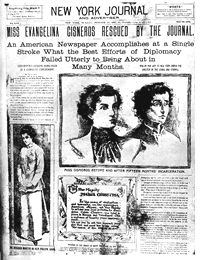
Later that year, a reporter for the Journal broke from jail in Havana a 19-year-old political prisoner named Evangelina Cisneros. The Journal — and more than a few other U.S. newspapers — celebrated the breathtaking breach of international law.

For the Journal, the Cisneros jailbreak (see image, above) was “epochal” and represented the “supreme achievement” of its paradigm of activist journalism.

It acknowledged that freeing Cisneros had violated Spanish law and flouted international convention — and the Journal seemed delighted to have done so, saying:

“The Journal is quite aware of the rank illegality of its action. It knows very well that the whole proceeding is lawlessly out of tune with the prosaic and commercial nineteenth century. We shall not be surprised at international complications, nor at solemn and rebuking assurances that the age of knight errantry is dead. To that it can be answered that if innocent maidens are still imprisoned by tyrants, the knight errant is yet needed.”

That sort of willingness to wink at illegality was demonstrated by the News of the World well before it became swept up in a cellphone-voicemail hacking scandal that brought about its demise.

Final edition

The News of the World, which published its final issue today, had been for years one of the world’s most controversial titles, due in part to its activist-oriented undercover operations, ostensibly undertaken to bring drug dealers, fugitive financiers, and other criminals to justice.

As I noted in my 2001 book, Yellow Journalism: Puncturing the Myths, Defining the Legacies, the targets of the News of the World often were “small-time celebrities and wayward sports figures dabbling in modest quantities of illegal drugs. The undercover methods were criticized as entrapment and dismissed as ‘a kind of investigative reporting without much investigating.'”

I also described a notorious case in 1999, in which reporters for News of the World “posed as wealthy Arabs and enticed a British earl to buy cocaine and share the drug with them. A detailed report about the peer’s conduct — he was depicted as drunkenly snorting cocaine with a £5 note — soon after was splashed across News of the World. He was arrested and convicted of selling drugs.

“But the presiding judge declined to send the peer to jail, citing the subterfuge of the News of the World. If not for the journalists’ sting, the judge observed, the crimes likely would not have been committed.”

Such outlandishness hinted at the tabloid’s more recent and more egregious misconduct of breaking into the cellular phone voicemail of hundreds of people, including members of Britain’s royal family and perhaps victims of the terror attack on London’s subway system July 2005.

Phone-hacking, of course, wasn’t an element in the repertoire of the yellow press of Hearst or of his mean-spirited rival, Joseph Pulitzer. Nor did they did bring on the war with Spain in 1898, as is often alleged.

But on occasion they turned to deception, misrepresentation, and self-motivated activism in pursuit of their lusty brand of big-time journalism.

WJC

Recent and related:

Noting the anniversary of Twain’s ‘report of my death’ comment

In 1897, Anniversaries, Debunking, Media myths, Newspapers, Yellow Journalism on June 1, 2011 at 7:02 am

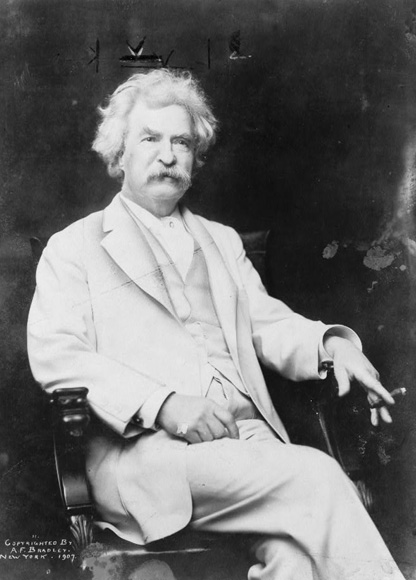
Tomorrow marks the 114th anniversary of Mark Twain‘s well-known, much-quoted, often-distorted observation: “The report of my death was an exaggeration.”

As is discussed in my 2006 book, The Year That Defined American Journalism, Twain’s remark was prompted by an article published June 1, 1897, in the New York Herald.

Mark Twain, 1907

The Herald, which then was regarded as one of the top daily newspapers in America, reported Twain, then 61, to be “grievously ill and possibly dying. Worse still, we are told that his brilliant intellect is shattered and that he is sorely in need of money.”

Twain was in London then, preparing to cover Queen Victoria’s Diamond Jubilee for William Randolph Hearst’s flamboyant New York Journal. That association allowed the Journal to puncture the Herald’s account as false.

In an article published June 2, 1897, beneath the headline, “Mark Twain Amused,” the Journal skewered the Herald’s story and offered Twain’s timeless denial: “The report of my death was an exaggeration.”

Twain’s line is often quoted as “the news of my death has been greatly exaggerated” and, sometimes, the Journal is said to have been the source for the erroneous report rather than the agent of its swift debunking.

According to the Journal, Twain said the likely source of the Herald’s error was the serious illness of his cousin, J.R. Clemens, who had been in London a few weeks before.

Ever eager to indulge in self-promotion, Hearst’s Journal enthusiastically embraced its brief association with Twain. Even so, it couldn’t have been much pleased with what the humorist filed about Victoria’s Jubilee.

As I wrote in The Year That Defined American Journalism, “Twain’s reporting about Victoria’s jubilee seemed half-hearted and hardly inspired. The spectacle was easily the most regal international story of 1897, and came at a time when the British empire was at or near its height. But Twain found the celebration overwhelming,” calling it “a spectacle for the kodak [camera], not the pen.”

Twain’s dispatch to the Journal also included this strange observation:

“I was not dreaming of so stunning a show. All the nations seemed to be filing by. They all seemed to be represented. It was a sort of allegorical suggestion of the Last Day, and some who live to see that day will probably recall this one if they are not too much disturbed in the mind at the time.”

Lining up Twain to cover the Jubilee was emblematic of Hearst’s inclination to spend lavishly to recruit big-name talent, if only for spot assignments.

Hearst was the leading practitioner of yellow journalism, or what he called the “journalism of action,” which embraced an activist vision for American newspapering.

His Journal argued that “a newspaper may fitly render any public service within its power. Acting on this principle, it has fed the hungry, brought criminals to justice and enforced by legal methods the responsibility of public officials.”

Not everyone was comfortable with or admired such an activist vision, especially as it came with such heavy and frequent doses of acute self-promotion.

Twain didn’t much like it, either. In his autobiography, he likened Hearstian yellow journalism to “that calamity of calamities.”

WJC

Related:

<!–[if !mso]> –> Twain’s reporting about Victoria’s jubilee seemed half-hearted and hardly inspired. The spectacle was easily the most regal international story of 1897, and came at a time when the British empire at or near its height. But Twain found the celebration overwhelming—“a spectacle for the kodak [camera], not the pen.”[i] His dispatch included this strange observation: “I was not dreaming of so stunning a show. All the nations seemed to be filing by. They all seemed to be represented. It was a sort of allegorical suggestion of the Last Day, and some who live to see that day will probably recall this one if they are not too much disturbed in mind at the time.”


[i]. Mark Twain, “The Great Jubilee As Described by the Journal’s Special Writers: Mark Twain’s Pen Picture of the Great Pageant in Honor of Victoria’s Sixtieth Anniversary,” New York Journal (23 June 1897): 1.

As if Hearst were ‘back with us,’ vowing to ‘furnish the war’

In 1897, Debunking, Furnish the war, Media myths, Spanish-American War, Yellow Journalism on May 10, 2011 at 2:26 am

Nieman Watchdog, a blog that “seeks to encourage more informed reporting,” indulged yesterday in the mythical tale of William Randolph Hearst‘s famous vow to “furnish the war” with Spain in the late 19th century.

Remington in Cuba for Hearst

It was a case of the blog’s turning to a fiction about Hearst and treating it as if it were fact.

The occasion for invoking “furnish the war” was to call attention to inaccuracies in news graphics accompanying reports last week about the slaying of terror mastermind Osama bin Laden.

“Journalism is a serious business where credibility is paramount,” the blog post asserted. “Editors need, first and foremost, to get the facts right, in graphics as well as text and video.”

The post further noted that “some publications presented as facts what was just fiction. Sometimes there was no factual support whatsoever. It’s as though William Randolph Hearst was back with us, saying once again, ‘You furnish the pictures and I’ll furnish the war.'”

As I discuss in my latest book, Getting It Wrong, the tale about Hearst’s vow to “furnish the war” is a hardy media-driven myth that lives on despite concerted attempts to discredit and dismantle it.

The vow supposedly was contained in a telegram sent to the famous artist, Frederic Remington, who was on assignment in Cuba for Hearst’s flamboyant New York Journal (see image, above). Remington and the correspondent Richard Harding Davis were assigned there to cover the insurrection against Spanish colonial rule — the conflict that gave rise in 1898 to the Spanish-American War.

They arrived in Havana in early January 1897; Remington stayed only six days.

Before leaving by passenger steamer for New York, Remington supposedly sent Hearst a cable, stating:

“Everything is quiet. There will be no war. I wish to return.”

Hearst replied with his famous vow:

Please remain. You furnish the pictures, and I’ll furnish the war.”

But Remington didn’t stay.

He promptly returned to New York, where his sketches were given prominent display in Hearst’s Journal. They appeared with such flattering headlines as: “Cuban War Sketches Gathered in the Field by Frederic Remington; The Gifted Artist, Visiting Cuba Especially for the Journal.”

That’s hardly the sort of tribute Hearst would have granted a wayward artist who ignored specific instructions to “remain” in Cuba.

I further note in Getting It Wrong that the anecdote about Hearst’s vow “lives on despite an irreconcilable internal inconsistency: It would have been absurd for Hearst to vow to ‘furnish the war’ because war — specifically, the Cuban rebellion against Spain’s colonial rule — was the very reason Hearst sent Remington to Cuba in the first place.”

Anyone reading U.S. newspapers in early 1897 “would have been well aware,” I write, “that Cuba was a theater of a nasty war,” which gave rise in April 1898 to the Spanish-American War.

Not only that, but the artifacts themselves — the telegrams reputedly sent by Remington and Hearst — have never surfaced. And Spanish censors monitored incoming and outgoing telegraphic traffic in Havana, and they surely would have intercepted Hearst’s incendiary message — had it been sent.

For those and other reasons, the tale about the Remington-Hearst exchange is surely apocryphal — fiction that too often masquerades as fact.

WJC

Recent and related:

Fact-checking ‘Mother Jones’: A rare two-fer

In Cronkite Moment, Debunking, Furnish the war, Media myths, New York Times, Spanish-American War on April 26, 2011 at 7:07 am

The most prominent media-driven myths — those dubious or apocryphal stories about the news media that masquerade as factual — include William Randolph Hearst’s vow to “furnish the war” and the so-called “Cronkite Moment” of 1968.

Mother Jones magazine, in the cover story of its May/June number, cites both tales as if they were genuine, in a rare, myth-indulging two-fer.

In an article written by Rick Perlstein and titled “Inside the GOP’s fact-free nation,” Mother Jones says of Hearst (who was no Republican):

“In a fearsome rivalry with Joseph Pulitzer, he chose as his vehicle the sort of manly imperialism to which the Washington elites of the day were certainly sympathetic — although far too cautiously for Hearst’s taste. ‘You furnish the pictures,’ he supposedly telegraphed a reporter, ‘and I’ll furnish the war.’ The tail wagged the dog.”

You furnish the pictures, and I’ll furnish the war.” Couching it with “supposedly” allows no free pass for myth-telling.

It’s quotation most often attributed to Hearst. And as I discuss in my latest book, Getting It Wrong, it’s a durable media-driven myth that has survived “concerted attempts to discredit and dismantle it.”

It is, I add, “succinct, savory, and easily remembered. It is almost too good not to be true.”

The purported recipient of Hearst’s telegram was not “a reporter,” as Perlstein writes, but Frederic Remington, the famous artist of the American West.

Remington, Davis in Cuba

Hearst had assigned Remington and the correspondent Richard Harding Davis to Cuba to cover the insurrection against Spanish colonial rule. They arrived in Havana in early January 1897, and Remington six days later.

He parted ways with Davis in Matanzas, Cuba, and, before leaving Havana for New York, supposedly cabled Hearst, saying:

“Everything is quiet. There will be no war. I wish to return.”

Hearst, in reply, cabled his famous vow, telling Remington:

“Please remain. You furnish the pictures, and I’ll furnish the war.”

Remington didn’t stay. He promptly returned to New York, where his sketches were given prominent display in Hearst’s New York Journal, appearing beneath such headlines as:

“Cuban War Sketches Gathered in the Field by Frederic Remington; The Gifted Artist, Visiting Cuba Especially for the Journal.”

That’s hardly an accolade Hearst would have extended to someone who had so brazenly disregarded instructions to remain on the scene.

As I write in Getting It Wrong, “the anecdote lives on despite a nearly complete absence of supporting documentation. It lives on even though telegrams supposedly exchanged by Remington and Hearst have never turned up.”

What’s more, I note in Getting It Wrong, the Remington-Hearst anecdote “lives on despite an irreconcilable internal inconsistency: It would have been absurd for Hearst to vow to ‘furnish the war’ because war — specifically, the Cuban rebellion against Spain’s colonial rule — was the very reason Hearst sent Remington to Cuba in the first place.”

Anyone who read U.S. newspapers in early 1897 “would have been well aware,” I write, “that Cuba was a theater of a nasty war,” which gave rise in April 1898 to the Spanish-American War.

The tale about the Remington-Hearst exchange is surely apocryphal.

So, too, is the presumed effect of the “Cronkite Moment” which, like the story about Hearst’s famous vow, is “succinct, savory, and easily remembered.”  It reputedly demonstrates the potency of broadcast journalism.

The “Cronkite Moment” was, I point out in Getting It Wrong, purportedly “an occasion when the power of television news was unequivocally confirmed,” a rare, pivotal moment when a truth-telling broadcast demonstrated the folly of a faraway war.

Perlstein writes in Mother Jones:

“Walter Cronkite traveled to Saigon after the Tet Offensive in 1968, saw things with his own eyes, and told the truth: The Vietnam War was stuck in a disastrous stalemate, no matter what the government said. That was a watershed.”

Well, no, it wasn’t.

Cronkite did indeed travel to Vietnam in February 1968 and upon his return to the United States aired an hour-long special report about the war, in which he concluded that the American military was “mired in stalemate” and suggested that negotiations offered the best way out.

But “mired in stalemate,” I write in Getting It Wrong, “was neither notable nor extraordinary” by February 27, 1968, when Cronkite’s report aired. As Mark Kurlansky wrote in his study of the year 1968, Cronkite’s assessment was “hardly a radical position” for the time.

Indeed, months before the program, the New York Times had been using “stalemate” to describe the war in Vietnam.

On July 4, 1967, for example, the Times said this about the war effort:

“Many officers believe that despite the commitment of 466,000 United States troops now in South Vietnam … the military situation there has developed into a virtual stalemate.”

And in a front-page analysis published August 7, 1967, the Times declared “the war is not going well.” Victory “is not close at hand.”

The Times published the analysis beneath the headline:

Vietnam: The Signs of Stalemate.

And in an editorial published October 29, 1967, the Times offered this assessment:

“Instead of denying a stalemate in Vietnam, Washington should be boasting that it has imposed a stalemate, for that is the prerequisite – on both sides – to a negotiated settlement. That settlement, if it is to be achieved, will have to be pursued with the same ingenuity and determination that have been applied to fighting the war.”

Cronkite’s “mired in stalemate” represented no watershed, no assessment of exceptional and stunning clarity. Cronkite said as much in his memoir, which was published in 1997. He wrote that his special report represented for President Lyndon B. Johnson “just one more straw in the increasing burden of Vietnam.”

In fact, public opinion had begun shifting away from supporting the war months before the “Cronkite Moment.”

It’s often said that Johnson watched Cronkite’s program and, upon hearing the “mired in stalemate” interpretation, snapped off the television set and said something to the effect of:

“If I’ve lost Cronkite, I’ve lost Middle America.”

LBJ: Not watching TV

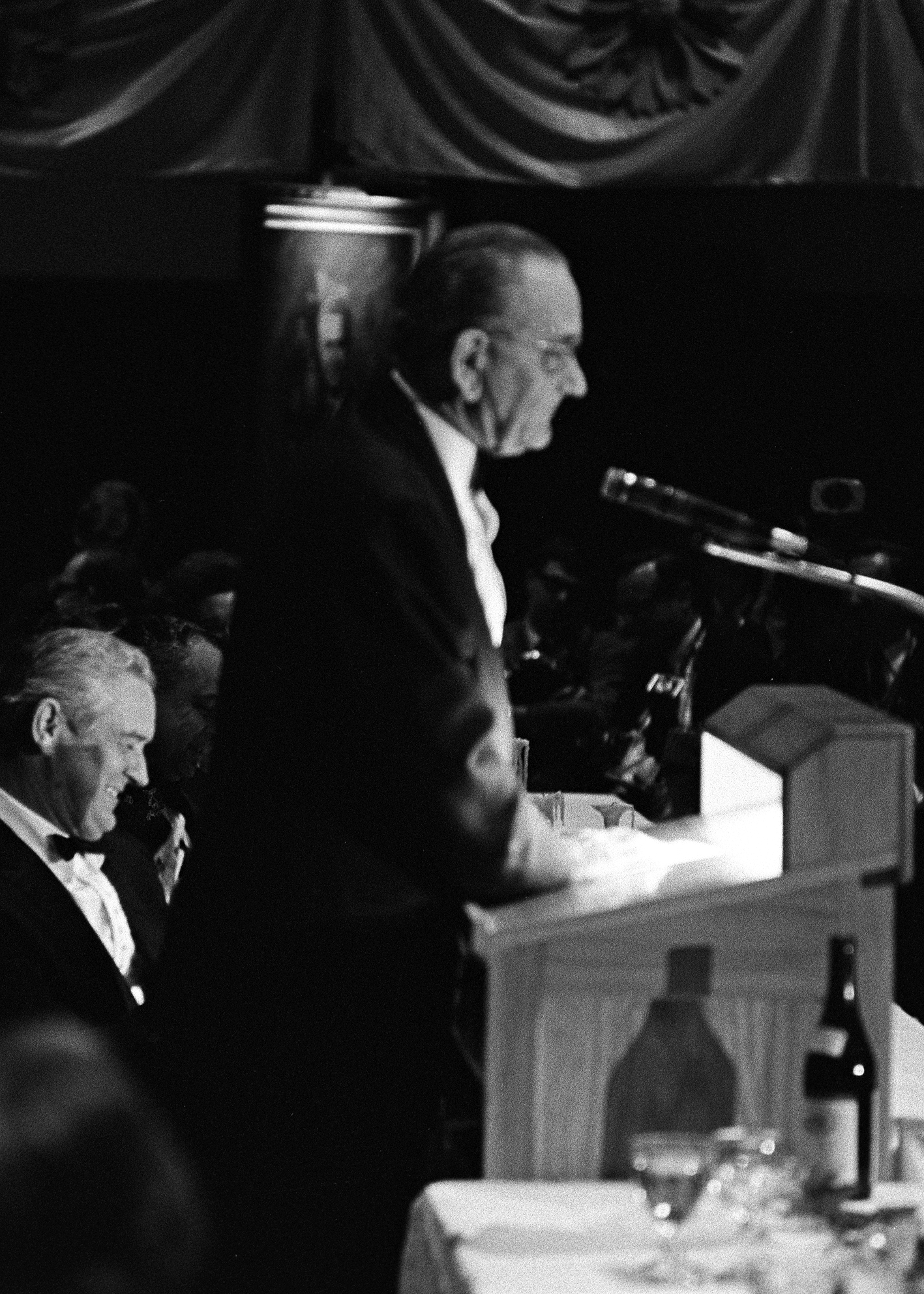
But as I discuss in Getting It Wrong, Johnson did not see the Cronkite report went it aired. The president at that time wasn’t in front of a television set. And he certainly wasn’t lamenting the loss of Cronkite’s support. Indeed, it is hard to fathom how he could have been much moved by a show he did not see.

At about the time Cronkite was intoning “mired in stalemate,” Johnson was in Austin, Texas, offering light-hearted banter at the 51st birthday party of Governor John Connally.

“Today,” the president said, “you are 51, John. That is the magic number that every man of politics prays for — a simple majority.”

WJC

Many thanks to Little Miss Attila
for linking to this post

Recent and related:

‘Furnish the war’ finds a place in sports

In 1897, Debunking, Furnish the war, Media myths, Newspapers, Spanish-American War, Yellow Journalism on February 28, 2011 at 8:13 am

Hearst: Didn't say it

William Randolph Hearst’s famous vow to “furnish the war” with Spain is one of American journalism’s most enduring myths. It’s a stunningly hardy though dubious tale that has been deployed in discussing journalistic sins and shortcomings of all sorts.

As I write in my myth-debunking book Getting It Wrong, the Hearstian vow “has been invoked to illustrate the media’s willingness to compromise impartiality, promote political agendas, and indulge in sensationalism.

“It has been used, more broadly, to suggest the media’s capacity to inject malign influence into international affairs.”

It even has application in news about collegiate sports.

An online sports-news site, Bleacher Report, turned to “furnish the war” in a commentary posted yesterday about the whiff of scandal around Auburn University’s championship football program.

Hearst’s reputed vow was a way to set up the commentary, which defended the program from what it called “the incessant beating of the investigation drum by Auburn detractors” suspicious of player-recruitment violations.

Of interest to Media Myth Alert is the commentary’s total buy-in of the Hearst anecdote, which, as evidence offered in Getting It Wrong clearly shows, is counterfeit, a discredited media myth.

The Bleacher Report commentary declared:

“When photographer Frederic Remington was dispatched to Cuba in the late 1800s to document a war and found none, he sent a message to publisher William Randolph Hearst: ‘There is no war.’

“Hearst allegedly responded: ‘Please remain. You furnish the pictures and I’ll furnish the war.’

“In the ensuing months Hearst’s newspaper fanned the flames with sensationalized front page articles that were of dubious accuracy and in many cases patently false. His articles stirred passions among a readership that neither knew nor cared if the reports were accurate. His relentless attacks eventually helped push U.S. administration into declaring war on Spain.  Hearst got his war.

“Since October, the Auburn football program has endured a similar smear campaign. …”

Reasons for doubting that Hearst ever made such a vow are many, and include the anecdote’s breathtaking illogic.

War was the reason Hearst, owner of the flamboyant New York Journal, sent Remington (an artist, not a “photographer”) to Cuba in the first place. That war was the Cuban rebellion against Spain’s colonial rule, which began in February 1895.

Remington

Remington was in Cuba briefly in January 1897.

By that time, I note in Getting It Wrong, newspaper readers “would have been well aware that Cuba was a theater of a nasty war. By then, the Cuban rebellion had reached island-wide proportion and not a single province had been pacified by Spain’s armed forces.”

It would have made no sense for Hearst to vow to “furnish the war.”

In addition, Hearst denied having made such a statement. Remington, apparently, never discussed it. And the telegrams bearing the content of the purported Remington-Hearst exchange have never surfaced.

Moreover, as I point out in Getting It Wrong, “there was no chance” that the telegrams “would have flowed freely between Remington in Havana and Hearst in New York.

“Spanish control of the cable traffic in Havana was too vigilant and severe to have allowed such an exchange to have gone unnoticed and unremarked upon,” I write, adding:

“A vow such as Hearst’s to ‘furnish the war‘ surely would have been intercepted and publicized by Spanish authorities as a clear-cut example of Yankee meddling in Cuba.”

Like many media myths, the tale of the Hearstian vow is accessible, pithy, and easily recalled. It supposedly illuminates larger lessons about the news media — in this case, the media’s malign potential to bring about a war the country otherwise wouldn’t have fought.

Which is nonsense, and historically inaccurate.

The Spanish-American War of 1898 was hardly a matter of Hearst’s having “got his war.” Rather, the conflict was the consequence of an intractable, three-sided standoff.

Cuba’s rebels would settle for nothing short of political independence. Spain refused to grant self-rule to the most important remnant of its once-sprawling American empire. And the United States, for economic and humanitarian reasons, could no longer tolerate an inconclusive war just 90 miles from its shores.

Simply put, Hearst and newspaper content were non-factors in the decision to go to war.

WJC

Recent and related:

Keller no keeper of the flame on famous NYT motto

In 1897, Anniversaries, Debunking, New York Times, Newspapers, Year studies, Yellow Journalism on February 11, 2011 at 8:56 am

Keller

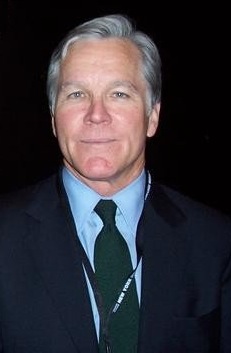
Bill Keller, executive editor of the New York Times, made clear the other day he doesn’t fully understand the derivation and significance of his newspaper’s famous, 114-year-old motto, “All the News That’s Fit to Print.”

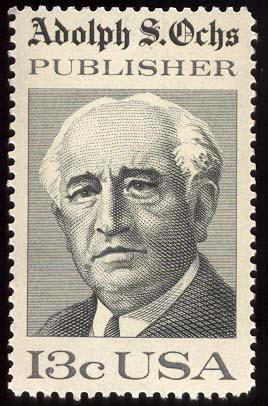
And he didn’t seem particularly comfortable with the slogan coined (most likely) by Adolph Ochs, who in 1896 acquired the then-beleaguered Times and eventually led the newspaper to preeminence in American journalism.

Ochs, commemorated

Sure, the motto’s smug and overweening, elliptical and easily parodied. But it is the most recognizable motto in American journalism, and it evokes a time now passed when slogans helped define and distinguish U.S. newspapers.

In an appearance not long ago at the National Press Club in Washington, Keller was asked about “All the News That’s Fit to Print,” which took a permanent place of prominence on the newspaper’s front page on February 10, 1897.

Keller rather sniffed at it, saying the motto “harkens back to a day when the aim of the newspaper was to be comprehensive.”

According to a transcript of his remarks, Keller said that nowadays the Times is “going to tell you maybe only a little bit, but a little bit about everything.

“And I think that slogan describes an aspiration, or a mindset. Now we tend to be more selective, and try to give you more depth, to tell you the stories that are not obvious.”

Actually, “All the News That’s Fit to Print” was framed a riposte to activist-oritented yellow journalism that flared in New York City in the closing years of the 19th century.

Ochs clearly meant the slogan to be a rebuke to the flamboyant ways of the  New York Journal of William Randolph Hearst and the New York World of Joseph Pulitzer. Their newspapers were the leading exemplars of the yellow press in fin-de-siècle urban America.

As I wrote in my 2006 book, a year study titled The Year That Defined American Journalism: 1897 and the Clash of Paradigms, the motto was, and remains, a daily rejection of flamboyant, self-promoting journalism.

And as the Times pointed out in 1935 in its obituary about Ochs, the motto “has been much criticized, but the criticisms deal usually with the phraseology rather than with its practical interpretation, and the phraseology was simply an emphatic announcement that The Times was not and would not be what the nineties called a yellow newspaper.”

I further noted in The Year That Defined American Journalism that the Times, at its 50th anniversary in 1901, “referred to ‘All the News That’s Fit to Print’ as its ‘covenant.’ One-hundred years later, a columnist for the Wall Street Journal aptly identified the motto as the ‘leitmotif not merely for the Times, but also, by a process of osmosis and emulation, for most other general-interest papers in the country, as well as for much of the broadcast media.'”

So, no, the motto wasn’t an assertion of intent to be comprehensive — although the Times surely carried a lot of news in the late 1890s. Thirty or more articles, many of them a paragraph or two in length, usually found places on its front page back then.

Ochs’ slogan was more than a daily slap at yellow journalism.

It also represents “a daily and lasting reminder of the Times’ triumph in a momentous … clash of paradigms that took shape in 1897—a clash that helped define the modern contours of American journalism,” as I noted in The Year That Defined American Journalism.

That clash pitted three rival, incompatible models for the future of American journalism.

“As suggested by its slogan,” I wrote, “the Times offered a detached, impartial, fact-based model that embraced the innovative technologies emergent in the late nineteenth century but eschewed extravagance, prurience, and flamboyance in presenting the news.

“Extravagance, prurience, and flamboyance were features typically associated with yellow journalism, a robust genre which, despite its controversial and self-indulgent ways, seemed to be irresistibly popular in 1897. The leading exemplar of yellow journalism was … Hearst’s New York Journal, which in 1897 claimed to have developed a new kind of journalism, a paradigm infused by a self-activating ethos that sidestepped the inertia of government to ‘get things done.’

“The Journal called its model the ‘journalism of action’ or the ‘journalism that acts,’ and declared it represented ‘the final state in the evolution of the modern newspaper.’

“The third rival paradigm,” I wrote, “was more modest and idiosyncratic than those of the Times and Journal. If improbable, it was nonetheless an imaginative response to the trends of commercialization in journalism. The paradigm was an anti-journalistic literary model devised and promoted by J. Lincoln Steffens, who in late 1897 became city editor of the New York Commercial Advertiser, then New York’s oldest newspaper.”

That model, Steffens said, was predicated on the notion “that anything that interested any of us would interest our readers and, therefore, would be news if reported interestingly.”

The Times ultimately prevailed in the three-sided rivalry that emerged in 1897, and “All the News That’s Fit to Print” lives on as a reminder of the outcome of that momentous clash of paradigms.

WJC

Recent and related:

114 years on the front page

In 1897, Anniversaries, New York Times, Newspapers, Yellow Journalism on February 9, 2011 at 7:37 am

Tomorrow makes 114 years on the front page for the best-known slogan in American journalism.

114 years on the front

The slogan, of course, is “All the News That’s Fit to Print,” which first appeared February 10, 1897, in the upper left corner (the left ear) of the front page New York Times.

I’ve called them the most famous seven words in American journalism and they have been endlessly parodied and analyzed since 1897. Even admirers of the Times have conceded that “All the News That’s Fit to Print” is “overweening” and even “elliptical.”

As I discussed in my 2006 book, The Year That Defined American Journalism: 1897 and the Clash of Paradigms, the motto has given rise to some lofty claims over the years. In 1901, at the 50th anniversary of its founding, the Times referred to “All the News That’s Fit to Print” as its “covenant.”

In 2001, a columnist for the Wall Street Journal described the motto as the “leitmotif not merely for the Times, but also, by a process of osmosis and emulation, for most other general-interest papers in the country, as well as for much of the broadcast media.”

Adolph Ochs began using the slogan soon after acquiring control of the then-beleaguered Times in August 1896. At first, Ochs made use of “All the News That’s Fit to Print” as an advertising and marketing device.

The slogan’s debut came in early October 1896, spelled out in a row of red lights on an advertising sign the Times had rented at New York’s Madison Square.

Four months later, without fanfare or explanation, the slogan appeared in the “left ear” of the front page. It has appeared in that place of prominence ever since.

In touting “All the News That’s Fit to Print,” Ochs clearly sought to distance the Times from the yellow press of William Randolph Hearst and Joseph Pulitzer. Their flamboyant newspapers dominated New York City’s media landscape in the late 1890s.

Ochs was nothing if not aggressive in promoting the Times and in seeking to position the newspaper as a sober counterweight to the activism and excesses of the yellow press.

To that end, he launched in late October 1896 a contest inviting readers to propose “a phrase more expressive of the Times’ policy” than “All the News That’s Fit to Print,” which by then had taken a modest place in a corner of the Times’ editorial page.

The Times promised to pay $100 to the person who proposed in ten words or fewer a slogan deemed better than “All the News That’s Fit to Print.”

The motto contest, cheesy though it may seem today, stirred a fair amount of attention–and reader interaction–in 1896.

Among the thousands of entries sent to the Times were such clunky suggestions as “All the News Worth Telling,” “All the News That Decent People Want,” and “The Fit News That’s Clean and True.”

Among the others:

“Full of meat, clean and neat.”

“Instructive to all, offensive to none.”

“The people’s voice, good the choice.”

“Aseptic journalism up to date.”

“Yours neatly, sweetly, and completely.”

As I wrote in The Year That Defined American Journalism: “Before the contest ended, the Times altered the stakes by making clear it would not abandon ‘All the News That’s Fit to Print.’

“The Times,” I wrote, “justified this change of heart by saying no phrase entered in the contest was more apt and expressive than ‘All the News That’s Fit to Print.’ The $100 prize would be awarded, to the person adjudged to have submitted the best entry. But the motto would not be changed.”

But the entries kept rolling in. Other suggestions included:

“Bright as a star and there you are.”

“All the news to instruct and amuse.”

“Pure in purpose, diligent in service.”

“You do not want what the New-York Times does not print.”

“All that’s new, true, and clever.”

Another entry was inspired by rival titles in fin-de-siècle New York:

“Out heralds The Herald, informs The World, extinguishes The Sun.” (That suggestion is evocative of the slogan of New York Newsday, a tabloid that ceased publication in 1995 after 10 years:  “On top of the News, ahead of the Times.”)

As the motto contest neared its close in early November 1896, the Times noted that that some people had “sent in diagrams and even pictures.

“While these exhibit both skill and thought,” the newspaper said, “they cannot be accepted, because they are not wanted.”

A committee of Times staffers winnowed the entries to 150 semi-finalists, which were submitted to Richard Watson Gilder, editor of The Century magazine. Gilder selected these as finalists:

  • Always decent; never dull.
  • The news of the day; not the rubbish.
  • A decent newspaper for decent people.
  • All the world’s news, but not a school for scandal.

As I wrote in The Year That Defined American Journalism, Gilder noted “that terms of the contest had changed from the original intent of selecting a slogan that ‘more aptly express the distinguishing characteristics of the New-York Times’ to the more theoretical task of determining which entry ‘would come nearest to it in aptness.’”

That entry, Gilder determined, had been submitted by D.M. Redfield of New Haven, Connecticut. Redfield’s suggestion:

“All the world’s news, but not a school for scandal.”

Catchy, that.

WJC

Many thanks to Jim Romenesko for linking to this post

Recent and related:

Media myth and Truthout

In 1897, Debunking, Media myths, Newspapers, Spanish-American War, Yellow Journalism on February 3, 2011 at 6:47 am

It’s at least faintly ironic that an online news site called Truthout — which asserts an embrace of “equality, democracy, human rights, accountability and social justice” — would post a reference to one of American journalism’s most enduring and delicious media myths.

Not Hearst's doing

In its serializing a book by radio host Thom Hartmann, Truthout the other day indulged in the myth that William Randolph Hearst vowed to “furnish the war” with Spain in 1898 — and then made good on the supposed pledge.

The installment Truthout posted Monday said Hearst “had cabled his artist correspondent to Cuba, Frederick[sic] Remington, ‘You provide the pictures, and I’ll provide the war.’

“Hearst came through on his end of the deal, and the Spanish-American War—started largely by his newspapers and the public sentiment they controlled ….”

As I discuss in my latest book, Getting It Wrong, the anecdote about Hearst’s vow is almost certainly apocryphal — a media-driven myth.

And so is the notion that Hearst’s newspapers fomented the Spanish-American War.

In the first chapter of Getting It Wrong, I note that the Remington-Hearst tale remains popular “despite a nearly complete absence of supporting documentation. It lives on even though telegrams supposedly exchanged by Remington and Hearst have never turned up. It lives on even though Hearst denied ever sending such a message.”

Moreover, I write:

The anecdote endures “despite an irreconcilable internal inconsistency: It would have been absurd for Hearst to vow to ‘furnish the war’ because war—specifically, the Cuban rebellion against Spain’s colonial rule—was the very reason Hearst sent Remington to Cuba in the first place.”

Given the context of Remington’s assignment, a vow to “furnish the war” simply would have been incongruous, and illogical.

Had Hearst sent such an inflammatory telegram, it surely would have been intercepted by Spanish censors, who controlled incoming and outgoing cable traffic in Cuba. Spanish authorities undoubtedly would have called attention to what would have been a clear case of Hearst’s meddling.

So it’s highly improbable that a cable containing a vow to “furnish the war” would have flowed without interruption between Hearst in New York and Frederic Remington in Havana. (Had the cable been sent, it would have been in mid-January 1897, near the end of Remington’s lone pre-war visit to Cuba.)

Moreover, no one who repeats the purported vow seems to note, or much care, that Hearst denied having sent such a message and Remington, a prominent artist of the American West, apparently never spoke about it.

The related myth — that Hearst’s newspapers brought on the conflict with Spain — is just as hardy as “furnish the war.” Like many media myths, it offers a reductive, simplistic, and easy-to-remember version of a complex historical event.

The Spanish-American War, quite simply, was not caused by the contents of Hearst’s newspapers, of which he had three at the time — two in New York City, one in San Francisco.

As I discuss in my 2001 book, Yellow Journalism: Puncturing the Myths, Defining the Legacies:

“The yellow press [of Hearst and Joseph Pulitzer] is not to blame for the Spanish-American-War. It did not force—it could not have forced—the United States into hostilities with Spain over Cuba in 1898. The conflict was, rather, the result of a convergence of forces far beyond the control or direct influence of even the most aggressive of the yellow newspapers, William Randolph Hearst’s New York Journal.”

Besides, no one who asserts that the yellow press was responsible for the war with Spain can persuasively demonstrate just how the often-exaggerated contents of Hearst and Pulitzer’s newspapers were decisive in the declaration of war in April 1898.

“If the yellow press did foment the war,” I wrote in Yellow Journalism, then “researchers should be able to find some hint of, some reference to, that influence in the personal papers and the reminiscences of policymakers of the time.

“But neither the diary entries of cabinet officers nor the contemporaneous private exchanges among American diplomats indicate that the yellow newspapers exerted any influence at all.”

When it was discussed within the administration of President William McKinley, the yellow press was dismissed as a nuisance or disdained at as a complicating factor.

The truth is that the yellow press neither drove, shaped, nor  crystallized U.S. policy vis-à-vis Spain in 1898.

Put another way: Hearst did not follow through on a vow he never made.

WJC

Recent and related: