W. Joseph Campbell

Posts Tagged ‘Cinema’

Remembering big: Another April anniversary

In Anniversaries, Debunking, Jessica Lynch, Media myths, Washington Post, Watergate myth on April 4, 2010 at 5:56 pm

April 3 not only was the seventh anniversary of the Washington Post‘s botched report about the mythical battlefield heroics of Jessica Lynch. The date also marked the 150th anniversary of the first run of the legendary Pony Express–a short-lived institution that is impressively steeped in myth.

As Christopher Corbett wrote in an engaging commentary published Friday in the Wall Street Journal:
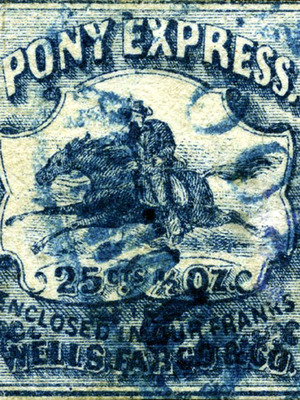
“We remember the Pony Express as one of the most enduring and endearing of American stories, a tale of the frontier, a story of bold entrepreneurs, daring young horsemen, true riders of the purple sage and all that.

“In truth, the venture hemorrhaged money from day one, was doomed by technology (another particularly American story), lasted a mere 78 weeks, ruined its backers and then disappeared into what historian Bernard DeVoto called ‘the border land of fable.'”

Corbett noted: “It was all over in 18 months. The service was shut down in the flash of a telegrapher’s key when the transcontinental telegraph was completed in October 1861.”

But for years afterward, “the West was aswarm with old men who claimed to be ‘the last of the Pony Express riders,'” Corbett wrote.

The tall tales and exaggerations that grew up around the Pony Express were in large part promoted by the cinema and the entertainment industry–factors akin to those that contribute to the rise and tenacity of media-driven myths, which are stories about and/or by the news media that are widely believed and often retold but which, on close inspection, prove to be apocryphal or wildly exaggerated.

The filmmaker John Ford incorporated the Pony Express into the 1948 Western, Fort Apache, where, Corbett noted, “the brave rider thunders into the fort to bring news of Custer’s Last Stand, which, alas, took place some 15 years after the Pony stopped running.”

It’s faintly reminiscent of the classic cinematic treatment of the Watergate scandal: Easily the best-known Watergate movie is All the President’s Men, a screen adaptation of the best-selling book by the same title.

The cinematic version of All the President‘s characterized the book’s authors, Carl Bernstein and Bob Woodward of the Washington Post, as central and essential to the scandal’s unraveling.

The upshot of that misrepresentation, I write in  Getting It Wrong, my forthcoming book about media-driven myths, has been “to solidify and elevate the heroic-journalist myth” of Watergate, to give it dramatic power, and sustain it in the collective memory.
I further note in Getting It Wrong that the film offers an unmistakable and unambiguous statement about “the power and centrality of the press in Nixon’s fall. All the President’s Men allows no other interpretation: It was the work Woodward and Bernstein that set in motion far-reaching effects that brought about the first-ever resignation of a U.S. president,” Richard Nixon.

What’s more, the heroic-journalist interpretation of Watergate minimizes or ignores the more decisive contributions in Nixon’s fall by agencies and organizations besides the Washington Post.

In his fine commentary, Corbett noted “the person who immortalized the Pony was William Frederick Cody, or Buffalo Bill. (He also claimed he had been a rider. Not true.)

“The [Pony Express] fast-mail service may have lasted only a year and a half, but it thrived for four decades in Cody’s Wild West show, seen by millions in the U.S. and Europe. To add drama to his re-enactment, Buffalo Bill might throw in a war party of savage Indians chasing a heroic rider who always managed to escape.

“It would become one of the most enduring images of the Pony Express, but it was not true; the actual riders rarely tangled with Indians,” Corbett wrote, adding:

“Why would a Paiute want a two-week-old copy of Horace Greeley’s New York Tribune?”

Corbett noted in closing:

“If the Pony Express continues to thrill and baffle us, consider the words of an old horseman in western Nebraska who advised me when I expressed some concerns about the pedigree of this yarn. ‘We don’t lie out here,’ he explained kindly. ‘We just remember big.'”

“Remember big.” A great line. And it’s certainly applicable in understanding why media-driven myths can be so tenacious and enduring.

WJC

Catching up: Great movie misquotations

In Cinematic treatments, Cronkite Moment, Debunking on February 8, 2010 at 12:16 pm

Heavy snows that have shut down much of metropolitan Washington, D.C., including American University today, have allowed the opportunity to work away at a stack of back issues of newspapers.

So only belatedly have I caught up with the “movie misquotations” item published January 15 in the “On Language” column of the Sunday New York Times magazine.

The column's headline

It’s an entertaining and revealing column that notes that “many of the most frequently cited motion-picture lines turn out to be misquotations.”

One well-known line, usually attributed to the Clint Eastwood character in Dirty Harry, is: “Do you feel lucky, punk?”

What the Eastwood character said was:

“You’ve got to ask yourself one question: ‘Do I feel lucky?’ Well, do ya, punk?”

The column points out that another frequent misquotation is Robert Duvall’s napalm line in Apocalypse Now, which often is cited as:

“I love the smell of napalm in the morning. It smells like victory.”

The Duvall character’s remark was much more detailed and complex:

“I love the smell of napalm in the morning. You know, one time we had a hill bombed for 12 hours. When it was all over, I walked up. We didn’t find one of ’em, not one stinkin’ . . . body. The smell, you know that gasoline smell, the whole hill. Smelled like victory.”

The column’s author, Fred R. Shapiro editor of Yale Book of Quotations, identifies several factors for the emergence of movie misquotations, including:

  • a tendency toward compression, as the Apocalypse Now example suggests.
  • a impulse to improve upon the original passage “by offering a better rhythm or cadence.”
  • an inclination for greater euphony. The famous Mae West line–“Why don’t you come up and see me sometime?”–really was: “Why don’t you come up sometime and see me?” In another movie, she said: “Why don’t you come up sometime?”
  • an effort “to keep up with colloquial speech.” The line commonly recalled as “Badges? We don’t need no stinking badges!,” was uttered in The Treasure of the Sierra Madre as: “I don’t have to show you any stinking badges!”

Shapiro’s column is evocative of the phenomenon of “version variability,” which I note in Getting It Wrong, my forthcoming book about media-driven myths.

“Version variability” is the the imprecision that alters or distorts an anecdote in its retelling, leading to differing versions of what was said or done. It can be a marker of media-driven myths.

The so-called “Cronkite Moment” of February 27, 1968, when CBS News anchorman Walter Cronkite went on air to say the U.S. war effort in Vietnam was “mired in stalemate,” offers a striking example of “version variability.”

President Lyndon Johnson supposedly was at the White House and watched the Cronkite report that night. Upon hearing the anchorman’s dire assessment, Johnson turned to an aide or aides and said:

“If I’ve lost Cronkite, I’ve lost Middle America.”

Another version quotes Johnson as saying: “I’ve lost Cronkite, I’ve lost the country.”

Yet another version has it this way: “If I’ve lost Cronkite, I’ve lost the American people.”

And: “If I’ve lost Cronkite, I’ve lost the war.”

And: “If we lose Cronkite, we lose America.”

Version variability of  such magnitude is a strong signal of implausibility.

As I note in Getting It Wrong, Johnson wasn’t at the White House when the Cronkite program on Vietnam aired. The president was in Austin, Texas, at a party marking the 51st birthday of his longtime political ally, John Connally.

WJC

Cinema and the tenacity of media myths

In Cinematic treatments, Debunking, Murrow-McCarthy myth, Watergate myth on January 17, 2010 at 12:41 pm

What explains the tenacity of many are media-driven myths? Why are many of them so resistant to debunking?

One important factor, and one that I explore in my forthcoming book, Getting It Wrong, is high-quality cinematic treatment of popular media-centered stories.

The notion that Washington Post reporters Bob Woodward and  Carl Bernstein brought down Richard Nixon’s corrupt presidency was cemented by the 1976 motion picture, All the President’s Men. The movie was based on the reporters’ bestselling book by the same name, which appeared in June 1974, just as the Watergate scandal was nearing its dénouement with Nixon’s resignation.

The misguided, mediacentric view that Edward R. Murrow’s reporting in 1954 abruptly ended the communists-in-government witchhunt of Senator Joseph R. McCarthy is another myth that the cinema has solidified.

McCarthy in 1954 (Library of Congress)

Getting It Wrong describes how Murrow “was very late in confronting McCarthy” and how “he did so only after other journalists had challenged the senator and his tactics for months, even years.”

As I further write in Getting It Wrong, the Murrow-McCarthy myth “was sealed for another generation with the release in 2005 of Good Night, and Good Luck,” a movie that offered a dramatic version of the back story to Murrow’s See It Now program on McCarthy.

See It Now was Murrow’s weekly, news-oriented documentary program on CBS; the 30-minute show on McCarthy and his tactics aired March 9, 1954. Supposedly, it was so compelling that it stopped the demagogic senator in his tracks.

While Good Night, and Good Luck never explicitly said as much, it lent just that impression—that Murrow courageously and single-handedly ended McCarthy’s reign of terror. That’s how many critics interpreted Good Night, and Good Luck, and that view was reiterated recently in a post at the “Irish Central” online site.

The post described Good Night and Good Luck as telling “the story of ace reporter Edward Murrow who brought down the great witch hunter Joe McCarthy” and praised the movie’s director-star, George Clooney. (Clooney played the role of a slightly pudgy, ever-earnest Fred Friendly, Murrow’s producer.)

That post is an example of just how ingrained the Murrow-McCarthy myth has become — and how effectively high-quality cinematic treatments can be in hardening media myths against debunking.

The cinema is far from the only factor accounting for the tenacity of media myths.

But because movies can powerfully influence how historical events are collectively remembered, they lengthen the odds that some media-driven myths can ever be rolled back.

WJC