Curious thing about the media myth of Watergate: The notion that the Washington Post’s dogged reporting toppled Richard Nixon’s corrupt presidency is readily embraced both by liberals and conservatives.
 The most recent example of this tendency came yesterday, on the “Power Player of the Week” segment of the Fox News Sunday program.
The “Power Player” segment featured Martin Baron, who’s been executive editor of the Washington Post for a little more than three months. It was a fair-minded look at a respected, veteran journalist; Baron was a top editor at the Miami Herald and the Boston Globe before joining the Post at the start of the year.
But whether Baron truly is a “power player” in Washington is speculative. What most interests Media Myth Alert was how the Watergate myth was blithely injected into the Fox News Sunday segment.
In his voice-over introducing the segment, the show’s host, Chris Wallace flatly and inaccurately asserted that the Post is “the paper that brought down Richard Nixon.”
It’s a not uncommon characterization. But it’s utterly exaggerated — and thoroughly undeserved.
As I note in my media-mythbusting book, Getting It Wrong, it’s an interpretation of Watergate that not even the Post embraces.
Some of the Post’s leading figures over the years have openly dismissed the notion that the newspaper’s reporting of Watergate ended Nixon’s presidency. (He resigned in 1974.)
For example, Katharine Graham, the Post’s publisher during Watergate, said in 1997:

Not the Post’s doing
“Sometimes people accuse us of bringing down a president, which of course we didn’t do. The processes that caused [Nixon’s] resignation were constitutional.”
In addition, the newspaper’s then-media writer, Howard Kurtz, asserted in 2005:
“Despite the mythology, The Post didn’t force Richard Nixon from office — there were also two special prosecutors, a determined judge, bipartisan House and Senate committees … and those infamous White House tapes.”
If not for the tapes — the secret audio recordings Nixon made of many of his conversations in the Oval Office — Nixon likely would have survived the scandal.
The Post, by the way, did not disclose the existence of the tapes, which demonstrated that Nixon had sought to derail the FBI’s investigation of Watergate’ signal crime — the burglary in June 1972 at the headquarters of the Democratic National Committee.
The existence of the tapes — evidence that was so pivotal to the scandal’s outcome — was made known in July 1973 by Alexander Butterfield, under questioning by investigators of a Senate select committee.
There’s more to deplore here than a Sunday TV show’s puffing up one of its segments by declaring the Post “brought down Richard Nixon.” The Watergate myth is more insidious than that.
It is a disservice to history: The Watergate myth distorts and dumbs down what was the most significant American political scandal of the 20th century.
And it extends to journalists the unmerited status of having been heroic central actors in exposing the crimes of Watergate.
More from Media Myth Alert:
- ‘The newspaper that uncovered Watergate’?
- The ‘newsroom where two reporters took down a president’? Sure it was
- The ‘defining moment in investigative journalism’? Wasn’t Watergate
- What was decisive in Watergate’s outcome?
- Mythmaking in Moscow: Biden says WaPo brought down Nixon
- Pumping up Watergate’s heroic-journalist myth
- Inflating the exploits of WaPo’s Watergate reporters
- Fox News misremembers Watergate and ‘follow the money’
- National Press Club invokes media myths of Watergate
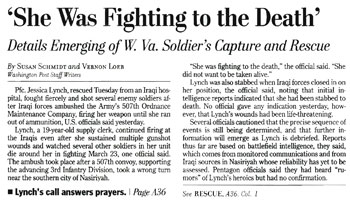
- Recalling who gave us the ‘manufactured heroism’ of Jessica Lynch
- ‘A debunker’s work is never done’
- ‘Getting It Wrong’ goes on Q-and-A





 Media Myth Alert